AI Agents vs Chatbots vs LLMs: Which One to Choose in 2026?
Dhrumil Mistry
Published: Mar 26, 2026
Confused about AI agents vs chatbots vs LLMs – and which one’s right for your business? Here’s the quick answer for you before we dive into the details of it.
Key Takeaways:
Chatbots are best for FAQs, basic support, and lead capture because they usually respond to user input based on their rules or NLP.
LLMs have the capability to learn, understand, and respond. It is best for content creation, Q&A, and knowledge tasks.
Develop your AI agents to work like human agents. They plan, act, and complete assigned tasks automatically using their LLMs as their reasoning engine.
The key difference between AI agents and chatbots lies in execution — agents act, while chatbots respond.
Modern AI systems combine all three: chatbot as interface, LLM as intelligence layer, and AI agents as execution engine.
Let’s start with a real-world use case: a company uses a chatbot to handle basic and frequent customer queries. After a while, they are flooded with escalations, because chatbots can answer their queries, but can’t actually process any of them further.
If they don’t handle this situation well, then it costs them customer satisfaction scores, their team members’ time, and effort. This is where businesses find themselves stuck and confused in the AI maze.
If you search on Google, you’ll find hundreds of tools – chatbots, LLMs, and AI agents, as the internet is flooded with such tools. All can look the same to you, but they are fundamentally different. Businesses often partner with a reliable chatbot development company to build more efficient and scalable conversational solutions tailored to their needs.
Businesses today are rapidly adopting AI, but many still struggle with one fundamental question: Chatbots vs LLMs vs AI Agents, what’s the real difference, and which one should you choose?
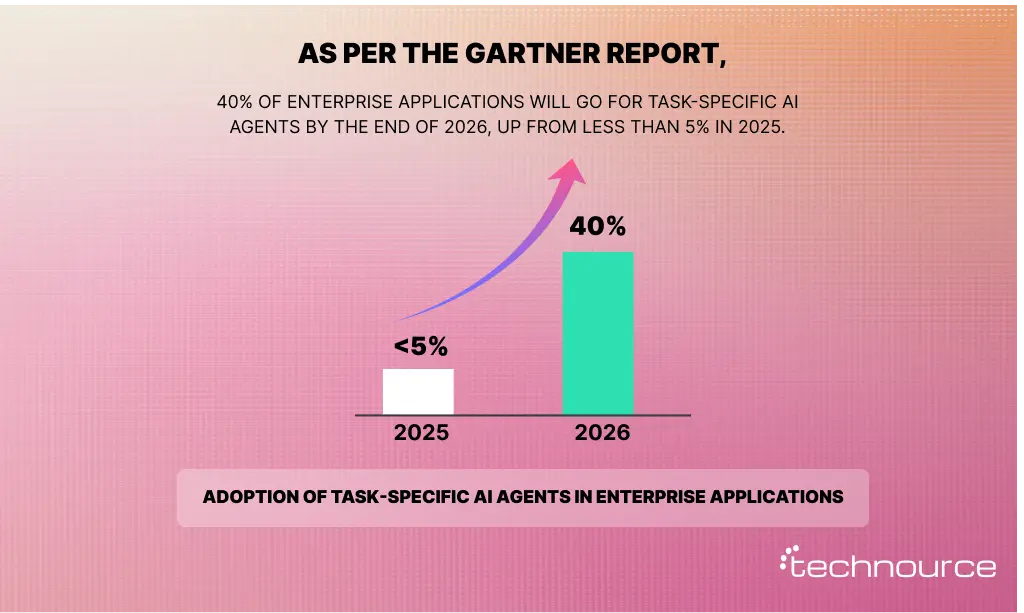
As per the Gartner report, it is predicted that 40% of enterprise applications will go for task-specific AI agents by the end of 2026, up from less than 5% in 2025.
Meanwhile, as per IBM’s 2025 CEO study only 25% of AI initiatives deliver expected ROI. That’s why it is important to choose an AI tool that aligns best with your organizational needs.
It is not just a technical decision; it’s a business-critical one.
Most blogs explain these technologies in isolation. In reality, they work together — and misunderstanding this is where most businesses go wrong. This guide focuses on how they actually function in real business scenarios.
What is a Chatbot? (And How It Differs from AI Agents)
This is where the difference between AI agents vs chatbots vs LLMs becomes important; chatbots are designed to respond, not to act.
A chatbot is a software program that allows users to interact through text or voice conversations. A chatbot operates by processing your input, which it compares against its trained patterns to generate the most suitable response.
In most cases, it works like an advanced FAQ system. It responds instantly and can operate 24/7 with consistent output, but its performance depends entirely on the training scenarios it received. Many businesses today rely on leading AI chatbot development companies to build more advanced, scalable, and context-aware chatbot solutions.
AI Agents vs Chatbots: Quick Comparison
Features
Chatbots
AI Agents
Function
Respond to queries
Execute Tasks
Intelligence
Rule-based / NLP / LLM
LLM + Planning + tools
Autonomy
Low
High
Action Capability
Limited
End-to-end execution
Use case
FAQs, Support
Workflow Automation
How Chatbots Work in Real Time: A Beginner’s Guide
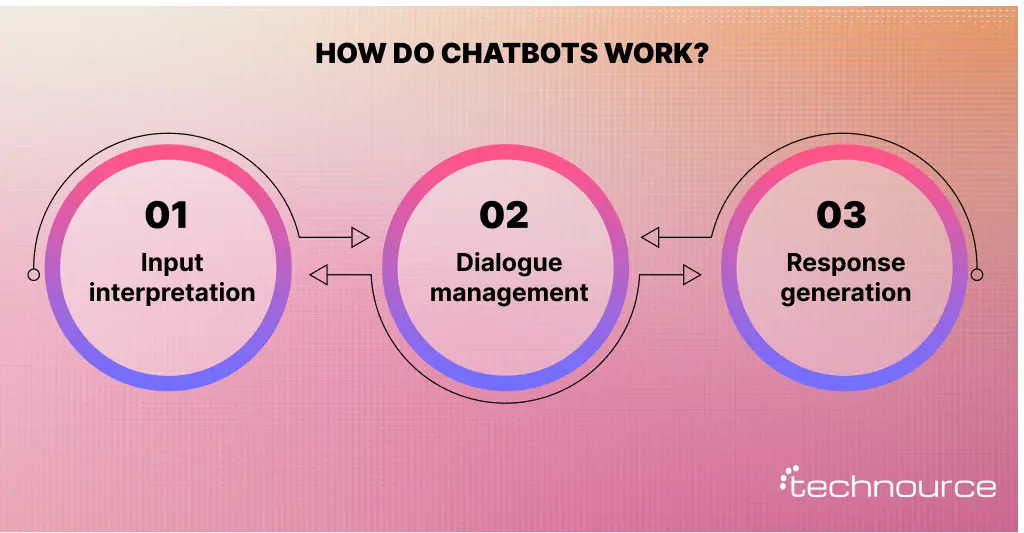
Modern chatbots follow a three-stage process:
Input Interpretation:
The user’s message is processed using keyword matching or NLP (Natural Language Processing) to detect intent.
Dialogue Management:
The system uses either logical reasoning or decision tree methods to choose the most appropriate response path.
Response Generation:
A pre-written or template-based reply is returned to the user.
Limitation: Chatbots only respond; they don’t reason, plan, or take any action.
Types of Chatbots
From rule-based bots to AI-powered assistants, chatbots vary in how they process and respond to queries.
Let’s explore the main types and how they differ in functionality.
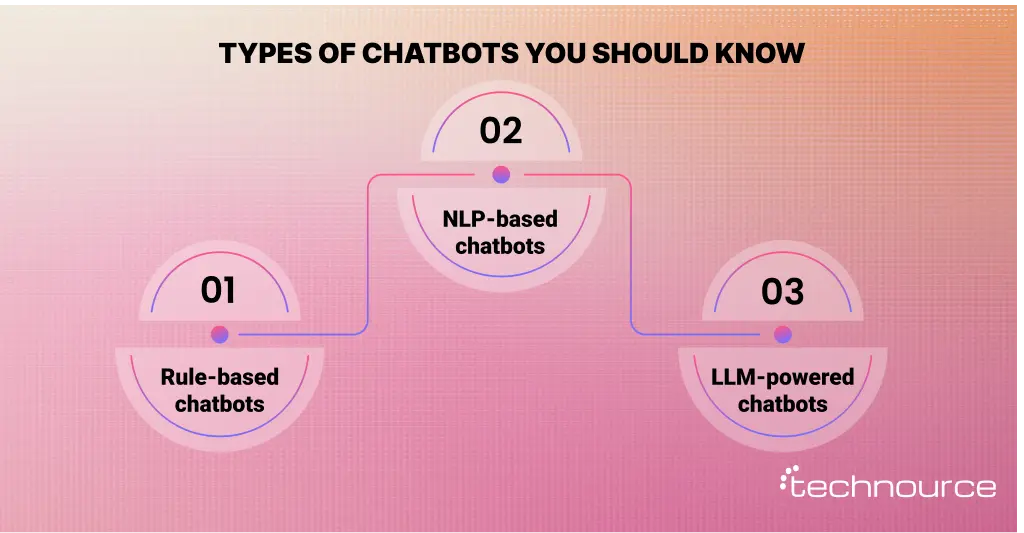
Rule-Based Chatbots:
Follow fixed if-then logic, which provides fast and inexpensive results while maintaining predictable performance. The system operates according to pre-existing program instructions.
NLP-Based Chatbots:
Use machine learning to understand intent more flexibly. They can handle different situations, but still need scripts to function. This is where NLP development solutions help improve contextual understanding and enhance how accurately user intent is interpreted.
LLM-Powered Chatbots:
Use large language models (like GPT or Claude) to generate responses. The system produces more advanced conversational content because it reacts to user input.
Key Distinction: Even an LLM-powered chatbot is still just a chatbot if it cannot take action. It can tell you how to process a refund. It cannot process one.
Where Chatbots Excel
Answering all the FAQs quickly
Handling all the product questions instantly
Qualifying leads and routing visitors
Booking appointments
Order status lookups via API
First-response triage before human handoff
Where Chatbots Fall Short
Tasks that require decision-making across systems
Personalised responses
Actions that trigger interruption in pre-set workflows
Any scenario that comes out of the training data
Real Examples of Chatbots: Intercom, Drift, Freshchat, WhatsApp Business bots, Zendesk Bot.
What is a Large Language Model (LLM)?
A large language model describes an artificial intelligence system that creates human-like language capacity through training with extensive text data. LLMs do not follow scripts. The system learns from word patterns that span over a billion words to predict the response that best fits the context.
A chatbot functions as a customer service representative, performing manual customer service tasks, while an LLM operates as a subject matter expert, possessing comprehensive knowledge and able to discuss any topic.
How LLMs Work
The foundation of LLMs exists in transformer model designs. They use all previous text to determine which word will most likely follow the current text. This process produces a model that can write various types of content, create summaries from long documents, develop precise answers to difficult questions, perform language translation, and create different levels of explanations for particular concepts.
The key technical point: The primary technical aspect shows that LLMs function without internal memory because they operate in a stateless state. The system does not store information from one session to the next because it lacks memory and tools. The system creates written content, but it does not perform any operations.
LLM Hallucination: What It Means For Businesses
Hallucination is generally misunderstood. When an LLM is not built with sufficient information about something, then it can confidently generate an incorrect answer.
For businesses, this matters because:
A large language model (LLM) produces believable but incorrect solutions when it responds to customer legal and compliance inquiries.
The absence of governance allows hallucinations to spread to customers throughout the entire organization.
The solution RAG establishes a grounding system that connects LLMs to your verified data.
The unregulated LLM system creates liability risks for compliance-sensitive industries, which include healthcare finance and legal sectors. Organizations should implement knowledge grounding systems and human review processes to work with LLMs.
LLM Types
Large Language Models come in different types based on their training approach and use cases.
Each type offers unique capabilities, from general-purpose understanding to domain-specific expertise.
Proprietary Models: GPT-4o (OpenAI), Claude Sonnet 4.6(Anthropic), Gemini 1.5 Pro (Google). High performance, managed infrastructure, usage-based pricing.
Open-Source Models: LLaMA 3 (Meta), Mistral, Falcon. Full data control, self-hosted, requires internal ML expertise.
Where LLMs Excel
Perfect fit for generating content: Blogs, emails, ads, etc.
Internal Knowledge assistants
Code writing, review, and documentation
Report summarisation and data-to-narrative generation
Multilingual communication
Where LLMs Fall Short
They cannot initiate any type of action
No persistent memory across sessions without external infrastructure
Prone to hallucination on domain-specific or recent information
High compute cost for large-scale, real-time applications
Real examples of LLMs: ChatGPT (GPT-4o), Claude (Anthropic), Gemini (Google), LLaMA 3 (Meta).
AI Agents vs LLMs: Quick Comparison
Features
LLMs
AI Agents
Core role
Generate Texts
Take actions
Function
Respond & create content
Plan, act, execute
Memory
context-based
Persistant
Tool Usage
None
Integrated tools & APIS
Output
Answers
Completed Tasks
What is an AI Agent? (Types, Use Cases & How It Works)
An AI agent operates as an independent system that utilizes an LLM to perform reasoning tasks while it integrates memory functions, operational tools, and its planning system to accomplish multiple tasks without requiring continuous human assistance.
The simplest way to understand it: an LLM responds. An AI agent acts.
IBM defines it directly: “AI chatbots are a modality, whereas agency is a technological framework.” An agent does not just generate text. An agent first identifies its objective and then divides it into smaller tasks, which it performs by using appropriate resources. After accomplishing a task, an agent verifies its outcome before making any necessary corrections. This is why many businesses are now investing in an AI agent development company to build intelligent systems that can automate complex workflows efficiently.
How AI Agents Work: Everything You Need to Know
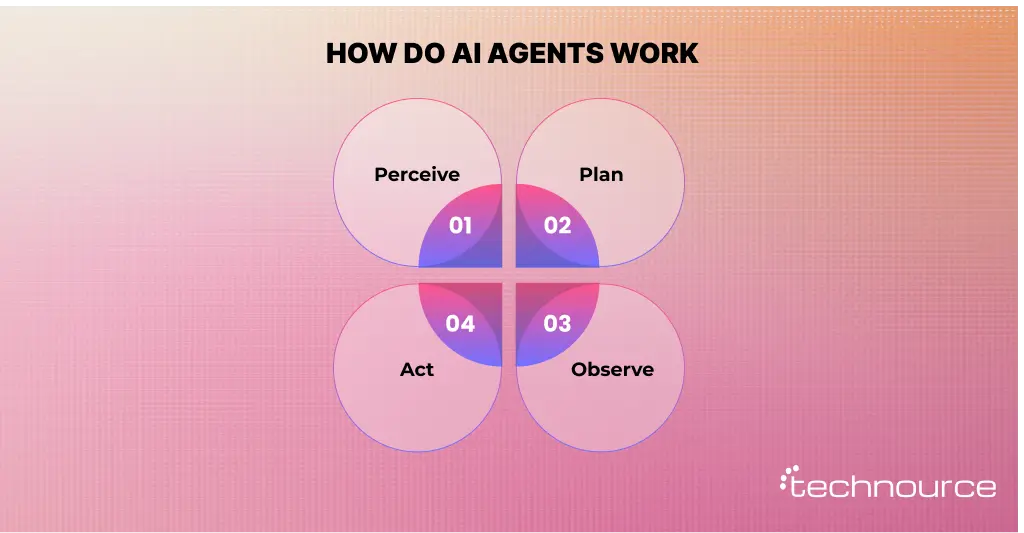
Every AI agent operates on a core loop:
Perceive: The agent receives a goal, task, or input through user input, system triggers, or other agent communication.
Plan: It uses its LLM to break the goal into sub-tasks and decide which tools to use.
Act: It executes its tasks through API calls, database queries, file writing, email sending, and CRM record updates.
Observe: It checks whether the action succeeded. If the first attempt fails, it will correct its mistakes and attempt the task again.
A single complex workflow can be executed in this loop, but it requires multiple repetitions to complete the process.
A chatbot tells you how to file an expense report. The AI agent automatically accesses your expense system to extract receipt information and uses it to complete the form. The system then sends the form to your manager for approval while the agent achieves completion status in the HRMS system, all without your active involvement.
What Makes an Agent Truly “Agentic”
Memory: Short-term (within a session) and long-term (stored in a vector database) context retention.
Tools: The system provides users with APIs, databases, code executors, web browsers, and internal business systems.
Autonomy: The ability to make decisions without a human confirming each step.
Planning: The framework requires goal decomposition through ReAct, Chain-of-Thought, and Tree-of-Thought to create sequential and parallel sub-tasks.
Chatbot vs LLM: Quick Comparison
Features
Chatbots
LLMs
Nature
Application/ interface
Core AI model
Function
Conversational flow
Language understanding & generation
Flexibility
Limited
Highly flexible
Learning
Predefined logic
Trained on large datasets
Capability
Answers predefined queries
Handles complex, open-ended queries
Types of AI Agents
AI agents can be categorized into reactive, model-based, goal-based, and learning agents.
Understanding these types helps in building systems that align with your automation and decision-making needs.
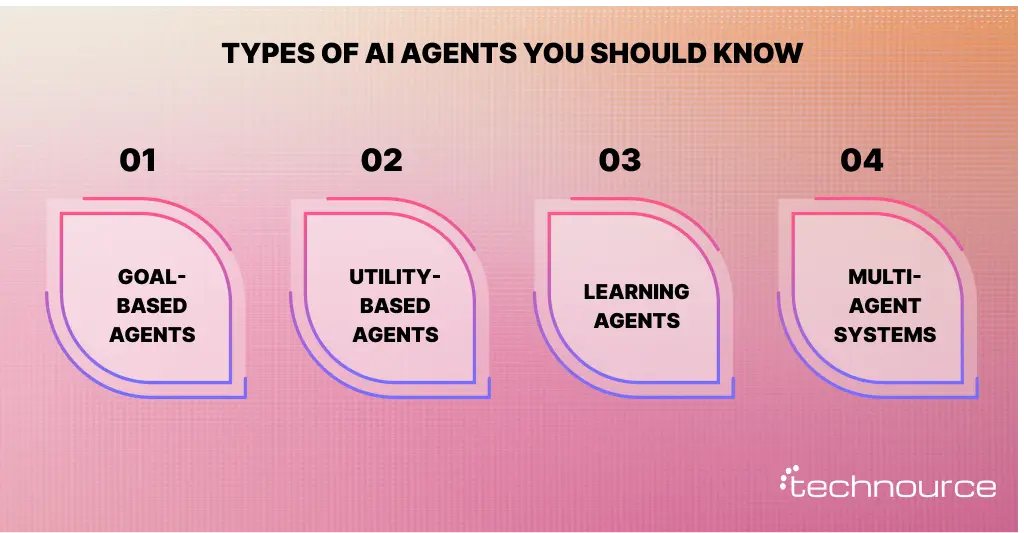
Reactive agents: React to direct environmental changes, which serve as their operational triggers. Their design enables quick execution with consistent results while maintaining straightforward behavior.
Goal-based agents: These agents create operational plans to achieve predetermined targets.
Utility-based agents: The system selects actions that lead to maximum desired results, such as reducing the time needed for resolution.
Learning agents: The system develops its capabilities by utilizing feedback mechanisms to enhance its future performance.
Multi-agent systems: The system consists of specialized agents who work together to solve challenges through interdepartmental collaboration and task delegation.
ChatGPT vs AI Agent: Key Differences People Misunderstand
This misunderstanding constitutes a widespread issue that currently exists in the market. ChatGPT operates as an LLM-powered chatbot that delivers responses to user input. Your prompts serve as the basis for its responses.
Unlike OpenAI Operator, which functions as an AI agent system, the program requires all operational tasks to receive user commands.
People find it hard to understand because ChatGPT now supports tool-calling functions, which allow it to show some agent-like behavior. The architectural design of the system, together with its business operations, exhibits core differences from the existing system.
Chatbots vs LLMs vs AI Agents: Key Differences Explained
Here is the full comparison across 8 dimensions. This is the table that all three types of readers — technical, business, and decision-maker — need to bookmark:
Features
Chatboats
LLMs
AI Agents
Autonomy
Low, reactive only
Medium, responds to prompts
High, self-directed towards goals
Memory
Session only (basic)
Context window only
Short-term + long-term via vector DB
Tool use
Limited API calls (pre-scripted)
None natively (needs wrappers)
Native — APIs, DBs, browsers, code
Best for
FAQs, lead gen, basic support
Content, Q&A, summarisation
End-to-end workflow automation
Cost to deploy
$ – Low
$$ – Medium
$$$ – Higher initial, lower long-term
Complexity handled
Simple, repetitive
Language tasks, moderate complexity
Multi-step, enterprise-grade complexity
Human oversight needed
Low (for simple tasks)
Medium (hallucination risk)
High governance recommended
Speed to production
Days to weeks
Weeks (API + integration)
Weeks to months (architecture + data)
Can they work together?
Yes, as the interface
Yes, as the reasoning engine
Yes, as the action layer
This comparison clearly shows how AI agents vs chatbots vs LLMs differ in terms of capability, flexibility, and real-world application. But in real-world scenarios, the challenge isn’t understanding the difference — it’s choosing the right combination for your specific business needs.
If your goal is simple interaction, a chatbot is enough. If you need intelligence and content generation, an LLM fits. But if your objective is end-to-end automation and execution, only AI agents can deliver that.
In most real-world scenarios, businesses don’t choose one — they combine all three to build scalable AI systems.
The Role of RAG in Bridging LLMs and AI Agents
The concept of RAG, which stands for Retrieval-Augmented Generation, a critical concept for building LLM-based solutions — yet many competitors barely explain it.
RAG provides the solution to LLMs that require access to public data until their training cutoff date. The system lacks knowledge about your organizational products and policies, customer information, and internal operational methods. When someone inquires about your company’s return policy, the LLM will either create a fictitious answer or declare its lack of knowledge.
RAG provides a solution that enables LLMs to retrieve your knowledge base during the query process.
How RAG works
Step 1: Your documents undergo chunking into vector embeddings, which the system stores in a vector database through which users can access PDFs and wikis, and knowledge base articles.
Step 2: The system retrieves the most relevant chunks from your database when a user asks a question.
Step 3: The LLM receives these chunks as context, which allows it to create a response based on your actual data instead of producing hallucinated content.
The outcome produces an LLM system that understands your organization while maintaining accurate performance without creating false information about your organizational area.
RAG Chatbots vs AI Agents: Which One Should You Use?
This is a question increasingly asked by CTO-level buyers, and the answer is practical:
The RAG chatbot should be used by users who require precise answers that your knowledge base contains. The system provides users with complete information without any need for them to perform extra tasks.
The AI agent should be used when users want to complete tasks that require a connection between multiple systems. The agent can use RAG for context and then take action on top of it.
RAG-based legal document search systems, which operate on Azure, show 97 percent accuracy without needing traditional search infrastructure techniques. RAG serves as the essential technology on which all enterprise LLM implementations depend.
Can Chatbots, LLMs, and AI Agents Work Together?
Yes, and in most serious enterprise deployments, they should.
The Internet shows them as competing technologies against LLMs and AI agents. The framing creates the false impression that you must pick one. The reality is more nuanced — and more powerful.
Enterprises use modern AI systems that operate through multiple stacked technology layers.
E-commerce Customer Support Stack: Real-World Use Case
E-commerce businesses need to implement their complete operational system through three essential components.
Customer types: “Where is my order?” → The LLM-powered chatbot interprets the query and identifies intent.
RAG layer: The system retrieves customer order information from the knowledge repository.
AI agent: The system establishes a connection to the shipping API, identifies a shipping delay, activates an automatic email notification that includes the revised delivery schedule, and records the customer interaction within the CRM system.
Result: The process requires no human participation. The process achieves complete resolution within 30 seconds. The service operates continuously throughout the week.
Multi-Agent Systems: The Next Frontier
Organizations implement multi-agent systems that operate through networks of specialized agents to handle intricate operations that exceed the capabilities of a single AI agent.
Example: an HR onboarding agent hands off to a systems access agent, which hands off to a compliance checklist agent, all completing in sequence, all without a human triggering each step.
The frameworks LangGraph, CrewAI, and Microsoft AutoGen enable users to create functional systems without needing to develop everything from the beginning.
How to Choose: AI Agents vs Chatbots vs LLMs?
There’s no one-size-fits-all answer here. The right choice depends on your use case, data readiness, and level of automation required.
Here is a practical decision framework for businesses. Answer these five questions:
1. Does your task require taking action in a system (updating records, processing data, triggering workflows)?
High automation needs
AI Agent
2. Does your task involve generating, summarising, or transforming text at scale?
Content/knowledge automation
LLM (+ RAG if domain-specific)
3. Is your use case primarily conversational — answering questions with defined responses?
Structured conversation
Chatbot
4. Do users need accurate answers grounded in your own data (not general knowledge)?
Domain-specific accuracy
LLM + RAG
5. Do you need a full end-to-end autonomous workflow with no human steps?
True automation
AI Agent stack
Budget Signal Guide
The costs to deploy a chatbot system range from $5000 to $50000 based on the complexity of natural language processing. This makes it a practical entry point for companies looking to develop an AI chatbot for their business without a heavy upfront investment. The system delivers quick results through its ability to handle multiple inquiries at once.
The implementation of RAG systems and LLM functionalities requires an investment between $15000 and $100000. The costs for API usage will increase as customers consume more API resources.
The development of customized enterprise AI agents with system integration requires an investment between $50000 and $250000. The system demands a large initial investment, which generates fundamental business value through its complete transformation.
What You Need Before Building Each
The development of a chatbot requires organizations to establish their specific intents, together with their conversation pathways and their integration points for both FAQs and ticketing.
Before an LLM deployment begins, organizations must develop a knowledge base that meets RAG requirements, together with an established governance system to handle hallucination risks and API access to their selected model.
The implementation of an AI agent requires organizations to have three elements: structured data that can be accessed, APIs or system connectors that function correctly, and established workflows for automation, together with a governance and monitoring system.
Gartner’s honest warning: 40% of agentic AI projects will be cancelled by the end of 2027 due to escalating costs, unclear business value, or inadequate risk controls. The development of agents should occur at locations that establish specific return on investment measures instead of locations that possess advanced technology capabilities.
Real-World Use Cases by Industry: Which AI Technology Delivers the Best ROI
Abstract technology only becomes valuable when mapped to real business outcomes. Here is how leading companies are using all three technologies by industry:
Customer Support
Chatbot: It takes care of frequently asked questions along with order tracking and simple problem-solving tasks. The system deflects 40 to 60 percent of first-level support inquiries.
LLM + RAG: This system retrieves answers that contain detailed information about the product knowledge database. The process of solving problems achieves a time reduction of up to 60 percent.
AI agent: The system handles complete ticket resolution because it reads tickets and retrieves account information before processing refunds or replacements and sending confirmation emails to close tickets. The process requires no human intervention.
Gartner predicts that agentic AI will handle 80% of standard customer service problems through automated solutions that require no human help by the year 2029. The implementation will lead to operational savings of 30%.
Healthcare
Chatbot: The system provides three functions, which include checking patient symptoms, scheduling appointments, and sending medication reminders to patients.
LLM + RAG: The clinical documentation assistant creates patient history summaries, generates discharge notes, and answers clinician questions through medical literature.
AI agent: The healthcare system uses automatic patient monitoring to identify high-risk individuals and schedule their follow-up appointments while handling referral processes and electronic health record updates.
Finance and Banking
Chatbot: The system provides users with balanced information and allows them to check their eligibility for loans and find nearby branch locations.
LLM + RAG: The system produces financial reports while it provides summaries of regulatory changes and answers compliance questions through its policy document database.
AI agent: The AI agent uses fraud detection workflows to observe transaction activities, which it uses to identify unusual behavior that it checks against established risk criteria before it sends complete documentation to the compliance department for further evaluation.
Check out our guide for more information: AI in Fintech
E-commerce and Retail
Chatbot: The system provides users with product suggestions and size information and answers their shipping questions.
LLM + RAG: The system creates product descriptions in real time while generating personalized email content for each individual.
AI agent: The returns processing agent uses one automated workflow to handle customer returns by checking eligibility for returns, organizing pickup, processing refunds, changing inventory, and sending confirmation to customers.
LLM + RAG: HR knowledge assistant, answers nuanced policy questions from the employee handbook.
AI Agent: Full onboarding automation, creates system accounts, assigns training modules, schedules orientation calls, and sends welcome email sequences.
Future of AI Agents, Chatbots, and LLMs: What’s Changing in 2026 and Beyond
We observe the development from AI functioning as a tool to AI becoming a complete workforce solution. The data, together with industry signals, provide clear evidence about the technological future of each system.
Industry Trends
AI adoption is accelerating rapidly across industries, with enterprises moving beyond basic automation toward more intelligent systems. According to recent reports, agentic AI and LLM-powered solutions are becoming central to digital transformation strategies.
With the help of AI consulting services, businesses are increasingly combining chatbots, LLMs, and AI agents to build scalable, end-to-end automation systems — shifting from isolated tools to integrated AI ecosystems.
Chatbots: Evolving From Scripts To Smart Assistants
The era of purely rule-based chatbots is ending. Intercom, Zendesk, and Freshworks all implement LLM technology into their chatbot systems. The future chatbot understands context, handles variation, and escalates intelligently. But it still responds rather than acts.
The real question for businesses is not “how do we make chatbots smarter?” It is “at what point does our use case require an agent instead?”
LLMs: Towards Multimodal and Domain-Specific Models
LLMs have developed into multimodal systems that can process text together with images, audio, video, and structured data. The systems in GPT-4o, Gemini 1.5 Pro, and Claude 3.5 already enable users to process documents, screenshots, and code through a single request. The next wave of development will bring specialized models that use domain-based training to improve accuracy for medical, legal, and financial applications while minimizing potential errors in critical use cases.
AI Agents: From Single Tasks to Autonomous Enterprise Workforces
The upcoming three years will follow this pattern, which shows the most important developments. Multi-agent systems — where dozens of specialised agents collaborate across departments — are moving from research to production.
Gartner’s bold projection: by 2035, agentic AI could drive nearly 30% of enterprise application software revenue, surpassing $450 billion.
The analyst firm has provided an honest warning about the situation because 40% of agentic AI projects will be terminated by 2027 when organizations implement agents without establishing governance, ROI assessment, and data preparedness. The technology is ready. Many organizations have not reached readiness yet.
Are AI Agents Replacing Chatbots?
AI agents are currently succeeding chatbots in certain situations throughout various locations. Organizations need chatbots because they deliver efficient solutions for handling multiple simple tasks that require fast processing and affordable service. AI agents will handle all tasks requiring both multi-step reasoning abilities and system operational capabilities.
The practical reality for 2026: a well-designed enterprise AI stack will have both. The chatbot serves as the initial point of contact between customers and the company. The agent functions as the back-office worker who performs the necessary work to finish the assignment.
McKinsey reports that 23% of organizations have started to implement agentic AI across at least one business operation. 39% are in experimental phases. The two groups together form 62% of users who drive technology innovation at the highest rate, which McKinsey has ever documented.
This is where many businesses get stuck, not because the technology is complex, but because aligning it with real workflows requires the right strategy and implementation approach.
How Technource Builds AI Agents, Chatbots, and LLM Solutions for Businesses
At Technource, we develop complete AI solutions that include basic NLP chatbots and advanced RAG systems, and personalized AI workflows. Our approach begins with a business outcome, which leads us to select the appropriate AI stack component that will create a measurable return on investment.
Based on our experience working with enterprise clients, most failures happen due to incorrect technology selection, not implementation.
Our team has developed solutions that include customer support automation, internal knowledge assistants, and complete operational workflows.
AI agent development: custom agents with LangChain, LangGraph, CrewAI, and OpenAI Agents SDK
LLM integration and RAG: domain-specific knowledge bases with accurate, hallucination-free responses
AI chatbot development: NLP-powered, LLM-backed conversational interfaces for web and mobile
Enterprise AI consulting: technology selection, architecture design, and implementation roadmap
We will audit your current workflows and recommend the right solution, LLM vs Chatbots vs AI agents, based on your specific goals and budget.
Conclusion:
When evaluating AI agents vs chatbots vs LLMs, the real advantage in 2026 won’t come from using just one, but from combining them effectively.
Chatbots deliver responses. LLMs create content and perform analytical tasks. AI agents perform their designated functions. The most advanced enterprise AI systems require all three components: a chatbot user interface, an LLM, and an AI agent that executes tasks.
The businesses that will win the AI transition in 2026 and beyond are not the ones deploying AI the fastest. The successful organizations will implement AI through correct methods, which include defined usage scenarios, accurate data handling, appropriate data management practices, and strong dedication to achieving measurable return on investment.
If you came here searching for the answer to whether to choose a chatbot, an LLM, or an AI agent, the honest answer is: it depends on what you need to accomplish, and now you have the framework to decide.
FAQ
Chatbots use rules and natural language processing to answer user inquiries and handle basic support tasks, while LLMs create human-like text through their understanding of language. AI agents perform advanced functionality by executing systems through their ability to create plans and make decisions. The three systems operate through their distinct functions, which show that chatbots only deliver responses while LLMs produce content and AI agents execute their responsibilities within their environment.
The advanced capabilities of AI agents enable them to operate more effectively than chatbots. AI agents can manage complex workflows that require multiple steps while executing independent actions that chatbots cannot perform. A chatbot works better than chatbots because it handles customer inquiries and leads qualification tasks at a higher speed while needing less money to operate. The most effective solution requires selecting an appropriate tool that meets specific needs rather than showing off the most impressive technology.
The current generation of chatbots uses LLM technology to create systems that perform better than the outdated chatbots from five years ago. An LLM-powered chatbot understands context, handles messy or casual language, and responds in a way that feels genuinely human. Platforms like Intercom and Zendesk already have LLMs baked in. The experience is completely different from older systems, which operated through predefined rules.
The AI agent uses LLMs as its core component because these systems provide operational capabilities through which the agent performs cognitive functions and makes decisions. The agent wraps that brain with memory tools and a planning loop, which converts reasoning processes into active execution. The LLM determines refund processing steps while the agent executes those steps through API calls, record updates, and email transmissions.
Select an AI agent for tasks that demand execution instead of basic information retrieval. An agent’s responsibilities encompass any workflow that requires interaction with several systems, along with real-time decision-making and automated task execution. A chatbot provides a quicker implementation process and lower operational costs when you need to manage customer inquiries and generate leads in large volumes.
Businesses use chatbots to provide customer support, to qualify leads, to book appointments, and to answer frequently asked questions. LLMs deliver their best performance through content creation and document summarization, programming support, and internal knowledge base question-and-answer sessions. AI agents manage all essential operations through automated processes, which cover invoice processing, employee onboarding, and complete support case management and advanced multi-step business operations.
They each handle a different layer. The chatbot manages the conversation with the user. The LLM (often with RAG) handles understanding, reasoning, and generating accurate responses. The AI agent executes operations within the backend environment through system updates, workflow activations, and task completions. The system enables artificial intelligence to converse with humans, think through problems, and perform tasks simultaneously.
Dhrumil Mistry is a tech expert and full-stack developer at Technource, skilled in PHP, Laravel, MySQL, and modern backend development. He contributes to building scalable, secure, and performance-focused digital solutions. Along with his backend expertise, he is proficient in frontend technologies such as React, Vue, and Next.js, enabling him to build seamless, responsive, and dynamic user interfaces. His interest in emerging technologies drives his work across AI/ML, data engineering, SaaS, blockchain, and IoT solutions, helping deliver innovative products for businesses.
Request Free Consultation
Amplify your business and take advantage of our expertise & experience to shape the future of your business.