Top AI Workflow Automation Tools, Features & Use Cases
Sanjay Singh Rajpurohit
Published: Mar 03, 2026
Table of Content Table of Content
Quick Summary: Businesses are wasting too much time and money on repetitive, data-entry tasks. These manual processes are consuming everyone’s time that could be spent more fruitfully on more important tasks. AI workflow automation tools are changing this scenario entirely. These tools handle complex and time-consuming workflows and complete them in no time. In this blog, we’ll walk you through everything you need to know about AI workflows, including the top workflow automation platforms and how to choose the right AI automation tools for your business, whether you’re implementing them in-house or working with an experienced AI development company.
Skilled workers spend most of their time managing regular, mundane tasks every day. Businesses are spending money on their employees for mundane tasks in this new era of technology. How do you think it’s fair? This is where AI workflow automation tools come into the picture. Unlike traditional workflow automation tools, these AI platforms understand, learn, adapt, and apply things into action. They’re not just here for executing pre-programmed steps; they learn and improve as they work, often by building AI agent–based workflows that can reason, decide, and act autonomously across systems.
In our work implementing AI workflow automation for mid-sized businesses, we’ve seen teams save anywhere from 10 to 25 hours per week just by automating approvals, data syncing, and reporting. One operations team we worked with reduced manual CRM updates by 70% in their first month by automating lead routing and follow-ups using AI workflows.
Intelligent automation tools have become essential, especially for businesses that want to scale without increasing the number of employees or their budget. Whether you’re a startup or an enterprise, understanding workflow automation solutions is important to your growth strategy, and this guide to AI business automation is designed to help you make informed, practical decisions at every stage of that journey.
What Is AI Workflow Automation and Why Businesses Need It
The term AI workflow automation describes system processes that use artificial intelligence and machine learning technology to handle business operations with reduced need for human work. This article serves as a practical guide to AI business automation, helping organizations understand how intelligent workflows replace repetitive tasks, adapt to real-world complexity, and drive measurable operational impact. AI automation tools exhibit superior operational capacity compared to traditional automation systems, which operate based on fixed rules because they can manage unexpected situations and acquire knowledge from recurring patterns while making autonomous intelligent choices.
In this situation, a customer support team processes hundreds of daily incoming emails. Traditional workflow automation tools apply keyword matching to direct emails toward designated departments. The AI automation platform uses context to identify urgent problems, which it treats as priority cases, while it creates automated responses and handles advanced issues without needing to be told what
Real-example: One logistics client we worked with used AI workflow automation to classify incoming shipment issues and auto-route them to the right team. Their average response time dropped from 6 hours to under 45 minutes within two weeks of deployment.
According to Mordor Intelligence, the workflow automation market was valued at $23.77 billion in 2025 and is forecast to reach $37.45 billion by 2030, representing a 9.52% CAGR.
Here’s why businesses need AI workflows today:
Time Efficiency: Studies show that implementing AI workflow automation solutions can reduce process execution time by up to 80%. Employees can devote their time to valuable work instead of spending it on duplicate work.
Scalability Without Adding Headcount: Every business leader dreams of achieving revenue growth while maintaining constant payroll expenses. Intelligent automation tools enable organizations to handle increased workloads without requiring additional staff members.
Error Reduction: Humans tend to commit errors when they perform tasks that require them to repeat phrases or actions.According to a report, workflow automation reduces error rates by 40-75% compared to manual processing. Automated workflow tools remove human mistakes from established procedures, which results in better data precision and regulatory adherence.
Cost Savings: A McKinsey study discovered that companies that adopt automation technologies achieve operational expense reductions between 25 and 35 percent during their first operational year. The financial benefits of workflow automation platforms directly impact the company’s profitability.
Better Customer Experience: Customers experience greater satisfaction because businesses provide quicker answers and make fewer mistakes. AI automation tools enable businesses to deliver better service without burning out their teams.
How AI Workflow Automation Tools Work
The study of AI workflow automation systems makes you realise their superior performance capabilities, which differentiate them from conventional methods.
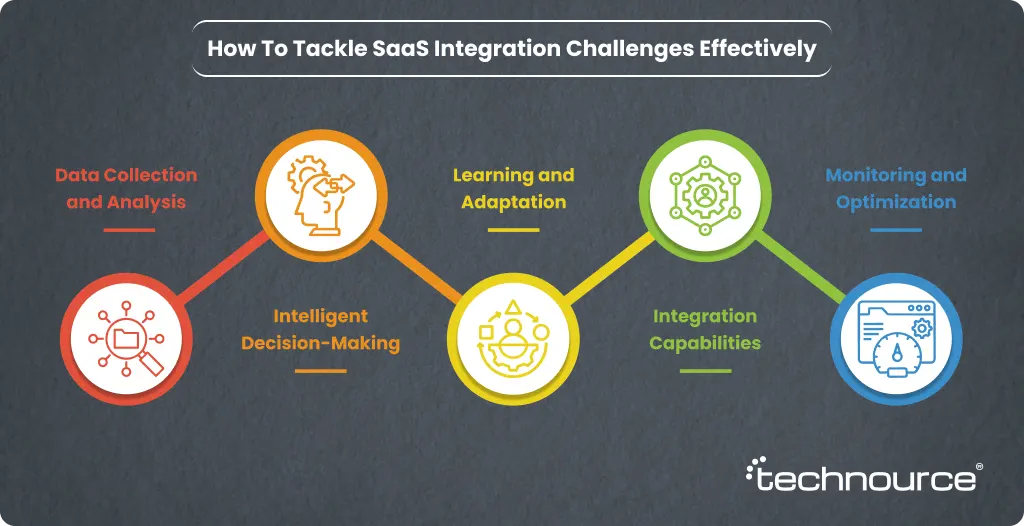
Step 1: Data Collection and Analysis: AI automation tools begin their operations by collecting data from multiple sources, which include email systems and CRM platforms, and document repositories. The AI workflow automation platform uses this data to discover operational patterns that help to find areas that can be improved.
Step 2: Intelligent Decision-Making: AI workflows use machine learning models to create advanced decision-making capabilities that go beyond basic workflow automation systems, which operate through if-then rules. The system can identify situations that need human decision-making and will properly escalate those situations.
Step 3: Learning and Adaptation: The best intelligent automation tools improve over time. The system develops better performance abilities through outcome-based learning, which enables it to refine its approach after processing additional data.
In practice, we’ve found this learning capability is most valuable in customer-facing workflows like ticket routing and lead qualification, where patterns emerge quickly, and accuracy improves noticeably after the first few hundred interactions.
Step 4: Integration Capabilities: Modern workflow automation platforms connect with your existing tools—CRMs, ERPs, communication platforms, and more. The power of AI workflow automation tools comes from their ability to work within different systems through seamless integration with various tools.
Step 5: Monitoring and Optimization: Automated workflow tools track performance data while they identify points that can be enhanced. The system keeps optimizing itself to provide the highest possible value through your workflow automation tool.
AI Workflow Automation vs Traditional Automation
This distinction matters because it affects what problems your business can solve.
Traditional Automation: Workflow automation solutions of the traditional variety are rules-based. The process executes in a fixed pattern, which requires the execution of Y when X occurs. The system works effectively for tasks that require repeating operations that have established boundaries. The system requires substantial manual configuration work because it needs to handle all operational exceptions.
AI Workflow Automation: AI automation tools use pattern recognition technology together with intelligent decision-making capabilities. The system handles exceptions through smooth transitions while it develops new skills through ongoing learning. When building AI agent–driven workflows, AI automation platforms can manage complex, multi-step processes that involve judgment calls and contextual understanding.
Real-World Example: A traditional workflow automation tool might route a customer inquiry based on department keywords. An AI workflow automation solution would understand the customer’s history, sentiment, urgency, and complexity to route it to the best-suited person and prepare relevant context. The system enables users to progress through their tasks like a guide who knows everything about their upcoming journey.
The high-value processes that traditional workflow automation tools cannot handle make AI workflows a valuable investment for modern businesses.
Top 8 AI Workflow Automation Tools in 2026
AI workflow automation is no longer a luxury; it’s a necessity for businesses aiming to scale efficiently in 2026. From marketing and sales to operations and customer support, AI-powered tools are helping organizations eliminate repetitive tasks, reduce human error, and improve productivity.
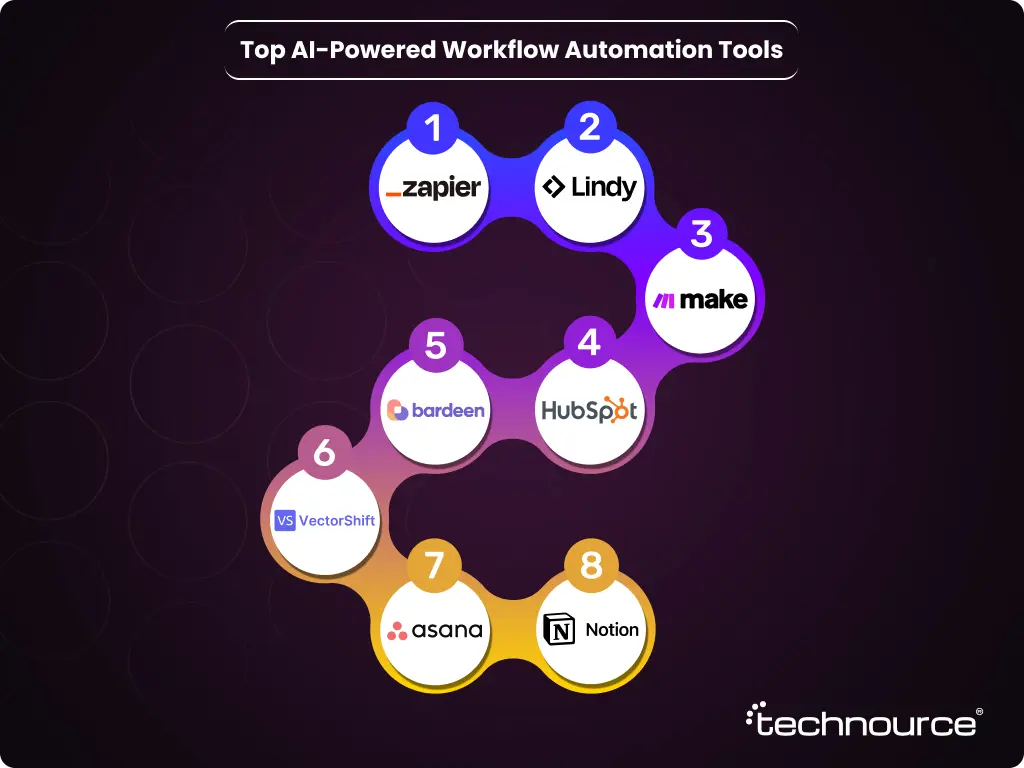
With rapid advancements in machine learning and intelligent integrations, modern automation platforms now go beyond simple task triggers. They analyze data, make smart decisions, and continuously optimize workflows. Below are the top AI workflow automation tools leading the market this year:
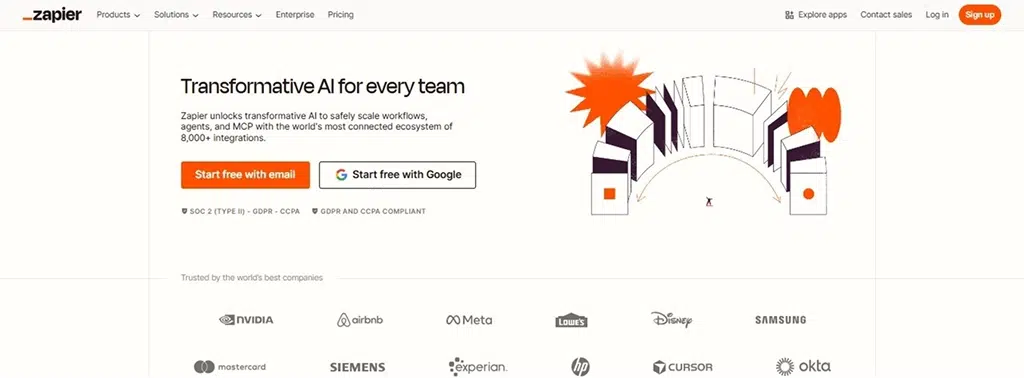
Best For: Cross-platform integration and connecting disparate apps
Organizations that require app connections without building custom software solutions should use Zapier as their primary workflow automation platform. The company developed Zapier as a standard workflow automation tool, but its AI functions have undergone substantial improvements since then. The platform connects more than 7000 applications, which makes it suitable for businesses that operate with multiple technology systems.
Verdict:In real projects, Zapier works best for lightweight automations like syncing leads between tools or triggering notifications. However, it struggles with complex logic, large data volumes, and real-time processing. We typically recommend Zapier for early-stage automation, not mission-critical workflows.
Lindy serves as the next-generation intelligent automation tool that operates through its AI-based platform. The traditional workflow automation solutions demand less work because Lindy enables organizations to create workflows through its user interface.
The system effectively handles procedures that require multiple steps and data transformation, and decision-making using contextual information. Lindy serves as a comprehensive AI automation platform that enables organizations to progress from basic process automation toward advanced intelligent process management.
Verdict: Lindy performs well for multi-step reasoning workflows, but it still requires careful prompt design and monitoring. It’s powerful, but not “set-and-forget” yet. Best suited for operations and research-heavy workflows rather than financial or compliance-sensitive tasks.
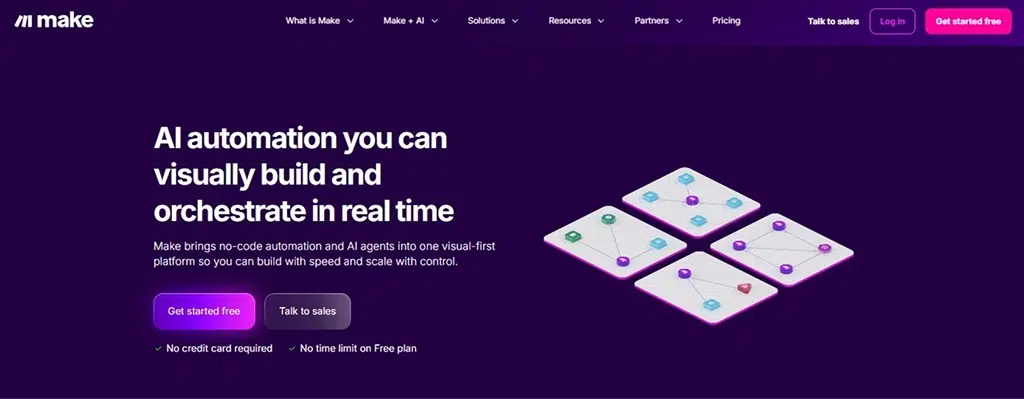
Best For: Visual workflow design and data transformation
The platform enables users to create visual workflows that transform data into automated processes through its software. Make enables users to create complex AI workflows through its scenario builder, which supports multiple design options, while its AI features enable users to build intelligent automated workflows.
The platform enables businesses to handle multiple data sources through its advanced data mapping and transformation tools, which operate within its intelligent automation system.
Verdict: Make is excellent when you need granular control over data transformation. We’ve found it especially useful for ETL-style workflows. However, its interface can overwhelm non-technical users, making it less ideal for business teams without technical support.
Best For: CRM-integrated customer-facing automation
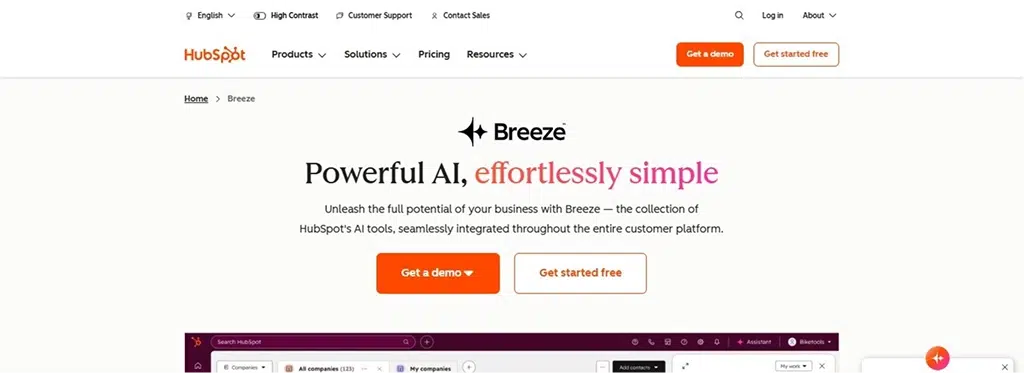
The AI workflow automation tools of HubSpot function as complete solutions for businesses that use its CRM system. The workflow automation platform automates customer-facing processes through its dedicated design, which meets the requirements of marketing, sales, and support teams.
The AI automation features include predictive scoring, intelligent task prioritization, and lead nurturing sequences that work without manual intervention.
Verdict: HubSpot AI shines if you already use HubSpot CRM. Outside that ecosystem, its automation value drops sharply. We don’t recommend it as a standalone workflow automation platform.
The Bardeen automation tool enables users to execute automatic processes through their web browsers across their frequently used internet sites and software applications. The system enables teams to automate their repetitive tasks through its user-friendly interface, which requires no technical expertise for setup.
The Bardeen automation tool enables users to execute automatic processes through their web browsers across their frequently used internet sites and software applications. The system enables teams to automate their repetitive tasks through its user-friendly interface, which requires no technical expertise for setup.
Verdict: Bardeen is effective for browser-based automation but less reliable for backend system integrations. We typically recommend it for individual productivity automation, not core business workflows.
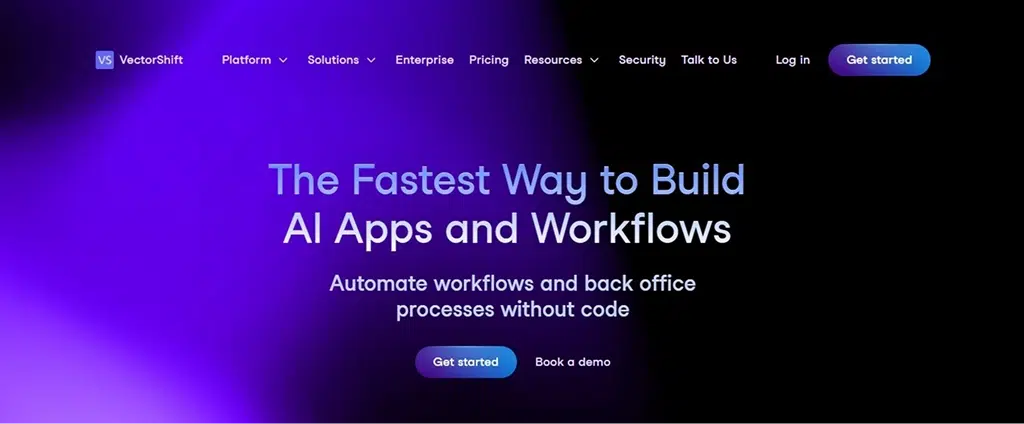
Vectorshift provides an AI workflow automation platform that enables enterprises to create customized automated processes that require advanced features. The system integrates advanced artificial intelligence capabilities with security mechanisms that meet enterprise requirements and maintain compliance.
The AI automation platform enables organizations to develop custom AI workflows that utilize their proprietary data and specific business rules, thus providing an ideal solution for organizations that require custom workflow automation systems.
Verdict: Vectorshift is powerful for enterprise use cases, but requires strong internal data governance and technical ownership. It’s not ideal for small teams without engineering support.
The software provides its best value through its ability to automate project workflows. The project management software of Asana provides strong workflow automation capabilities, which function as its main feature. The platform enables teams to set up automated systems that handle project tasks through its rules engine.
The workflow automation platform of Asana brings direct benefits to teams who already use Asana by decreasing the time they spend on manual tasks. The intelligent automation tool provides a solution to organizations that use multiple project workflows at the same time.
Best For: Knowledge worker automation and content teams
The software serves its best purpose by automating knowledge worker tasks and supporting content production teams. Notion provides a complete workflow automation system through its database system, which works together with its automation features for knowledge workers and small teams.
The content teams and operations departments benefit from the AI workflow automation features, which include AI-powered writing tools and database automation. Notion provides workflow automation solutions that work effectively for smaller organizations that need simple systems, although it lacks the focus of dedicated AI automation software.
Verdict: Notion automation works best for internal workflows like content pipelines and documentation. It’s not suitable for high-volume transactional automation or real-time system sync.
AI Workflow Automation Use Cases by Industry
Artificial Intelligence is no longer limited to experimentation; it is actively transforming how industries operate. AI workflow automation helps organizations streamline repetitive processes, reduce human error, improve efficiency, and enhance decision-making. By integrating intelligent automation and AI integration solutions into daily operations, businesses can scale faster while maintaining accuracy and consistency.
Below are some of the most impactful industry-specific use cases where AI workflow automation is driving measurable results.
Customer Support
The support teams use workflow automation solutions to handle ticket distribution and automated response generation, and issue management. AI automation tools provide three functions, which include sentiment analysis, complexity prediction, and first-response time reduction. The companies that use these intelligent automation tools experience a 40 percent increase in their ticket resolution speed.
One SaaS support team we worked with automated ticket classification and routing and saw a 32% reduction in backlog within the first month.
Sales and Business Development
AI workflows perform three functions, which include lead qualification and follow-up scheduling, and CRM record updating. The workflow automation platforms eliminate administrative tasks, which enables sales teams to concentrate on building customer relationships. The tool generates a strong ROI because it directly affects revenue streams.
Finance and Accounting
The processes of invoice processing, expense categorization, and reconciliation work well with AI automation tools. The workflow automation tools enable organizations to cut manual data entry needs by 90 percent, which allows accountants to work on strategic analysis rather than data entry tasks.
A finance client automated invoice matching and approval workflows and reduced processing time from 3 days to under 6 hours.
Human Resources
AI workflow automation provides substantial advantages to onboarding workflows, leave approval processes, and employee record management operations. The use of automated workflow tools delivers consistent results that operate at high speeds to enhance employee satisfaction while decreasing the workload for HR staff.
Marketing Operations
The process of lead nurturing and campaign scheduling, together with performance reporting, now relies on AI automation platforms, which handle these tasks. The intelligent automation tools enable marketing teams to expand their campaign operations without needing additional staff members.
Key Features to Look for in an AI Workflow Automation Tool
When evaluating AI workflow automation tools, focus on these critical features:
Pre-built Templates: Look for workflow automation platforms offering templates for common processes. This accelerates deployment significantly.
Integration Breadth: The value of any AI automation tool depends on its ability to connect with your existing stack. Evaluate whether it integrates with your key systems.
Ease of Use: Not everyone is technical. The best workflow automation solutions are accessible to business users without coding knowledge.
Scalability: Start small with your AI workflows, but ensure your intelligent automation tools can grow with your business.
Analytics and Monitoring: You need visibility into how your automated workflow tools are performing. Look for detailed reporting and optimization suggestions.
Security and Compliance: AI workflow automation often handles sensitive data. Ensure your chosen AI automation platform meets your security and regulatory requirements.
Support and Training: Good documentation and customer support make the difference between a successful workflow automation tool implementation and a failed project.
Benefits of AI Workflow Automation for Businesses
In today’s competitive landscape, businesses are constantly looking for smarter ways to streamline operations and maximize efficiency. AI workflow automation helps organizations eliminate repetitive manual tasks, reduce human errors, and improve overall performance. By integrating intelligent systems into daily processes, companies can scale faster, make better decisions, and stay ahead of the competition.
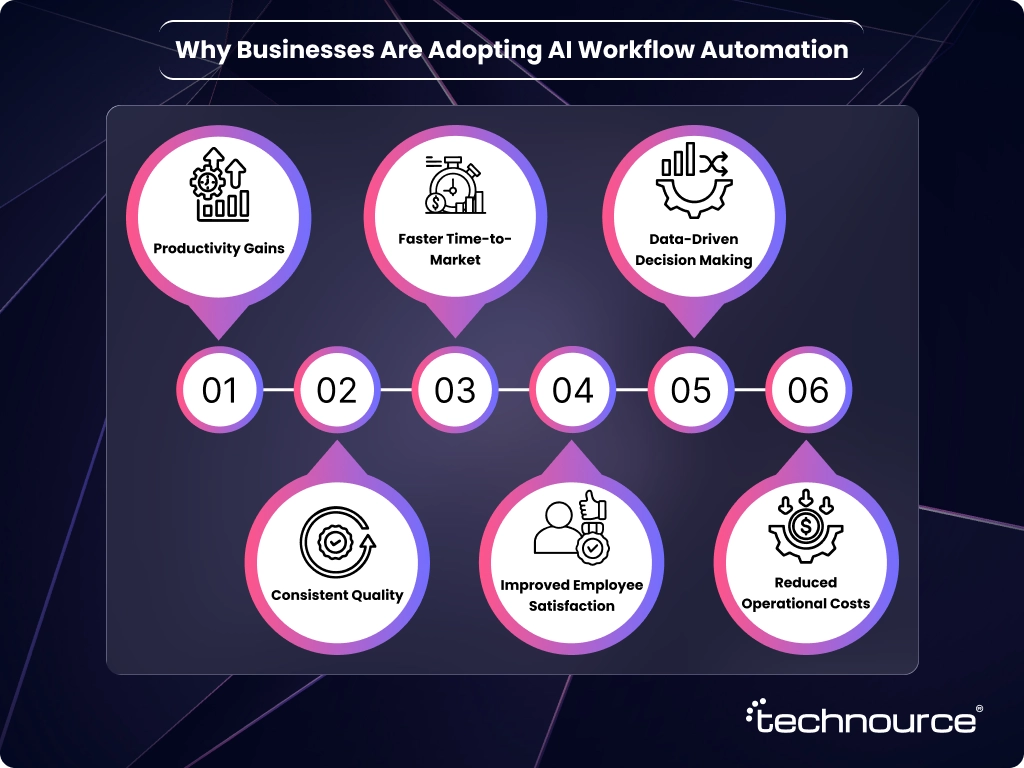
Productivity Gains
According to PS Global Consulting, businesses integrating AI into workflows could achieve a transformative 40% boost in workforce productivity over the next decade. The organization receives workforce benefits because the additional time saved through this method works as a substitute for hiring new employees.
Consistent Quality
Intelligent automation tools execute processes the same way every time. The process maintains constant quality standards because it executes without any manual operations.
Faster Time-to-Market
AI automation platforms enable organizations to process and deploy data more efficiently and effectively. Businesses that achieve faster operational speed than their competitors will obtain major business advantages.
Improved Employee Satisfaction
Employees who work with automated systems to complete their boring tasks will have extra time to spend on important work activities. The new process increases employee contentment while making it easier to keep employees.
Data-Driven Decision Making
AI workflow automation tools create process insights that provide organizations with useful information about their operations. Organizations can utilize these insights to develop more effective strategic plans while implementing ongoing operational enhancements.
Reduced Operational Costs
Studies show that workflow automation tools reduce operational costs by 25-35%. This improvement exists in three areas, which include staffing expenses and expenses for error correction and processing time.
Limitations of AI Workflow Automation Tools
The capabilities of AI workflow automation should be assessed according to their actual capabilities and their actual limitations.
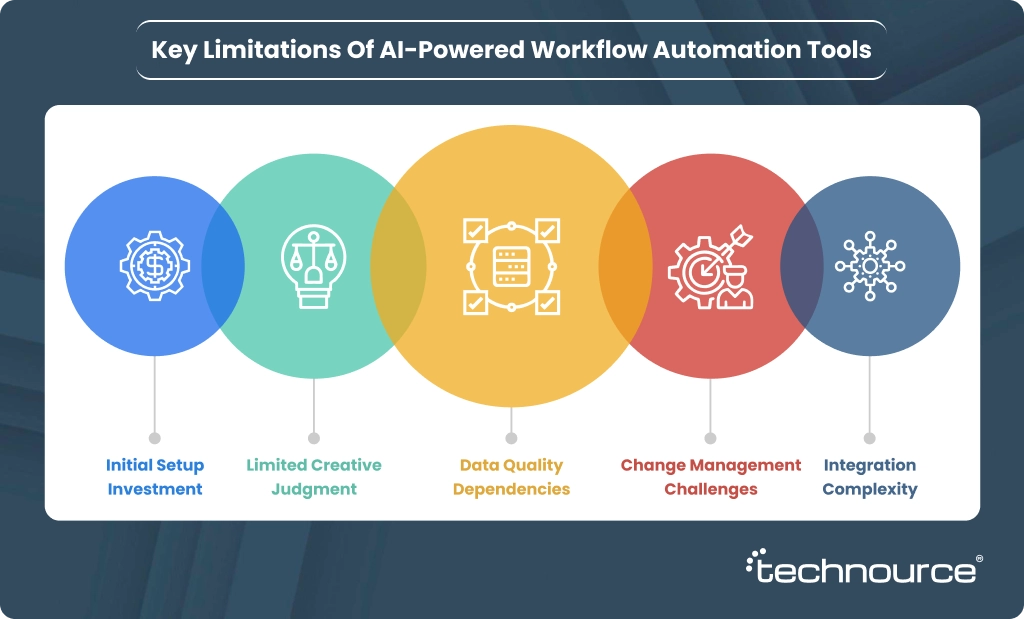
Initial Setup Investment: Building AI workflows requires upfront effort and expertise. The setup phase of workflow automation solutions demands resources, although those solutions will eventually recover their initial implementation costs.
Limited Creative Judgment: Intelligent automation tools excel at pattern-based decisions but struggle with truly creative or nuanced judgment that requires human insight.
Data Quality Dependencies: AI automation tools depend on data quality for their operational performance. Poor data input means poor automation output.
Change Management Challenges: Employees sometimes resist workflow automation platforms, viewing them as threats. Successful implementation requires strong change management.
Integration Complexity: Modern AI automation platforms have improved their integration capabilities, yet connecting with legacy systems remains a complex task. Not all workflow automation tools integrate equally well with older systems.
In several implementations, we’ve seen automation fail not because of the tools, but because the underlying process was broken. Automating a bad workflow only makes bad outcomes faster. Process design still matters.
Build vs Buy: When Custom AI Workflow Automation Makes Sense
This is a crucial decision for enterprises.
Buy (Existing Solutions): Most organizations find that buying preexisting artificial intelligence workflow automation solutions provides better operational and financial results. Workflow automation platforms like Zapier, Make, and Lindy deliver established solutions that come with continuous customer assistance. This method demonstrates effective performance for standard business operations.
Build (Custom Development): Organizations should use custom artificial intelligence automation systems when their operational methods require solutions that existing intelligent automation systems cannot deliver. Organizations should establish custom artificial intelligence workflows through development partnerships when their business advantage relies on exclusive operational methods.
The Middle Ground: Many businesses use established workflow automation solutions for standard processes while building custom automated workflow tools for differentiated processes. The organization combines preexisting workflow automation solutions with its ability to create custom solutions through this method.
Most of our clients start with platforms like Zapier or Make and later move to custom AI workflows once they identify high-ROI processes. This avoids overspending early while still enabling differentiation later.
The most effective strategy for most businesses requires them to begin with current artificial intelligence automation technologies while developing personalized solutions through their growth.
Why Choose Technource for AI Workflow Automation?
At Technource, we understand that implementing AI workflow automation is about more than choosing the right workflow automation platform; it’s about transformation.
We’ve helped dozens of organizations select, implement, and optimize their AI automation tools. Our approach combines strategic consulting with hands-on implementation. We don’t just set up your workflow automation solutions; we help your team understand how to maximize value from intelligent automation tools.
Whether you’re evaluating AI workflow automation options, need help building custom AI workflows, or want to optimize existing automated workflow tools, our experienced team guides you through every step. We understand the nuances of different workflow automation platforms and can match your specific business needs with the right AI automation platform.
Conclusion
AI workflow automation tools aren’t just another technology trend—they’re becoming essential infrastructure for competitive businesses. The difference between companies thriving and merely surviving increasingly comes down to how effectively they’ve automated and optimized their operations.
Whether you choose established workflow automation solutions or partner with top AI automation companies to build custom intelligent workflows, the key is getting started. Begin with one high-impact process, measure the results, and build from there. The best AI automation tools are the ones you actually use and continuously optimize.
The future belongs to businesses that work smarter, not just harder. AI workflow automation is how you get there.
FAQs
RPA (Robotic Process Automation) follows rigid, pre-programmed rules. AI workflow automation adds intelligent decision-making and learning capabilities. AI workflows can adapt to new situations, while RPA cannot.
Businesses typically see 25-35% cost reductions in affected processes within the first year. The actual number depends on your current processes and where you focus your workflow automation efforts.
Most modern AI automation platforms are designed for business users. That said, complex implementations benefit from technical expertise. Many workflow automation tools support both no-code and technical approaches.
Most implementations break even within 3-6 months. High-impact use cases may show ROI within weeks. Workflow automation platforms with quick implementation tend to deliver faster results.
Yes, but with limitations. Intelligent automation tools excel with decisions that follow patterns or use historical data. Decisions requiring genuine creativity or unprecedented judgment should remain with humans.
Good candidates for AI workflow automation are repetitive, rule-based, and data-driven. They typically show clear input-output relationships and happen frequently enough to justify the implementation effort.
Mr. Sanjay Singh Rajpurohit is the Founder and CEO of Technource, a visionary leader with deep expertise in AI, web, mobile, and custom software development. With a strong foundation in education and over a decade of entrepreneurial experience, he guides his team in delivering scalable, innovative digital solutions across industries. He focuses on building future-ready products by integrating cutting-edge technologies and fostering a culture of continuous improvement. In June 2024, he was honored with the “Mister Ahmedabad Personality” title, recognizing his impactful presence beyond the tech world.
Request Free Consultation
Amplify your business and take advantage of our expertise & experience to shape the future of your business.