GCP vs AWS vs Azure: Which Cloud Platform Is Right for Your Business in 2026?
Dhrumil Mistry
Published: Mar 10, 2026
Table of Content Table of Content
Quick Summary:
There is no single “best cloud platform” because businesses must choose a platform that suits their operational needs and their existing technology infrastructure.
The three major cloud computing platforms that dominate the global market are AWS, Microsoft Azure, and Google Cloud Platform (GCP).
Azure excels in Microsoft ecosystem integration and hybrid cloud solutions.
GCP stands out in AI/ML, data analytics, and Kubernetes-native architecture.
This guide compares GCP vs AWS vs Azure across pricing, features, market position, and real-world use cases to help you make an informed decision.
Cloud computing has become an essential requirement for all contemporary enterprises, yet choosing between AWS, Azure, and GCP can be complex because each platform offers multiple capabilities. Each of them serves different goals; organizations prioritizing AI workloads often prefer GCP, while an enterprise with Windows Server can work well with Azure. Enterprises often rely on AWS to manage diverse and large-scale workloads for its extensive service catalog.
Our cloud experts at Technource have curated this guide that explains the critical differences among GCP, AWS, and Azure in terms of pricing, features, use cases, and market positioning.
GCP vs AWS vs Azure: Quick Comparison at a Glance
Here’s a quick comparison table that summarizes the key differences between GCP vs AWS vs Azure across many important factors.
Category
AWS
Microsoft Azure
Google Cloud (GCP)
Global Market Share (2025)
30%
20%
13%
Best For
Large-scale enterprise workloads
Microsoft & hybrid environments
AI, ML & data-driven workloads
Compute Service
EC2
Azure Virtual Machines
Compute Engine
Serverless
AWS Lambda
Azure Functions
Cloud Functions
Container Service
EKS / ECS
AKS
GKE
Data Warehouse
Redshift
Synapse
BigQuery
AI/ML Platform
SageMaker
Azure AI + OpenAI
Vertex AI
Hybrid Cloud
AWS Outposts
Azure Arc / Stack
Anthos
Pricing Model
Per-second billing + Savings Plans
Per-second + Hybrid Benefit
Per-second + Automatic discounts
No. of Services
250+
200+
200+
Regions
33
65+
38
As mentioned in the table, AWS is known for its range of services and its global enterprise adoption. In contrast, Azure integrates seamlessly with the Microsoft ecosystem and dominates the market when it comes to hybrid cloud choices.
With AI/ML adoption and innovation, GCP demonstrates strong capabilities along with its data analytics capabilities. Most enterprises use a multi-cloud strategy right now to balance performance, cost efficiency, and operational scalability.
Market Share & Cloud Industry Positioning
The global cloud infrastructure continues to evolve around these three platforms: AWS, Azure, and GCP.
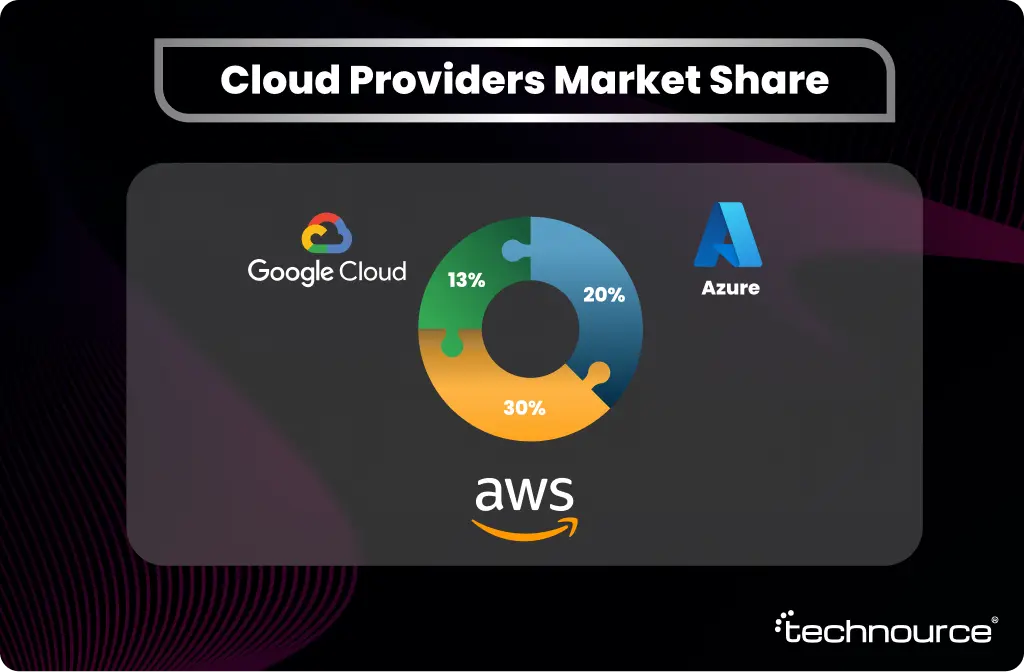
According to Synergy Research Group, these three platforms collectively control more than 60% of the global cloud infrastructure market, which exceeded $90+ billion in quarterly revenue in 2025.
Q2 2025 Cloud Market Share:
AWS remains the leader for total revenue and long-term customer retention. The company maintains its IaaS and PaaS market leadership through its cloud computing service launch in 2006 and its extensive service portfolio, which includes more than 250 services.
Microsoft Azure holds the second position and has demonstrated strong year-over-year growth, driven by enterprise hybrid cloud adoption and deep integration with Microsoft’s ecosystem, including Office 365, Active Directory, and Azure OpenAI services.
Google Cloud has established itself as a smaller market player that has experienced continuous growth, especially in AI/ML workloads, data analytics, and Kubernetes-based deployment operations. Its leadership in BigQuery, Vertex AI, and container orchestration (GKE) has strengthened its position among data-driven organizations.
Although AWS holds the largest market share, Azure and Google Cloud both compete with AWS through their respective enterprise growth and AI-focused development in hybrid cloud and generative AI infrastructure.
Overview of AWS, Azure, and Google Cloud
Before diving into detailed comparisons, it helps to understand how each cloud provider evolved and what core strengths define their ecosystem today. While all three offer similar foundational services, their strategic focus areas differ significantly.
Amazon Web Services (AWS)
AWS was launched in 2006, pioneering cloud infrastructure with S3 and EC2. AWS offers over 250 services across compute, storage, databases, machine learning, and analytics.
Strengths:
Widest set of services offered
Easily integrated with any third-party tool (SAP, Microsoft, etc.)
A strong global presence
Huge support from the developer community
Best for: Large enterprises requiring a broad range of cloud services
Microsoft Azure
Azure, launched in 2010, leverages Microsoft’s enterprise footprint. Azure holds its specialty in hybrid cloud services and seamless integration with Microsoft products.
The platform excels in hybrid cloud capabilities and seamless Microsoft product integration.
Strengths:
Best with Microsoft tool integrations such as Teams, Office 365, etc.
100+ compliance certifications, excellent for regulated industries
65+ regions globally, strong presence in restricted markets
Best for: Businesses that totally depend on the Microsoft environment but need to upgrade to a hybrid infrastructure.
Google Cloud Platform (GCP)
GCP has carved a niche in data analytics and AI. Google’s investment in Kubernetes, BigQuery, and machine learning makes it stand out in the cloud infrastructure market.
Strengths:
Best data analytics and AI/ML tools
Cost-effective, along with many automatic discounts
Reliable and strong Kubernetes ecosystem
Detailed documentation and advanced APIs
Cloud Adoption Trends: The Use of Hybrid & Multi-Cloud
Organizations are increasingly adopting hybrid and multi-cloud strategies to improve flexibility, resilience, and vendor independence.
Hybrid Cloud Leadership:
Azure Arc and Azure Stack HCI are bonuses for Azure Hybrid
Outposts and Local Zones are the best players of AWS for hybrid scenarios
GCP provides Anthos for multi-cloud and hybrid management
Multi-Cloud Drivers:
Avoiding vendor lock-in
Optimizing each workload on the best platform
Distributing risk across providers
Leveraging platform-specific strengths (AWS for breadth, GCP for AI, Azure for Microsoft integration)
Netflix operates over 100000 AWS instances, while Microsoft uses its Azure platform, and Spotify builds its services on Google Cloud Platform to establish its multiple cloud environments. The market for cloud infrastructure grew by 25 percent between Q2 2025 and the previous year, while hybrid and multi-cloud deployments became the fastest-growing segment in the industry.
The organizations show growing interest in knowing “What steps should I follow to run AWS for computing needs, GCP for data analysis, and Azure for business applications?” The strategic approach is used to stop organizations from depending too much on one specific vendor.
GCP vs AWS vs Azure: Cloud Computing Pricing Comparison
Cloud pricing is not something you decide by hourly rates alone. For enterprise workloads, total cost of ownership (TCO) depends on usage patterns, network transfer, licensing alignment, and long-term commitment strategy.
Here’s how the three platforms compare.
1. Billing Models & Discount Structures
AWS, Azure, and GCP offer a pay-as-you-go pricing model, and the difference can be determined by how discounts are applied.
AWS
On-demand pricing
Reserved Instances (up to ~72% discount with 1–3 year commitment)
Savings Plans (flexible compute discounts)
Spot Instances (up to ~90% discount, interruption-based)
AWS offers the most advanced discount ecosystem, but it requires active cost management.
Microsoft Azure
On-demand pricing
Reserved VM Instances (up to ~65% discount)
Spot VMs (up to ~80% discount)
Azure Hybrid Benefit (reduces Windows & SQL licensing costs significantly)
Azure delivers a strong ROI for enterprises already invested in Microsoft licensing.
Google Cloud Platform (GCP)
On-demand pricing
Committed Use Discounts (up to ~70%)
Preemptible VMs (up to ~80% lower cost)
Automatic Sustained Use Discounts (applied automatically without commitment)
GCP’s pricing model is often viewed as more predictable due to automatic discounting.
2. Pricing Comparison Snapshot
Category
AWS
Azure
GCP
Billing Granularity
Per-second
Per-second
Per-second
Long-Term Discounts
Reserved + Savings Plans
Reserved Instances
Committed Use
Automatic Discounts
No
No
Yes
Spot/Preemptible
Up to 90%
Up to 80%
Up to 80%
Hybrid License Benefit
Limited
Strong
Limited
Pricing Complexity
High
Moderate
Low
3. Real-World Compute Example
Example workload:
8 vCPU, 32GB RAM (US-East region)
Provider
Approx. On-Demand Cost
AWS
~$0.30/hour
Azure
~$0.29/hour
GCP
~$0.27/hour
At base rates, GCP appears 10–15% cheaper.
However, enterprise pricing differences narrow significantly once long-term discounts and workload optimization are applied.
4. Storage & Managed Database Costs
Storage pricing differences are minor. Lifecycle management and retrieval frequency usually impact cost more than base pricing.
Provider
Approx. Cost
AWS S3
~$0.023
Azure Blob
~$0.018–0.020
GCP Cloud Storage
~$0.020
5. Hidden Costs That Affect Enterprise TCO
Base compute pricing is rarely the largest expense.
Major cost drivers include:
Data egress fees (outbound traffic charges)
Cross-region data transfer
Managed service premiums
Idle or overprovisioned resources
Without governance and monitoring, organizations often overspend 20–30% on unused capacity.
6. Pricing Verdict (Enterprise Perspective)
Base compute pricing is rarely the largest expense.
Major cost drivers include:
AWS is often preferred when organizations have an experienced FinOps team capable of optimizing Reserved Instances and Savings Plans.
Azure is typically adopted by enterprises operating within Microsoft-centric ecosystems seeking strong hybrid governance capabilities.
Organizations prioritizing large-scale data analytics and AI-driven innovation frequently adopt Google Cloud Platform due to its analytics-first architecture.
For most enterprises, architecture design and governance maturity influence total spend more than provider selection alone.
All three cloud computing platforms provide comparable core functionalities, although their design approaches show distinct differences.
AWS serves demanding, customized environments through its extensive range of services and detailed infrastructure management options.
Azure provides businesses with advanced tools for connecting their existing systems while managing user identities and enforcing hybrid security regulations.
GCP focuses its efforts on data engineering and Kubernetes-native design and AI-first research development.
The actual performance of features depends on their ability to handle specific workloads rather than their maximum technical capabilities. GKE Kubernetes maturity enables container-heavy SaaS platforms to achieve operational benefits while regulated enterprises running Windows-based systems find Azure governance tools to better match their needs. AWS enables organizations to create customized solutions through its ability to manage networking connections, computing resources, and multiple service integrations.
Architectural Comparison: AWS vs Azure vs GCP
Beyond pricing and service availability, AWS, Azure, and GCP differ significantly in architectural philosophy. These differences influence scalability, governance complexity, security implementation, and long-term operational efficiency.
Identity & Access Management (IAM)
Identity management plays a critical role in enterprise cloud security.
AWS IAM provides highly granular policy-based access control, which enables users to select specific service and resource access rights.
Azure Active Directory (AAD) works seamlessly with existing enterprise identity systems, which makes it an optimal solution for businesses that use Microsoft products.
GCP IAM uses a project-based permission system, which simplifies access control while minimizing administrative tasks.
Enterprise Insight:
Azure provides easier identity governance solutions for enterprise organizations compared to AWS, which enables better security management in complex environments.
Networking Architecture
The ability to network systems through their current architecture enables organizations to handle dispersed workload operations.
AWS offers the most customizable Virtual Private Cloud (VPC) architecture with maximum customization options through its ability to control network routing and create network segments across different geographical areas.
Azure provides hybrid connectivity solutions between its VPN Gateway and ExpressRoute connections that link to on-premise systems.
GCP uses Google’s private backbone network, which provides direct low-latency connections between its different regions.
Enterprise Insight:
AWS excels in networking customization, whereas GCP simplifies global networking deployment.
Disaster Recovery & Availability Design
High availability and disaster recovery maturity vary across platforms.
AWS provides mature multi-region failover and replication strategies supported by availability zones worldwide.
Azure focuses strongly on enterprise business continuity and compliance-driven recovery planning.
GCP
leverages globally distributed infrastructure for automatic workload resilience.
Enterprise Insight:
All three providers deliver strong availability guarantees, but implementation complexity differs depending on the architecture design.
Cloud Design Philosophy
Each provider approaches cloud infrastructure differently:
Platform
Architectural Philosophy
AWS
Infrastructure flexibility and service depth
Azure
Enterprise integration and hybrid governance
GCP
Cloud-native scalability and data-first innovation
Understanding these architectural differences helps organizations align cloud adoption with long-term operational strategy rather than short-term feature comparison.
Cloud Storage: Who Does It Best?
All three offer reliable object storage. The real differences emerge in edge cases and pricing.
AWS S3:
99.99% durability, multiple storage classes
Complex pricing with many edge case fees
Widest integration ecosystem
Azure Blob Storage:
Cost-effective with hot/cool/archive tiers
Seamless integration with Azure services
Free inbound data (2024 improvement)
GCP Cloud Storage:
Lowest base rates
Simplest pricing structure
Automatic intelligent tiering saves money
Use case: Cost-sensitive teams often prefer GCP, whereas if teams need flexibility, then they choose AWS, and if their work is Microsoft-dependent, then they typically adopt Azure.
Use-Case Based Comparison: Which Cloud Is Right for You?
Based on common enterprise cloud adoption patterns, the following scenarios illustrate how organizations typically align workloads with each cloud provider.
Scenario 1: E-Commerce Startup
Recommendation: GCP
Why? The system provides affordable computing power, which enables users to create microservices through its Kubernetes platform while delivering top-tier customer behavior analytics capabilities that come at a monthly cost below $10,000. Many startups planning to develop cloud application architectures prefer containerized deployments on GCP to accelerate MVP releases while maintaining cost predictability.
Scenario 2: Enterprise Financial Services
Recommendation: Azure
Why? The organization requires compliance with FedRAMP and HIPAA standards while using its current Windows and SQL system, and needs hybrid cloud solutions to meet its regulatory obligations. Hire Azure developers because Azure Arc enables organizations to manage their on-premises resources together with their cloud-based assets.
Scenario 3: Media & Entertainment Streaming
Recommendation: AWS (primary) + multi-cloud
Why? Netflix proves this: AWS’s 33 regions for low-latency content delivery, proven scale, CloudFront CDN unmatched performance. Multi-cloud prevents single vendor risk.
Scenario 4: AI/ML Research Organization
Recommendation: GCP
Why? The research organization needs to implement GCP as its primary cloud solution. The industry benchmark for AI technology is established through Vertex AI and Gemini APIs, while BigQuery enables businesses to conduct analytics operations at enterprise scale, and TPU technology facilitates deep learning workloads with transparent GPU hour rates.
Scenario 5: Hybrid Manufacturing Facility
Recommendation: Azure
Why? The Azure platform serves as the best solution for the hybrid manufacturing facility. The Azure Arc system enables users to control edge device operations and their on-site hardware and cloud activities through a centralized control panel. The factory floor operations use Windows systems, which enable manufacturers to achieve significant cost reductions through their built-in system capabilities.
Enterprise Cloud Decision Framework: Choosing Between AWS, Azure, and GCP
The features of a cloud platform do not serve as the only criterion for making platform selection decisions. Enterprise cloud decisions typically depend on organizational maturity, regulatory requirements, workload architecture, and long-term scalability goals.
The following framework provides a practical decision model used when evaluating cloud infrastructure platforms.
Organizational Requirement
Recommended Platform
Strategic Reason
Microsoft-centric enterprise environment
Azure
Native integration with Active Directory, Windows Server, and enterprise governance tools
AI/ML and data-driven workloads
GCP
Advanced analytics ecosystem with BigQuery and Vertex AI capabilities
Global consumer applications at a massive scale
AWS
Mature global infrastructure and extensive service ecosystem
Hybrid or legacy infrastructure modernization
Azure
Strong hybrid cloud capabilities via Azure Arc and Stack HCI
Container-first SaaS platforms
GCP
Kubernetes-native architecture powered by GKE
Complex networking and multi-region architecture
AWS
Highly customizable VPC networking and infrastructure control
Cost-optimized experimental workloads
GCP
Predictable pricing with automatic sustained-use discounts
The majority of businesses implement multiple cloud services because they want to match their workloads with the most effective platform that meets their performance needs, governance requirements, and cost efficiency standards.
Cloud Services Comparison: Final Comparison
When comparing AWS, Azure, and GCP at a high level, the differences become clearer across service depth, developer experience, support, and migration capabilities. The right choice often depends less on features and more on how your teams plan to build, scale, and operate in the cloud. For businesses building subscription-based platforms or scalable digital products, partnering with a specialized SaaS application development company can further streamline cloud architecture decisions and long-term platform scalability.
Services Depth
AWS: 250+ services, dominates in breadth. Overwhelming for startups, but perfect for enterprises running everything on one platform.
Azure: 200+ services, focusing on enterprise integration quality over quantity.
GCP: 200+ services, concentrated on data, analytics, AI, and containerization excellence.
Developer Experience
AWS: Steep learning curve, documentation overwhelming, largest community.
Azure: Better tutorials for Microsoft developers, integration-focused learning path.
GCP: Modern APIs, clean documentation, quickest time to “hello world.”
Support Quality
AWS: Slow basic support, but robust enterprise SLAs.
Azure: Fast support for enterprise customers, excellent for Microsoft partnerships.
GCP: Solid support, improving with enterprise growth.
GCP: Good, but fewer third-party tools compared to AWS.
Conclusion
The cloud platform battle isn’t about finding the “best”; it’s about your requirements and their alignment towards them.
AWS is commonly selected for environments requiring extensive infrastructure flexibility and global-scale service availability.
Azure remains a strategic choice for enterprises deeply integrated with Microsoft technologies or pursuing hybrid cloud modernization.
GCP is frequently adopted by organizations building data-intensive and AI-native applications.
The future is multi-cloud. Most Fortune 500 companies currently utilize all three cloud platforms. Organizations should determine how to use each platform because their decision should not focus on which platform to choose.
Ready to make your cloud decision? Technource specializes in cloud architecture consulting services, helping organizations evaluate, migrate, and optimize their cloud infrastructure.
Whether you need to hire AWS developers, hire Azure developers, or hire DevOps engineers for Kubernetes, our expert team guides every step.
FAQs
Base rates vary 10-15%, but Total Cost of Ownership depends on workload, data transfer, and discount strategy. GCP is cheaper per-hour; AWS offers superior discount tools.
Containerized workloads (Kubernetes) move easily; AWS-specific services (RDS, Aurora, DynamoDB) create lock-in. Plan for multi-cloud from day one if switching is a possibility.
Performance varies by workload. AWS EC2 Nitro instances excel for compute, GCP BigQuery leads analytics, and Azure performs well on Windows workloads. Benchmark your specific workload.
Not immediately, but mid-sized companies (>$50M revenue) often benefit from GCP’s analytics + AWS’s breadth or Azure’s integration. Start single-cloud, evolve as complexity grows.
The market favors AWS expertise (largest installed base), but GCP developers command premium rates due to scarcity. Technource offers recruiting services for AWS, Azure, and DevOps engineers, letting you build expert teams without recruitment overhead.
All three offer cost monitoring tools. Real savings come from right-sizing instances, leveraging discounts, and eliminating idle resources. Consider automation tools or consulting support.
Dhrumil Mistry is a tech expert and full-stack developer at Technource, skilled in PHP, Laravel, MySQL, and modern backend development. He contributes to building scalable, secure, and performance-focused digital solutions. Along with his backend expertise, he is proficient in frontend technologies such as React, Vue, and Next.js, enabling him to build seamless, responsive, and dynamic user interfaces. His interest in emerging technologies drives his work across AI/ML, data engineering, SaaS, blockchain, and IoT solutions, helping deliver innovative products for businesses.
Request Free Consultation
Amplify your business and take advantage of our expertise & experience to shape the future of your business.