



- Market Reality: 78% of organizations now use AI, but qualified AI developers remain scarce. Understanding how to hire AI engineers strategically is critical for a competitive advantage
- Cost Transparency: Hiring AI developers ranges from $50–$200/hour, depending on expertise, location, and engagement model. Total project costs often exceed initial estimates without proper planning
- Skills Evolution: AI-native developers with RAG, vector database, and agentic AI experience command premium rates and deliver measurably better outcomes than general developers
- Hiring Timeline: The complete process to find AI developers and integrate them into your team typically takes 4–8 weeks when done correctly
- ROI Multiplier: Businesses that hire artificial intelligence developers see an average 35% improvement in operational efficiency within the first year of AI implementation
The business sector today requires organizations to adopt AI technologies as their primary operational method because of the competitive environment. The common problem that all businesses encounter involves posting AI developer positions that attract numerous candidates who fail to demonstrate the necessary building skills during the interview process.
The current situation happened because organizations maintain a deep-rooted structural issue that affects their hiring practices for AI developers. The market for AI talent has experienced a complete transformation during the last year and a half. According to a report by McKinsey, worldwide use of Artificial Intelligence technology increased from 55% in 2023 to 78% in 2024, representing a 42% increase in one year.
Two years ago, RAG (Retrieval-Augmented Generation) and agentic AI frameworks, together with production-grade LLM deployment, operated as specialized technologies. Today, these systems are essential requirements in the business environment.
This guide cuts through the noise. Whether you’re a startup founder building your first AI feature or an enterprise CTO scaling an AI transformation, you’ll learn exactly how to hire AI developers who can execute, not just theorize.
As part of the latest AI trends, companies are rapidly shifting toward intelligent automation and decision systems.

Why Businesses Need to Hire AI Developers in 2026
As AI adoption accelerates globally, businesses that move beyond basic use cases are seeing the biggest gains.
Organizations that succeed today are not just adopting tools; they are investing in generative AI in business to create scalable and personalized experiences.
AI Adoption Trends and Market Demand
The process of implementing a system requires different methods than the process of implementing a system. Most companies running basic implementations barely scratch the surface of what AI can do. AI adoption statistics show how rapidly businesses are moving from experimentation toward broader AI implementation. The organizations that achieve success in 2026 create custom AI solutions that address their particular business challenges, often leveraging AI integration services and solutions to connect AI seamlessly into their workflows.
McKinsey’s 2025 survey found that organizations with dedicated AI teams report 3.5x higher returns on their AI investments compared to those relying solely on external consultants. In-house AI developers understand your data, workflows, and constraints in ways external teams never can.
ROI of Hiring Artificial Intelligence Developers
AI engineers work as time-saving assets for your organization through their employment. Tasks that used to take multiple days are now completed within minutes. Here’s a cross-industry snapshot:
- Customer Service: 40–60% reduction in response times and 25–35% cost savings within 6 months.
- Supply Chain: 15–25% reduction in carrying costs and 10–20% improvement in stock availability.
- Software Development: 25–40% faster feature delivery and 30% fewer bugs.
- Sales & Marketing: 10–30% conversion rate improvement and 15–25% lower acquisition cost.
The Growing Shortage of Skilled AI Engineers
The World Economic Forum reports that AI specialists are among the fastest-growing occupations worldwide, with an annual demand increase of 40%. Supply isn’t keeping pace. Top-tier AI developers receive multiple offers and have the leverage to be selective. Organizations that solve hiring first pull ahead.
AI Developer vs ML Engineer vs Data Scientist – Who Should You Hire?
AI Developers create AI-based applications that deliver solutions for particular business challenges. Their work involves product development, which requires them to integrate AI systems into chatbots, recommendation engines, and image identification technologies.
Machine Learning Engineers create, develop, and improve the machine learning models. The team develops predictive models, classification systems, and training pathways through their data handling work.
Data Scientists use their analytical skills to extract information from data while conducting experiments, developing statistical models, and presenting results to stakeholders.
Example: For a customer churn prediction system, data scientists determine churn indicators while an ML engineer runs model training and an AI developer connects it to the retention system.
When to Hire AI Engineers vs AI/ML Developers
- Hire AI engineers when you’re integrating existing AI APIs, building user-facing features quickly, or speed-to-market matters most.
- Hire AI/ML developers when you need custom models on proprietary data, off-the-shelf solutions don’t fit, or model accuracy is a core differentiator.
Hybrid Roles: AI-Native Developers in 2026
AI-native developers combine traditional software engineering with practical AI deployment experience. They understand RAG architectures, can implement vector databases, build agentic AI systems, and critically know when AI is the right tool and when it isn’t. The development community struggles to locate these developers, but they generate exceptional business value. This profile should receive your priority because it represents the upcoming professional requirements driven by emerging technologies shaping the future of development.
Read our blog on AI & Machine Learning in Mobile App Development: A Comprehensive Guide
Types of AI Developers You Can Hire
Not all AI developers bring the same expertise; choosing the right type depends entirely on your use case and business goals.
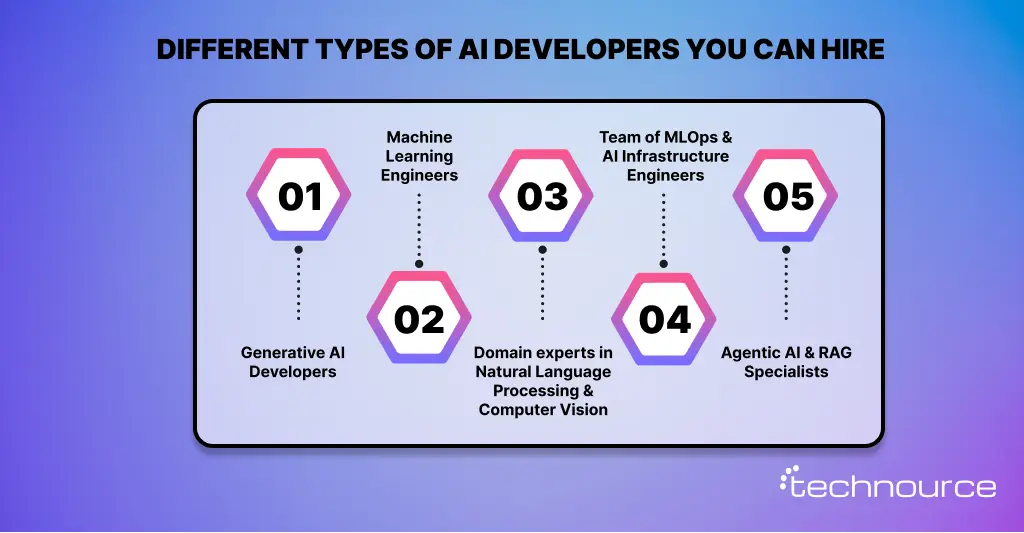
1. Generative AI Developers create systems that produce various content types, including text, images, code, and video content. Their work combines Large Language Models with diffusion models, while they specialize in prompt engineering and fine-tuning, RAG implementation, and AI safety.
2. Machine Learning Engineers create predictive systems that analyze data to detect fraud, forecast demand, segment customers, and build recommendation engines.
3. The domain experts in Natural Language Processing and Computer Visionconduct their specialized work. The NLP developers create chatbots and develop tools for sentiment analysis and document classification. Computer vision developers create systems that utilize image recognition technology, object detection methods, and visual question answering systems.
4. The team of MLOps and AI Infrastructure Engineers manages model deployment processes while they also monitor production systems, create CI/CD pipelines, and manage system scalability. The critical role of model deployment experts gets overlooked by hiring managers because their work remains essential to operations. The system requires deployment for its model to become valuable, which prevents the model from reaching its full potential.
5. Agentic AI and RAG Specialists represent advanced capabilities in modern AI development. These experts specialize in building AI agents and designing intelligent systems that can autonomously reason, take actions, and optimize workflows.
Agentic AI developers focus on creating systems that enable machines to make context-aware decisions and execute tasks independently. Meanwhile, RAG specialists develop vector databases and semantic search frameworks to ensure accurate, real-time information retrieval from an organization’s knowledge base.
Essential Skills to Look for When Hiring AI Developers
Hiring the right AI developer isn’t just about tools; it’s about a combination of technical depth, practical experience, and problem-solving mindset.
Core Technical Skills
- Python stands as an essential requirement because it serves as the primary programming language that drives all AI development work.
- The required ML Frameworks include both TensorFlow and PyTorch, together with Scikit-learn, Hugging Face Transformers, and LangChain.
- The system requires AWS through SageMaker or Google Cloud with Vertex AIor Azure ML, together with Docker and Kubernetes for its production operations.
- The candidate needs to demonstrate experience with OpenAI and Anthropic, Google, and Cohere, together with other AI service providers, through API integration work.
Generative AI and LLM Expertise
Key capabilities such as prompt engineering, fine-tuning techniques (LoRA, QLoRA), model selection across providers, and effective context window management play a critical role. Developers who master these concepts build AI applications that deliver adaptive, intelligent responses rather than relying on rigid, prewritten scripts.
RAG, Vector Databases, and AI Integration Skills
The three essential components for this solution include vector databases, which include Pinecone, Weaviate, Chroma, and Qdrant, together with semantic search and chunking and retrieval strategies, and secure integration with your existing data infrastructure. The ability to create prototypes together with operational systems represents critical differences that exist between prototype developers and production engineers.
AI-Native Development Mindset
AI-native developers ask, “How do I orchestrate AI systems to solve this?” instead of “how do I code this?” The candidate demonstrates these skills through their ability to use AI coding tools together with their development of systems that use AI for probabilistic operations, their capability to conduct rapid testing, and their ongoing educational process. The way candidates explain their previous work experience shows their understanding of projects better than any resume description.
Soft Skills That Impact Project Success
The essential skills include communication when explaining AI concepts to non-technical stakeholders, problem translation, which requires understanding business goals before creating solutions, and adaptability, collaboration, and ethical awareness. AI projects fail more often from communication breakdowns than technical issues.
Explore top ReactJS tools in our exclusive guide to Read our blog on Top 10 AI Automation Companies to Develop a Systemized Business in 2026
How Much Does It Cost to Hire AI Developers in 2026?
AI development costs vary widely depending on experience, location, and project complexity—understanding this upfront helps you plan realistically.
AI Developer Hourly Rates by Experience
AI developer rates increase significantly with experience, as higher-level talent brings deeper expertise and faster execution.
| Level | Experience | Hourly-rate | Typical Work |
|---|---|---|---|
| Junior | 0-2 Years | $50–$80 | Basic integrations, simple chatbots |
| Mid-level | 2-5 Years | $80–$130 | Custom models, RAG, production deployments |
| Senior | 5-10 Years | $130–$180 | Complex systems, architecture, team leadership |
| Expert/Lead | 10+ Years | $180–$250+ | AI strategy, novel problems, AI platforms |
Important: Senior talent is often cheaper than junior talent in total cost. A senior developer completes in two weeks what a junior takes two months, with better architecture and fewer mistakes.
Cost Breakdown by Region
AI developer costs vary significantly by geography, making location a key factor in your hiring strategy.
- United States: $100,000–$400,000+/year (AI hubs command 20–40% premium)
- Western Europe: €60,000–€250,000+/year (Eastern Europe 30–50% lower)
- India: $10,000–$72,000+/year (significant cost advantage with strong talent pools)
- Remote/Global: Typically 40–60% of US rates for equivalent quality
AI Developer Pricing Models
Choosing the right pricing model depends on your project scope, timeline, and how much flexibility you need.
- Hourly: Best for exploratory projects, ongoing maintenance, or unclear scope
- Fixed-Price: Best for well-defined projects, specific features, and budget constraints
- Dedicated Team/Retainer: Best for long-term initiatives, ongoing product development, consistent capacity needs
Hidden Costs in AI Development
Beyond developer salaries, the cost of developing AI includes several hidden expenses that can significantly impact your total budget.
- Infrastructure: $500–$5,000+/month (cloud compute, AI APIs, monitoring)
- Data: Preparation often consumes 40–60% of project time
- Management overhead: 15–25% of development cost
- Iteration: AI models rarely work perfectly on first deployment; budget for tuning cycles
Developer rates typically represent 50–60% of total AI project expenses, not 80–90% as many businesses assume.
Total Cost of Ownership Example
Medium business building a customer service AI with RAG (3–4 months):
- Senior AI Developer: ~$83,200
- Infrastructure + APIs (dev): ~$10,000
- Data prep + project management: ~$25,000
- Total Development: ~$118,200
- Monthly Operations: ~$12,500–$16,000
- First-Year Total: ~$289,000
Understanding the full picture prevents budget surprises and helps you make informed build-vs-buy decisions.
Hiring Models: How to Hire AI Engineers the Right Way
When partnering with agencies, focus on selecting the best AI application development company that aligns with your technical requirements, communication style, and long-term business goals.
1. In-House AI Development Team
This solution provides better results for businesses that develop products with AI technology as their primary focus, require continuous AI development over several years, and need to safeguard their intellectual property.
This system allows you to achieve total system control while building your expertise through multiple development stages, but it demands expensive resources and requires two to three months for staff recruitment, and it creates risks for employee retention. The development team should include two to three developers because it provides backup support for the project.
2. Freelance AI Developers for Hire
This solution works best when your organization needs to execute temporary tasks that require highly specific technical knowledge and wants to assess project viability before making substantial financial commitments. The system allows users to start work immediately while providing flexible operations that require less financial investment, but its active staffing ability is restricted, and its transition process needs improvement.
The platform provides access to two types of talent sources, which include Toptal (vetted, premium) and Upwork (large pool, requires screening). The company should initiate its operations by conducting a basic paid evaluation project.
3. AI Development Agencies and Companies
This solution works best for organizations that need permanent AI development teams because they lack internal AI resources and want to establish project timelines and receive continuous assistance.
The agency delivers multiple capabilities to its clients through established operational methods, which include systems that operate as backup resources, but their services are provided at a higher expense and with diminished authority over daily matters. The company should assess potential candidates by examining their case studies, technical skills, and communication methods.
4. Offshore vs Remote AI Developers
Offshore agencies provide 40 to 70% cost reductions, which include access to extensive talent databases, although their time zone differences necessitate workforce scheduling without direct contact.
Remote work systems enable companies to hire personnel from throughout the world while achieving better staff scheduling because their employees use a tested system for effective workplace collaboration. Successful outcomes need precise document creation, together with effective project control methods, periodic progress evaluations, and remote team communication platforms.
Best Model Based on Your Business Stage
There’s no one-size-fits-all approach—your hiring model should match where your business is today.
- Early Startup: Freelancers or small agencies to validate ideas quickly
- Growing Startup (Post-PMF): Build 1–2 core in-house engineers, use agencies for major feature work
- Scale-Up: Expand in-house for core platform, agencies for expansion, freelancers for experiments
- Enterprise: Strong in-house teams supplemented by agencies and specialized freelancers

Step-by-Step Process to Hire AI Developers
If you break it down step by step, hiring the right AI developers becomes far less overwhelming.
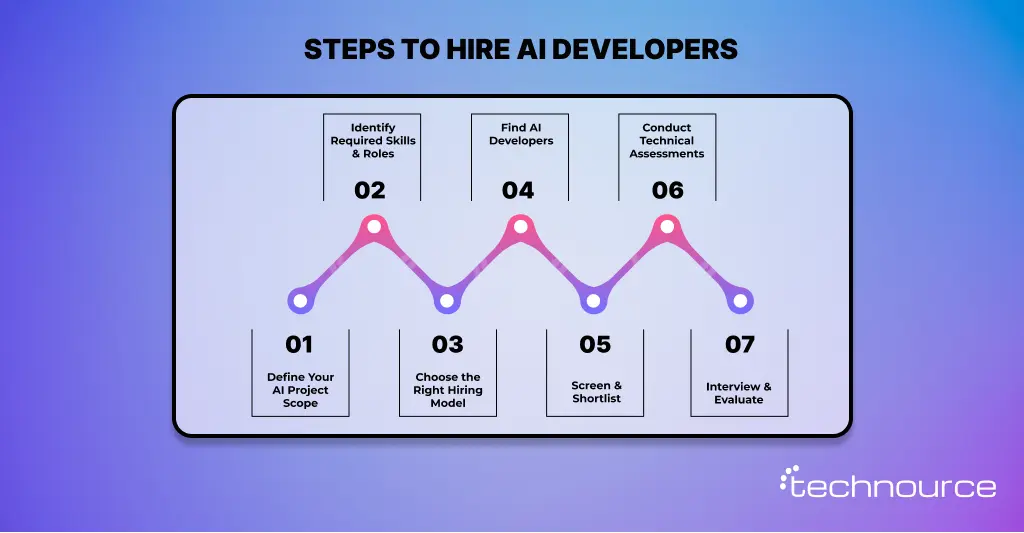
Step 1: Define Your AI Project Scope
Before you even think about hiring, get clear on what you actually need.
Not “we want to use AI.” That’s too vague.
Instead, define the real problem — something like:
“We want to reduce support response time by 50%,” or “we want to automate document processing.”
Then go a level deeper:
- What does success look like in numbers?
- What data do you already have (and where is it)?
- What are your limitations — budget, timeline, compliance?
Write all of this down. Seriously.
This becomes your foundation, and you should share it with every candidate you speak to. It saves time and filters out people who aren’t a fit.
Step 2: Identify Required Skills and Roles
Once the problem is clear, the hiring becomes much easier.
Ask yourself:
- Do we need something custom, or can APIs handle this?
- Is this a text problem (NLP), image problem (vision), or structured data problem?
- Do we need someone senior who can design systems, or someone to execute?
A lot of hiring mistakes happen here. People hire “AI developers” without knowing what that even means for their use case.
The clearer you are here, the better your candidates will be.
Step 3: Choose the Right Hiring Model
There’s no “best” way to hire; it depends on your situation.
A simple way to think about it:
- Short timeline, smaller budget → go with freelancers
- Clear project, mid-range budget → agencies work well
- Long-term, core AI needs → build an in-house team
Don’t overcomplicate this. Just match the model to your reality, not what sounds impressive.
Step 4: Find AI Developers
Where you look matters, but how you look matters more.
For full-time roles:
- LinkedIn (use smart keyword searches)
- GitHub (look at actual code, not just profiles)
- AngelList/Wellfound for startup talent
For freelancers:
- Toptal (more expensive, but reliable)
- Upwork (huge pool, needs filtering)
- Gun.io (good vetted options)
For agencies:
- Clutch
- GoodFirms
- Or just direct research
One important thing:
The best developers are usually not actively applying to jobs. You’ll need to reach out, not just wait.
Step 5: Screen and Shortlist
You don’t need hours per candidate, just a smart process.
Start simple:
- Spend ~5 minutes scanning each portfolio
- Look for relevant projects, not just buzzwords
- Send a few quick questions (availability, rates, experience)
When someone looks promising, then go deeper:
- Check their GitHub
- Look at real work, not just claims
Keep your shortlist tight — around 5 to 7 candidates max.
Anything more just adds noise.
Step 6: Conduct Technical Assessments
This is where most people go wrong; they rely too much on interviews.
Instead, do three things:
1.Ask them to walk you through a real project
Not theory — actual work they’ve done
2. Give a small paid test
Something close to what they’ll actually do
(4–8 hours, pay them fairly)
3. Have a proper technical discussion
Ask how they think, not just what they know
This step alone can save you from a very expensive bad hire.
Step 7: Interview and Evaluate
Now look beyond just technical skills.
Pay attention to:
- How do they explain things (can you actually understand them?)
- Whether they ask questions before jumping to solutions
- How do they think through problems
A strong candidate doesn’t rush to answer; they first try to understand the problem properly.
Also, don’t skip reference checks.
A quick call can tell you more than a polished interview ever will.
Step 8: Onboard and Integrate
Hiring isn’t the finish line; it’s just the start.
A good onboarding process makes a huge difference.
First week:
- Get all access and tools set up
- Introduce them to the team
- Share documentation and expectations
First month:
- Give them a real (but manageable) project
- Stay in close touch — quick daily check-ins help
- Pair them with someone for context and support
First few months:
- Set clear goals
- Bring them into your workflows
- Fix issues early instead of letting them build up
When onboarding is done right, people start contributing in weeks instead of months.
Where to Find AI Developers for Hire
Finding the right AI developers isn’t just about where you look; it’s about how effectively you evaluate and approach talent, while staying aligned with current AI trends shaping the industry.
Top platforms: LinkedIn for full-time hires (Boolean search targeting specific skills), GitHub for quality-checking active contributors, AngelList for startups, Toptal for vetted freelancers, Upwork for volume with careful screening, Clutch/GoodFirms for agencies.
AI software development companies : they provide immediate access to diverse skills, proven processes, faster time-to-market, and team redundancy — valuable when you lack internal expertise to guide development.
AI consulting services : Clarify strategy before you commit to development. A 2–4 week engagement ($10,000–$50,000) can prevent a six-month disaster by identifying technical landmines and unrealistic expectations. Look for consultants with hands-on production deployment experience, not just strategic credentials.
Global vs local hiring: Local offers easier collaboration and simpler logistics; global opens larger talent pools at 40–70% cost savings. Many successful teams combine local core members with global specialists.

How to Evaluate and Interview AI Developers
A strong evaluation process helps you distinguish between theoretical knowledge and real-world execution skills.
Portfolio and Project Evaluation Checklist
✅ Clean, well-organized code with meaningful naming and comments
✅ End-to-end implementations (data → model → deployment)
✅ Production systems with real users and measurable outcomes
✅ Clear documentation explaining approach and trade-offs
❌ Only tutorials and course projects
❌ Poor or absent documentation
❌ No consideration for production requirements
AI Developer Interview Questions
- “Walk me through how you’d approach a new AI project from scratch.” — Listen for problem definition before solution design.
- “Tell me about an AI model that failed in production. What went wrong?” — Best candidates have failure stories. No failures = red flag.
- “Explain RAG architecture. When would you use it, and what are the pitfalls?” — Tests current knowledge of critical 2026 techniques.
- “We’re seeing high latency in our LLM-based feature. How would you diagnose it?” — Great answers ask clarifying questions about scale and SLAs.
- “How would you build a content recommendation system for [your domain]?” — Evaluates domain translation and systematic thinking.
Technical Test Examples
- ML Assessment (4–6 hrs): Provide a realistic dataset; request exploratory analysis, trained model, evaluation metrics, and approach explanation.
- RAG Assessment (6–8 hrs): Provide sample documents; request a Q&A system with retrieval, answer generation, source citation, and “not found” handling.
- LLM Integration (4–5 hrs): Build a content moderation tool with flagging, explanation of why content was flagged, and confidence scores.
Red Flags to Watch Out For
⚠️ Theoretical knowledge only: explains concepts but hasn’t deployed production systems
⚠️ No failed projects: real AI development involves failure and learning
⚠️ Credential obsession: emphasizes degrees over demonstrable results
⚠️ Outdated skills: unfamiliar with LangChain, modern vector databases, or current models
⚠️ No questions asked: developers who don’t ask about data, constraints, or success metrics don’t understand that context matters
⚠️ Unrealistic promises: guarantees results without understanding the problem
Common Mistakes to Avoid When Hiring AI Developers
Rushing hiring decisions, ignoring real-world experience, and overlooking model transparency are the most common mistakes that lead to poor AI outcomes.
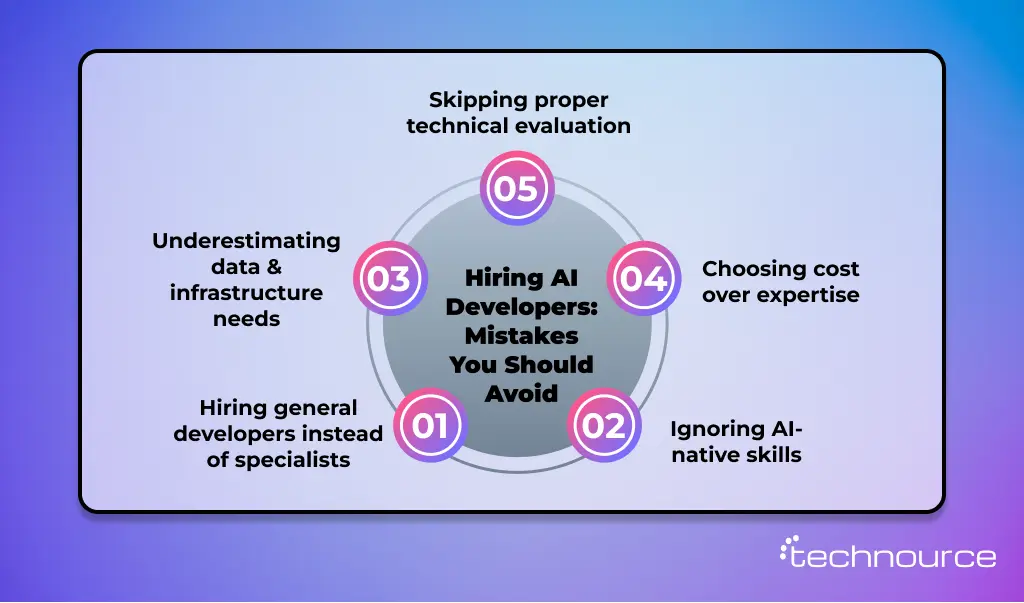
1. Hiring general developers instead of specialists: General software engineers lack AI-specific skills and don’t know what they don’t know. They produce systems that technically function but underperform in production. Only works if you have senior AI expertise in-house to mentor them.
2. Ignoring AI-native skills: Screening for traditional algorithms while missing prompt engineering, RAG implementation, and modern LLM workflow knowledge. Developers with 10 years in the industry but no recent AI exposure may lack these entirely.
3. Underestimating data and infrastructure needs: Brilliant developers can’t overcome poor data quality or missing infrastructure. Catalog your data availability, access, quality, and governance before hiring.
4. Choosing cost over expertise: The math doesn’t work. Senior developers are 3–5x faster, produce higher quality, and when accounting for total cost of ownership, are often 40–60% cheaper than cheaper alternatives.
5. Skipping proper technical evaluation: Many candidates interview well, but can’t execute. Always include portfolio review, paid practical test, technical depth interview, and reference checks.
Managing Remote AI Developers and Distributed Teams
The success of distributed AI teams depends heavily on how well you manage communication and collaboration.
Communication and Collaboration Best Practices
Overcommunicate context — remote developers lack ambient office information. Document project goals, architecture, data sources, coding standards, and contacts. Use daily standups (15 min) and weekly deeper reviews. Default to asynchronous, written communication so decisions leave a record.
Tools for Managing AI Development Projects
- Project management: Linear or Jira, Notion for documentation, Slack for daily communication
- Code collaboration: GitHub/GitLab with mandatory pull request reviews
- AI-specific: Weights & Biases or MLflow for experiment tracking, DVC for data versioning
- Meetings: Zoom/Google Meet for calls, Loom for async demos
Time Zone and Productivity Management
Establish 3–4 hours of core overlap, clear hand-off documentation, and developer independence for unblocked progress. Measure outputs (features shipped, quality maintained) — not hours logged. Avoid surveillance-style monitoring; it demotivates strong performers.
Performance Metrics for AI Teams
- Development: Sprint velocity, code review turnaround, deployment frequency
- AI-specific: Model accuracy, training cost, inference latency, data drift response time
- Business: User satisfaction, cost savings, revenue impact, time saved
- Team health: Developer satisfaction, documentation quality, retention
Case Study: How Businesses Successfully Hire AI Developers
Mid-size SaaS company ($15M ARR) adding AI features to compete with larger rivals. Zero in-house AI expertise, hundreds of applicants, but no clear path forward.
Phase 1: Strategy (4 weeks, $25,000): AI consulting engagement identified three high-value use cases and determined API-based solutions would suffice (no custom model training needed).
Phase 2: Pilot with Freelancer (8 weeks, $40,000): Senior freelance developer from Toptal built and validated automatic task categorization. Architecture and lessons documented.
Phase 3: Scale with Agency (6 months, $180,000): The custom AI development company delivered all three AI features with production deployment and internal team training.
Phase 4: Build In-House (ongoing): Hired one full-time senior AI engineer ($160,000/year). Agency remains available for specialized projects.
Results:
- AI features launched in 10 months vs. the estimated 18–24 months with an in-house build
- 30% improvement in task completion rates for AI feature users
- 15% increase in enterprise sales from competitive differentiation
- First-year total cost: ~$325,000 | Projected second-year cost: ~$200,000
Key lessons: Start with strategy; validate with a freelancer; scale with an agency; build internal capacity gradually. This phased approach reduces risk and allows learning at each stage.
Future Trends in AI Developers Hiring (2026 and Beyond)
To stay competitive, businesses need to understand not just current hiring practices, but where AI talent is headed.
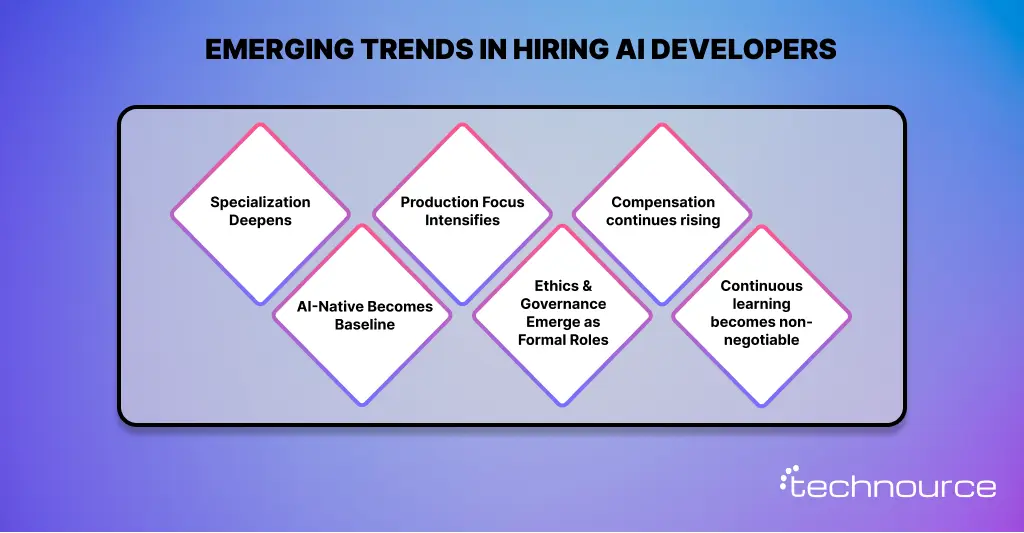
1. Specialization Deepens: The “general AI developer” role is fragmenting into agentic AI specialists, RAG architects, AI safety engineers, prompt engineering experts, and multimodal AI developers.
2. AI-Native Becomes Baseline: Within 2–3 years, AI-native development won’t be a differentiator. It’ll be minimum competence.
3. Production Focus Intensifies: Surging demand for MLOps and AI infrastructure expertise as companies realize models only create value when reliably deployed at scale.
4. Ethics and Governance Emerge as Formal Roles: EU AI Act and potential US frameworks drive demand for developers who understand compliance and bias mitigation.
5. Compensation continues rising: 10–15% annual salary increases expected through 2028. Remote normalization means companies hire the best available talent regardless of location.
6. Continuous learning becomes non-negotiable: The half-life of AI skills is shrinking. Companies must provide time and resources for upskilling or watch their teams become obsolete. Additionally, integrating AI in recruitment will become standard practice, enabling organizations to continuously evaluate talent, predict skill gaps, and build stronger AI teams proactively.
Hire AI Developers with Technource
At Technource, we’ve built AI solutions across industries, from healthcare to fintech, from retail to manufacturing, and understand what separates successful AI projects from expensive failures. Our team includes generative AI developers with production LLM and RAG experience, ML engineers for custom model development, MLOps specialists for reliable production systems, and AI consultants for strategic guidance.
Our team includes generative AI developers with production LLM and RAG experience, ML engineers for custom model development, MLOps specialists for reliable production systems, and AI consultants for strategic guidance.
Why partner with Technource:
- 1000+ delivered projects, including complex enterprise AI implementations
- Full-stack AI capabilities from strategy through deployment and maintenance
- Flexible Engagement Models: dedicated teams, short-term specialists, or ongoing consulting
- Technology Independence: We recommend what’s best for your situation, not what we’re tied to.
Conclusion:
Hiring AI developers in 2026 isn’t just about filling technical roles; it’s about acquiring the capability to compete in an AI-first world.often by partnering with a reliable software product development company that understands both technology and business outcomes.
The key insights:
- Specificity matters: Hire the right specialist for your actual use case
- Process beats intuition: Systematic evaluation dramatically outperforms gut-feel hiring
- Hybrid models work: Strategic combinations of internal teams, agencies, and freelancers often outperform any single approach
- Costs are higher than expected: Budget for total AI project cost, not just developer rates
- Current skills trump credentials: AI-native developers with RAG and agentic AI experience outperform traditional ML engineers who haven’t kept pace
- Start smart: Consulting before development prevents costly wrong turns
When you hire artificial intelligence developers strategically, you’re not just adding technical capability; you’re building a competitive advantage that compounds over time.
Your future competitors are already moving. Start now, hire intentionally, and execute systematically.

FAQs
Expect $50–$80/hour for junior, $80–$130 for mid-level, $130–$180 for senior, and $180–$250+ for expert-level AI engineers. US full-time salaries range from $100,000–$400,000+ annually. Offshore and remote options reduce costs by 40–70%. Developer rates represent only 50–60% of total project expenses. AI developers build products using AI (via APIs or pre-built models); ML engineers create, train, and optimize the models themselves. Hire AI developers for user-facing features; hire ML engineers for custom models trained on your proprietary data. In-house hiring: 6–12 weeks. Freelancers: days to 2 weeks. Agencies: 1–2 weeks. Add 2–3 weeks for a thorough technical evaluation, which shouldn’t be rushed. Strong Python, ML frameworks (TensorFlow, PyTorch, Hugging Face), generative AI and LLM expertise, RAG and vector database knowledge, cloud platform experience, and production deployment skills. In 2026, prioritize AI-native developers over traditional credential holders. Hire freelancers for short-term projects or when you have internal AI expertise to guide development. Choose agencies for complete team needs, complex projects, or when you lack internal AI leadership. Many businesses use both. Yes, with the right processes. Ensure time zone overlap, strong written communication skills, clear documentation, and solid project management. Remote developers from India, Eastern Europe, and Latin America offer 40–70% cost savings with strong quality.


