Staff Augmentation Pricing Models: Complete Guide to Cost & Rates
Amar Purohit
Published: Mar 05, 2026
Table of Content Table of Content
Quick Summary: Thinking about staff augmentation, but not sure where to start? This blog is for you. Staff augmentation helps companies scale development teams without the challenges of traditional hiring, but pricing models can be confusing. This guide breaks down staff augmentation costs, explains hourly, monthly, and fixed pricing structures, and helps you choose the right option using real data and practical examples.
Let’s be real: hiring is expensive, time-consuming, and honestly, pretty stressful. Between recruiting, interviewing, onboarding, and waiting for someone to ramp up, it can take months and tens of thousands of dollars just to fill a single position.
That’s where staff augmentation comes in. Instead of hiring full-time employees, you’re bringing in skilled developers on a contract basis, usually through a staffing partner. And the numbers speak for themselves.
According to Gartner, the global IT staffing and IT services market is projected to reach $857 billion by 2031, up from $299 billion in 2023. That’s a 187% increase in just eight years. Why? Because more companies are realizing that staff augmentation isn’t just cheaper, it’s smarter.
But here’s the thing: not all staff augmentation pricing models are created equal. The cost can vary wildly depending on whether you’re paying staff augmentation costs per developer by the hour, month, or project. Geography matters too. An offshore developer might cost you $20/hour while an onshore specialist runs $150/hour. That same role.
The real question isn’t “how much does staff augmentation cost?”, it’s “which pricing model makes the most sense for my specific situation?” And more importantly, how do you avoid paying too much for mediocre talent or too little and getting people who can’t deliver?
Let’s dive in and know all the ins and outs of staff augmentation pricing models.
What is Staff Augmentation & Why Pricing Matters?
The process of staff augmentation enables organizations to hire skilled developers from outside their company who will collaborate with their existing development team, often through a trusted staff augmentation development company.
The workers who join your team for three-month or longer projects become non-employee contractors. The key difference between staff augmentation and outsourcing? You remain in control of operations. Outsourcing requires you to delegate complete project responsibility to the vendor, who manages all aspects of the work.
Through augmentation, your team receives additional development resources who will function as members of your existing workforce. The workers attend your standup meetings, and they execute your established workflows while reporting to your organizational leaders. The process establishes communication efficiency together with rapid team integration, which results in enhanced product quality.
Why Pricing Transparency is Critical
The lack of staff augmentation pricing models leads to unexpected financial results for your organization. Your initial expectation of $30 per hour developer rates turned into unexpected costs from infrastructure expenses, management costs, and secret onboarding charges.
The cheapest option revealed itself to be a mistake because you discovered that the developers lacked the necessary skills. McKinsey research shows that 56% of companies struggle to forecast IT staffing costs accurately. The organizations fail to understand their actual spending because they lack knowledge about their complete financial obligations.
Let’s put some numbers on this. If you hire a senior developer as a full-time employee in the US, you’re looking at:
Base salary: $150,000-$200,000/year
Benefits (health, etc.): +$40,000-$60,000
Other Equipments: +$5,000-$10,000
Recruiting and onboarding: +$15,000-$25,000
Total first-year cost: $220,000-$285,000
That same senior developer through staff augmentation? Somewhere between $80,000-$120,000/year. Even with the vendor’s markup and management overhead, you’re looking at 50-70% savings. And you don’t have to worry about benefits, payroll taxes, or what happens when the project ends.
That’s why understanding staff augmentation rates and picking the right model matters so much. The difference between the right decision and the wrong one can be hundreds of thousands of dollars.
Want to know if you’re getting a fair deal? Here’s what the market actually looks like right now.
According to PayScale’s 2025 IT Staffing Report, staff augmentation rates have increased 3-5% year-over-year, driven by increasing demand for specialized skills and a lower supply of experienced developers.
Rates have been climbing because demand exceeds supply. Between 2020-2025, average offshore rates increased 25-30%. Nearshore rates up 35-40%. Onshore up 40-45%.
Why? Partly inflation, but mostly because there’s simply more demand for developers than supply. Companies are fighting for talent. Rates go up.
What’s likely ahead: Expect another 2-5% annual increase in all markets through 2026 as AI demand intensifies and global talent competition continues.
Main Staff Augmentation Pricing Models Explained
Staff augmentation pricing requires multiple approaches because no single solution exists for all situations. We will explain all available options to show you the best time to implement each one.
Model 1: Hourly Rate Model
What it is: You will need to pay for every hour worked. This option provides you with the highest flexibility.
Typical rates depend on the developer’s experience:
Junior Developers: $15-$30/hour
These individuals possess less than 2 years of work experience. They can perform basic tasks such as bug fixes, UI updates, and maintenance work while they continue their education. The job is ideal because it contains fixed tasks that need no more than basic decision-making. The majority of these workers operate from offshore facilities in countries such as India, the Philippines, and Vietnam.
Mid-Level Developers: $30-$60/hour
Developers with 2-5 years of experience can handle full-feature development while guiding junior team members through complex tasks. The employees reach their work capacity while maintaining enough competence for you to stop supervising them.
The employees represent the ideal choice because they provide essential skills at an affordable price. The employees operate from nearshore sites located in Latin America and Eastern Europe, while selected offshore sites offer additional options.
Senior Developers: $60-$100+/hour
These developers hold 5+ years of experience. The professionals establish system designs while managing teams and creating solutions for complex challenges. You are paying for their experience and their decision-making skills, which help your team work better. The services are available at nearshore and onshore locations.
When to use hourly:
Your project scope isn’t totally locked down yet.
You need flexibility to scale up or down week-to-week
You’re not sure how long you’ll need help.
You have variable workloads (some weeks you need more people, some weeks fewer)
Pros:
Maximum flexibility
You only pay for hours actually worked
Easy to start and stop
No long-term commitments
Cons:
Your monthly bill is unpredictable
It can incentivize inefficiency (more hours = more revenue for the vendor)
Time tracking becomes a whole thing
Hard to plan budgets quarter-to-quarter
Tip: If you go hourly, set weekly hour caps. Don’t let your vendor bill you 60 hours one week and 40 the next without explanation. Define your scope clearly so there’s no scope creep hiding in those extra hours.
Model 2: Monthly Retainer Model
What it is: You pay a fixed amount every month for a dedicated team or resource allocation.
Typical retainer ranges:
2-3 person team: $3,000-$8,000/month
4-6 person team: $8,000-$15,000/month
7+ person team: Custom pricing (usually $15,000-$30,000+/month)
Here’s what a typical $10,000/month retainer actually breaks down to:
Component
Amount
What’s Included
Developer Salaries (2 devs)
$6,000
Base compensation for developers
Management & Coordination
$1,500
Project managers, daily standups, and reporting
Infrastructure & Tools
$600
Cloud, licenses, security, servers
QA & Testing
$1,000
Quality assurance, bug testing
Admin & Legal
$500
Payroll, contracts, compliance
Training & Ramp-up
$400
Product training, onboarding, documentation
Total
$10,000
Full-service team
When to use a monthly retainer:
You have consistent, ongoing work
You can commit for at least 3-6 months
You want predictable monthly costs
You want a dedicated team that learns your product
Pros:
Predictable monthly bills (budgeting is easy)
Lower hourly rate than the hourly model (because the vendor knows they have steady work)
Dedicated focus—this team works on your project
Better team continuity and product knowledge
Includes management and support built in
Cons:
If work dries up, you’re still paying for those unused hours
Minimum commitment period (usually 3-6 months)
Less flexibility if you suddenly don’t need help
Some vendors will pull your team onto other projects during slow weeks
Tip: A retainer works great if your workload is reasonably consistent. Just make sure your contract specifies: What happens if your project slows down? Can you reduce team size? What’s the notice period if you want to end the contract?
Model 3: Project-Based Pricing Model
What it is: You define a project scope, deliverables, and timeline. The vendor quotes a fixed price. You pay that amount regardless of how many hours it takes (within reason).
Generally, project costs are:
Small projects: $5,000-$15,000 (simple features, 2-4 weeks)
Medium projects: $15,000-$50,000 (complex features, 1-3 months)
Large projects: $50,000-$250,000+ (full applications, 3-12 months)
How vendors calculate project pricing:
They start their process by calculating the required hours, which they multiply by their hourly rate before adding risk and management costs. The total cost for the project, which needs 400 hours at a rate of $50 per hour, amounts to $20000. The total reaches $26000 after you apply a 30% buffer and management costs.
When to use project-based pricing:
Your scope is well-defined and locked down
You know exactly what you want delivered
You have a clear timeline
You’re not expecting major changes mid-project
Pros:
Single, negotiated price (no surprises)
Your budget is locked in
The vendor is motivated to deliver on time (because delays cost them money)
No time tracking arguments
Easy to fit into a budget and present to stakeholders
Cons:
Inflexible if scope changes
Usually costs more because the vendor is taking on risk
Scope creep becomes contentious
You need to be really detailed upfront about what you want
Change orders can be expensive
Tip: Project-based pricing works only if you’re 100% sure about the scope. If there’s any uncertainty, add 15% to your estimate and include a detailed scope document with your contract. Define exactly what constitutes a “change request” and what the cost would be.
Model 4: Dedicated Developer Model
What it is: You hire dedicated developers as full-time staff members who work exclusively on your projects. The worker functions as an employee but lacks a formal employment status.
2 Mid-Level Developers: $4,000/month each = $8,000 total
1 QA Specialist: $2,500/month
Total: $18,500/month for a dedicated team: Hire a dedicated team now!
When to use dedicated developers:
You need a full-time commitment to one project.
You’re planning a multi-year relationship.
You need someone to own a piece of your codebase.
You want accountability and true team membership.
Pros:
Full commitment to your project (not split between clients)
Stronger accountability
They learn your product deeply over time
You can have real one-on-ones and performance reviews
Better for strategic, long-term work
Cons:
Most expensive option per month
Less flexibility if needs change
Requires longer commitment
Can hit contractor vs. employee classification issues (varies by jurisdiction)
Timezone coordination if they’re offshore
Real talk: Dedicated developers work best when you have 12+ months of work ahead and want someone who really understands your product. It’s an investment, but it pays off.
Model 5: Hybrid/Flexible Pricing Model
What it is: A combination approach. You pay a base retainer for a core team, then pay hourly for additional work as needed.
Example structure:
Base retainer: $5,000/month = 100 guaranteed hours at $50/hour
Additional hours: $45/hour (slightly discounted)
Yearly commitment: 10% discount on everything
This is perfect when you don’t know if you’ll need 80 hours or 120 hours in a given month. You lock in your base team, then scale up when you need it.
When to use a hybrid:
Variable workloads
Growing projects where needs aren’t yet predictable
Mix of ongoing maintenance + project work
This is actually how most smart companies do it. You get stability from the retainer and flexibility from the hourly overflow.
Cost Breakdown: What You’re Actually Paying For
Most people face difficulties because they do not realize that the developer’s hourly rate functions as more than a direct payment. The price includes multiple components, which customers must understand to determine quote fairness.
The actual case study shows us the situation. You plan to spend $7,200 each month for the services of two mid-level developers. Here’s where that money actually goes:
What You’re Paying For
Amount
Percentage
Developer Base Cost
$4,500
62.5%
Management & Coordination
$1,080
15%
Infrastructure & Tools
$720
10%
Quality Assurance
$540
7.5%
Admin & Compliance
$360
5%
Developer Base Cost (60-65%)
The Developer Base Cost occupies 60 to 65 percent of the total expense. The actual cost to hire developers depends on two factors, which are their work location and their professional experience. An offshore mid-level developer will cost your vendor $3000 per month, according to their employment costs.
The onshore developer costs $8000 per month to hire. The vendor needs to add a markup, which typically falls between 30 percent and 50 percent, so they can cover their operational expenses and generate profit.
Management & Coordination (15-20%)
Your team needs someone who will take charge of their activities. The project manager will conduct daily meetings while creating progress reports and overseeing the interaction between your team and additional personnel, and they will help with communication issues that arise when team members work from different time zones. The worker provides services to various clients, which requires them to charge a percentage instead of a fixed payment.
Infrastructure & Tools (8-12%)
Your developers require a dedicated workspace. The setup process requires various components, which include cloud environments (AWS, Azure, and GCP), development tool licenses, Jira project management software, GitHub repositories, VPN connections, security monitoring systems, and hardware resources.
The vendor’s local office will provide this equipment to offshore teams. Your developers must supply their own devices for onshore work, yet your company still incurs expenses for software licenses.
Quality Assurance & Testing (8-12%)
The vendors who provide good quality testing services to their customers include this service as part of their total pricing package. The team for the project includes more than one individual. The project requires multiple elements, which include automated testing setup, code reviews, performance testing, and bug verification. This is actually where a lot of “cheap” vendors cut corners, which leads to quality problems that occur later on.
Administrative & Legal (3-5%)
The administrative and legal processes require a budget of 3 to 5 percent of our total expenses. The organization requires contracts, background checks, tax compliance, employment verification, payroll processing, and insurance. The organization needs this uninteresting material because it serves essential functions. Vendors who skip this are cutting corners in ways that could expose you to liability.
Training & Ramp-Up (2-4%)
Your new team members need to learn your product, understand your codebase, and get comfortable with your processes. The first three weeks of work require employees to complete three main components, which include documentation and onboarding calls, and productivity time reduction. Real Mini Case Study: SaaS Startup Cost Breakdown
Let’s look at an actual startup we worked with. They needed two mid-level developers for a 6-month project building a new feature set.
Why the difference: The hourly model assumes you’re paying for every hour. The retainer model bundles everything, and the vendor operates more efficiently. Plus, the developers worked 140 hours/month on average (not 160), because there are always meetings, documentation, and other overhead.
The money saved: $20,400 in 6 months by choosing the right model.
Pricing Comparison: Hourly vs. Retainer vs. Project
Let’s compare all three models side-by-side so you can see which makes sense for your situation.
Factor
Hourly
Monthly Retainer
Project-Based
Best For
Variable workloads, short-term needs
Ongoing work, consistent needs
Well-defined projects, clear scope
Monthly Cost Range
$2,000-$8,000 (variable)
$5,000-$20,000 (fixed)
$5,000-$250,000+ (one-time)
Cost Per Hour
$25-$80
$12-$40
Varies by project
Budget Predictability
Low
High
Very High
Flexibility
Very High
Medium
Low
Time Commitment
None
3-6 months typical
Project-specific
Ideal Project Length
< 3 months
3-24+ months
1-12 months
Best for Uncertain Scope
Yes
Somewhat
No
Best for Fixed Budget
No
Yes
Yes
Team Continuity
Low
High
Medium
The Decision Tree
Ask yourself these questions:
1. How certain is your project scope?
100% certain → Project-based (lock in the price)
Pretty sure, but some unknowns → Retainer (get budget certainty with flexibility)
Very uncertain → Hourly (pay for what you need, when you need it)
2. How long is this engagement?
Less than 2 months → Hourly
2-6 months → Retainer or Project
6+ months → Retainer or Dedicated
3. How much will the workload vary?
Wild swings (50+ hour weeks and 20-hour weeks) → Hourly
Relatively consistent → Retainer
Totally predictable → Project-based
4. What matters more: budget certainty or flexibility?
Need to know exact cost for board presentation → Project or Retainer
Take a moment and answer these five questions about your situation. Your answers will point you toward the right model.
Calculating Your Actual Staff Augmentation Cost
Okay, so you think you know what you need. A couple of developers, maybe for 6 months, a monthly budget of around $10K. But how do you actually get from “I need developers” to “this is what I’ll pay”?
Here’s the framework:
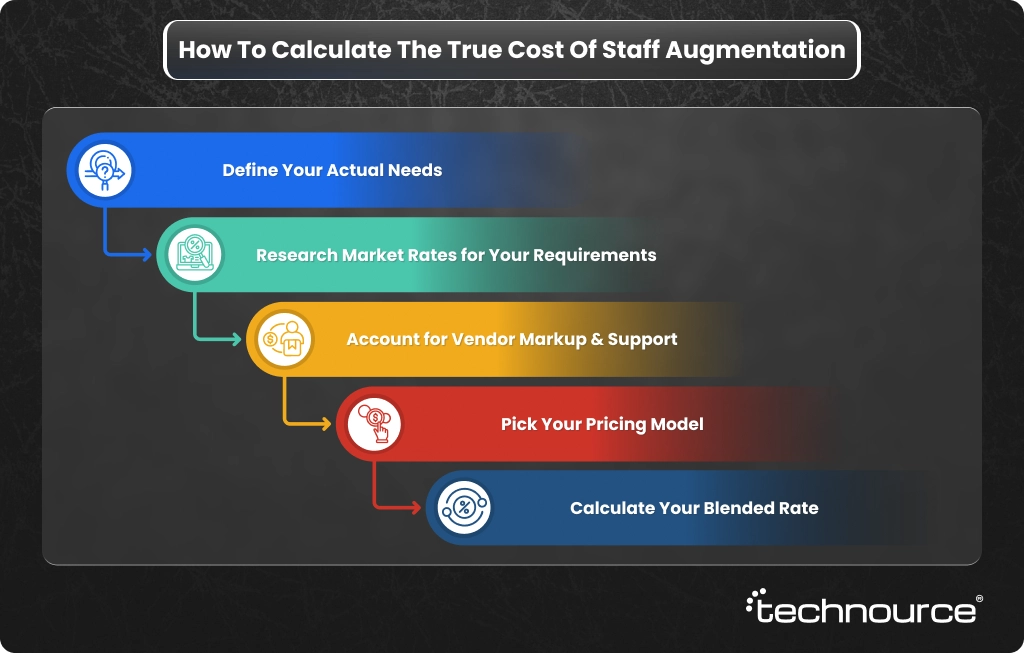
Step 1: Define Your Actual Needs
Don’t just say “developers.” Be specific:
What skills do you need? (Full-stack, backend, frontend, DevOps, QA, etc.)
What seniority level? (Junior, mid, senior, lead)
How many people?
For how long?
What geography works for you? (Onshore, nearshore, offshore, hybrid)
Example: “2 mid-level full-stack developers, primarily backend focus, for 6 months, nearshore or onshore acceptable”
Step 2: Research Market Rates for Your Requirements
Based on the skills, seniority, and geography, what’s the market rate?
Let’s say you need mid-level developers. Based on 2025 market data:
Nearshore: $40-$50/hour
Onshore: $80-$100/hour
Offshore: $25-$35/hour
Pick the locations you’re comfortable with and note the rate range.
Step 3: Account for Vendor Markup & Support
Your vendor isn’t working for free. They take a markup (usually 30-50%) on labor costs, plus they’re covering management, infrastructure, QA, and admin.
If the developer’s cost is $3,000/month, the vendor might charge you:
Cost: $3,000
Markup (40%): $1,200
Management/Infrastructure/QA: $1,000
Total: $5,200/month
Step 4: Pick Your Pricing Model
Given your situation, which model makes the most sense?
Uncertain scope → Hourly
Consistent work → Retainer
Well-defined project → Project-based
Step 5: Calculate Your Blended Rate
If you’re hiring a mixed team, what’s the average cost per hour?
Look, there are a lot of staff augmentation companies out there. So why should you choose Technource?
It’s not just about having the cheapest hourly rate (spoiler: cheapest is usually a warning sign). It’s about getting the best value. And value means quality developers, transparent pricing, smooth integration, and actually delivering on time.
Transparent Pricing You Can Actually Understand
We don’t do hidden fees. When we quote you, here’s what you get:
A clear breakdown of developer costs
Management and coordination costs are listed separately
Infrastructure and tool costs
QA costs
Any other costs that apply
No surprises at the end of the month. You know exactly what you’re paying for.
Our pricing models:
Hourly: $25-$80/hour depending on seniority and location (onshore specialists to skilled offshore developers)
Monthly Retainer: Highly scalable, 3-6 month minimum, includes dedicated support and coordination
Project-Based: Fixed pricing for defined deliverables, 15% contingency buffer included
Dedicated Developers: Full-time team members, exclusive commitment, replacement guarantee included
Hybrid/Flex Model: Base retainer plus overflow hourly capacity for variable workloads
All of these are available in multiple geographic mixes: onshore, nearshore, offshore, or hybrid.
Quality That Justifies the Cost
Cheap developers cost a fortune in rework. That’s why companies partner with us to hire experienced developers who can deliver production-ready code without constant supervision. We vet every single person before they join your team.
Here’s our quality promise:
Every developer passes a technical skills assessment (not just a resume)
We verify 2+ years of actual industry experience
We assess cultural fit for your team
We do background checks and reference verification
We monitor performance against agreed metrics
If a developer doesn’t work out, we replace them, guaranteed!
Our track record: 98% client satisfaction, 92% team retention rate, and an average code quality score that beats industry standards by 15%.
Real Case Study: How Technource Saved a Mid-Market Company $200K
The company: B2B SaaS platform with 35 developers
The problem: Their product roadmap required launching 6 major features in 12 months, but they only had a budget for 4. Hiring new full-time developers would cost $400K+ (salaries, benefits, recruiting, onboarding). They’d also have to find and hire within 6 weeks or miss their roadmap.
Team stayed together for 18 months (extended their engagement)
2 developers were hired full-time
Estimated product revenue from these features: $4.2M in the first year
Why this worked: The company didn’t just save money; they saved time. They had developers delivering 8 weeks faster than they could have hired, which meant revenue impact 8 weeks earlier. That’s worth a lot more than the $181K saved.
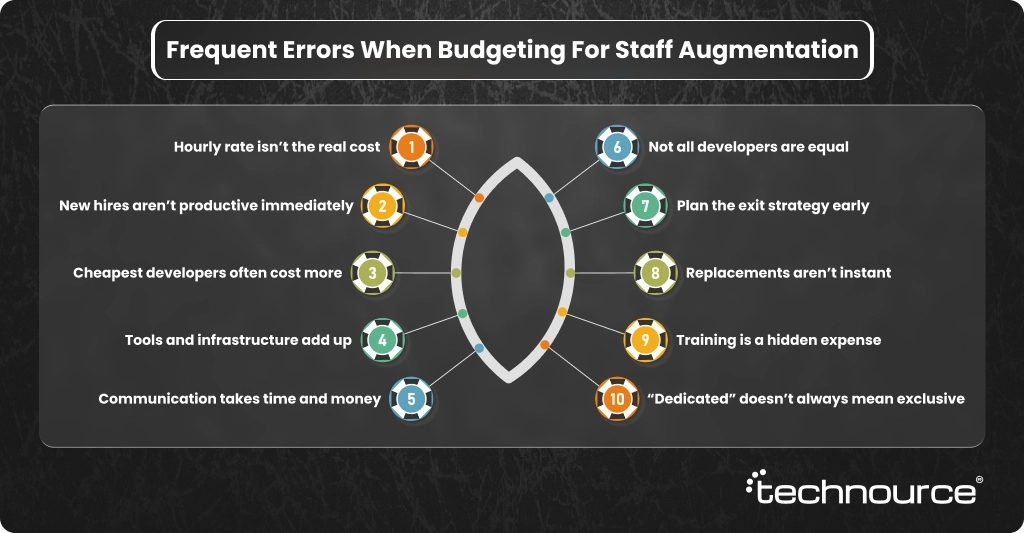
Common Mistakes in Budgeting for Staff Augmentation
People make the same mistakes over and over with staff augmentation budgeting. Don’t be one of them.
Hourly rate isn’t the real cost: add 15–20% for management, QA, infra, and admin overhead.
New hires aren’t productive immediately: expect only 40–60% output in the first 2–4 weeks.
Cheapest developers often cost more: poor quality leads to rework, delays, and higher total spend.
Tools and infrastructure add up: budget $600–$1,500 per developer per month for tech stack needs.
Communication takes time and money: offshore coordination adds 10–15% extra effort.
Not all developers are equal: vendor vetting and training quality matter more than job titles.
Plan the exit strategy early: without documentation and handover, project closure causes major delays.
Replacements aren’t instant: allow 2–3 weeks ramp-up if a developer drops out.
Training is a hidden expense: onboarding into your product and culture costs 2–4 weeks.
“Dedicated” doesn’t always mean exclusive: confirm whether developers work only on your project or others, too.
Conclusion
Staff augmentation pricing isn’t complicated once you understand the pieces. You’re paying for:
The developer’s skill and experience
The vendor’s overhead (management, infrastructure, QA)
The right model depends on your situation. Hourly works when you’re uncertain. A retainer works when you have consistent needs. Project-based work when the scope is locked. Dedicated to long-term commitment.
The biggest mistake? Optimizing for the lowest hourly rate instead of the best overall value. A $25/hour developer who delivers buggy code is more expensive than a $50/hour developer who ships clean code.
That’s where Technource comes in. We’re not the cheapest. We’re the best value. Transparent pricing, vetted developers, proven process, and real results.
FAQs
With traditional recruiting, 4-6 months. With Technource, 3-5 business days. We maintain a pre-vetted pool, so we match from available talent rather than starting from scratch.
Most quality vendors, including Technource, include a replacement guarantee. We’ll swap them out (usually within 5-10 business days) at no additional cost if they’re not meeting expectations in the first 30 days.
Yes, typically 40-70% cheaper in year one. A full-time senior developer costs $150K-$200K in salary plus $40K-$60K in benefits, equipment, and recruiting. Staff augmentation for the same skill level runs $80K-$120K/year. Plus, you don’t have benefits, payroll taxes, or severance obligations.
Real. If you hire full-time offshore, expect some overlap loss. Hybrid teams (some nearshore, some offshore) solve this—you get offshore costs with nearshore timezone coverage. Or you accept that some communication will be asynchronous.
Amar is the Senior Business Development Manager at Technource, where he drives business growth through innovation-focused custom software development, AI solutions, and emerging technologies. With 9+ years of experience, he bridges market needs with tailored digital strategies to deliver real business impact. A believer in building strong client partnerships, Amar brings insight and energy into every collaboration.
Request Free Consultation
Amplify your business and take advantage of our expertise & experience to shape the future of your business.