Low-Code vs. No-Code Application Development: Build Smarter, Faster
Shailesh Gujjar
Published: Jul 26, 2024|Updated: Mar 13, 2026
Quick Summary: Low-code no no-code platforms are used to develop applications with less to no coding through drag and drop interfaces. Even non-technical people develop applications with no code/low code for their business. The benefits of developing these applications help developers cater to clients within a stipulated time without compromising quality. In this blog, we will discuss the nitty-gritty of low-code/no-code development so that you can also develop an application with the same for your brand.
On a Friday afternoon, my development team was engrossed in black coffee with tangy cheese balls to give their taste buds a perfect treat between the arduous work session! I still remember that we were discussing buying a gift for one of our web development hustlers.
We were checking the price of an overpriced coffee machine that the person absolutely doesn’t need, because he is addicted to code more than coffee!
In the meantime, a chatbot pops up with its sweet demeanor, “Do you want to make your next cup memorable with ideal foam and frothed milk”?
Believe me, the pop-up audio is entrancing!
However, when I have a query about whether it has a return policy or ships during the holiday time, that bot becomes my obsession as it consistently satiates my inquisitive mind!
That’s the power of low-code no-code platforms. When done right, it can transform long development hours into faster ones with lower costs and produce a game-changing final product (in my case, the chatbot), ultimately increasing user satisfaction.
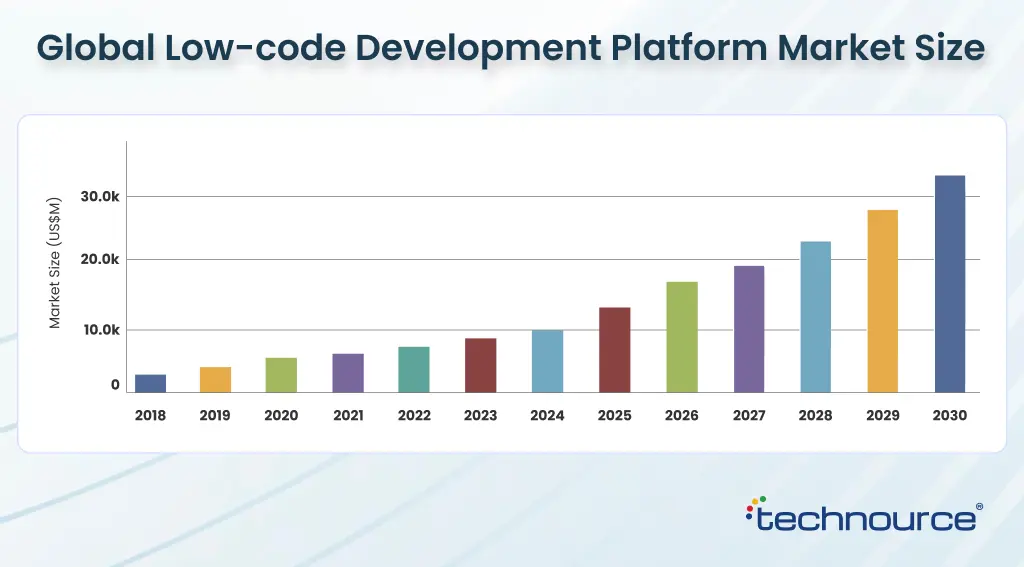
According to Statista, the global no-code and low-code market expected to reach USD 35,222.3 million by 2030.
We’ve been working with low-code no-code application development for a while as die-hard programmers! I’ve witnessed the rise of these platforms and how they’re enabling developers with a non-technical background to create functional and visually appealing applications.
For this blog, I am going to jot down the meteoric rise of low-code and no-code platforms and how they can be a boon for your brand, too. Whether you want to flesh out a brand-new SaaS product or tweak a personal software, low low-code/no-code platform can be a recipe for success!
What is Low-Code Development?
According to Microsoft, low-code is a rapid application development method that enables automatic code generation through visual building blocks like Pull-down menu interfaces and drag-and-drop. This automation enables the developers to focus on the differentiator instead of the common programming denominator.
What is a Low-Code Application Development Platform?
According to Zoho, low-code app development is the way to plan, iterate, and develop applications with less knowledge. Low-code development platforms enable businesses to create custom solutions with cutting-edge functionalities tailored to specific business models.
My team is working on low-code application platforms that offer intuitive visual builders, responsive chatbots, and built-in integrators, enhancing development speed and resulting in high-quality output. It helped us to deliver robust applications to our clients as these platforms eliminate typical coding processes.
What is No-Code Development?
This is also a rapid application development approach, as it is often considered the sunset of modular plug-and-play. No-code development allows developers to transform an existing concept into an application with minimal time and resources.
What is a No-Code Application Development Platform?
According to Wikipedia, a no-code development platform supports the development of software via a GUI or graphical user interface. No code development platforms work by providing pre-built templates and components that you can adjust to fit the app requirements. As everything is represented visually, you can focus on the design part while functioning code operates simultaneously.
Why Businesses Are Opting for Low-Code/No-Code Platforms
“Expectations were like fine pottery. The harder you hold them, the more likely they are to crack.”- In my years of coding experience, I have seen customers who were likely to drown themselves in the pool of expectations without thinking about the final output. As a senior team member, I cannot promise vague things to my clients that I cannot deliver.
On that note, I introduced the “Iow code no code” mobile app development to the clients because I believe that customer service is crucial for gaining their trust.
According to Microsoft, 98% of US consumers recognize customer service success before choosing a brand. Low-code no-code app development is the recipe for success for any business application. Here is why-
1. Quicker Development Cycle
Low-code and no-code platforms enhance the app development process tenfold by using pre-built components and visual interfaces. This enables businesses to develop and launch business applications quickly. Additionally, these apps can be modified at a later stage based on the requirements.
2. Cost Savings
According to Statista, the growth of low-code mobile app development has witnessed a significant hike from 2022 to 2024. One of the Main reasons is the reduced cost with low-code app development platforms. With reusable components and intuitive components, mobile app development is easy! This reduces the dependency on external developers and accelerates app development by leveraging the skill set of internal teams.
In a nutshell, low-code and no-code platforms reduce the enormous costs associated with long timelines.
3. Quick Market Change Adaptation
After the inception of AI in the software development process, businesses are operating in an agile development environment where adaptability is crucial. In fact, I have witnessed how the market is changing overnight. On that note, no code app development platforms make it super easy to modify existing applications or develop new ones to meet these changing development requirements.
Low-code and no-code tools can enhance the ability to develop new business applications, while revamping the existing ones. This provides multifaceted benefits like increasing operational efficiency and strengthening customer loyalty.
4. Streamlined Maintenance
With automated processes and pre-built components, you can now manage application updates without having extensive technical knowledge. For instance, system adjustment functionalities can be performed through drag-and-drop tools instead of rewriting the code lines. This reduces the downtime while enhancing efficiency.
5. Scalability
You cannot move forward without thinking of scalability. Businesses require mobile applications that can grow together with their operations, while handling the number of users, information, and latest features without any hindrances.
For example, if a small mobile apps development company experiences a surge during the holiday season, low-code tools enable it to scale its infrastructure fast. Also, adding new features makes it easy to address customer needs with low-code platforms.
6. Easy Integration
Low-code platforms are designed to offer multiple integration options for leveraging existing systems. The ready-made platforms can integrate with existing services, allowing you to use current processes instead of switching to a new platform.
Top 7 Low-Code & No-Code App Builders for Mobile Apps
Developing a new application can take a big chunk of your precious time. From setting up data resources to iterating and deployment- everything needs time until you find it bug-free! What if we tell you that AI can cherry on the cake by fostering the app setup process, while developing solutions with code. With Low low-code no-code app builder infused with AI, you can place the right things in the right way!
Here are my picks for the top 10 no-code app builders-
1. Retool
This is a low-code mobile app builder for developers who want to build apps without losing control. Retool supports Git sync, drop-to-code workflows and real-time preview. Additionally, it integrates with databases, APIs and custom logic. If your team has a strong technical background, Retool shortens the development time without the limitation of visual-only builders.
Usability
Provider user-friendly drag and drop interface that enables users to develop apps quickly.
Developers can integrate complex data models, add logic and automate processes by using pre-defined components like charts, tables and forms.
Integrations
Developers can integrate Google Cloud, AWS, and Firebase to store and manage data.
Database integrations like MySQL, PostgreSQL and NoSQL can be integrated.
This low-code mobile app development platform can be integrated with CRMs like HubSpot, Salesforce and payment gateways to automate workflows, while simplifying data management.
2. Appian
This low-code platform focuses on business process automation by combining visual development with RPA, BPM and AI integration. Recently, Appian has bagged the 2025 Gartner Peer Insights Voice of the Customer Enterprise Low-Code Application Platforms due to its substantial workflow depth, compliance and management.
Usability
Simplifies the process of developing forms, workflows and user interfaces so that the business owners can implement basic automation and applications.
User can leverage Appian’s scripting language, Appian Expression Language (AEL), to develop custom business rules, integrations and advanced data handling.
For complex scenarios, Appian enables the use of Java to develop custom components.
Integrations
Integrates seamlessly with enterprise systems like CRM, ERP and SAP. Also, it integrates with cloud services like Azure, AWS, etc.
Developers can create custom plugins for various third-party applications.
3. OutSystems
One of the best low-code app builders in 2025, OutSystems provides full-stack low-code development. However, it has an optional high-code support that accompanies your extensive app development scenarios.
Usability
Have a drag-and-drop interface that enables developers to build quick web applications with less coding.
In built C# console and AI-powered automation foster easy usability and advanced customizations.
Integrations
OutSystems has 400 pre-developed integrations that integrate seamlessly with systems like Microsoft Dynamics, Salesforce and SAP.
4. Zoho Creator
After the Arattai moment in India, Zoho Corporation is rolling up its sleeves for the next big announcement that will ease the lives of netizens as usual. However, it’s already helping the SMBs and startups with its low-code platform—Zoho Creator. The affordable pricing and cutting-edge features are an excellent fit for the non-technical users who want to develop applications without facing complicated scenarios.
Usability
Developers can design forms, dashboards and workflows with its drag-and-drop facility.
Offers innovative analytics tools and pre-built templates to streamline any process.
Integrations
Developers can effortlessly plug Zoho Creator into modern third-party services with REST API integrations support. However, additional efforts might be needed for intricate integrations.
5. UI Bakery
If you want to create custom-branded web applications, UI Bakery would be an ideal choice as it offers multiple features. Your dedicated team can develop precise, reusable components without the headache of full-stack complexities. This low-code app development platform is ideal for SaaS dashboards, where both visual consistency and front-end control matter.
Usability
Developers can quickly assemble interfaces by using the component library while tweaking layouts with less effort.
Offers auto-generated API connections, which accelerate the development speed.
Integrations
Developers can seamlessly connect with NoSQL and SQL databases, APIs, REST and cloud services. This platform also supports JWT and OAuth to manage user access easily.
6. FlutterFlow
Produced by Flutter, FlutterFlow is one of the low-code app development platforms. This allows the developers to develop cross-platform web and mobile apps with a highly customizable visual interface.
According to GLIMPS, the interest in FlutterFlow grew 23% over the last year, highlighting its popularity.
Let’s take the example of AB. Money, a top-ranking education brand in Eastern Europe. With FlutterFlow, AB. Money has achieved the scalability, speed and flexibility to help the users manage stress, while improving their mental health.
Usability
Offers a visual builder, which makes UI development intuitive.
Developers can have access to the complete Flutter framework, allowing them to generate instant Flutter code.
Integrations
Can be integrated with backend services like Auth, Storage and Firebase Store.
For a seamless integration, developers can integrate multiple payment methods like Razorpay, Stripe, etc.
User can sign in through Facebook, Google and Apple.
Google and the Firebase analytics platform can be integrated.
7. Mendix
If you’re running an enterprise-grade company, Mendix is an ideal choice as it provides full-stack development support. Since its inception, this platform has been best suited for large organizations, undergoing complex business processes.
Usability
To ensure a seamless app development process, this platform offers reusable components and automated backups.
Provides an IDE or integrated development environment that supports effective collaboration and efficient project management.
Integrations
Allows developers to connect with multiple data sources, including GraphQL, REST, SDKs, databases and APIs. Therefore, external systems can be integrated easily, allowing them to connect with a broad range of services.
Low-Code vs. Custom App Development: What to Choose?
Asking me to develop an application from scratch is like handling me raw chicken pieces coming straight from the farm and expecting a 5-star restaurant-like scrumptious meal. Chances are higher that I’d be lost within the wings and feathers of a chicken. However, if you put all the pre-portioned ingredients and a chef’s guide, I’ll deliver the triumvirate of flavors, bound to please the most demanding of taste buds.
The question is- does your brand need customized flavors, or is a brilliantly assembled dish ready to make you sing with joy?
Let’s make it clear: custom development is the process of creating applications entirely from scratch, tailored to meet business requirements. On the other hand, low-code platforms offer a visual approach to modern app development, minimizing coding complexities and maximizing the mobile app development process.
Features
Custom App Development
Low Code Development
Speed
Slower due to various planning, design and testing cycles.
Quick development and deployment, ideal for MVPs.
Scalability
Developed to scale your business.
Developers may face bottlenecks once the complexity increases.
Integration
Seamless integration with all the internal systems.
AI-powered no-code app builders offer pre-built connectors with limited extensibility.
Cost
Higher upfront maintenance cost. However, the maintenance cost for a long time is lower.
Lower upfront cost. However, the cost is based on the low-code mobile app builders.
Security
All the apps developed through custom app development are designed to meet strict compliance requirements.
Generic features may not meet the niche requirements.
When to Choose Custom App Development?
If you need in-depth customization, aligned with your business goals, go for custom app development.
If your product has advanced features and integrations and needs to be modified, go for custom development.
When to Choose Low-Code App Development?
You want rapid prototype ideas or launch MVPs.
You have less experienced developers in your team, but still want to use their skills to develop apps in less time.
Have a limited budget but still want a top-notch final product.
What are the Top Use Cases in Low-Code App Development?
Every morning when I wake up, my fingers automatically scroll down the customer emails, and yeah, my brain takes some time to process those! However, most customers are asking for the development of new apps, including simple task automation, ERP integration, to make their lives easier!
Low-code app development is the answer to all these! In fact, I have checked the success rate of low-code/no-code app development through its practical use. Here are some of the use cases that I find effective:
1. Rapid Application Prototyping
You cannot undermine the benefits of quick application testing for moving forward to the next step. With low-code platforms, you can develop prototypes of the software solutions within a stipulated time. This allows for quicker concept validation.
2. Scalable Applications
Scaling up with traditional software development models can be time-consuming. With low-code development, you can scale your business application quickly. From adding new features to tapping into new markets, low-code platforms are the ideal option to fit into the current business landscape.
3. Cross-Platform Development
Till date, my team has been developing apps, constantly delivering a seamless user experience across multiple platforms. I won’t say it’s a magic wand, but that’s the power of low-code development. If we can do it, you too can! Built-in cross-platform capabilities enable developers to work seamlessly on tablets, desktops, and smartphones. Therefore, it saves time and resources in the long run.
4. Workflow Automation
AI is an inalienable part of developing robust apps that perform seamlessly. Low-code development allows enterprises to automate redundant tasks while streamlining workflows. From managing customer inquiries in real time to automating document approvals and optimizing supply chain processes, low-code platforms can be used to meet specific needs.
Let’s take the example of Addiko Bank. They wanted to enhance the customer experience. However, the manual tasks were taking a considerable amount of time, and the process wasn’t consistent. Once a customer submitted a loan request, it took more than five business days to approve the request.
Addiko Bank used a low-code application platform to unify underwriting systems and core banking. Also, the bank added automation to support official processes such as documentation creation, customer request approval, and document verification. As a result, the approval process took less time compared to previous ones.
Key Challenges of Low-Code/No-Code App Development
Even the rose has thorns! When it comes to low-code development, it has its own limitations! Let’s be familiar with these challenges before you start your next project:
Less Customization Options – As low-code platforms provide pre-built templates, it limits the extent of customization.
Integration Issues – Once the developed app through a low-code platform becomes complex, integrating apps with existing systems is daunting.
Scalability – For long-term growth, scalability poses significant challenges to business owners as the apps developed through a low-code platform cannot handle increased loads over time.
Security Issues – Sometimes, low-code platforms cannot ensure security from vulnerabilities and also fail to address security measures.
How to Overcome Low-Code Development Challenges?
Leverage Hybrid Development – To eliminate the limitation of limited customization, consider adopting a hybrid development approach. Combine traditional coding with low-code platforms to achieve the intended level of customization.
Invest in a Robust Integration Solution – Say goodbye to severe complexities caused by integrations. Invest in integration solutions to bridge the gap between existing systems and low-code applications. This ensures seamless functionality for your business app.
Prioritize Security – Ensure that you’re making security the primary aspect during the low-code development process. Mitigate the risks by performing code reviews, security assessments, and other important tasks during the app development.
What are the Best Practices to Develop a Low Code/No Code Application?
According to Precedence Research, the low-code development platform is experiencing massive growth to meet the demands of the current business landscape. The market may grow at a CAGR of 22.92% by 2034. From this number, it’s clearly understandable that the demand for low-code platforms is to develop robust applications. To get the most out of your low-code development experience, consider the following practices-
1. Optimize Efficiency
If you come and ask me what I like most in low-code development, the answer will be speed. Begin by using pre-built templates and reusable components to scale faster, while maintaining consistency. From there, develop the additional use cases if needed.
2. Foster Collaboration
Low-code/no-code app builders come with built-in features, which make the collaboration process. This will help your team to work efficiently. Use the tools that support feedback loops, project management and revision tracking for smoother teamwork.
3. Establish Strong Governance
To manage the low-code platforms, establish clear governance policies. Set the responsibilities, maintain documentation and set up version control. This ensures accountability, transparency and quality as more people contribute to the development process.
4. Follow Data Protection Regulations
Don’t undermine the importance of security, especially when developing robust applications that handle sensitive information. Ensure you’re following data protection while using low-code platforms to stay compliant. Take advantage of built-in security features like encryption, authentication and access controls to protect your business application.
How Renowned Brands Have Successfully Leveraged Low Code/ No Code to Gain a Competitive Edge?
Coca-Cola – “Microsoft Power Platform has allowed us to break free of the challenges we had with custom code and innovate quickly on top of our legacy systems.” Bob Means, the director of business solutions, Coca-Cola Bottling Company United, has depicted the fantastic growth that the brand has achieved through leveraging Microsoft’s Power Platform. The experts have developed a suite of AI-fueled applications that streamlined the supply chain operations, resulting in 50% less order processing time.
Schneider Electric – This global specialist in automation and energy management has used OutSystems to develop, maintain and improve the application quality. We saw a modern application platform as a catalyst to bridge the gap between business demands and the available IT resources. We chose OutSystems, and now we have an engine in place that’s fueling digital transformation at Schneider Electric.” Amrpreet Kaur, director of Schneider Digital, made this statement after choosing OutSystems to fuel the digital transformation.
Top 4 AI Trends Shaping the Future of Low-Code/No-Code Development
According to the GlobeNewswire, the low-code/no-code development platform may reach $94.75 billion by 2028 at a CAGR rate of 31.6%. Here, the applications of AI are playing a pivotal role, transforming these from standard development platforms into productivity tools. Here are some trends that will redefine the bright future of low-code development.
1. AI-Driven Development
From visual builders to intelligent systems, AI-based development solutions have transformed low-code platforms to interpret business requirements better. Modernized tools can suggest workflow optimizations, generate functional code snippets, and automate testing through NLP prompts.
2. The Rise of iPaaS Integration
Many companies face compatibility issues while integrating low-code platforms with existing legacy systems. That’s why the modern low-code platforms are integrating iPaaS by blending low code with integration features.
3. Adaptation to Advanced Security Protocols
With the ongoing demand for mobile and website application development services, low-code platforms are incorporating advanced security protocols directly into their architectures. This may include data encryption, automated vulnerability scanning and in-built compliance tools to address data privacy concerns.
4. Data Assessment and Visualization
No code/low-code platforms can be used for the data clearing, transformation and visualization process. The platforms enable the developers to analyze data and find trends without prior coding experience. With accurate usage of low-code and no-code data science, customer segregation and fraud detection can be like walking in the park!
We’re Passionate About the Growth of Your Brand!
The businesses are likely to witness the exponential growth of low-code applications in the upcoming years. If you want to be a part of it, let my team help you with effective SaaS app development solutions. Failure is not an option for us! That is why we’re one step ahead of traditional software development companies. From iteration to deployment and final release of the product, our trusted experts are always there to keep the momentum going!
At Technource, we work hard to ensure the value you receive from the app development process is worth the investment you made. We can start with an introductory call, and who knows, it might not be a real deal-closer over time?
FAQs
Definitely, you can develop a robust mobile application in 2025 without coding, using no-code platforms. These tools use drag-and-drop interfaces with pre-developed components to make the app development process easier.
For a startup with fewer resources and short-term goals, no-code platforms are better for developing robust yet straightforward applications with a focus on quick validation. On the other hand, low code is better for those startups that have long-term goals and anticipate future complexity.
Yes, a low-code app offers security. Suppose an application is built on reputable platforms that offer security features like multi-factor authentication, data encryption, and role-based access controls. In that case, it will offer security than traditionally coded apps.
The cost of no-code mobile app development is significantly less than traditional methods. However, the cost may depend on various factors.
Shailesh Gujjar is a Team Leader at Technource with over 10 years of experience as a web and mobile development expert. He specializes in JavaScript technologies like Node.js, React, and Angular, as well as mobile platforms including native Android, Flutter, and React Native. Shailesh leads end-to-end development projects, ensuring secure, high-performance solutions through strong technical and leadership capabilities.
Request Free Consultation
Amplify your business and take advantage of our expertise & experience to shape the future of your business.