AI Development Cost in 2026: App Pricing, Features & ROI Explained
Amar Purohit
Published: Jan 28, 2026|Updated: Mar 03, 2026
Quick Summary: AI app development cost can feel like a moving target. In this guide, we cut through the confusion and show you exactly what you should expect to pay in 2026. From basic chatbots we all interact with in many websites/apps to enterprise systems, we’ll explain the 8 factors that actually affect your bill, uncover the hidden costs everyone forgets about, reveal how to save 25-40% on development, and share real ROI examples that prove AI actually pays for itself.
Are you planning to build an AI application in 2026? Then you are following the right trend.Recent market surveys indicate that the global AI sector is going to be worth $1.81 trillion by 2030, and its annual growth rate will be 38.1%. However, here comes the harsh truth: creating a bespoke AI solution will cost you between $20,000 and $500,000 or even more, depending on the different factors such as the complexity of the solution, the location of your team, and your business needs.
The primary obstacle is that most companies lack a clear view of the sources of such AI app development. As a result, they end up paying 30-50% more because they are not aware of the hidden costs incurred, the initial attempts that were deemed unsuccessful, or the slow development methods that were used. This is why choosing the right AI development company becomes critical to controlling costs and avoiding common pitfalls.
This isn’t just about building AI, it’s about building it smart.
At Technource, we’ve delivered 500+ AI and machine learning projects across 30+ industries, including SaaS, fintech, healthcare, retail, logistics, and manufacturing, over the past 8+ years. From $20K MVP chatbots to $400K+ enterprise AI platforms, we’ve seen exactly where companies overspend, and how the smartest teams save 25–40% without cutting corners. This guide is built on real project data, not assumptions. In this all-inclusive guide, we will dissect each and every dollar of the AI app development cost in 2026, and not only that, but also show you where the money literally goes and list the already tested methods that cut costs down to 25-40%.
AI App Development Cost in 2026: Quick Price Overview
No beating around the bush, just plain figures, this is the cost of AI app development you’re going to deal with in 2026.
Basic AI Apps: $20K-$50K
If you are looking into developing simple chatbots, basic automation, or integrating a single-feature AI, then that’s 2-4 months of work and a budget of $20-50K. You are not taking the whole bank but just trying the concept. Most of the startups get their AI development journey at this point.
Mid-Level AI Apps: $80K-$150K
Most companies find their sweet spot in advanced chatbots, personalization engines, and predictive analytics. 4-8 months, quite a complex case, and real output. This tier of AI application development cost is where the cost to develop an AI app becomes sensible financially. Hire AI developers.
Enterprise AI Apps: $150K-$400K+
The custom machine learning models and fully customised AI platforms demanding high-functionality features take 8-18 months, along with big teams and a pretty good investment.
Example: A medium-sized B2B SaaS firm collaborated with Technource for the implementation of an AI chatbot to automate their customer support operations, which were growing annually. Our budget of about $60,000 was for the installation of an NLP-based chatbot interconnected with their current CRM and support tools. After the launch period of five months, the company noticed a substantial 42% decline in support tickets, which resulted in easing the agents’ work and reducing the response times significantly. With the help of this solution, the company managed to reduce its support costs by about $90,000 per year, and as a result, the project enjoyed the full ROI in less than seven months.
The ROI Reality
This is the real catch: companies that use AI apps increase productivity by 26% within a year, which practically pays for the whole thing. Just keep in mind that these are the costs of development. Hidden costs (infrastructure, maintenance, compliance) can amount to an additional 15-30% of your total cost.
8 Key Factors Influencing AI App Development Cost in 2026
App Complexity & Feature Scope: The Foundation Everything Sits On
This is rule number one. A simple AI chatbot that answers FAQs? That’s nothing like building a predictive maintenance system for manufacturing equipment.
Simple Use Cases ($10-30K)
FAQ chatbots
Sentiment analysis tools
Basic image classification
Recommendation widgets
Complex Use Cases ($100-400K+)
Multi-modal AI systems (text + image + voice)
Real-time decision-making engines
Custom NLP pipelines
Advanced computer vision applications
The scope creep trap is real. According to industry data, 35% of software projects fail due to unclear requirements, but a very well-defined and well-made scope document, eliminating confusion and prioritizing requirements, will help you save 20-30% in cost to build an AI app.
💡 Cost Tip: We recommend that companies start with MVP launch. Basic core features, and based on that, collect user feedback and then expand. This helps in cost-cutting by 30-40%.
Pre-Trained vs Custom AI Models: Cost Comparison
This decision alone can swing your budget by $ 40,000 or more.
Pre-trained Models ($5-30K)
Use existing models from OpenAI, Google Cloud, Hugging Face
Ready to deploy in weeks
Lower cost, faster implementation
Good for general use cases
Examples: GPT-4 integration, BERT for text analysis, standard computer vision models
Our Take at Technource: 80% of our clients start with pre-trained model integrations (we leverage OpenAI, Google Cloud, and TensorFlow), then migrate to custom models once they see ROI. This hybrid approach saves costs upfront while maintaining scalability.
Data Preparation and Management Costs in AI App Development
Bad data = bad results = wasted money.
Data-related costs typically account for 15-25% of your total AI project budget, but most teams underestimate them.
Where Data Costs Hide:
Collection: Gathering raw data (varies by source, API costs, manual collection, third-party datasets)
Cleaning & Labeling: 60-70% of the data science effort is consumed by this process. For instance, the cost of human annotating 100,000 pictures for a vision machine model can be $5-15K.
Storage & Infrastructure: It can be $500-$5K/month cloud storage for huge datasets that are dependent on the volume.
Ongoing Updates: There must be a regular supply of fresh data to the models. Such maintenance of the data pipeline will require a budget of 5-10% of the development cost yearly.
According to research performed by Kaggle, 76% of the total time of data scientists is dedicated to data cleaning and not to model building. A structured data strategy from day one saves serious money.
Cost Optimization: Implement data governance early. Use synthetic data for training. Partner with data providers to reduce collection costs.
Technology Stack and Cloud Infrastructure Cost Considerations
Your tech choices compound over time.
Infrastructure Costs Breakdown:
Development Phase:
GPU/ML compute instances: $100-500/month
Development databases: $50-200/month
Version control, CI/CD tools: $0-300/month
Production Phase (Once Live)::
API servers: $200-2K/month
Model inference costs: $500-5K+/month (depends on request volume)
Data storage: $100-1K+/month
Monitoring & logging: $100-500/month
Annual Infrastructure Cost Estimate: $5K-$60K+
AWS, Google Cloud, and Azure combined accounted for 65% of enterprise ML workloadsAWS, Google Cloud, and Azure combined accounted for 65% of enterprise ML workloads, and infrastructure costs were usually 15-20% of total development budgets yearly.
It is better to choose serverless tools like AWS Lambda and Google Cloud Functions. Their auto-scaling feature allows you to pay only for what you use, so it helps you cut down the cost by 30-40% compared to traditional server costs. Read our full guide on How to Build AI Software in 2026.
How Team Expertise and Location Affect AI Development Cost
This is the elephant in the room: geography matters.
Developer Rates by Region (2026):
Region
Hourly Rate
Annual Salary
US
$80-$150/hr
$165K-$310K
Western Europe
$60-$100/hr
$125K-$200K
India/Eastern Europe
$25-$50/hr
$50K-$100K
Latin America
$40-$70/hr
$80K-$140K
Hybrid team (US lead + offshore engineers)? Budget $350-$550K annually, saving 35-40% without sacrificing quality.
Technource’s Advantage: We operate a hybrid delivery model with centers in India, Eastern Europe, and the US. Your project gets a senior US architect (ensuring quality), paired with our highly skilled offshore engineers (reducing costs). Hire an expert development team for your next AI development project.
AI Integration with Existing Systems: Cost and Complexity
Integrating AI into your existing tech stack often costs more than the AI itself.
Legacy System Integration: +10-15% to project cost Modern Stack Integration: +5-8% to project cost
Integration Headaches Include:
API compatibility issues
Data migration challenges
Security & authentication protocols
Real-time synchronization requirements
Testing across multiple systems
Example: A fintech company we worked with needed to integrate an AI fraud detection model with their 15-year-old banking system. Integration took 40% of the project timeline. Planning for this upfront saved them from a costly rewrite.
Compliance, Security, and Testing Costs in AI App Development
Cutting corners here is career-limiting.
Regulatory Requirements by Industry:
Healthcare (HIPAA, FDA): +8-15% project cost
Finance (PCI-DSS, SOX, AML): +10-20% project cost
EU Operations (GDPR): +5-10% project cost
General Data Privacy: +5% project cost
Testing Costs:
Unit testing & integration testing: 10% of dev cost
Performance testing (load, stress): 5% of dev cost
Security penetration testing: 3-8% of dev cost
AI model accuracy & bias testing: 8-12% of dev cost
How Project Timeline Impacts AI App Development Cost
Longer projects = more resources = higher costs.
Typical AI Project Timelines:
Simple chatbot: 3 months → $30-40K
Predictive analytics: 6-9 months → $80-150K
Computer vision system: 8-12 months → $120-250K
Enterprise ML platform: 12-18+ months → $200-500K+
The Acceleration Factor: Need it in half the time? Expect to pay 1.3x to 1.5x more (parallel workstreams, senior resources, overtime). There’s no free lunch here.
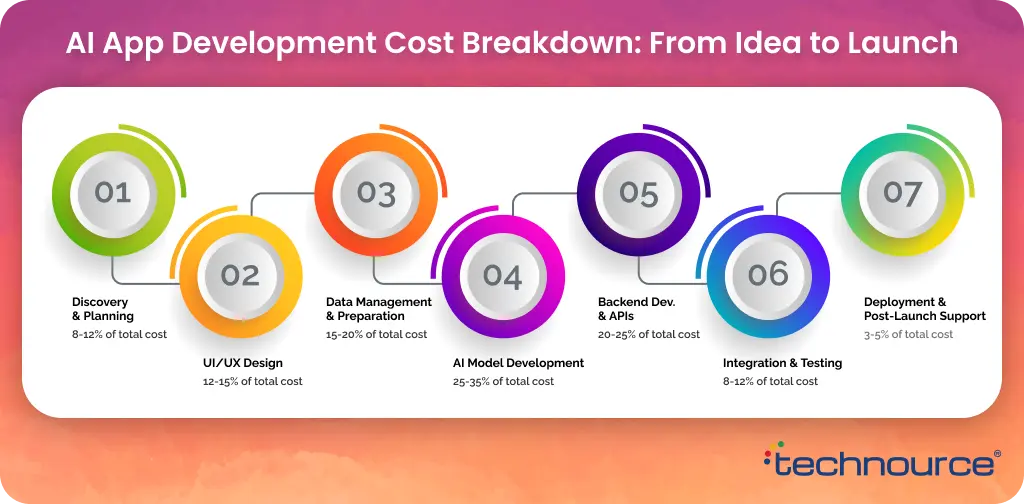
AI App Development Cost Breakdown: From Planning to Deployment
Understanding the distribution helps you negotiate and plan better.
Discovery & Planning (8-12% of total cost)
This phase includes requirements gathering, feasibility studies, tech architecture decisions, and scope definition.
Cost Range: $2K-$15K Timeline: 2-3 weeks
Deliverables:
Detailed requirements document
AI feasibility assessment
Technical architecture diagram
Resource & timeline estimation
Risk assessment
Smart Move: Invest heavily here. A great discovery phase prevents 50% of cost overruns later.
UI/UX Design (12-15% of total cost)
What happens: Creating user interfaces, wireframes, prototypes, and user experience flow. Cost Range: $5K-$25K Timeline: 3-4 weeks
Includes:
User research & personas
Wireframe design
High-fidelity mockups
Interactive prototypes
Design system documentation
Data Management & Preparation (15-20% of total cost)
What happens: Data collection, cleaning, labeling, validation, and infrastructure setup. Cost Range: $8K-$40K Timeline: 4-8 weeks (often overlaps with other phases)
Breakdown:
Data sourcing: $2-10K
Cleaning & preprocessing: $3-15K
Annotation/labeling: $2-10K
Storage infrastructure: $1-5K
This phase is very important as it determines the model’s success. Many models are trained on poor-quality data, which leads to project failure.
AI Model Development (25-35% of total cost)
What happens: Building, training, tuning, and optimizing machine learning models. Cost Range: $15K-$100K+ Timeline: 6-12 weeks
What happens: Building server infrastructure, databases, APIs, and system architecture. Cost Range: $10K-$60K Timeline: 6-10 weeks
Includes:
API development
Database architecture
Server configuration
Authentication & authorization
Scalability planning
Integration & Testing (8-12% of total cost)
What happens: Connecting AI with existing systems, comprehensive QA, and performance validation. Cost Range: $5K-$25K Timeline: 4-6 weeks
Includes:
System integration testing
End-to-end testing
Performance & load testing
Security testing
UAT (User Acceptance Testing)
Deployment & Post-Launch Support (3-5% of total cost)
What happens: Launching to production, monitoring, and initial support. Cost Range: $2K-$20K Timeline: 2-3 weeks + ongoing
Includes:
Deployment automation
Production monitoring setup
Alerting & logging
Initial bug fixes
Performance optimization
Key Takeaway:
Most AI cost overruns happen before coding even starts. Investing properly in discovery, data preparation, and testing prevents up to 50% of budget waste later.
AI App Development Cost by Application Type
AI Chatbots: From Simple to Sophisticated
Basic Rule-Based Chatbots: $10K-$25K
Decision tree logic
Predefined responses
2-3 months development
Good for: FAQs, basic support, internal tools
Limitations: No learning, rigid responses
NLP-Powered Chatbots: $30K-$80K
Natural language understanding
Learning from conversations
Multi-intent handling
4-6 months development
Good for: Customer service, lead qualification, complex queries
Generative AI Chatbots (GPT-powered): $40K-$150K+
Advanced language models
Context awareness
Real-time learning
4-8 weeks for the implementation (primarily for integration), but continuous API charges ($500-5K/month based on usage)
Real Case Study: A mid-sized SaaS firm we’ve collaborated with initially opted for a $35K NLP chatbot and observed a 35% drop in support tickets. This early success clearly highlighted the future of generative AI, leading to the expansion of a $120K generative AI version for sales support. The return period? Half a year.
Predictive Analytics Platforms: $50K-$250K
What They Do: Forecast trends, identify patterns, and enable data-driven decisions.
Cost Drivers:
Historical data volume
Real-time processing needs
Integration complexity
Accuracy requirements
Examples:
Demand forecasting for retail: $60-100K
Churn prediction for SaaS: $50-90K
Risk assessment for banking: $150-300K
Equipment failure prediction: $80-150K
Technource worked with a manufacturing enterprise to implement a predictive maintenance solution aimed at minimizing unplanned equipment downtime. The project, with a budget of approximately $120,000, involved building a predictive analytics platform using historical and real-time sensor data. After deployment, the client experienced a 28% reduction in unplanned downtime, translating into nearly $350,000 in annual savings through improved productivity and reduced maintenance costs. The AI system paid for itself in just four months, delivering strong and measurable ROI.
ROI Reality: Predictive analytics typically generate 200-300% ROI within 18 months through better decision-making, cost reduction, and revenue optimization.
Computer Vision Apps: $50K-$500K+
The Most Expensive AI Category due to:
Large dataset requirements (thousands to millions of images)
GPU-intensive training
High accuracy standards
Common Applications & Costs:
Product quality inspection: $80-150K
Facial recognition: $100-200K
Medical image analysis: $150-400K (high accuracy + compliance requirements)
Real-time object detection: $100-250K
Document scanning & OCR: $50-120K
Recommendation Engines: $30K-$150K
E-commerce Personalization: $40-100K Content Recommendation (streaming/media): $50-120K Social Platform Recommendations: $80-150K+ Impact: Recommendation engines typically increase conversion rates by 15-35% and average order value by 10-25%.
Voice Assistants: $100K-$350K
Complexity Factors:
Speech recognition quality
Natural language understanding
Multi-language support
Integration with smart devices
Cost-Effective Alternative: White-label solutions from Amazon (Alexa), Google, or IBM Watson can start at $10-30K integration cost instead of building from scratch.
Autonomous Systems: $500K-$2M+
Self-driving vehicles, robotics, and autonomous drones
Why So Expensive:
Massive safety requirements
Continuous model improvement
Real-world testing
Regulatory compliance
Extreme accuracy standards (99.99%+)
Hidden and Ongoing Costs of AI App Development
You’ve got a quote. Great! But here’s what’s NOT included:
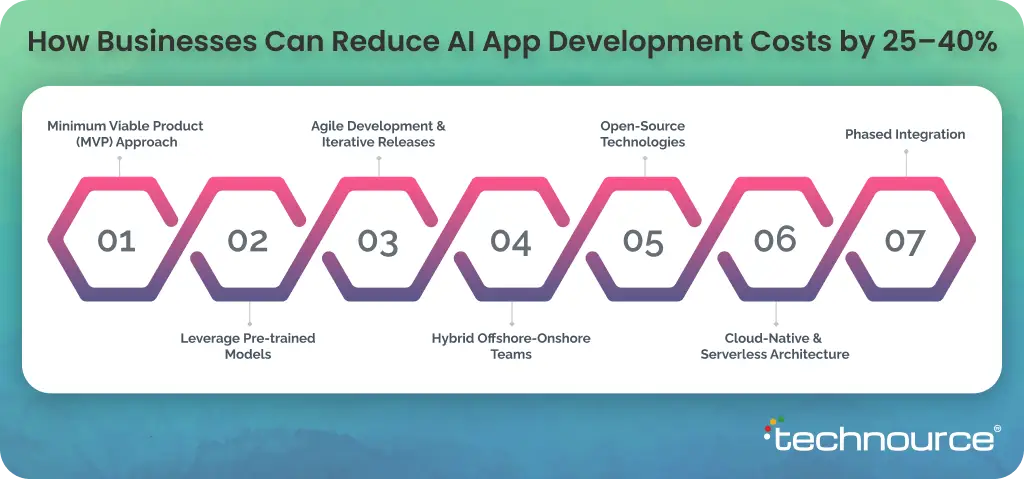
How it works: Launch with 3-5 core features only Cost savings: 30-40% Timeline: 2-4 months vs. 6-12 months for full feature set Best for: Startups, uncertain requirements, quick validation
Strategy #2: Leverage Pre-trained Models
How it works: Use OpenAI, Google Cloud ML, Hugging Face instead of training from scratch Cost savings: 40-50% Timeline: Weeks vs. months Trade-off: Less customization, but often good enough Best for: Standard NLP, general computer vision, common use cases
Strategy #3: Agile Development & Iterative Releases
How it works: 2-week sprints, regular releases, gather feedback, adjust Cost savings: 20-25% Timeline: More predictable Benefit: Catch scope creep early, reduce rework Best for: All projects
Strategy #4: Hybrid Offshore-Onshore Teams
How it works: US architects + offshore engineers Cost savings: 35-40% Quality: Same as pure US-based (with good management) Timeline: No impact Best for: Companies willing to embrace distributed teams
Strategy #5: Open-Source Technologies
How it works: Use TensorFlow, PyTorch, Apache, PostgreSQL vs. proprietary tools Cost savings: 15-25% Timeline: No impact (sometimes faster) Support: Massive community support Best for: All projects where there’s a viable open-source alternative
How it works: Pay only for what you use (AWS Lambda, Google Cloud Functions) Cost savings: 30-40% on infrastructure vs. traditional servers Scalability: Automatic Best for: Variable workloads, startups, variable traffic patterns
Strategy #7: Phased Integration
How it works: Integrate AI with existing systems gradually, not all at once Cost savings: 10-15% Risk: Reduced Timeline: Slightly longer, but more stable Best for: Large enterprises with complex legacy systems
Key Takeaway:
Cost reduction doesn’t come from cutting quality; it comes from smart architecture, MVP-first thinking, and the right delivery model.
AI App ROI: Cost Recovery and Business Impact
AI usually recovers its cost more quickly than nearly all other tech investments. In practical examples, the ROI is very remarkable, e.g., a $50,000 AI-powered customer service chatbot can cut $100,000 annual support costs and bring $40,000 in revenue. Thus, payback in 4 to 5 months and 580% ROI over 3 years is already realized. In the same manner, the $120,000 predictive maintenance system can remove unplanned downtime and create new production capacity; thus, it will already be $400,000 in combined savings and revenue plus one year and paid off in 3 to 4 months with 1,250% ROI. Even quicker, an $80,000 AI-based recommendation system for online retail can raise conversion rates and order size so that $300,000 in extra revenue is generated, the breakeven point is at 2 to 3 months, and the three-year ROI is over 1,100%.
User Adoption Rate: % of target users actively using the system
Cost Per Transaction: Reduction in cost per operation
Customer Satisfaction: NPS, CSAT improvements
Processing Time: Reduction in time to decision/action
Revenue Per User: Increase in monetization metrics
Operational Efficiency: Time savings, error reduction
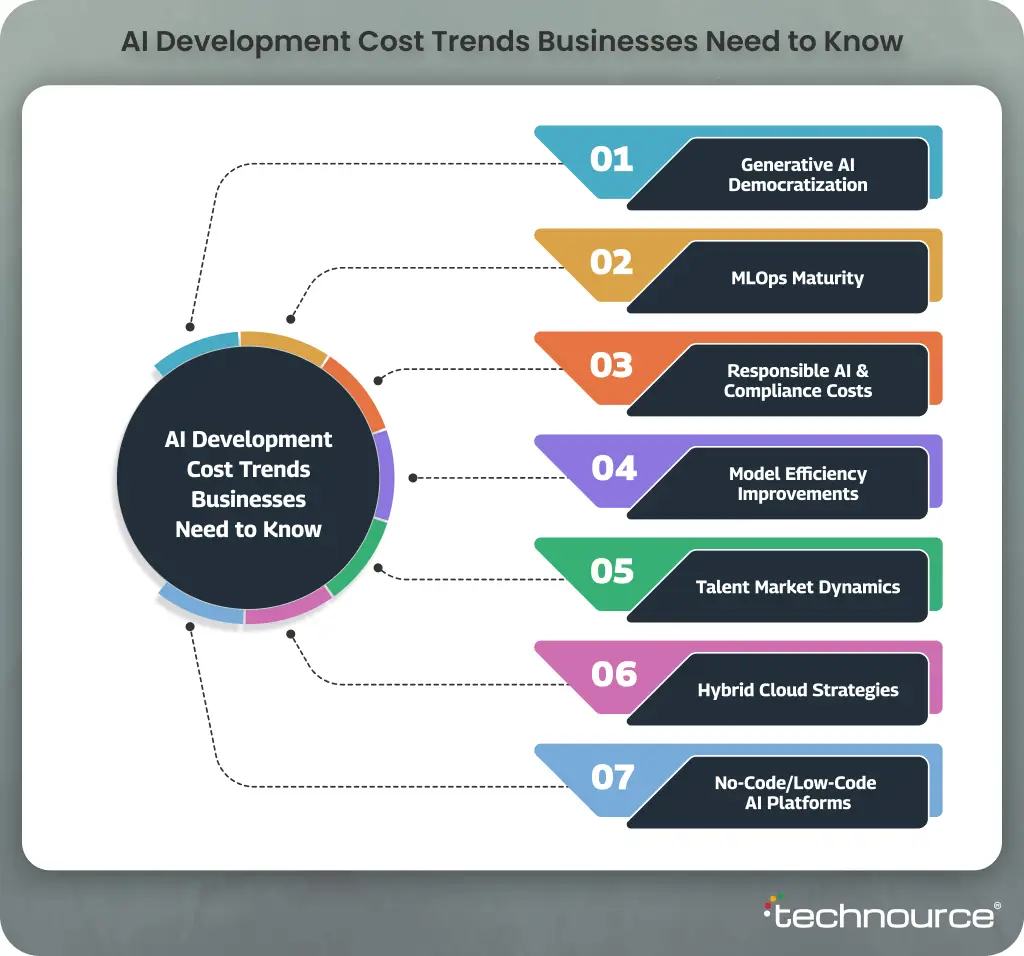
AI Development Cost Trends to Watch in 2026
Generative AI Democratization
Pre-trained large language models (GPT-4, Claude, Llama 2) are making specialized AI development cheaper and faster. Custom model training is becoming less necessary, as businesses increasingly adopt scalable generative AI development solutions built on top of these powerful foundation models.
Impact: Initial development costs down 40-50%, but ongoing API costs up.
MLOps Maturity
Better tools, frameworks, and best practices for managing ML workflows in production, often implemented with the support of a machine learning development company, are reducing operational friction and costs.
Impact: 20-25% reduction in maintenance and scaling costs.
Responsible AI & Compliance Costs
Regulations around data privacy, AI fairness, and transparency are increasing compliance requirements.
Impact: 5-15% on budgets for healthcare, finance, and EU operations.
AI engineer salaries are stabilizing after explosive growth. More talent entering the market = competitive pricing.
Impact: 10-20% moderation in senior engineer rates.
Hybrid Cloud Strategies
Multi-cloud and hybrid cloud adoption are optimizing costs through competition and flexibility.
Impact: 15-25% cost savings through smart infrastructure choices.
No-Code/Low-Code AI Platforms
Tools like AutoML, Vertex AI, and specialized platforms are enabling non-experts to build simple AI.
Impact: Basic AI apps now possible for $10-30K (previously $40-80K).
Common AI App Development Cost Mistakes and How to Avoid Them
Mistake #1: Vague Requirements
What happens: Team starts building, discovers missing requirements halfway through, rework = disaster Cost impact: 20-50% budget overrun How to fix: Spend 2-3 weeks on discovery. Ask 100 questions. Get stakeholder alignment before a single line of code.
Mistake #2: Choosing the Wrong Tech Stack
What happens: You pick an expensive proprietary solution or outdated technology that nobody knows Cost impact: 25-40% wasted costs, plus technical debt How to fix: Use proven open-source technologies. Ask your vendor what stack they recommend and why.
Mistake #3: Underestimating Data Preparation
What happens: Teams think data is “ready.” It’s not. They spend months cleaning, then need to rebuild models Cost impact: 15-30% overrun + delays How to fix: Data audit before the project starts. Allocate 15-20% of the budget to data work.
Mistake #4: Scope Creep
What happens: While we’re at it, let’s add this feature…” = 50% more work that wasn’t planned Cost impact: Massive overruns How to fix: Agile methodology. Lock down MVP scope. Put additional features in Phase 2.
Mistake #5: Insufficient Testing
What happens: Launch an AI model without proper testing. It breaks in production. Emergency fixes = expensive Cost impact: 10-25% additional costs + reputation damage How to fix: Budget 10-15% of development time for QA. Test edge cases.
Mistake #6: Ignoring Infrastructure Planning
What happens: The AI model works in development. In production with real data = it’s slow, expensive, or crashes Cost impact: Emergency scaling = 2-3x normal costs How to fix: Plan infrastructure architecture early. Load test before launch.
Mistake #7: Changing Teams Mid-Project
What happens: Losing team members = knowledge loss = rework Cost impact: 20-40% delay and cost overrun How to fix: Lock in your team and vendor. Make them accountable for delivery.
Why Technource Is a Cost-Efficient Partner for AI App Development
Here’s the hard truth: most AI development companies don’t optimize for cost. They optimize for profit margins. We do the opposite.
Here’s Our Proven Cost-Saving Model:
Smart Tech Stack Choices
We use open-source technologies (TensorFlow, PyTorch, PostgreSQL) over expensive proprietary solutions. This saves you 20-30% on licensing and reduces vendor lock-in.
Pre-trained Model Prioritization
For 80% of projects, custom models are overkill. We start with fine-tuning industry-leading pre-trained models (OpenAI, Google Cloud, HuggingFace), then migrate to custom models only when ROI justifies it. This cuts initial development by 40-50%.
Senior US architects + world-class offshore engineers = world-class quality at 35-40% lower cost. We’ve built teams for 500+ AI projects across 30+ industries. See case studies and client testimonials here.
Fixed-Price, Transparent Pricing
No surprise bills. No, “it’s more complex than we thought.” We provide detailed estimates with clear phase-wise breakdowns. What you agree to is what you pay.
Proactive Infrastructure Optimization
Our DevOps team designs cloud architectures that scale efficiently. Clients typically save 30-40% on infrastructure costs vs. the industry average through intelligent resource allocation and serverless computing.
Long-term Partnership Mentality
We’re not trying to upsell you. We’re trying to prove our value so you work with us for the next 10 projects. Clients who start with a $60K chatbot often expand to $300K+ AI ecosystems with a top AI development company, us—because we deliver.
Conclusion: Planning AI Project Budget the Smart Way
Building an AI app in 2026 doesn’t mean breaking the bank. It means:
Choosing the right partner who prioritizes efficiency over profit margins
Starting with an MVP, not a gold-plated feature set
Using proven technologies that work at scale
Maintaining transparency on costs every step of the way
Planning for growth without emergency spending
The companies winning with AI in 2026 aren’t the ones with the biggest budgets. They’re the ones with the smartest partners.
AI development costs are only rising. But smart development costs are falling. The difference? Having the right team in your corner.
Ready to Build Smarter, Faster, Cheaper?
Let’s talk. We’ve helped 200+ companies launch successful AI projects. Half of them came to us frustrated with overpriced quotes. All of them thanked us 6 months into production when they realized they saved $100K+ and launched in half the time.
P.S. We’ll show you exactly what your project should cost, what hidden expenses you should plan for, and how you can save 25-40% without cutting corners. The only catch? You have to be serious about wanting the truth.
AI solution pricing ranges from $20,000 for basic chatbots to $400,000+ for enterprise systems. Most mid-level AI apps cost between $80,000-$150,000 and take 4-8 months. The final price depends on complexity, data requirements, team location, and compliance needs. A simple rule-based chatbot might be $20-40K, while a custom machine learning model with computer vision capabilities could hit $200K+.
Beyond the initial development bill, expect 15-30% additional costs for cloud infrastructure ($500-$5K/month), ongoing maintenance (10-20% annually), API usage fees, team expansion, compliance audits, and security testing. Many companies are shocked to learn that infrastructure costs alone can add $5-60K annually. Data preparation and retraining models are often underestimated too—typically 15-20% of your total project budget.
Save 25-40% by: (1) Starting with an MVP (minimum viable product) instead of full feature set, (2) Using pre-trained models like GPT-4 instead of training custom ones, (3) Choosing a hybrid team (US architects + offshore engineers), (4) Leveraging open-source tech (TensorFlow, PyTorch), and (5) Building on serverless architecture for automatic scaling. The MVP approach alone cuts costs by 30-40% while letting you validate ideas faster.
Eight main cost drivers: (1) App complexity (simple chatbot vs. complex predictive system), (2) AI model type (pre-trained vs. custom training), (3) Data preparation (collection, cleaning, labeling—often 20-30% of budget), (4) Technology stack (open-source vs. proprietary), (5) Team expertise and location (US devs cost 2-5x more than offshore), (6) System integration (legacy system integration adds 10-15%), (7) Compliance requirements (healthcare/fintech adds 8-20%), and (8) Timeline (accelerating costs 1.3-1.5x more).
The difference comes down to capability. A basic decision-tree chatbot answers FAQs but can’t learn. NLP chatbots understand natural language but need training. Generative AI chatbots (ChatGPT-powered) provide human-like conversations but add ongoing API costs ($500-5K/month depending on usage). Timeline: 2-4 months for basic, 4-6 months for advanced, 4-8 weeks for GPT integration.
Amar is the Senior Business Development Manager at Technource, where he drives business growth through innovation-focused custom software development, AI solutions, and emerging technologies. With 9+ years of experience, he bridges market needs with tailored digital strategies to deliver real business impact. A believer in building strong client partnerships, Amar brings insight and energy into every collaboration.
Request Free Consultation
Amplify your business and take advantage of our expertise & experience to shape the future of your business.