AI in recruitment reduces time-to-hire by up to 40% and cuts cost-per-hire by 35%.
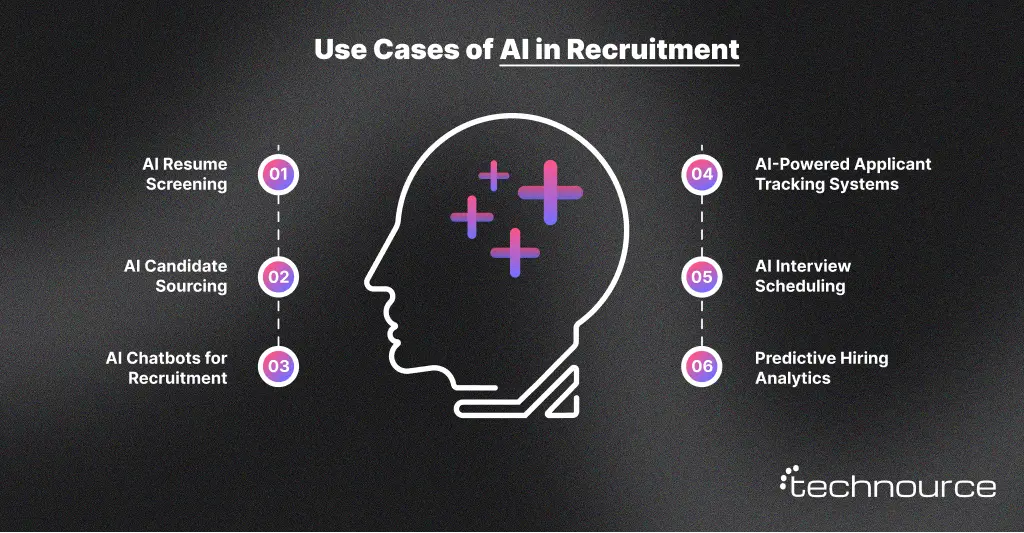
Core use cases include resume screening, candidate sourcing, interview scheduling, and predictive analytics.
AI doesn’t eliminate bias, it shifts it; regular audits are non-negotiable.
The build vs. buy decision depends on your scale, budget, and technical requirements.
Real companies like Hilton, IBM, and Unilever are already seeing measurable results.
Your recruiter spent 23 hours this week screening resumes. Roughly 21 of those hours? Wasted.
That’s not a guess. Research shows recruiters spend up to 23 hours on screening for a single role, and nearly 88% of resumes reviewed during high-volume hiring come from unqualified applicants. Meanwhile, a strong candidate applied Tuesday morning, waited three weeks without a word, and accepted your competitor’s offer by Friday.
That’s not a guess. Research shows recruiters spend up to 23 hours on screening for a single role, and nearly 88% of resumes reviewed during high-volume hiring come from unqualified applicants. Meanwhile, a strong candidate applied Tuesday morning, waited three weeks without a word, and accepted your competitor’s offer by Friday.
This is traditional hiring. And it’s bleeding companies dry, in time, money, and talent.
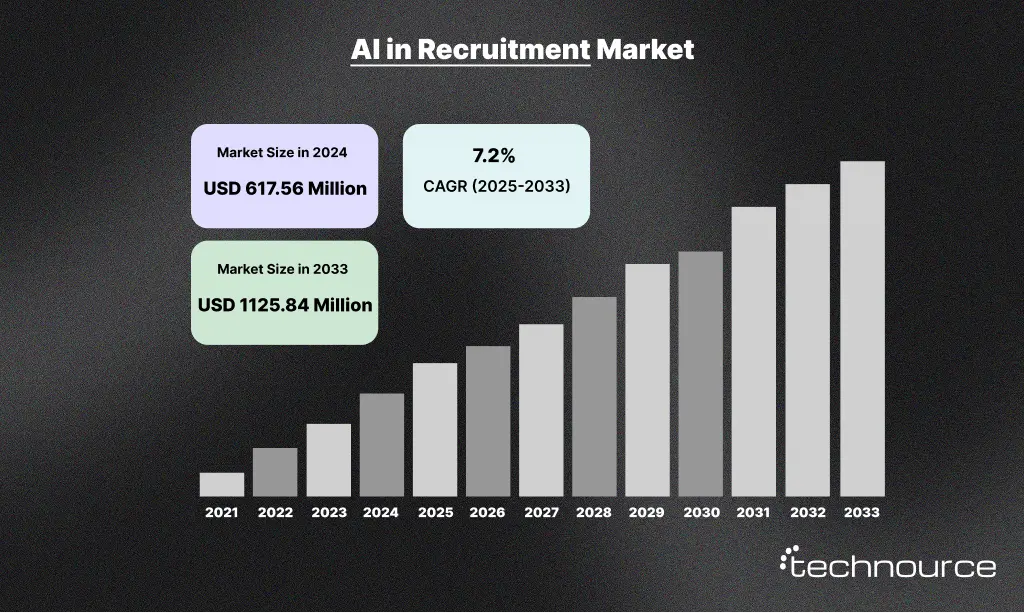
According to the report published by Straits Research, the global AI recruitment market was valued at $661.6 million in 2023. It’s projected to hit $1.1 billion by 2030. That kind of growth signals one thing: technology is solving a real problem. But here’s what most articles miss, deploying AI in recruitment doesn’t automatically fix broken hiring. Plenty of companies are automating the wrong things, amplifying existing bias, or buying tools that don’t talk to each other.
This is where working with a custom AI development company becomes critical, not just to adopt tools, but to implement solutions that align with real hiring workflows and business goals.
The guide explains the actual functions of artificial intelligence in recruitment together with its operational strengths, weaknesses, and its proper implementation methods. This guide is made for all types of organizations, from fast-growing startups to established companies upgrading their traditional hiring methods.
What AI in Recruitment Actually Means
“AI in recruitment” gets stretched to cover everything from a basic keyword filter to a fully autonomous hiring pipeline. That range matters because these are completely different tools solving completely different problems.
AI-powered recruitment systems use machine learning (ML) and natural language processing (NLP) and predictive analytics to automate their work. The system removes nonessential tasks that prevent recruiters from completing their main responsibilities.
Think about what a recruiter’s week actually looks like:
Sorting through hundreds of applications
Scheduling calls across time zones
Answering the same candidate questions over and over
Writing and rewriting job descriptions
Comparing assessment scores manually
Each of those tasks has an AI equivalent now. The combined system results in a substantial increase because of its multiple components. AI-powered recruitment systems help companies achieve a 40% decrease in their hiring duration and a 35% reduction in their hiring expenses. The results organizations achieved through implementation show actual outcomes which prove their effectiveness because they dedicated resources to obtaining accurate data and selecting tools that matched their real operational needs instead of the most impressive demonstration they witnessed.
Core Use Cases: Where AI Is Actually Working
Here are some of the most important use cases for recruiters where AI is scaling and working wonders:
1. AI Resume Screening
Traditional screening is fast, but chaotic. A recruiter opens an application, skims it against a mental model of “good,” and makes a judgment call, usually in under 10 seconds. Two recruiters looking at the same resume often reach different conclusions. By the fiftieth application of the day, that judgment is noticeably worse than it was at the tenth.
AI resume screening applies consistent logic at scale. It doesn’t just keyword-match, the better platforms understand context. A candidate listing “Python” in a data science portfolio scores differently than someone listing it under “hobbies.” Skills, experience levels, industry background, and qualifications are all parsed and ranked uniformly across every single application.
To make this work effectively at scale, companies often rely on robust AI integration services and solutions that connect screening systems with existing hiring platforms, ensuring data flows seamlessly across tools.
Unilever saw this firsthand. After implementing AI screening across 180 countries, they went from manually reviewing 250,000 applications per year to a streamlined automated process. Time-to-hire dropped by 75%. Recruiter hours spent on admin fell by 50,000 annually. That’s not magic, that’s what automating the right layer of the funnel looks like.
Organizations building more advanced hiring ecosystems also invest in software product development solutions to create tailored screening workflows that reflect their unique hiring criteria rather than relying on generic filtering logic.
2. AI Candidate Sourcing
Most recruitment strategies are designed to react to job openings. A role opens, a post goes live, and you wait. AI candidate sourcing turns that model on its head.
Modern sourcing tools search through professional networks and GitHub repositories and portfolio sites and public databases to find candidates who meet your requirements including those who have not applied and are not currently seeking work. The candidates who meet this criterion usually represent the best talent available for hiring. The process of reaching these candidates demands speed and precision which manual outreach methods cannot maintain.
The stronger platforms go beyond finding people, they rank them using behavioral signals:
What roles has this person historically moved into?
What skills have they been adding recently?
Are they likely to be open to a move based on tenure patterns?
That predictive layer makes outreach far more targeted. Instead of 300 identical InMails and hoping for the best, you’re sending 40 personalized messages to candidates who actually fit.
3. AI Chatbots for Recruitment
Candidate experience is the thing every company claims to prioritize and consistently fails to deliver. The biggest complaint? Silence. Candidates apply, hear nothing, email, hear nothing again.
An AI chatbot for recruitment doesn’t fix everything, but it handles the part candidates complain about most. A well-implemented chatbot can:
Engage candidates immediately after application
Confirm receipt and set timeline expectations
Answer FAQs about the role and process
Collect basic screening information
Schedule initial calls without human involvement
The better chatbots use NLP to handle non-standard questions, not just route traffic through a rigid decision tree. When a candidate asks “Is this role remote?” or “What does round two look like?” the system should answer clearly, not redirect them to a page they’ve already read.
Many organizations partner with an AI chatbot development company to build conversational systems tailored to their hiring workflows, rather than relying on rigid, one-size-fits-all tools.
At a more advanced level, companies are moving toward building AI agent systems that can manage entire interaction flows autonomously, from initial engagement to qualification and scheduling, without constant human input.
4. AI-Powered Applicant Tracking Systems
The traditional ATS was a filing cabinet with search functionality. Useful, but passive. A modern AI-powered applicant tracking system is an entirely different tool.
Instead of passively logging candidate movement, it surfaces patterns:
Which sources produce your best long-term hires?
Where are candidates dropping off, and why?
Which hiring managers have the longest time-to-close?
Which roles in your database are filled faster when sourced internally?
Beyond analytics, AI-enhanced ATS platforms match proactively. When a new role opens, the system suggests candidates already in your database who fit, your silver medalists from six months ago, the intern whose contract ended, the candidate who was perfect for a role that fell through. All surfaced automatically instead of buried in search results.
For companies running complex pipelines across multiple business units, this feature alone can dramatically cut sourcing costs.
Behind the scenes, many of these systems are powered by scalable web application development solutions that ensure performance, security, and seamless candidate experience across devices and regions.
5. AI Interview Scheduling
This sounds mundane. It’s not.
Interview scheduling is a coordination nightmare, especially with multiple interviewers, multiple time zones, and candidates who can only talk during their lunch break. The back-and-forth alone can add days to your time-to-hire. Multiply that across 50 open roles and you’ve got a serious operational drag.
AI interview scheduling tools integrate with everyone’s calendars, surface mutual availability, send invites, handle reschedules, and send reminders, all without human involvement. The newer AI-powered versions go further: they respect interviewer preferences, protect “no meeting” blocks, and sequence rounds efficiently so candidates aren’t waiting a week between each step.
On average, companies save 2–3 hours per interview when they automate scheduling. At scale, that’s not a small number.
6. Predictive Hiring Analytics
This is where AI-powered recruitment gets genuinely powerful, and genuinely complex.
Predictive hiring analytics uses ML to forecast outcomes from historical data. Which candidates are likely to succeed in this role? Which hires are likely to leave within 12 months? What is the likelihood that this offer will be accepted based on the provided salary range? Evidence-based decision-making should replace instinctive decision-making when this process is performed successfully.
The system becomes biased when it is poorly executed or when it learns from inaccurate historical information because it creates automatic discrimination which is more difficult to contest than judgment made by humans. Amazon learned this the hard way. Their AI recruiting tool, trained on 10 years of internal hiring decisions (which skewed heavily male in technical roles), ended up penalizing resumes mentioning women’s organizations and downgrading graduates of all-women’s colleges. The tool was scrapped.
The lesson isn’t “don’t use predictive analytics.” It’s “know exactly what your model was trained on and audit its outputs regularly.” Predictive hiring analytics is arguably the highest-leverage AI application in recruitment when used responsibly, but it’s also the one with the steepest consequences when it isn’t.
Real Benefits of AI in Recruitment
Let’s talk about what the benefits of AI in recruitment actually look like in practice, without the hype.
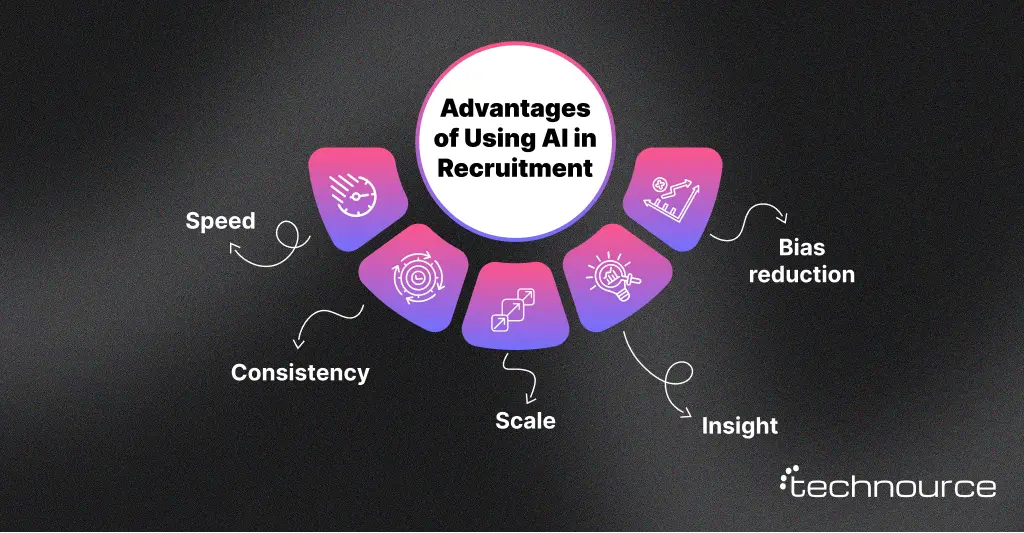
Speed: Time-to-hire improvements are the most consistent result across organizations that implement AI well. Top candidates are typically off the market within 10 days of starting a search. If your process takes six weeks, you’re not competing.
Consistency: AI applies the same logic to every application. That doesn’t guarantee fairness, flawed logic applied consistently is still flawed, but it eliminates the inconsistency of different recruiters applying different standards to the same role.
Scale: Handling 5,000 applications for 10 open roles would require either a large team or a long timeline. AI handles the initial volume without either.
Insight: Which job boards produce your best hires? Which stage has the most drop-offs? Which office has a compensation gap that’s killing offer acceptance? A well-instrumented AI recruitment stack surfaces this.
Bias reduction: AI doesn’t eliminate bias, it shifts it. But algorithmic bias is auditable in a way that human bias often isn’t. You can test it, find it, and fix it. That’s at least a starting point. Our team at Technource has built custom hiring platforms and ML-powered screening engines for companies across industries.
Examples of AI in Recruitment
Real companies. Real results. Here’s what AI in recruitment actually looks like in practice.
Example 1:
Hilton Hotels implemented an AI-powered video screening platform and reduced time-to-hire from six weeks to five days. The AI pre-screened video responses, ranked candidates by fit score, and let hiring managers review only top-tier submissions. Recruiter hours spent per hire dropped by 90%.
Example 2:
IBM uses Watson AI internally to predict attrition. The system identifies with roughly 95% accuracy which employees are likely to leave within six months, giving managers a window to act. IBM reports saving $300 million in attrition-related costs since implementation.
Example 3:
Vodafone deployed AI screening globally and saw a 16% increase in female hires. Removing recruiter bias from the initial screening stage produced a more diverse shortlist, without any manual intervention.
Example 4:
L’Oréal used an AI chatbot to manage 1.7 million job applications in a single year. The recruitment team dedicated all their efforts to making final hiring decisions because the chatbot handled candidate screening, question answering, and interview scheduling tasks.
These organizations demonstrate that recruitment functions as an engineering problem that organizations can solve through proper engineering methods. The successful outcomes of each case study resulted from organizations running AI tests that operated according to predetermined use cases while they monitored actual results through objective assessments.
The Risks of Using AI in Recruitment
Here’s what the optimistic coverage consistently glosses over.
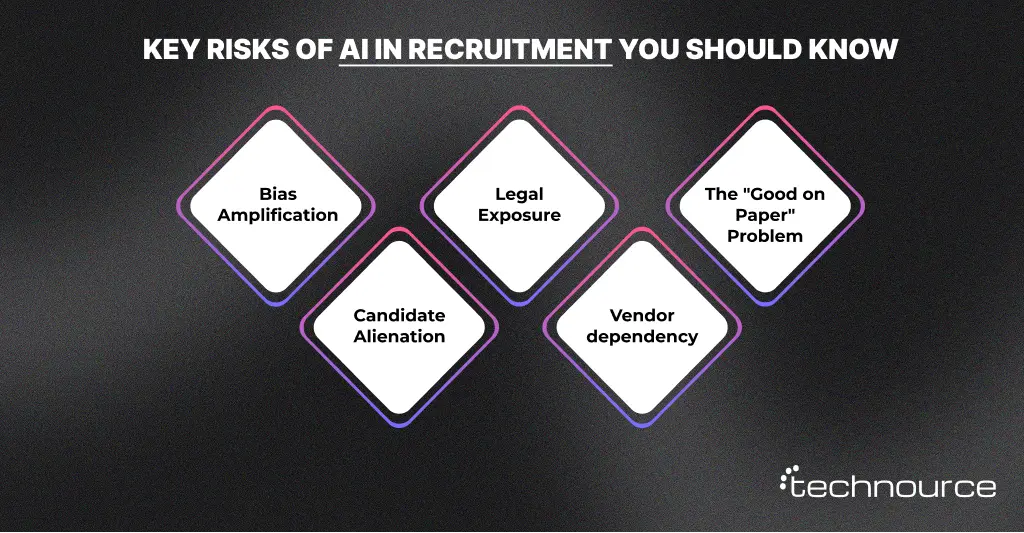
1. Bias Amplification
If your historical hiring data reflects a non-diverse workforce, which describes most large companies, training an AI on that data means automating your past mistakes. Any system that learns “who we’ve hired” also learns “who we’ve preferred,” and those two things aren’t always the same.
2. Candidate Alienation
A 2023 survey found 35% of job seekers said they’d withdraw from a process they discovered was fully automated. Transparency matters. Candidates who know AI is involved and understand how it works perform significantly better than those who discover it by accident.
3. Legal Exposure
The regulatory environment is moving fast:
Illinois’s AI Video Interview Act requires consent before AI analyzes video responses
New York City’s Local Law 144 mandates annual bias audits for any AI hiring tool
The EU AI Act classifies recruitment AI as high-risk, with strict disclosure requirements
Companies ignoring this are building legal liability directly into their hiring process. And the pace of regulation is only increasing, what’s optional today in one jurisdiction may be mandatory tomorrow in yours.
4. Vendor dependency
When your entire recruitment operation runs through a third-party platform, you’re exposed to that vendor’s pricing changes, model updates, and data practices. You’re responsible for hiring outcomes, even when the algorithm is a black box.
5. The “Good on Paper” Problem
AI excels at optimizing for measurable criteria. But some of the most impactful hires have unconventional backgrounds, career pivots, self-taught skills, and non-linear paths. A system tuned to maximize resume match scores will consistently deprioritize exactly these candidates.
How to Implement AI in Recruitment
You’re convinced the technology is worth exploring. Here’s how to approach it without repeating the common mistakes.
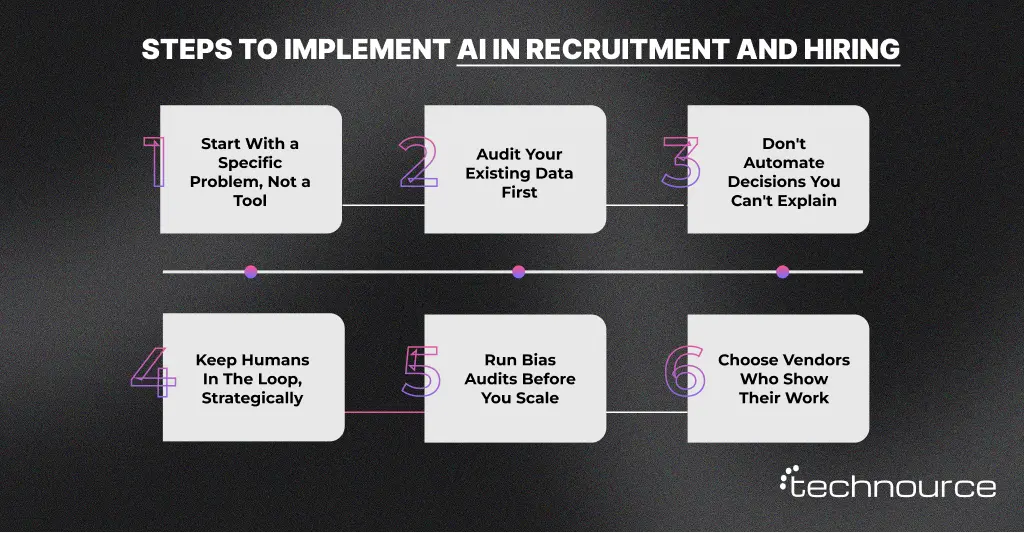
1. Start With a Specific Problem, Not a Tool :
Not “we want AI in our hiring process”, but “we’re losing two weeks per hire to scheduling” or “we have a 40% drop-off at the application stage and don’t know why.” Technology should follow the problem.
2. Audit Your Existing Data First :
Whatever AI solution you implement will be shaped by the data it connects to. If your ATS data is inconsistent, messy tagging, incomplete records, or stages labeled differently across teams, fix that first. Garbage in, garbage out.
3. Don’t Automate Decisions You Can’t Explain :
Any AI-driven ranking that produces a recommendation you can’t articulate to a candidate or regulator is a liability. “Ranked lower due to missing certification” is defensible. “Ranked lower based on a proprietary score” is not.
4. Keep Humans In The Loop, Strategically :
AI handles volume. Humans handle judgment. The final hiring decision, the culture conversation, the offer negotiation, those stay human. Use AI to give your recruiters space to actually do those things well. A common mistake is treating AI as a replacement for recruiter involvement rather than a way to make that involvement more meaningful.
5. Run Bias Audits Before You Scale :
Before your AI screening tool processes thousands of applications, test it on a representative sample. Check whether outcomes differ across gender, ethnicity, and age. If they do, understand why before you scale. A bias audit isn’t a one-time exercise; it’s an ongoing process that should occur whenever the model is retrained or the job criteria change significantly.
6. Choose Vendors Who Show Their Work :
If a vendor can’t or won’t explain how their model reaches decisions, that’s a red flag. You’re accountable for your hiring outcomes, you need enough visibility to stand behind the outputs.
AI Bias in Hiring
This deserves its own section — not because it’s an argument against AI, but because it’s the issue that causes the most damage when ignored.
“AI is objective” sounds intuitive. It’s technically wrong. AI models learn from human-generated data. Human data reflects human decisions. Human decisions carry human bias. The model inherits all of it — often in ways that are harder to detect than the original human version.
The fix isn’t returning to purely human screening, which has its own well-documented failures. The fix is a combination of:
Better, more representative training data
Diverse teams involved in model design and testing
Regular audits of model outputs across demographic groups
Regulatory compliance as a floor, not a ceiling
Some companies now use AI specifically to counter bias, stripping names, photos, graduation dates, and university names from resumes before a human sees them. Used this way, AI becomes a tool for fairness rather than a source of harm.
The honest position: AI-assisted hiring can be less biased than purely human hiring. But it requires intention, testing, and ongoing accountability. It doesn’t happen by default just because you replaced a spreadsheet with a machine learning model.
One practical step many organizations overlook: involve your legal and HR teams in AI tool selection, not just your engineering or procurement teams. The people who understand your workforce demographics and compliance obligations need a seat at the table before a model goes live, not after something goes wrong. Technource has helped companies design and deploy custom hiring AI, from resume parsing models to full-stack ATS platforms. If you want to own your tech instead of renting it, Hire AI developers with Technource.
Build vs. Buy — Hire AI Developers or Get a SaaS Platform?
This is the question every company hits once they move past “should we use AI” and land on “yes, now how?”
The Off-the-shelf Route: buying an existing AI recruitment software platform, is faster to deploy and requires less internal technical capability. For most mid-market companies without a strong engineering team, it’s probably the right starting point. Platforms like Greenhouse, Lever, Workday with AI add-ons, HireVue, and Pymetrics cover a lot of ground without requiring you to build anything from scratch.
The Custom Route: where you hire AI developers, makes sense when:
Your industry has unusual credentialing or compliance requirements
You need deep integration with proprietary internal systems
Your hiring volume is large enough that you need infrastructure tuned to your specific workflow
You’re building a recruitment product for others, an HR tech startup or staffing firm
You’ve tried the platforms and keep hitting their limitations
In such cases, organizations often choose to develop their own custom software to gain full control over hiring logic, data handling, and long-term scalability.
A hybrid approach: This is increasingly common. Use existing platforms for standard pipeline functions. Build custom AI components where you need something specific. A company might run Workday for ATS functionality while using a custom NLP model for resume parsing in their niche vertical, connected through an integration layer.
The cost difference between SaaS and custom is real and significant. But so is the capability difference at scale. The right answer depends on your volume, your team, your data, and how much control you actually need over the system producing your hiring decisions.
The Future of AI in Recruitment
Where is all of this heading? A few directions worth watching.
Generative AI for Job Descriptions: Tools that write role descriptions tailored to specific candidate personas, adjusting tone, emphasis, and language based on who you’re trying to attract.
This shift is part of a broader trend where generative AI in business is transforming how companies create, personalize, and optimize content across operations, including hiring.
Agentic Hiring Pipelines: AI that doesn’t just assist with tasks but manages sequences of them autonomously, sourcing candidates, screening them, scheduling interviews, and flagging finalists for human review without waiting for a prompt at each step.
Skills-based Hiring Over Credential-based: AI is making it easier to assess what candidates can actually do rather than what their resume says they’ve done. This is a structural shift that could meaningfully broaden the talent pool, particularly for roles where formal credentials have historically gatekept capable people. Companies adopting this model early are already finding stronger culture fits and lower attrition rates than peers still filtering by degree alone.
Real-time Sentiment and Engagement Analysis: Some platforms are beginning to analyze candidate engagement signals, email open rates, response times, portal activity, to predict offer acceptance probability before an offer is even made. This gives recruiters the intelligence to adjust compensation, speed up timelines, or personalize outreach for high-priority candidates.
Tighter Regulation, Globally: The EU AI Act is the most comprehensive framework so far, but it won’t be the last. Companies building AI-assisted hiring processes now should design with compliance in mind, retrofitting it later is significantly more expensive.
The companies that invest in AI recruitment infrastructure thoughtfully over the next two to three years won’t just hire faster. They’ll build a structural advantage in talent acquisition that compounds over time, better data, better models, better outcomes.
Conclusion:
AI doesn’t make hiring impersonal. Broken hiring is already impersonal; it’s 23 hours of wasted screening, three-week silences, and strong candidates slipping away to faster-moving competitors.
What AI in recruitment actually offers is the ability to fix that, if you approach it honestly. Not as a silver bullet, not as a way to eliminate human judgment, but as a set of tools that handle volume, surface insight, and free up recruiters to do the parts of the job that actually require a human.
The companies getting real results from AI-powered recruitment share a few things in common: they started with a specific problem, they audited their data before they automated it, and they kept humans accountable for outcomes even when AI was making the first cut. They also chose partners, whether vendors or development teams, who could explain what the system was doing and why.
Whether you’re buying an off-the-shelf platform, hiring AI developers to build something custom, or somewhere in between, the strategy matters more than the technology. Get the problem definition right. Get the data right. And build the accountability structures before you scale, not after.
If you’re exploring how to implement AI in your hiring process, feel free to contact us, we’ll help you map the right approach based on your goals.
FAQs
AI in recruitment refers to the use of machine learning, natural language processing, and predictive analytics to automate and improve the hiring process, from sourcing and screening candidates to scheduling interviews and forecasting hiring outcomes.
The key benefits include faster time-to-hire, lower cost-per-hire, consistent candidate evaluation at scale, better quality-of-hire through predictive analytics, and improved candidate experience through automated communication.
No, AI shifts bias rather than eliminating it. If a model is trained on historically biased hiring data, it can amplify that bias algorithmically. Regular audits, diverse model-building teams, and transparent AI systems are essential to managing this risk.
It depends on your scale, technical resources, and specific requirements. SaaS platforms are faster and cheaper to deploy. Custom solutions, built with the help of an AI development company, offer more control, deeper integrations, and long-term flexibility for companies with complex needs.
Hilton cut time-to-hire from 6 weeks to 5 days using AI video screening. Unilever saved 50,000 recruiter hours annually through AI resume screening. L’Oréal managed 1.7 million applications using AI chatbots. IBM uses predictive AI to identify flight-risk employees with 95% accuracy.