Doctor Appointment App Development Cost, Features & Process
Shailesh Gujjar
Published: Mar 31, 2026|Updated: Apr 02, 2026
Are you losing patients due to poor experiences, long wait times in the clinic, and inconvenient prescription management? Or, Are you facing continuous patient phone calls, overwhelmed front-desk staff, and scheduling errors?
Without a digital booking system, US clinics struggle with inadequate management, resulting in non-streamlined business operations.
As per the report published by Tebra, 67% of patients prefer to schedule through a doctor appointment booking app. This research shows the rapid development of mobile technologies and how they are shifting manual processes to automated ones.
TL; DR
A doctor appointment application allows a patient to schedule/reschedule/manage doctor appointments.
The clinics are benefiting from this type of application as the dashboards of these apps act as the engine of a train.
The global digital health market is growing rapidly, driven by mobile health apps, telemedicine adoption, and integration of EMR with existing apps.
Regulatory readiness, like HIPAA risk assessment and GDPR compliance, plays a crucial role in safeguarding patient data and avoiding legal complexities.
Let’s hear it from Richards, a healthcare clinic owner from Delaware, US. “Earlier, I faced tremendous issues while scheduling a doctor visit manually. My clinic was already overburdened with tasks, and the team members are not ready to schedule any new visits. However, one of my friends introduced me to a doctor appointment scheduling app. Now, the process is smart, convenient, and hassle-free!
Richard is not alone! Thousands in the healthcare industry are facing the same issue and seeking a smart, cost-effective solution.
And, the solution is doctor appointment app development, which is a key part of modern doctor application development strategies focused on improving patient experience and operational efficiency.
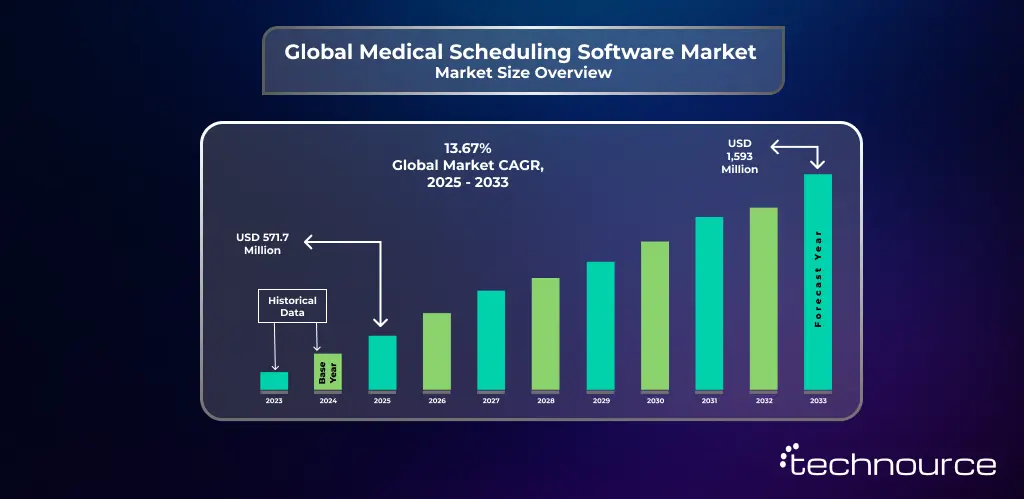
According to Market Data Forecast, the global doctor booking app software market size may reach to $1,593 million by 2033. The number reflects the exponential growth of the appointment-scheduling software market and aligns with ongoing healthcare app development trends shaping the industry.
If you’re like Richard and want to opt for a doctor appointment booking app, this blog will serve as a knowledge trove. We’ll help you learn about doctor appointment application development, backed by experts’ hands-on experience and successful implementations across multiple projects in modern software development environments.
What is a Doctor Appointment Booking App?
This is a digital tool that enables patients to schedule and manage medical visits with clinics easily. Not only that, the apps help patients by monitoring their healthcare data and securely sharing it with specific doctors remotely.
For clinics, doctor booking applications enable automation of administrative work, reduce manual appointment scheduling, and enhance the patient journey.
Modern appointment applications have several significant features, such as time-slot availability, appointment booking and payment, and telemedicine access.
According to Grand View Research, the global telehealth market may reach $455.27 billion by 2030. This is not just a number. Instead, it’s a testament of success that generated the growth.
Types of Doctor Appointment App Development Solutions
“One size does not fit all”. This approach is the true game-changer for developing a doctor appointment booking app. Before you hatch up your next steps, ask yourself these questions-
What is the size of my clinic?
Am I going to design it for a specific team or for the entire clinic, including doctors and patients?
Will it serve as an instant solution for the patients?
What features do I want to incorporate?
Once you have the answers, it will help you to define the type of doctor appointment application. Let’s have a look at how different software development models can influence the structure and scalability of your solution:
1. Single Clinic Appointment Applications
A private practice or a single clinic can use this type of application. Both the clinic operations team and patients benefit from it.
How’s it Helping Clinics?
Allow patients to schedule an appointment directly based on availability.
Sends notifications and reminders to patients about the doctor’s appointment.
Helps to check the test results or previous medical results of a patient with the help of a database.
Bridges the communication gap through real-time chat/call.
How’s it Helping Patients?
Direct appointment booking.
Notifications and reminders based on booking status.
Ease of accessing medical records.
Who Uses Single Clinic Appointment Apps?
Boutique healthcare providers
Private medical practices
Small to medium-sized clinics
2. Multi-Clinic Marketplace Appointment Apps
These applications are designed to bridge the connection gap between multiple clinics, doctors, and hospitals. Multi-clinic appointment apps enable smooth booking across multiple locations, maximizing streamlined operations.
How’s it Helping Clinics?
Based on clinical conditions, specialty, and insurance, the clinics can reach thousands of patients.
Enables solving administrative bottlenecks by streamlining fragmented processes.
Allows a clinic to provide the options where a patient can choose between a video call or an in-person visit.
How’s it Helping Patients?
Search clinics by price, location, specialty, and rating.
Can compare multiple doctors.
Pay online.
Book appointments easily.
Who Uses Them?
National or Government Health System
Healthcare startups
Large hospital networks
3. Telemedicine Apps
These applications offer the option to book appointments for remote consultations via chat, video, or voice.
How’s it Helping Clinics?
Enables the clinics by integrating AI scribes to reduce documentation-related stress.
Provides data-driven insights to help the operations team learn about a patient’s specific clinical condition.
Can offer tailor-made virtual services like nutrition coaching, teletherapy and 24*7 on-demand consultations.
How’s it Helping Patients?
Patients can connect with doctors, especially those who are from remote areas.
AI-powered symptom checkers enable patients to self-diagnose.
Receives e-prescriptions instantly once a consultation ends.
Who Uses Them?
Telehealth startups
Hospitals having virtual branches
Digital therapy platforms
Corporate or Insurance-Integrated Apps
Designed for insurance policyholders or employees, these applications can connect patients with specific doctors and clinics covered under a health plan.
How’s it Helping Patients?
Patients can book appointments with specialists or clinics under a specific insurance plan.
Booking of preventive care programs is easily accessible with this type of application.
Patients can submit and track claims after visits.
Patients can manage digital health records and other medical histories.
Who Uses this Application?
Corporate sector offering healthcare benefits
Insurance companies upgrading client experience
HR departments providing wellness programs to employees.
What are the Benefits of a doctor appointment scheduling app?
With the rise of AI in healthcare, patients’ expectations are increasing. To match it, clinics are using a doctor appointment booking app to achieve the best results. In a nutshell, patients and clinics are leveraging doctor appointment booking apps to make things simple, convenient, and connected, especially when partnering with a reliable mobile app development company.
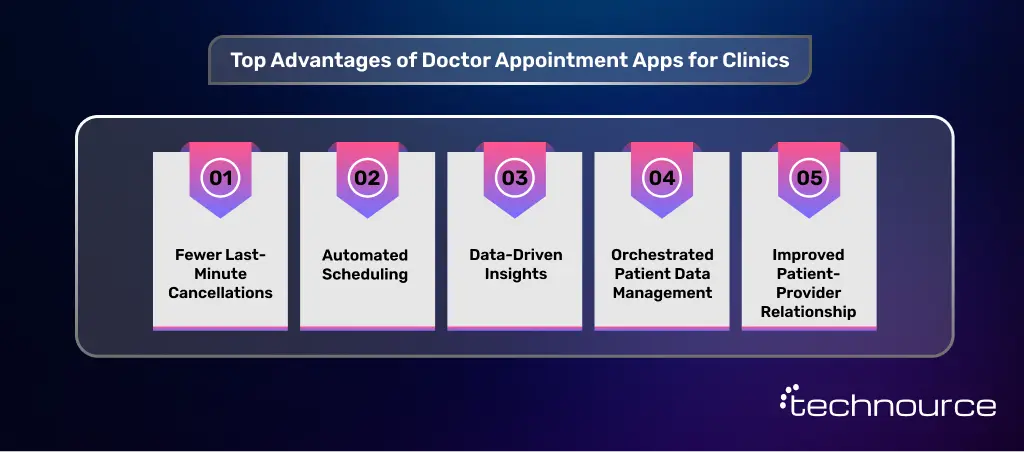
Top 5 Benefits of Doctor Appointment Booking App for Clinics
The benefits of doctor appointment booking apps help a clinic streamline its operations by reducing redundant work. Here you go:
1. Fewer Last-Minute Cancellations
According to Healthcare Finance, no-show for primary care costs a clinic approx. $200 per hour, ranging between 5-30%. On that note, doctor scheduling applications are beneficial because they send SMS, push notifications, and emails to reduce no-shows and keep patients informed about upcoming visits.
2. Automated Scheduling
Physically, appointment management takes a lot of time. The doctor booking application reduces the need for manual labor by automating repetitive tasks. An application enables clinics to update doctor availability, prevent double bookings, and streamline operations.
3. Data-Driven Insights
The dashboard of a doctor booking app is developed using AI, NLP, and ML. This helps clinics improve patient retention and track appointment numbers, etc. Moving ahead, these insights enable in-demand forecasting, staffing adjustments, and smarter decision-making.
Over time, the information can highlight patterns, such as which services are attracting more patients and which time slots are causing more cancellations.
4. Orchestrated Patient Data Management
Doctor booking applications connect with EMR or EHR systems to give healthcare providers instant access to patient symptoms, histories, and past visits. This nuanced view helps healthcare providers create smart, efficient plans to deliver personalized care.
5. Improved Patient-Provider Relationship
A seamless, user-friendly relationship between the patient healthcare service provider helps a clinic to cut through the noise. Smart features like quick payments, personalized reminders, and easy communications establish long-term loyalty and trust.
A good experience not only keeps patients engrossed in an application but also compels them to leave positive reviews. Besides, they are more likely to come back for future visits.
Top Benefits of a Doctor Appointment Booking Application
According to Data Horizon Research, the North American doctor appointment booking app market size was 1.5 billion in 2023 and may reach 5.3 billion in 2033. This number denotes the exponential growth of the app market. Amidst that, the maximum engagement comes from the patients due to its multiple benefits.
1. Quick and Transparent Doctor Selection
A thoughtfully curated application provides patients with clear visibility into doctor ratings, credentials, specialties, and consultation charges. Also, patients can compare options, enabling them to make informed decisions.
This transparency develops trust and motivates patients to maintain long-term patient engagement.
2. 24*7 Accessibility
With doctor booking applications, patients don’t have to wait in the queue to book an appointment. They can easily schedule/reschedule an appointment with a single click. This facility is helpful, especially for busy individuals, older adults, and those who need regular checkups.
3. 360 Degree Health Management
Modern scheduling apps let patients store prescriptions, test results, and medical history in one place. This unified view enables them to track treatments, follow diet plans, and share medical information with doctors. This develops a more connected and informed care experience.
If you’re planning to develop your healthcare application, it’s essential to focus on scalability, compliance, and user experience from the very beginning.
How does an Application for a Doctor’s Appointment Work?
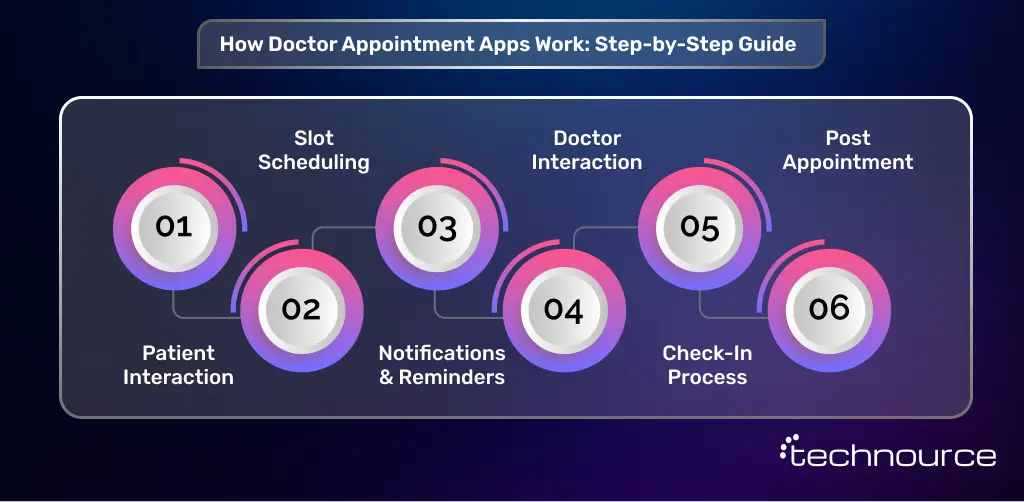
Doctor app booking is a smart system that helps clinics and patients connect by bridging the gap. The working methodology of a doctor booking app revolves around organizing, scheduling, and managing appointments from both ends—clinics and patients —supported by advanced software development trends such as automation and AI integration.
Let’s have a closer look at the breakdown of how it works:
1. Patient Interaction
According to the clinical condition, rating, and location, patients search for doctors. Based on available appointment slots, patients choose doctors based on convenient dates and times.
2. Slot Scheduling
Once a patient books the slot, a confirmation message is sent to him/her. The same appointment notification is sent to the doctor. Next, the calendar is automatically updated with the scheduled date.
3. Notifications and Reminders
The mobile app sends continuous notifications to patients, reminding them of their appointments. Also, the doctors are reminded about an appointment. Based on the doctor’s availability,
4. Doctor Interaction
From the app interface, doctors can view appointment times and patient details, including specific clinic conditions, previous checkup history, and prescribed medications.
5. Check-In Process
Patients can use the app to check in upon arrival at the clinic. The application sends an alert to the clinic and doctors.
6. Post Appointment
Once the visit is complete, the system schedules the next booking based on the patient’s condition. Also, a patient can provide feedback on an appointment through a doctor appointment booking app.
Key Features to Include During Doctor Appointment App Development
Before you engage yourself in the doctor appointment application development procedure, let’s have a clear idea about the features that you must incorporate. It should be user-centric and easily accessible for both patients and healthcare providers.
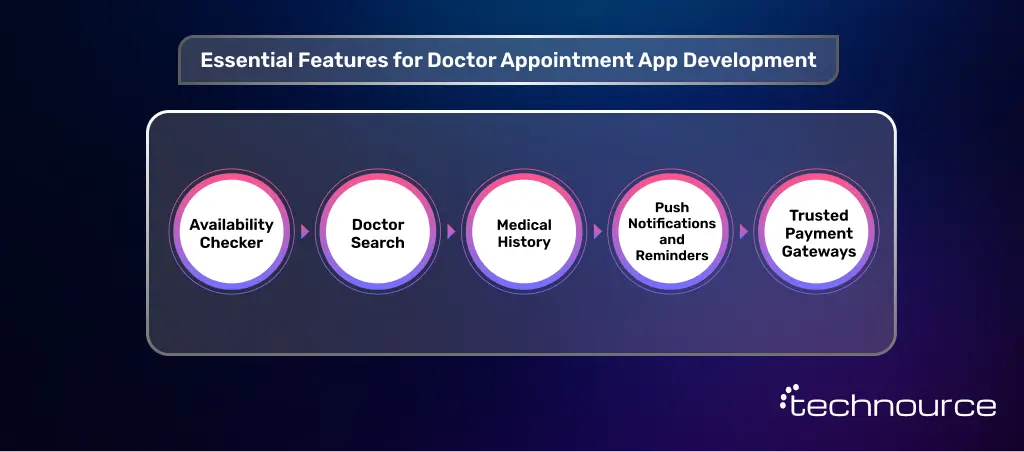
Top 5 Doctor Appointment Scheduling App Features for Patients
These features emphasize simplicity, accessibility, and reassurance to help patients manage things easily.
1. Availability Checker
This is one of the primary functionalities of the application, helping patients to check the doctors’ real-time availability. The interface must make it easier to cancel or reschedule without friction.
2. Doctor Search
Patients must be able to browse and filter specialists by location, availability, experience, and language spoken.
Let’s hear it from Magnolia, a COPD patient, “My chronic health issue prevents me from searching and booking the best doctor manually. However, my partner suggested a doctor appointment booking application to me. In the same, I apply the filters and choose a specialist based on certain criteria. It helps me a lot by providing me access of multiple specialists with a single click.”
3. Medical History
A specialist booking app must include an option to enter a patient’s basic details, such as gender, age, allergies, current medications, and insurance information.
4. Push Notifications and Reminders
Consistent reminders and no-shows reduce and improve patient engagement. Some common instances include changes to doctor availability, confirmation, and reminders.
5. Trusted Payment Gateways
Patients must have access to reliable payment gateways, such as PayPal, Stripe, or Apple Pay, to process transactions. This feature must include refund options, automatic invoicing, and transparent pricing.
Top 4 Key Doctor Appointment Booking App Features for Clinics
An app must be designed for productivity, clarity, and uniformity for multiple tasks. This enables healthcare providers to view patient information, manage appointments, and communicate securely.
1. Appointment Confirmation/Cancellation
Efficiently handling last-minute changes is pivotal to a doctor booking app. The app interface must be designed uniquely so that the clinics can approve/reschedule/ cancel appointments based on a doctor’s consent. Also, the message must be sent to the patient regarding the current status of their booking.
2. Calendar Management
Clinics must have a dynamic scheduling system that syncs across all devices. It must handle cancellations, appointments, and reschedules automatically.
3. EHR/EMR Integration
The application must have access to EMR or EHR systems that can review prescriptions, patient histories, allergies, and past diagnosis results without switching applications.
4. Performance Dashboard
Healthcare providers and doctors benefit from engaging dashboards that show valuable information, such as weekly/daily appointment volume, average consultation time, no-show rate trends, and patient satisfaction rates.
Advanced Features that Help a Doctor Booking App Stand Out
Smart Search Option- An app with this option enables patients to filter the doctors’ profiles by location, rating, desired treatment, etc.
AI-powered Symptom Checker- Voice AI agent or agentic chatbots can interpret the existing symptoms and provide generalized insights, including consultations.
Scheduling Optimization- By studying the user patterns, ML can predict cancellations, balance doctor availability, and optimize appointment slots.
Multiple Payment Options- The application must have various payment options so that a patient can pay easily.
Multi-Lingual Support- If an app targets diverse markets, then it must offer a multi-lingual support option. This will help a patient to book a doctor appointment with maximum user comfort.
Smart Reminders- A doctor scheduling application should have a smart reminder option to send personalized notifications directly to the patients’ mobiles.
Doctor Appointment App Development Process: A Step-by-Step Guide
Developing an app for doctor appointments needs a smart, orchestrated strategy. This will help healthcare providers attract more patients in this competitive landscape.
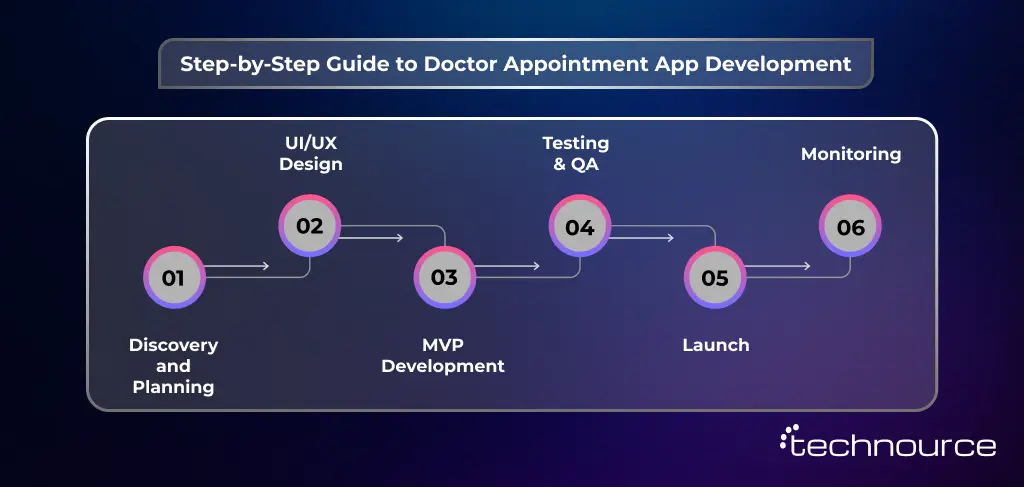
The development process has six phases. Based on your clinic size and requirements, you can adjust the scope of app development. Here are the steps:
Step 1- Discovery and Planning
The objective of this phase is to understand the business outcomes, patients’ chronic issues, and the regulatory scope before you start developing a doctor consultation app.
5 Things to Follow During this Stage
1. Real-Life User Interviews and Workflow Mapping: Gather data by interacting with the people who handle the regular chores in your clinic, including clinicians, front-desk staff, patients, compliance officers, and billing teams.
2. User Research: Conduct short surveys and interviews to detect noise like no-shows, insurance verification failures, etc. This will help you to understand what’s the current scenario.
3. Market Research: Identify your competitors, jot down their features and how those are helping them to stand out. Also, check compliance frameworks and data rules to assess how things are currently moving.
4. Prioritize MVP Scope: Put attention on core MVP features, including doctor search, user onboarding, push notifications, booking flow, etc.
5. Technical Blueprint: Ask your in-house technical team to develop a next-level architecture, including frontend, backend stack, and hosting.
What are the Key Deliverables?
Patient personas
Problem statement
Architecture and integration development planning
MVP scope
Assessment of competitors’ operation methodology
Step 2- UI/UX Design
Once you’re done with initial market research and MVP scope assessment, the next phase is to start UI/UX design services. Ensure that you have an expert team that can handle this. Otherwise UI/UX mistakes can spoil the entire app interface.
5 Things to Focus on During UI/UX Development
1. Structural Foundation: Discuss with the internal design team and define the informational architecture across the primary modules- the admin console, the patient dashboard, and the doctor portal. Map patient and doctor roles, data visibility levels.
2. Critical Flows Assessment: From discovering the doctor’s name to make paymaking through payment gateways- design all the important flows. Also, curate the prototype to guide a patient if a doctor suddenly cancels the scheduled appointment.
3. Build Trust Factor: Your doctor appointment app development solution must assure the patients that they’re in the right hands. To keep the promise, build trust by including verified doctor credentials, expert-level badges, transparent pricing, and clear language.
4. Constant Tone and Functionality: The internal design team must establish a reusable design system. Define typography, spacing, and colors to keep the tone uniform.
5. Prototype Development: Create clickable prototypes for web and mobile. For example, run 3-4 usability testing loops with 9-10 target users. Collect their feedback and iterate accordingly between sessions.
What are the Key Deliverables?
Ready-to-use wireframes and complete user flows
Updated design system
Interactive prototypes
Thoroughly designed content style guide
Step 3- MVP Development
The objective is to make the first working version of a doctor appointment booking app. With this, the developers will understand how real users schedule doctor appointments and manage the healthcare experience.
5 Things to Focus on During MVP Development
1. Simple and Functional User Journey: A doctor appointment booking app development must make the user journey functional and simple. This enables delivering core value without complexity.
2. Core Functionality Development: The app must be built in a way that allows patients, administrators, and doctors to communicate with each other seamlessly.
3. Data Privacy: During the MVP development, prioritize data security and privacy. This ensures compliance when developing patient information.
4. Short, Focused Sprints: MVP development takes 9-14 weeks, structured into short sprints. Divide the sprints into early, mid-phase, and final phase.
5. Maintain Stability: Ensure that performance, stability, and security are maintained throughout the process.
What are the Key Deliverables?
Functional MVP with the latest features for maximum engagement.
Secure infrastructure.
Tested product, ready to use for pilot project.
User feedback collection and improvement plan.
Step 4- Testing and QA
The objective of this phase is to ensure that the delivered feature is accessible and efficient for all users. Testing a mobile application rigorously ensures that the final product meets all end-user requirements.
7 Things to Focus on in the Testing Phase
1. Funtcionality: Check that the application works as expected in a given real-world scenario. Verify all the aspects of the application to ensure everything works fine before deployment.
2. Compatibility: The app for doctors’ appointments must perform seamlessly across all mobile devices and web platforms. Ensure that the QA team tests it across multiple operating systems, including Android, iOS, and web browsers.
3. Performance: The goal in performance testing is to evaluate how the system behaves under peak moments. Create pressure load moments and test how the application tackles them.
4. Security: An appointment scheduling application deals with multiple types of sensitive health information. Run manual and automated scans to find the weak spots. Ensure file uploads are secure and the data is encrypted.
5. Privacy: The application must comply with frameworks like GDPR, HIPAA, and local data protection laws. Therefore, it must be tested to confirm that the patient records are stored properly.
6. Accessibility: This point confirms that users with disabilities can use a doctor appointment booking app. The internal QA team must run screen-reader paths, check color contrast ratios, and test keyboard-only navigation.
7. Interoperability: If an app is integrating with multiple medical systems, interoperability testing verifies that it exchanges data properly.
What are the Key Deliverables?
Test planning, real-life cases, and report generation.
Optimization backlog generation.
Penetration test report.
Statement of accessibility confirmation.
CI/CD integration report
Step 5: Launch
This stage involves launching the scheduling application. Here, the developers track performance, issues that occur during sessions, and gather user feedback quickly. In a nutshell, this step bridges the gap between users’ accessibility and product development.
6 Things to Focus on in the Launch Phase
1. App Store Readiness: Fill privacy labels, upload screenshots and include review notes required for approval.
2. Data Migration: If you’re migrating from a legacy app, ensure the team is importing key data for better accessibility without losing the core features.
3. Check Legal Setup: Finalize privacy policy, terms of use and handle medical data safely.
4. Limited Pilot Strategy: Begin with a small target, such as launching the application with a small network or a user group. This limited rollout helps with test performance, the accumulation of feedback, and the making of adjustments accordingly.
5. Gradually Introduce Advanced Features: Set small goals during the launch for introducing smart, automated features like telemedicine, online payments, etc. This will help the development team understand how to incorporate changes without compromising the speed of the current workflow.
6. Set Up Analytics: Track conversion rates and measure booking satisfaction easily by setting up analytics.
What are the Key Deliverables?
Successful limited app launch.
Documentation package compliant.
Verified app store listings.
Live dashboard monitoring report
Data migration logs.
Step 6- Monitoring
Are you ready to monitor how your product is performing across operational, technical, and business dimensions? This stage will enable the team to quickly analyze issues, measure progress, and maintain a user-centric experience.
Top 4 Key Performance Indicators to Focus on in the Monitoring Phase
1. Engagement Metrics: Check every detail, including user engagement rates, cancellation numbers, and average time-to-appointment. This will help you to deduce the customer satisfaction score (CSAT) with the doctor scheduling application.
2. App Health: Monitor application health, including error logging, API latency, crash-free sessions, delivery rates, and push notifications.
3. Check Security Signals: Check abnormal data exports, failed login attempts, and admin action logs.
4. Business Performance:Monitor average revenue per user (ARPU) and marketplace fill rate to understand how the application is performing.
What are the Key Deliverables?
Unified monitoring dashboard
Real-time ticketing systems with communication tools.
Regular performance report
Automated error tracking
What are the Technical Stack Requirements for Doctor Consultation App Development?
Successful doctor appointment application development has many things. One of the primary foundations is the tech stack, comprised of frontend and backend. Choosing the right tech stack plays a crucial role in ensuring scalability, security, and long-term performance. Let’s have a look:
Backend Development Tools: The Application Engine
The backend tools manage all data, logic, and API communication for the doctor application.
Databases: MySQL/PostgreSQL for relational data and Cassandra/MongoDB for non-relational data are used to meet compliance standards.
Programming Languages: Python or Java are used for security features, enterprise-grade stability, and support developer ecosystems.
Frameworks: Node.js is used due to its high-speed, intensive task completion time.
Frontend and Mobile App Development Tools
The choice between cross-platform and native tools impacts development and performance. It is directly linked to development costs and performance.
Cross-Platform Mobile App Development: React Native or Flutter boosts time-to-market by using a single codebase for Android and iOS.
Native Mobile Development: If you want a performance-centric application for maximum user experience, Swift/Kotlin is the #1 choice. For a seamless Android experience, Java and Kotlin are the top choices, supported by robust tools.
Web App Development: Vue.js or React.js is used for doctor-facing and administrative web portals. This offers dynamic, smart, and data-rich interfaces.
API Integrations
To make a doctor booking app smart, connected, and convenient, choose FHIR/HL7 for healthcare compliance. To link patient records directly, connect to EHR systems. For complex workflows, choose a microservices architecture.
Component
Tools
Why It Matters for Healthcare
Database
MySQL, PostgreSQL
To maintain transaction privacy and robust integration capabilities.
Backend Language
Python, Java
Security, stability, and AI/ML readiness.
Mobile (Native)
Kotlin, Swift
Next-level security features and optimal performance.
Version Control
Git, GitHub/GitLab
Change logs are auditable and important for compliance.
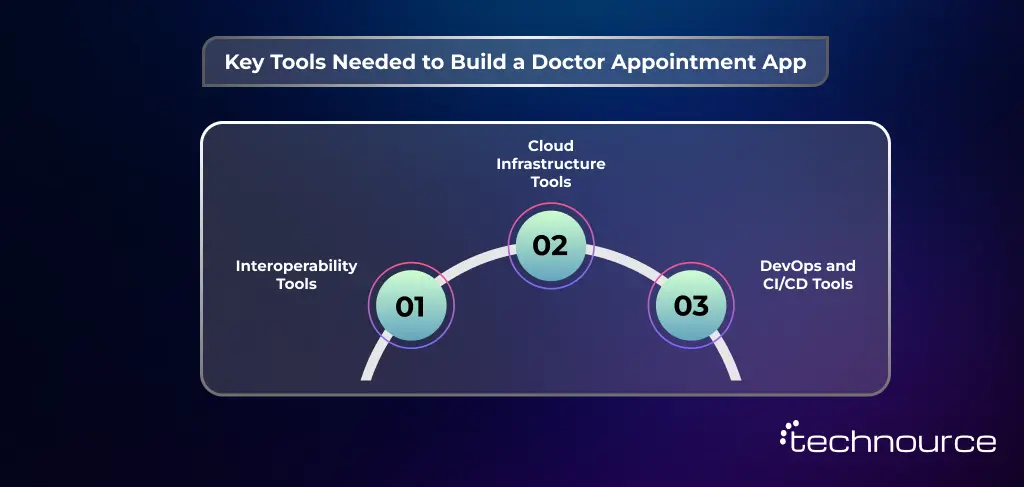
What are the Critical Tools that Help in Doctor Appointment App Development?
Tools are primary for robust app development. It maintains application standards and governs data exchange.
1. Interoperability Tools
If you have any existing apps, interoperability tools can integrate them with the new one. This ensures that no patient data is lost.
Health Level Seven: A traditional data exchange standard that enables libraries and tools to generate HL7 messages.
Fast Healthcare Interoperability Resources: Using FHIR SDKs and APIs helps in real-time, seamless data exchange.
2. Cloud Infrastructure Tools
An app for doctors’ appointments should handle spikes in peak traffic. That is why app scalability is important, and it is achieved through a modern cloud solution.
Serverless Computing: Azure functions or AWS Lambda can be used for cloud-based application development This reduces costs and time in the long term.
Containers & Orchestration: Kubernetes for smart, automated deployment and Docker for containerizing services help in scalable delivery.
API Gateway: Tools like Azure API Management or Amazon API Gateway are important for API development, as they help secure, manage, and monitor API calls your application generates.
3. DevOps and CI/CD Tools
CI/CD tools automate the release procedures. This ensures reliable, rapid, and secure updates, making CI/CD development solutions essential for modern application delivery.
Infrastructure as Code: CloudFormation or Terraform to manage cloud resources, ensuring auditable and consistent environments.
CI/CD Pipelines: GitLab CI, Jenkins, or GitHub Actions are used to automate code testing, development, and deployment.
What are the Compliance Requirements for Doctor Appointment Application Development?
As of now, we have discussed coding, development, and deployment. However, it’s not about technical things. Instead, the developers must comply with stringent regulations to protect patient privacy and ensure the application’s security.
1. Data Protection Regulations
To protect personal data in Europe, the GDPR must be strictly enforced. This law gives people more control over information. GDPR compliance is all about being responsible and respectful with patient information.
2. HIPAA Compliance
It protects patient health information and allows people to keep their health insurance when they change jobs. In a doctor appointment app development solution, HIPAA compliance denotes that you use robust security measures like encryption and access controls.
3. Healthcare Industry Standards
PCI DSS is one of the essential standards that safeguards online payments. Besides, the HITECH Act encourages clinics to secure digital records.
Doctor Appointment App Development Challenges You Must Know
Developing a doctor’s appointment app comes with unique challenges. Fortunately, you can overcome them with strategic planning and timely execution.
1. Real-Time Booking Conflicts
The schedule of doctor-patient appointments changes constantly due to unforeseen reasons. This extends working hours and creates a long patient waiting queue.
Also, if multiple users are booking at the same time or the clinic uses an external system, then data sync becomes complex. As a result, the patient becomes frustrated and seeks another option.
Solutions
Incorporation of a centralized booking engine serves as the single source of app access. This allows users to use the application without switching to different menus.
Implementation of locking mechanisms can prevent booking. This is helpful for scenarios when two patients try to book the same slot.
Utilization of horizontal scaling and caching to maintain real-time performance under peak load pressure.
Development of a retry and reconciliation service, which prevents data from being mismatched between systems.
2. Non-Understanding of Application Design
If an app looks clumsy, impersonal, or insecure, the users will quit the application. Also, a cluttered app interface will create a communication challenge.
Solutions
Focus on UX transparency and clarity, which brings clear explanations to patients.
Show encouraging security texts like “All data encrypted”, to boost patient engagement.
Incorporate calm color pallets, consistent UI patterns, and high readability fonts for maximum engagement.
Develop onboarding information, showcasing how it educates users and how their data is handled.
3. Integration Issues
Many healthcare providers still rely on outdated EMRs that may lack modern APIs. Integrating with those apps creates a complex situation during doctor app development.
Solutions
Use HL7 and FHIR as the base data models to convert legacy data into a newly developed app.
Choose ETL to support periodical sync if real-time integration isn’t an ideal option.
Focus on data integrity and maintain version logs to detect overwrites.
Develop a phased integration strategy. Begin with read-only access, and enable write operations once stability is established.
4. Regulatory and Security Difficulties
Developers may underestimate the regulatory standards and regional privacy laws. This may lead to security breaches, costing millions in fines and tarnishing the reputation.
Solution
Follow compliance from the beginning of the doctor consultation app development with design privacy principles.
Include role-based access control.
Use encryption to safeguard patients’ health information.
Segregate analytics information from detectable patient data.
5. Localization Challenges
Expanding an app needs to address cultural expectations, usability and accessibility across multiple devices and demographics. For example, an application catering to a specific region may not be suitable for another due to language and cultural differences.
Solution
Develop a multi-lingual architecture from the beginning to make it widely accessible.
Finalize UX and content based on the region’s culture. This will help patients act accordingly without a language or cultural barrier.
Include smart features like high-contrast themes, screen reader support, and large tap targets.
Conduct usability testing in each target to ensure cultural relevance and linguistic accuracy.
What is the Cost to Develop a Doctor Appointment Application?
According to the Deloitte US Center for Health Solutions, healthcare leaders in various parts of the world are trying to drive efficiencies, enhance patient engagement, and boost productivity through centralized operations. On that note, the development of a doctor scheduling application plays a crucial role.
This begs the following question: “What is the cost of developing a doctor appointment booking app?”
Calculating the financial investment for doctor appointment application development requires a nuanced approach in 2026 and beyond. The price is driven by intelligence depth, system interoperability, and data security. Let’s have a detailed look:
Regulatory Compliance: Constantly meeting HIPAA standards and ensuring GDPR compliance adds 30-40% to the development cost.
Security: Incorporating end-to-end encryption for data, securing multi-factor authentication, and maintaining audit logs adds cost in the development stage.
AI and Automation: Incorporation of AI-powered chatbots, NLP-driven assistants to tackle difficult medical queries add significant costs.
System Interoperability: Integrating newly developed software with legacy software is a significant investment.
Usability and Design: Developing an interface that matches the needs of both parties, i.e., clinics and patients, requires extensive research, related to more expenditures.
Continuous Operational Expenses: You need to set a budget for annual maintenance. This costs 30-35% more resources than the initial set budget.
The cost is categorized into three tiers based on the project scope.
Application Complexity Level
Key Features
Estimated Cost
Basic Level App
Call scheduling, email reminders, and payment gateway integration
$50,000-$80,000
Mid-Level App
AI-powered chatbots, telemedicine, and multi-lingual customer support
Real-world Doctor Appointment Scheduler Software Solutions
Smart, automated, efficient doctor appointment-scheduling solutions are helping patients and healthcare providers alike. Patients can schedule/reschedule/ cancel appointments based on their availability.
On the other hand, clinics are maintaining doctor appointments and arranging further treatment with a single click in the application. This is impacting revenue and enhancing patient satisfaction. Here are some popular healthcare apps:
1. Zocdoc
A leading healthcare marketplace that allows patients to book doctor appointments. Established in 2007, it has 175+ calendar integrations with renowned health plans like Blue Shield of California.
Core Features:
AI appointment scheduler
Real-time appointment display
Live availability synchronization
Insurance verification
Automated reminders
Multiple booking touchpoints
Ideal for:
Marketplace reach
Doctor discovery
Clinics seeking maximum booking channels
2. Practicesuite
A cloud-based EHR platform and medical practice management offering billing, scheduling, clinical documentation, and patient portal.
Core Features:
Patient check-in/check-out
Intuitive appointment scheduling
Automated patient reminders
Integrated patient portal
EHR with lab integration
Ideal for:
Patients having mobility issues
Small to mid-size practices
3. Skedulo
This is a smart, intelligent scheduling platform developed for home health agencies. Skedulo optimizes appointment allocation based on provider skills, travel time and patient preferences.
Core Features
Patient matching
Intelligent scheduling engine matching clinics with patients
HIPAA compliant
API integrations
Ideal for:
Home health organizations
Healthcare networks
Future Trends in Doctor Scheduling Appointment Apps
Are you ready to embrace the future of doctor appointment app development solutions? Technology is consistently acting as the magic wand, transforming the existing app development landscape. Upgrade your application performance with these smart, augmentative technologies:
Health AI Agent Integration: Help the patients by providing them with granular knowledge about understanding their medical records and connecting with the licensed doctors accordingly. In 2026, Amazon launches a health AI agent on the app and website with free 24*7 access. This agent answers questions, explains health records, schedule appointments based on a patient’s requirements.
Telemedicine Integration: Integrate the healthcare applications with existing EHR/EMR systems. This trending technology will help doctors access a patient’s medical history.
Cloud Computing: It enables storing more doctor profiles and their information within a single application. This will help doctors quickly access patient data and evaluate the patient’s health report.
Wearable Device Connectivity: Devices like smartwatches and fitness brands gather health care data like oxygen levels and heart rates from patients. The collected data is then shared with doctors. Next, the specialists review them and provide the necessary advice to the patient based on the clinical condition.
Why Choose Technource as Your Reliable Partner for Doctor Appointment Booking App Development?
If you’re ready to develop a doctor consultation application project, Technource is one step ahead to help you achieve your desired results. As a renowned healthcare software development company, we know how to make your application smart, responsive, and HIPAA-compliant.
Since our inception, we have worked with mental health, diagnostics, small clinics, and large enterprises. Our developed solutions helped these companies to gain favorable results.
We only work based on the latest tech stacks, bringing the most value for your hard-earned bucks.
At Technource, our team is constantly designing and developing healthcare solutions while keeping security and compliance at the core of the software architecture.
Not only development and deployment, but we’re here to take care of your application even after the launch. Our team constantly tests the application in real-world scenarios to assess its performance.
If you still have questions, feel free to reach out to our healthcare software development expert. Let’s transform your idea into a real-life application, together!
FAQs
These apps reduce waiting times in long queues, cut paperwork, and let providers offer top-notch online care.
You will receive a separate profile that allows you to add doctors’ availability and other details.
The basic MVP development may take up to 16 weeks. However, the timeline depends on multiple factors, such as app complexity, features, integrations, and the development team’s expertise, etc.
Absolutely. The developed app will support built-in video calling for secure, remote checkups.
Of course. Doctors and patients can view prescriptions, history, and reports anytime.
Check the selected company’s rating, approx. cost of development, past client reviews, tech stacks used, and the project timeline.
Shailesh Gujjar is a Team Leader at Technource with over 10 years of experience as a web and mobile development expert. He specializes in JavaScript technologies like Node.js, React, and Angular, as well as mobile platforms including native Android, Flutter, and React Native. Shailesh leads end-to-end development projects, ensuring secure, high-performance solutions through strong technical and leadership capabilities.
Request Free Consultation
Amplify your business and take advantage of our expertise & experience to shape the future of your business.