
Blog Summary
This guide explains healthcare interoperability in 2026: how HL7 v2 and FHIR APIs work together, which integration architecture fits your product, and which federal rules set the deadlines. You will also see realistic costs and timelines, an eight-step build process, and two Technource case studies with measured results.
Key Takeaways
- Healthcare interoperability costs $3,000-$8,000 for a FHIR proof of concept, $20,000-$50,000 for most integrated MVPs, and $60,000-$100,000 for enterprise MVPs.
- A FHIR proof of concept takes 2–4 weeks. Most integrated MVPs go live in 8–16 weeks, and enterprise MVPs take 4–6 months, with EHR vendor approvals often setting the pace.
- Most products need both standards: keep HL7 v2 for legacy event feeds and expose FHIR R4 APIs for apps, payers, and TEFCA exchange.
- Standards adoption still lags: 91% of hospitals integrate third-party data into their EHR for clinical use, but only 52% do it through a standards-based API (ASTP/ONC, 2026).
- Technource healthcare builds delivered 50% faster clinical decision-making (My Vital View) and 65% faster e-prescribing approvals (Telepath).
Your product has to talk to EHRs, labs, pharmacies, and payers before a single clinician trusts it.
Healthcare interoperability has improved fast. In 2025, 76% of U.S. hospitals sent, received, found, and integrated outside patient data electronically, up from 70% in 2023 (ASTP/ONC, 2025 data).
Spending follows that need. According to Grand View Research, the healthcare interoperability solutions market is estimated at about $5.1 billion in 2026 and is projected to reach about $12.9 billion by 2033.
Yet a connection is not the same as interoperability. Records that arrive as a PDF or fax, or land in the wrong patient chart, still force clinicians to retype them.
The real problem is architecture: choosing the right standard, integration pattern, and budget before the first interface is built.
What Is Healthcare Interoperability?
Healthcare interoperability is the ability of different health IT systems, such as EHRs, lab systems, pharmacy platforms, payer systems, and patient apps, to exchange data and use it without manual re-entry. Interoperability works across four levels, from moving data between systems to shared meaning and governance across organizations.
Most projects stall at the third level. The data moves, but the receiving system cannot map codes, units, or patient identities on its own.
| Level | What It Means | Example |
|---|---|---|
| Foundational | One system can send data, and another can receive it | A lab result arrives as an attached PDF |
| Structural | Data follows a defined format with known fields | An HL7 v2 ORU message carries each result in its own segment |
| Semantic | Both systems share codes and meaning | A FHIR Observation uses LOINC codes the EHR understands |
| Organizational | Consent, policy, and governance support exchange between organizations | A health system shares records through a TEFCA network |
Why Does Healthcare Interoperability Matter in 2026?
Healthcare interoperability matters in 2026 because federal rules now require standards-based data exchange, and products that cannot plug into EHRs and payers struggle to win contracts. Clean data exchange also removes manual re-entry, speeds clinical decisions, and gives AI features reliable data to work with.
| Benefit | What Changes | How It Works |
|---|---|---|
| Complete patient view | Clinicians see outside records at the point of care | Summary of care records and results flow into the EHR automatically |
| Less manual re-entry | Staff stop retyping faxes, PDFs, and portal exports | Integration engines and FHIR APIs write structured data directly |
| Faster care decisions | Abnormal results and device readings reach the right person sooner | Event-driven feeds trigger alerts and tasks in real time |
| Prior authorization automation | Approvals move from fax and phone to APIs | FHIR-based Prior Authorization APIs connect provider and payer systems |
| Faster partner onboarding | New hospitals and clinics connect without fresh custom builds | Reusable FHIR APIs and mapping templates replace one-off interfaces |
| AI-ready data | Models work on coded, consistent records | FHIR resources with standard codes feed AI pipelines |
Standards adoption is the gap to close. According to ASTP/ONC, 91% of hospitals integrate data from third-party technology into their EHR for at least one clinical purpose, but only 52% do it through a standards-based API (2026).
Benefits for Providers and Health Systems
Providers gain time back from data handling and see fuller records when they make decisions.
- Clinicians see outside labs, medications, and notes inside the EHR instead of separate portals.
- Staff spend less time on fax queues and duplicate entry, especially when AI-powered workflow automation handles document intake.
- Quality reporting gets easier because data arrives coded and complete.
Benefits for Healthtech and SaaS Product Teams
For product teams, interoperability decides how fast you can sell into health systems.
- Hospital IT and security reviews now expect FHIR R4 and SMART on FHIR support from vendors.
- A reusable integration layer lets a healthtech SaaS platform onboard each new customer without rebuilding interfaces.
- Clean, structured data makes later features such as analytics, alerts, and AI possible.
Building a healthcare product that has to talk to EHRs but not sure where to start?

What Are the Main Healthcare Interoperability Standards?
The main healthcare interoperability standards are HL7 v2 for real-time event messages, FHIR R4 for APIs, C-CDA for clinical documents, X12 for claims and eligibility, DICOM for imaging, and NCPDP SCRIPT for e-prescribing. Most products use two or three of them, chosen by the systems they connect to.
| Standard | What It Carries | Typical Use |
|---|---|---|
| HL7 v2 | Event messages (ADT, ORM, ORU, SIU) | Admissions, orders, and results between hospital systems |
| FHIR R4 | Resources over REST APIs in JSON or XML | Apps, patient access, payer APIs and TEFCA exchange |
| C-CDA | Structured clinical documents | Discharge summaries and care transitions |
| X12 | Administrative transactions | Claims, eligibility checks and remittance |
| DICOM | Medical images and their metadata | Radiology and imaging workflows |
| NCPDP SCRIPT | Prescription messages | E-prescribing between prescribers and pharmacies |
HL7 v2: The Messaging Workhorse
HL7 v2 is a pipe-delimited messaging standard that hospital systems use to announce events such as admissions, orders, and results. Each message is triggered by an event and sent over a TCP connection, usually through an integration engine.
The catch is variation. Two hospitals can both send an ADT A01 admit message and still fill the fields differently, so every new site needs mapping and testing.
FHIR R4 and FHIR APIs
FHIR R4 breaks health data into resources such as Patient, Observation, MedicationRequest, and Encounter, and exposes them through REST APIs. Developers read and write data with standard HTTP calls and JSON, which shortens onboarding for web and mobile teams.
US Core profiles define which fields U.S. systems must support. Bulk FHIR exports large patient groups for analytics and quality reporting.
Patient-facing adoption is broad. According to ASTP/ONC, about 70% of hospitals let patients access their data through FHIR-based apps in 2024.
SMART on FHIR and CDS Hooks
SMART on FHIR adds OAuth 2.0 authorization, so a third-party app can launch inside the EHR with the right patient and user context. CDS Hooks lets the EHR call an outside service at moments such as opening a chart or signing an order, then shows the advice as a card.
Together, they let you ship features that clinicians use inside the EHR instead of behind a separate login.
C-CDA, X12 and DICOM
C-CDA still carries most care-transition documents, X12 still runs claims and eligibility, and DICOM remains the imaging standard. Plan for them when your product touches referrals, billing, or radiology.
HL7 vs FHIR: What’s the Difference?
HL7 v2 pushes event messages between systems over TCP, while FHIR exposes data as resources through REST APIs that apps can query on demand. FHIR does not replace HL7 v2 in most hospitals: v2 still runs internal event feeds, and FHIR serves apps, payers, and national exchange.
| Criteria | HL7 v2 | FHIR R4 |
|---|---|---|
| Data model | Event-based messages | Resource-based REST APIs |
| Format | Pipe-delimited text | JSON or XML |
| Transport | TCP/MLLP | HTTPS |
| Data access | Pushed when events happen | Queried on demand or pushed by subscription |
| Learning curve | Steep and site-specific | Lower for web developers |
| Federal status | Widely used, not the basis of new API rules | Required for certified APIs and CMS payer APIs |
| Best for | Admissions, orders and results inside hospitals | Apps, patient access, payers and TEFCA |
Technource’s Recommendation
Don’t rip out working HL7 v2 feeds. Put an integration engine in front of them, map events into FHIR resources, and expose FHIR R4 APIs to apps and partners.
You get modern APIs without asking hospitals to change their core systems.
Which Regulations Drive Healthcare Interoperability?
Five U.S. frameworks drive healthcare interoperability in 2026: the 21st Century Cures Act information blocking rules, the HTI-1 rule with USCDI v3, the CMS-0057-F payer API rule, TEFCA, and HIPAA. Together, they decide which data you must share, in which format, and how securely.
| Rule | Applies To | Key Requirement |
|---|---|---|
| Cures Act information blocking | Providers, certified health IT developers, networks and exchanges | Do not unreasonably restrict access, exchange, or use of electronic health information |
| HTI-1 and USCDI v3 | Developers of certified health IT | USCDI v3 became the baseline data set on January 1, 2026 |
| CMS-0057-F | Medicare Advantage, Medicaid, CHIP and ACA marketplace payers | Patient Access, Provider Access, Payer-to-Payer and Prior Authorization FHIR APIs by January 1, 2027 |
| TEFCA | Networks and organizations that join through a QHIN | Exchange under the Common Agreement through 11 designated QHINs |
| HIPAA | Covered entities and business associates | Administrative, physical, and technical safeguards for PHI |
The deadlines are close. ASTP/ONC made USCDI v3 the required baseline for certified health IT on January 1, 2026, and CMS requires impacted payers to have their FHIR APIs live by January 1, 2027.
TEFCA is scaling fast. According to ASTP/ONC, more than 71,000 sites participate through 11 QHINs, and HHS reported over 1 billion health records exchanged by June 2026.
Every HL7 feed or FHIR API that carries PHI needs HIPAA-required safeguards: encryption, access controls, audit logs, and a business associate agreement with each vendor.
Teams that run a HIPAA compliance checklist before go-live catch missing audit logs and vendor agreements early.
This section is general information, not legal or regulatory advice. Confirm your obligations with qualified healthcare counsel.
Not sure whether CMS-0057-F, USCDI v3, or information blocking rules apply to your product?

What Does a Healthcare Integration Architecture Look Like?
A healthcare integration architecture is the layer that connects your product to EHRs, labs, payers and devices, usually through an integration engine, a FHIR server and an API gateway. Most products choose one of five patterns: point-to-point, integration engine hub, FHIR facade, API gateway or event-driven.
| Pattern | Best For | Trade-off |
|---|---|---|
| Point-to-point | One or two connections | Each new system adds another custom interface |
| Integration engine hub | Many HL7 v2 feeds across sites | Needs engine licensing and interface specialists |
| FHIR facade | Legacy systems that must expose FHIR APIs | Mapping quality decides data accuracy |
| API gateway | Apps and partners calling FHIR APIs | Needs strict OAuth scopes and rate limits |
| Event-driven | Real-time alerts, analytics and AI pipelines | More moving parts to monitor |
Core Components of an Interoperability Layer
Most production builds share the same building blocks, even when the pattern changes.
- Integration engine: receives, transforms and routes HL7 v2, X12 and file feeds.
- FHIR server or repository: stores or proxies FHIR resources and answers API queries.
- Terminology service: maps local codes to LOINC, SNOMED CT and RxNorm.
- Master patient index (MPI): matches incoming records to the right patient.
- API gateway and OAuth server: controls who can call which API, using SMART on FHIR scopes.
- Audit logging and monitoring: records every PHI access and alerts on failed messages.
Code mapping and normalization are data integration work, and they usually take more time than the API code itself.
In the My Vital View project, BodyTrace devices were linked to patients by device IMEI through an API, so readings stayed with the right patient even when a device was reassigned.
Technource’s Recommendation
Start with a FHIR facade over an integration engine if you connect to hospitals that still run HL7 v2. Add an event stream only when you need real-time alerts or AI pipelines.
Point-to-point is fine for a pilot with one EHR, but plan the hub before the third connection.
Which EHR and System Integrations Do Most Projects Need?
Most healthcare products need three to five integrations: at least one EHR, plus labs, e-prescribing, payers or connected devices, depending on the workflow. Each integration has its own standard, vendor program and approval process.
| Integration | Standard or Tool | Typical Use |
|---|---|---|
| Epic | FHIR R4 APIs, SMART on FHIR, HL7 v2 | Apps inside Epic and patient or provider data access |
| Oracle Health (Cerner) | FHIR R4 APIs, HL7 v2 | Clinical data access and app launch |
| athenahealth | FHIR R4 and proprietary APIs | Ambulatory scheduling, charts and billing data |
| Labs | HL7 v2 ORM and ORU, FHIR | Orders out and results back into the chart |
| E-prescribing | NCPDP SCRIPT through certified partners | New prescriptions, refills and approvals |
| Payers | X12 and CMS-0057-F FHIR APIs | Eligibility, claims and prior authorization |
| RPM devices and wearables | Vendor APIs, BLE, FHIR Observation | Vitals and device readings |
| HIEs and TEFCA networks | FHIR, IHE profiles, C-CDA | Record exchange across organizations |
Readings from BLE monitors and cellular devices need patient matching and alert rules before they reach the chart, which is why IoT in healthcare projects budget extra testing for device data.
Each EHR vendor runs its own developer program, sandbox and review. Budget calendar time for registration and customer-site approvals, not just build time.
Which AI Features Are Worth Building on Interoperable Data?
The AI features worth building on interoperable data are the ones that remove manual data work: document-to-FHIR extraction, AI-assisted code mapping, prior authorization automation, patient matching and record summaries. Each one depends on clean, coded data from the integration layer.
| AI Feature | What It Does | Risk / Impact |
|---|---|---|
| Document-to-FHIR extraction | Turns faxes, PDFs and scanned referrals into structured FHIR resources | High impact; needs human review for low-confidence fields |
| AI-assisted code mapping | Suggests LOINC, SNOMED CT or RxNorm codes for local terms | Cuts mapping time; analysts approve each suggestion |
| Prior authorization automation | Gathers required clinical data and pre-fills payer requests | High impact under CMS-0057-F; final decisions stay with people |
| Patient matching | Scores likely record matches across systems | Fewer duplicate records; tune thresholds carefully |
| Record summaries | Summarizes outside records for clinicians at the point of care | Saves review time; show the source for every point |
| Interface monitoring | Spots failed or unusual message patterns early | Low risk; fewer silent data gaps |
Most teams add these through AI integration services on top of the FHIR layer, rather than inside each interface.
Keep AI outputs as drafts or suggestions until a person confirms them, and log every model decision that touches PHI.
Want AI that runs on clean FHIR data without adding compliance risk?
What Tech Stack Is Best for Healthcare Interoperability?
Most 2026 interoperability stacks pair an integration engine with a FHIR server, an API gateway with OAuth 2.0, a terminology service and HIPAA-eligible cloud hosting on AWS, Azure or Google Cloud. The best choice depends on your EHR targets, message volume and team skills.
| Layer | Common Choices | Note |
|---|---|---|
| Integration engine | Mirth Connect, Rhapsody, InterSystems HealthShare, Open Integration Engine | Check licensing before you commit |
| FHIR server | HAPI FHIR, Azure Health Data Services, Google Cloud Healthcare API, AWS HealthLake | Managed services cut setup time |
| API gateway and auth | Kong, Apigee, AWS API Gateway, Keycloak | Enforce SMART on FHIR scopes |
| Backend | Node.js, Python, Go | Use maintained FHIR client libraries |
| Terminology | Ontoserver, Snowstorm, vendor terminology APIs | Keep code maps versioned |
| Hosting | HIPAA-eligible services on AWS, Azure or Google Cloud | Sign a BAA with the cloud provider |
| Monitoring | Datadog, Grafana, ELK Stack | Alert on failed and queued messages |
Engine licensing changed in 2025. NextGen moved Mirth Connect to a single commercial license from version 4.6, and version 4.5.2 was the last open-source release.
Teams choosing the right tech stack for interoperability should weigh EHR vendor support first and developer familiarity second.
How to Build a Healthcare Interoperability Solution: Step-by-Step
Building a healthcare interoperability solution takes eight steps, from data mapping to monitoring. Steps 3 and 5 run alongside other steps, so most integrated MVPs go live in 8–16 weeks.
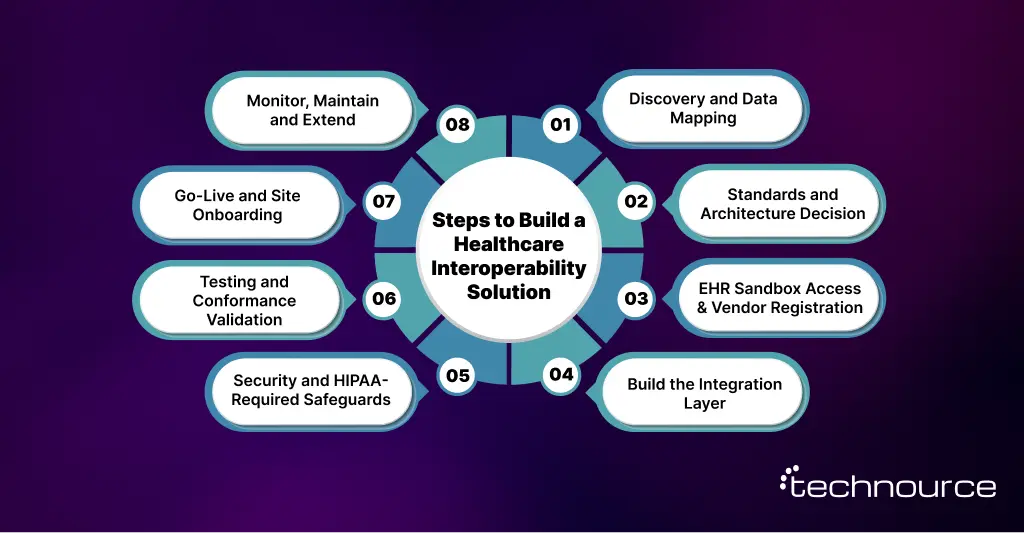
Step 1: Discovery and Data Mapping (1–2 Weeks)
List every system, workflow and data element the product needs, then map each field to its source and target.
Write down who sends what, when and in which standard. This map becomes the test plan later.
Step 2: Standards and Architecture Decision (1 Week)
Choose HL7 v2, FHIR or both for each connection, then pick the integration pattern and hosting.
Many teams scope the first release as an integrated MVP and use MVP development services to ship one EHR connection before adding more.
Step 3: EHR Sandbox Access and Vendor Registration (1–2 Weeks, Alongside Step 1)
Register with each EHR vendor’s developer program and request sandbox credentials early.
Customer-site approvals often take longer than the build, so start them in parallel with discovery.
Step 4: Build the Integration Layer (3–6 Weeks)
Build interfaces, FHIR APIs, code mappings and patient matching logic.
Validate every resource against US Core profiles as you go, not at the end.
Step 5: Security and HIPAA-Required Safeguards (1–2 Weeks, Alongside Step 4)
Add encryption in transit and at rest, OAuth scopes, role-based access and audit logging.
Healthcare breaches remain the costliest of any industry, at an average of $6.64 million per breach (IBM, 2026). Threat-model every new API endpoint before it goes live.
Step 6: Testing and Conformance Validation (2–3 Weeks)
Run unit, end-to-end, conformance and negative tests with realistic message volumes.
Test malformed messages, duplicates, timeouts and out-of-order events. No message should disappear without an alert.
Step 7: Go-Live and Site Onboarding (1–2 Weeks)
Switch on production endpoints one site or customer at a time, with a rollback plan ready.
Watch message queues and error rates closely for the first two weeks.
Step 8: Monitor, Maintain and Extend (Ongoing)
Track interface health and update mappings when partners change their systems.
Plan upgrades to new USCDI and FHIR versions as federal rules change.
How Much Does Healthcare Interoperability Cost?
Healthcare interoperability costs $3,000-$8,000 for a FHIR proof of concept, $20,000-$50,000 for most integrated MVPs and $60,000-$100,000 for an enterprise MVP. The final figure depends on the number of systems, the standards involved, data mapping and security scope.
| Build Type | Typical Scope | Cost (USD) | Timeline |
|---|---|---|---|
| FHIR proof of concept | Read-only FHIR connection to one EHR sandbox | $3,000–$8,000 | 2–4 weeks |
| Mid-complexity MVP | App with one EHR integration and SMART on FHIR launch | $20,000–$30,000 | 8–12 weeks |
| Complex MVP | Two or more EHRs, HL7 v2 and FHIR, integration engine | $30,000–$50,000 | 12–16 weeks |
| AI MVP | AI features on FHIR data, such as document extraction | $10,000–$50,000 | 8–14 weeks |
| Enterprise MVP | Multi-site exchange, payer APIs or TEFCA connection | $60,000–$100,000 | 4–6 months |
Integrations that ship inside a patient-facing app add front-end and app-store work on top of these figures, so price the healthcare mobile app development scope alongside the interfaces.
What Drives Healthcare Interoperability Cost?
Six factors move the budget most: systems, standards, mapping, write-back, security and vendor processes.
| Cost Driver | Why It Adds Cost |
|---|---|
| Number of systems and sites | Each EHR, lab or payer brings its own mapping and testing |
| HL7 v2 plus FHIR | Two standards mean an integration engine plus a FHIR layer |
| Data mapping and terminology | Local codes must map to LOINC, SNOMED CT and RxNorm |
| Writing back to the EHR | Write access needs more validation and vendor approval than read-only access |
| Security and audit scope | OAuth, audit trails and penetration testing add build and test time |
| EHR vendor programs | Registration, app review and site approvals add calendar time |
Hidden and Ongoing Costs to Budget
The build is only part of the spend. Plan for these items from day one.
- EHR vendor and marketplace fees: some EHR programs charge for app listing or API use.
- Integration engine licensing: commercial engines are licensed per instance or connection.
- Cloud hosting and FHIR server usage: costs grow with API calls and stored resources.
- Interface maintenance: partners change fields and versions, so mappings need regular updates.
- Compliance upkeep: annual risk assessments, penetration tests and new USCDI versions.
Ongoing costs depend on project scope, so estimate them with the build, not after launch.
Build vs Buy: Should You Build Your Own Integration Layer?
Build a custom integration layer if interoperability is part of your product’s value or you need deep, two-way EHR workflows. Buy an integration platform if you need standard data access fast, and choose a hybrid when you want speed now and control later.
| Factor | Custom Build | Integration Platform | Hybrid |
|---|---|---|---|
| Speed to first connection | Slowest start | Fastest, if your EHR is supported | Fast start |
| Upfront cost | Higher | Lower | Medium |
| Ongoing cost | Hosting and maintenance | Per-connection or per-call fees that grow with scale | Platform fees for some connections only |
| Control over data model | Full | Limited to the platform’s model | Full where it matters |
| Vendor lock-in | Low | High | Medium |
| Best for | Interoperability is core to your product | Standard read access and fast pilots | Most growing healthtech products |
Technource’s Recommendation
Start hybrid if you are still proving demand: use a platform for standard EHR reads and build your own FHIR layer for the workflows customers pay for.
Move more connections in-house once per-connection fees exceed the cost of running your own layer.
What Are the Biggest Challenges in Healthcare Interoperability?
The biggest challenges in healthcare interoperability are integrating received data, HL7 v2 variation between sites, patient matching, code mapping, EHR vendor approvals and API security. Most of them are data and process problems, not code problems.
Integration is the weakest link. According to ASTP/ONC, 96% of hospitals sent summary of care records electronically in 2025, but only 79% could integrate received records into the EHR without manual entry.
| Challenge | Real Consequence | How to Solve It |
|---|---|---|
| Integrating received data | Records arrive, but staff still retype them | Map to FHIR resources and write coded data into the chart |
| HL7 v2 variation | Each new site breaks the interface | Keep a spec per site and normalize to one internal model |
| Patient matching | Data lands in the wrong record | Use an MPI with tuned match rules and manual review |
| Code mapping | Results lose meaning between systems | Use a terminology service with versioned maps |
| Vendor approvals | Launch dates slip by weeks or months | Start registration and site approvals during discovery |
| API security | Every new endpoint widens the attack surface | Enforce OAuth scopes, rate limits, audits and testing |
| Rule changes | Interfaces fall out of compliance | Track USCDI, FHIR and CMS updates in the roadmap |
Common Mistakes to Avoid in Healthcare Interoperability Projects
The most common interoperability mistakes are treating integration as a late feature, assuming FHIR works the same in every EHR and skipping monitoring after go-live. Each one adds months of rework.
- Adding integration at the end: design the data model and interfaces in discovery, not after the UI is built.
- Assuming one FHIR fits all: each EHR supports different resources and fields, so test in each vendor sandbox.
- Ignoring HL7 v2: many hospital events still arrive only as v2 messages.
- Skipping terminology work: unmapped codes make data unusable for alerts, reports and AI.
- No plan for failed messages: without error queues and alerts, data gaps stay hidden.
- Underestimating approvals: vendor and customer reviews often outlast development.
Which KPIs Should You Track After Go-Live?
Track six KPIs after go-live: message success rate, end-to-end latency, manual re-entry volume, patient match rate, API uptime and time to onboard a new site. Together, they show whether data arrives, arrives fast and gets used.
| KPI | What It Shows | How to Measure |
|---|---|---|
| Message success rate | Share of messages processed without errors | Engine logs: processed vs failed and queued |
| End-to-end latency | Time from source event to data in the target system | Timestamps at send and at write |
| Manual re-entry volume | Data staff still retype | Manual entries per week, before and after launch |
| Patient match rate | Records matched automatically | MPI auto-matches vs manual reviews |
| API uptime and error rate | Reliability for apps and partners | Gateway metrics and 4xx/5xx rates |
| Time to onboard a new site | How reusable the integration layer is | Days from contract to first live message |
How to Choose a Healthcare Interoperability Development Company
Choose a healthcare interoperability development company that has shipped live HL7 and FHIR integrations, can show EHR sandbox experience and builds HIPAA-required safeguards into the architecture. Ask for named projects and measured results, not a list of standards.
| Question to Ask | Good Answer | Red Flag |
|---|---|---|
| Which EHRs have you integrated with? | Named EHRs, vendor programs and live projects | “We support all EHRs” |
| How do you handle HL7 v2 variation? | Per-site specs and a normalization layer | Hard-coded mappings per client |
| How do you test FHIR conformance? | Validation against US Core plus vendor sandbox tests | Testing only in production |
| How do you secure PHI in APIs? | OAuth scopes, encryption, audit logs and BAAs | Shared API keys or no audit trail |
| What happens after go-live? | Monitoring, alerting and mapping updates | Support ends at launch |
| Will we own the code and mappings? | Yes, with documentation | Proprietary lock-in |
Technource has 14+ years in business and is rated 4.9/5 on Clutch and 4.9/5 on GoodFirms.
What Are the Future Trends in Healthcare Interoperability?
Four trends will shape healthcare interoperability through 2027: TEFCA exchange at scale, payer APIs for prior authorization, AI agents that read and write FHIR data, and Bulk FHIR for analytics. All four reward products built on clean FHIR APIs.
TEFCA and FHIR Exchange at Scale
TEFCA is moving from early rollout to everyday exchange between networks. Products that can query and receive records through a QHIN connection reach more providers with fewer point-to-point interfaces.
Payer APIs and Electronic Prior Authorization
With CMS payer APIs due on January 1, 2027, prior authorization requests will move from fax and portals to FHIR APIs. Provider-facing products that connect to these APIs can cut approval delays.
AI Agents That Read and Write FHIR
AI agents will gather records, draft prior authorization packets and update tasks through FHIR APIs, under human review.
Healthcare AI agent development will depend on scoped API access and full audit trails.
Bulk FHIR for Analytics and Quality Reporting
Bulk FHIR exports let teams move whole patient populations into analytics and quality tools without custom extracts. Expect more payers and health systems to ask vendors for Bulk FHIR support.
How Technource Delivers Measurable Results in Healthcare Interoperability
Technource builds the integration layer as part of the product, not as an afterthought. These two healthcare platforms show how device, pharmacy and e-prescribing integrations turn into measurable results.
How Technource Built My Vital View, a Remote Patient Monitoring Platform That Speeds Clinical Decisions by 50%
We built My Vital View, a B2B SaaS remote patient monitoring platform for a U.S. healthcare organization that offers RPM and CCM services. The client needed patient devices, care teams and billing workflows connected in one system, without manual data handling.
We connected BLE devices and BodyTrace cellular devices, with IMEI-based API sync that keeps readings linked to the right patient. The platform runs on Node.js, React.js, React Native and MongoDB, with Twilio, SendGrid and WestFax for messaging, email and fax workflows.
Retest logic asks patients to repeat an extreme reading before providers are alerted, which cuts false alarms.
Measurable Result
- 50% faster clinical decision-making
- 100% remote access for patients and care teams
- Fewer unnecessary provider alerts through retest logic
- Automated RPM and CCM session tracking and billing logs
- Live on web, iOS and Android
How Technource Built Telepath, a Branded Online Pharmacy Platform That Speeds E-Prescribing Approvals by 65%
We built Telepath, a multi-tenant SaaS platform that lets U.S. healthcare organizations launch branded online pharmacies. The client needed prescriptions, pharmacy partners, shipping and telehealth connected under one platform.
We integrated DoseSpot for e-prescribing, Carepoint and TransitionRx for pharmacy coordination, Easypost for shipping, Agora for video visits and Paytheory for payments. The stack uses React.js, Node.js, MySQL and AWS S3, with audit logs and order tracking for compliance.
Measurable Result
- 65% faster approvals with e-prescribing
- 90% transparent onboarding with flexible sign-up flows
- Multiple organizations running branded pharmacies on one platform
- Real-time pharmacy coordination and shipment tracking
- Audit logs and pharmacy order tracking for compliance
Technource’s Approach to Healthcare Interoperability
Five principles guide every integration we build.
- Map before you code: every field gets a source, a target and an owner during discovery.
- FHIR outside, v2 where needed: we expose FHIR R4 APIs and keep HL7 v2 feeds behind an integration engine.
- One workflow, one metric: each integration ties to a measurable result, such as approval time or manual entries removed.
- Security in the architecture: OAuth scopes, encryption and audit logs ship with the first release.
- Monitor after launch: error queues, alerts and mapping updates are part of the plan, not an extra.
Conclusion
Healthcare interoperability comes down to three decisions: which standards each connection needs, which integration architecture fits your growth and how much to build versus buy.
Get those right, and cost and timeline become predictable: $20,000-$50,000 and 8–16 weeks for most integrated MVPs.
As an AI-powered product engineering company, Technource delivers healthcare software development services with HL7, FHIR and AI built into the architecture.
If you are ready to scope your integration, contact us for a short consultation that maps your standards, architecture, budget and timeline.
Ready to turn your healthcare product into a fully interoperable platform?
Frequently Asked Questions
Healthcare interoperability is the ability of EHRs, labs, pharmacies, payers and apps to exchange data and use it without manual re-entry. Interoperability works across four levels: foundational, structural, semantic and organizational. In 2025, 76% of U.S. hospitals sent, received, found and integrated outside data electronically, according to ASTP/ONC. HL7 v2 sends event messages, such as admissions and lab results, between systems over TCP. FHIR R4 exposes data as resources through REST APIs that apps query in JSON. Most products need both: HL7 v2 for legacy hospital feeds and FHIR for apps, payers and TEFCA, with CMS payer FHIR APIs due by January 1, 2027. No. FHIR adds a modern API layer, but most hospitals still run HL7 v2 for admissions, orders and results. The practical approach is a FHIR facade over an integration engine, which exposes FHIR R4 APIs without changing core systems. A FHIR proof of concept on top of existing feeds takes 2–4 weeks. The four levels are foundational, structural, semantic and organizational. Foundational means data moves, structural means it follows a known format, semantic means both systems share codes and meaning, and organizational adds consent, policy and governance. Most projects stall at the semantic level, where code mapping decides whether data is usable. SMART on FHIR is an authorization framework that lets third-party apps launch inside an EHR and access data through OAuth 2.0 scopes. SMART on FHIR supports EHR launch, where the patient and user are already selected, and standalone launch. A mid-complexity MVP with one EHR integration and SMART on FHIR launch typically costs $20,000-$30,000. Healthcare interoperability costs $3,000-$8,000 for a FHIR proof of concept, $20,000-$30,000 for a mid-complexity MVP with one EHR, $30,000-$50,000 for multi-EHR builds with an integration engine and $60,000-$100,000 for an enterprise MVP. Vendor fees, engine licensing and hosting depend on scope and are budgeted separately. A FHIR proof of concept takes 2–4 weeks. Most integrated MVPs go live in 8–16 weeks, and enterprise MVPs take 4–6 months. EHR vendor registration and customer-site approvals often set the pace, so start them during discovery rather than after the build. CMS-0057-F requires impacted payers, including Medicare Advantage, Medicaid, CHIP and ACA marketplace plans, to run four FHIR APIs by January 1, 2027: Patient Access, Provider Access, Payer-to-Payer and Prior Authorization. Provider-facing products that connect to these APIs can automate prior authorization requests and status checks. TEFCA, the Trusted Exchange Framework and Common Agreement, is the U.S. framework for health information exchange between networks. Organizations join through designated QHINs. According to ASTP/ONC, more than 71,000 sites participate through 11 QHINs, so a TEFCA connection reaches many providers without separate interfaces. Not always. One or two FHIR connections can run without an engine. Once you handle HL7 v2 feeds or three or more systems, an engine saves time by centralizing transformation, routing and error handling. A complex MVP with two or more EHRs and an integration engine costs $30,000-$50,000.
Related Insights and Articles