Quick Summary: “The best way to predict the future is to build it”, but before you build your entire product, build an MVP first.
Most founders waste months building products nobody wants, but an MVP helps you validate your idea in just 12–16 weeks with a smart investment of $40K–$80K. This guide walks you through market validation, a 7-step MVP build process, and confident launching. Learn what really matters in MVP development, how to hire the right developers, and how Technource has helped 100+ founders turn ideas into paying users.
According to recent research on startups, approximately 90% of startups fail due to the incorrect choice of product-market fit. The silver lining, however, is that start-ups that build an MVP at first can cut their failure rate in half. MVP development means that you won’t have to waste a lot of time and money on a product that is not going to be sold, and also, you will be able to test your idea in an inexpensive and fast way in the real world.
This comprehensive guide will walk you through every step of MVP building, from defining your strategy to choosing the right MVP development services and team. Whether you’re a first-time founder or scaling your startup, this guide will help you validate your idea, reduce risks, and move confidently toward a successful product launch.
What Is an MVP (Minimum Viable Product)?
The term Minimum Viable Product (MVP) refers to the product that has only the very basic features needed to make the first customers content and validate the central assumptions about your business idea.
Why Skipping MVP Development Increases Cost and Risk
Every entrepreneur wants to build a so-called “perfect product”, and why not, right? They invest so much money and time in the development process, and waste money on anything on features that nobody even asks for, and then wonder why customers don’t care about their product.
Let me be honest with you. Most people do it wrong. They spend months and months making it perfect, adding features nobody asked for, and then launch. All this for what? Not a single user cares about your shiny feature you spent months working on if it doesn’t have a major role. The true blessing of having an MVP is that it decides whether the idea you are working on is worthwhile to continue exploring, or not, before the heavy investment follows.
How an MVP Reduces Risk, Cost, and Time-to-Market
You can probably be wrong in the way you’ve been thinking. What you think is the customers’ need for X turns out to be Y, being the actual need. A company cannot afford to build the whole product if it is based entirely on guesses. An MVP allows you to test your main hypothesis with real people within a few weeks instead of months, especially when you focus on hiring MVP full-stack developers who understand rapid validation.
You will receive feedback that matters. Genuine users will let you know what really works and what doesn’t. This feedback will be of greater worth than any market research report, as it is actionable; thus, the choice is easy. Research from Forrester shows that companies that implement customer feedback see 10% average increase in revenue growth.
Your expenses will drop. A lot. Rather than spending $200,000 on the whole product, you can validate your idea for just $30,000-$50,000. If it works, excellent! If not, well, you’ve gained valuable insights without large losses.
You will be the first in the market. While your adversaries are taking one year to perfect their products, you will have the benefit of actual users and the data. That would be a giant plus.
MVP Strategy: How to Validate a Product Idea Before Development
Before you write a single line of code, you need a strategy. And I mean a real one, not just “build an app.”
1. What Separates Successful MVPs from Failed Ones
The biggest mistake I see is founders trying to build the “complete” product with fewer features. That’s not an MVP. That’s still too much.
A real MVP does one thing well. Airbnb’s MVP wasn’t a marketplace with reviews, messaging systems, and payment infrastructure. It was literally just photos of rooms and a way to book them. That’s it. They validated the core idea first, then built everything else.
Instagram started with photo sharing and filters. No DMs, no Stories, no Reels. They nailed the core feature and iterated from there.
The pattern here? Find your core feature. Build only that. Make it beautiful. Launch it.
2. Decide on MVP core features
Here’s how you can decide on what to keep in your MVP:
Start with simple brainstorming, ask yourself, “Does this feature solve any major problems?” If it’s a no, then you know what to do. Cut it, period.
MVP core features usually look like:
User signup/login
Core functionality (whatever solves the main problem)
Ability to save or view results
Basic search or filtering, if needed
Nice-to-have features that can wait:
Advanced analytics
Multiple payment options (pick one)
Mobile app (web can work first)
Admin dashboards
Integrations with other tools
MVPs with 3-5 core features are perfect for successful MVP development and launch; anything more than that is a waste of time and money.
3. Learn from Real Examples That Everyone Knows About
Uber started in San Francisco with just black car bookings. No surge pricing algorithm. No Uber X. Just “tap to get a car.” The simplicity was their MVP strategy to make it successful.
Spotify wasn’t launched like what it looks like today. They started with the core MVP feature “freemium model” and tested if that worked or not, and then expanded globally.
Dropbox literally started with a video showing how file syncing works. That video was their MVP. They got 75,000 signups from it. Then they built the actual product.
What do all these have in common? They didn’t try to build everything at once. They validated the core idea first.
Building too many features. I see this constantly. Founders add “one more feature,” and suddenly their MVP takes twice as long and costs twice as much. Resist this temptation.
Ignoring what customers actually want. You’ll have ideas about what people need. Customers will tell you something completely different. Listen to customers, not your gut.
Choosing the wrong tech. Bad technology choices can add months to your timeline. More on this later.
Hiring developers with proper research. Companies hire developers for MVPs at lower rates. Yes, the budget is tight, but risking it with hiring a team isn’t appropriate. Their mistakes will cost you way more in bugs and delays.
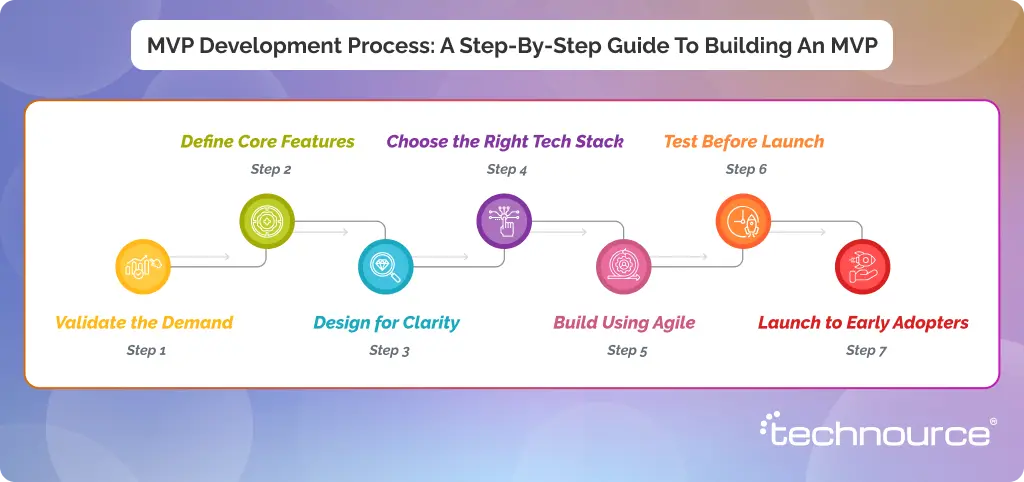
MVP Development Process: Step-by-Step Guide to Build an MVP
Let’s get started. Here’s exactly how to build an MVP that works:
Step 1: Validate the Demand (2–3 Weeks)
Before you spend anything on MVP features, ensure that there is demand for your product.
Ask questions to around 20-25 people who fall into your target market. Know their current issues, what they prefer, and what type of products they like. Note down the actual phrases that they use. For instance, if a person states, “Oh, for sure, I would definitely use that,” they might be just being polite. On the contrary, if they become irritated while elucidating their present system, then that is a very strong pain point.
You might also want to ask: “Would you be willing to pay for this?” You must know the extent to which they are willing to go when it comes to paying for it.
Build a very basic landing page that gives a brief description of your concept, and check whether any people sign up. It is indeed a validation of your concept. If people are not signing up, then that’s also an indication that your idea or concept needs something different.
Step 2: Define Core Features (1–2 Weeks)
Now that you know people want this, figure out exactly what you’re building.
Write down every feature you think you need. Then be ruthless. Cut 50% of them. I’m serious.
Use the MoSCoW method:
Must have: The 3-5 features that solve the core problem
Should have: Important, but you can live without it
Could have: Nice extras for later
Won’t have: Out of scope, period
Your MVP must-haves should fit on a single page. If you need two pages, you’re doing too much.
Step 3: Design for Clarity (2–3 Weeks)
Your MVP doesn’t need to be beautiful, but it needs to be usable.
Create wireframes showing how users move through your app. Then design mockups that look decent. Test with a few real users, literally show them the design, and watch them use it. They’ll tell you what’s confusing immediately.
Good design doesn’t mean fancy. It means clear. Users should understand what to do without reading instructions.
Step 4: Choose the Right Tech Stack (1 Week)
People greatly underestimate this importance. Tech stack selections that are not optimal can prolong your timeline by weeks.
Our recommendations for the majority of MVPs are as follows:
Frontend: React.js (everyone knows it, offers plenty of libraries, and is very fast to build)
Backend: Node.js (one language, JavaScript—throughout the stack, thus less switching of contexts for developers)
Database: PostgreSQL (the best in reliability, good at scalability, and open source)
Hosting: AWS (budget-friendly pricing for startups, and excellent documentation)
What leads us to this conclusion? The reason is that this stack has enabled a large number of MVPs to come up with solutions for every difficulty in the same context that you will have. You’re not inventing the wheel here; you’re applying a tried-and-tested formula.
Do not let yourself get too creative with tremendously advanced technologies. An idea is for you to test, not to build the next Google. Technology that is dull yet reliable is what you should go for.
Step 5: Build Using Agile (4–8 Weeks)
This is the stage where agile methodology comes into play.
Use 2-week sprints for your work. At the end of each sprint, you should have features that are fully working and usable by someone. “We are 90% done for the last month.” Nonsense is not acceptable anymore.
Standing up meetings are daily 15 minutes, everyone speaks about what he/she have done, what he/she is doing, and what is the hindrance for him/her. That’s all.
Code review’s importance: Before code is released to production, it is reviewed by an experienced person. This helps in finding bugs early and maintaining a good standard of code. It also takes time, but the time lost now is the time gained later.
Step 6: Test Before Launch (2–3 Weeks)
Don’t launch with bugs. Seriously, it’s embarrassing, and it tanks your user experience.
Get a QA person to poke holes in your product. Have actual users test it before you launch. Watch them use it. Don’t explain anything, just watch. When they get confused, that’s a problem you need to fix.
Test on real devices. If you’re building a mobile app, don’t just test on the simulator. Test on actual phones.
Step 7: Launch to Early Adopters
Launch to a small group of people first. Get feedback. Fix issues. Then expand.
Set up analytics to track what users do. Which features do they actually use? Which ones do they ignore? Your analytics will tell you the truth about what matters.
Create a feedback channel—email, in-app feedback widget, Slack community, whatever. Make it easy for users to tell you what’s wrong.
Plan to iterate weekly. User feedback comes in, you implement changes, you launch updates. This is your new normal for the first few months.
MVP Development Cost in 2026: Budget, Team & Timeline
Let me be straight with you about MVP costs. They vary a lot depending on what you’re building.
MVP Cost Breakdown by Project Type
Simple MVP (like a SaaS tool with basic features):
Budget: $20,000 – $35,000
Timeline: 8-10 weeks
Team: 2-3 developers
Medium MVP (a mobile or web app with more complexity):
Budget: $40,000 – $75,000
Timeline: 12-16 weeks
Team: 4-5 developers
Complex MVP (full-stack app with integrations):
Budget: $80,000 – $150,000+
Timeline: 16-24 weeks
Team: 5-7 developers
What Affects MVP Development Cost the Most
Your geography. US-based developers cost $150-$250 per hour. Indian developers with the same experience cost $30-$60 per hour. That’s a massive difference, and honestly, experienced offshore developers deliver the same quality. This is why many startups hire remotely; you literally get 70-80% cost savings for the same work.
Developer experience. A senior developer will be more expensive initially, but he/she will produce a lot of good quality code in a shorter time period. On the other hand, a junior developer will charge less, but he/she might stretch your timeline by a couple of months and create some technical debt that will make you sorry in the end.
How well are your requirements defined? Unclear requirements mean scope changes, which in turn lead to cost overruns. If you know exactly what you want ahead of time, then the project will be less expensive and more efficient.
Technology selections. The use of trusted tech stacks is less expensive than the use of the latest technology nobody has ever tried before. You will be spending some time fixing your problem, not solving the problems with the framework.
How to Reduce MVP Development Cost Without Risk
Be ruthless about features. Every feature you add costs time and money. Cut 50% of what you think you need.
Use pre-built solutions. Don’t build payment processing from scratch; use Stripe. Don’t build authentication from scratch; use Auth0. These services exist for a reason.
Start with a smaller team. You don’t need five developers from day one. Start with 2-3 experienced people. More people don’t mean faster delivery.
Pick boring technology. Do not try to be oversmart and overexperimental. Choose what’s proven. React, Node.js, PostgreSQL.
The Real Timeline
In general, MVPs take 11-15 weeks from starting to launch, which is about 3-4 months.
Some people claim they built an MVP in 4 weeks. Great for them. But you’re building something real that users will actually use, so give yourself proper time. Rushing introduces bugs and cuts corners that bite you later.
How to Hire MVP Developers and Build the Right Team
You could hire a freelancer from Upwork. You could hire an agency. You could try to build an in-house team. Let me break down your options.
What You Actually Need
For most MVPs, you need:
1-2 backend/full-stack developers (the core builders)
1 frontend developer (UI/UX implementation)
1 designer (can handle UI/UX or product design)
1 QA person (testing, catching bugs)
For smaller budgets, one really good full-stack developer can handle both backend and frontend, with a designer handling QA initially.
Your Hiring Options
Freelancers (Upwork, Toptal)
Pros: Flexible, can scale up/down quickly
Cons: Variable quality, communication issues across time zones, and you become a project manager
Best for: Small feature additions, not full MVP builds
Agencies
Pros: Structured process, experienced teams, you get a dedicated contact
Cons: More expensive, sometimes less flexible
Best for: Full MVP builds where you want a professional process
In-House Hiring
Pros: Full control, team building, long-term investment
Cons: Takes months to hire, expensive salary + benefits, need to find people willing to take a startup risk
Best for: Companies with multiple products or long-term vision
Dedicated Remote Teams (like Technource)
Pros: Cost-effective, experienced with MVPs, faster to assemble, flexible contracts
Cons: Timezone differences require a communication structure
Best for: Startups that want quality without breaking the bank
How to Hire Reliable MVP Developers
Look for people with MVP experience specifically. Someone who’s built 2-3 MVPs understands the constraints and priorities. They move fast, cut scope when needed, and focus on what matters.
Check their portfolio. GitHub is your friend; you can see their code quality. Look for projects similar to yours.
Give them a test project. Pay them to build something small in 1-2 weeks. This tells you about code quality, communication, and reliability way more than any interview can.
Reference checks matter. Call their past clients. Ask about reliability, code quality, and communication.
The cheapest developer usually isn’t the best deal. A slightly more expensive, experienced developer who moves 30% faster and writes cleaner code saves you money overall.
Why Technource Is a Leading MVP Development Company
I could talk about why choosing the right partner matters, but honestly, let me just tell you what we do.
What We’ve Actually Done
We’ve been building MVPs for 10+ years. That’s not a marketing line, that’s literally what we do best. We’ve helped over 100 founders build MVPs across different industries.
Some stats that matter: Our clients have raised over $50M in funding using MVPs we built. 85% of them keep working with us after the MVP phase for scaling. We deliver on time 98% of the time.
Technource MVP Case Study: FinTech Investment Platform
The Project
A fintech startup needed to validate market demand for an investment management platform before investor meetings. They partnered with Technource to build an MVP in 12 weeks. The team (2 backend developers, 1 frontend developer, 1 designer, 1 QA engineer) used React.js + Node.js + PostgreSQL + AWS, cutting scope ruthlessly to 5 core features: user authentication (via Auth0, not custom-built), portfolio creation, real-time market data display (Alpha Vantage API), buy/sell transactions (Stripe integration), and basic reporting.
Eight proposed features were explicitly deferred to v1.1/v2.0, keeping the one-page feature spec intact. Total cost: $52,000 ($28K backend developers, $12K frontend, $6K design, $2.5K QA, $4K PM/tech lead). Daily standups and 2-week sprints ensured working demos every Friday; code review caught bugs before production. Testing phase included 8 real users, security audit, and load testing—result: 0 critical bugs at launch.
The Results
The MVP launched (Week 14) to immediate traction: 2,000 signups in the first 2 weeks, 60% activation rate, and sustained 45% week-2-to-week-4 retention. Users created 3,800 portfolios, averaging 8.5 transactions each, validating the core feature set. Most importantly, the traction changed investor conversations; the same 15 VCs who passed on the pitch now had 8 meeting requests after seeing real users. Four months post-launch, the startup closed a $2.1M seed round at $8.5M valuation.
The MVP’s success proved two things: ruthless scope control (say no to “one more feature”) and experienced teams (no learning curve with proven tech stack) compress timelines without sacrificing quality. This fintech startup went from idea to $2.1M in funding in 4 months by building lean, testing fast, and iterating based on real data instead of guesses.
Our Process (Actually Pretty Simple)
Week 1-2: Discovery. We sit down, understand your idea, validate its feasibility, and lock down the scope. No surprises, no scope creep. We figure out exactly what you’re building.
Week 3-4: Design. We create wireframes and mockups, and run them by real users. We iterate until users understand what to do without instructions.
Week 5-12: Build. We build the actual product. Weekly demos, daily communication, transparent progress. You see working features every week.
Week 13-14: Test & Launch QA, bug fixes, deployment. We launch to your early users and help you gather feedback.
Ongoing: Support & Scaling We don’t disappear after launch. We monitor, we help you iterate, and if your MVP succeeds, we help you scale.
What Makes Technource Different From Other Agencies
Cost Advantage. We’re based in India, which means we’re 40-50% cheaper than US agencies. But we don’t cut corners on quality. Our developers have 5+ years of experience and have built multiple MVPs each, making it easy for startups to hire experienced development team members without stretching their budget.
MVP Specialists. We’re not a general development shop. We specialize in MVPs. We know how to cut scope smartly, prioritize features ruthlessly, and ship fast.
No Contracts. Month-to-month engagement. If you’re not happy, you can leave. If you are (which you will be), you’ll stay.
Experienced Team. You don’t get junior developers. You get developers who’ve been through this before and know what works.
Timezone Advantage. We’re in India (IST), which overlaps with US business hours. Communication is easy. A sync works great for a distributed team.
MVP Development Best Practices
Use Agile Development: Build in 2-week sprints, so you always have real, working software and clear visibility on progress.
Keep Your Eyes on User Feedback: Let real user behavior and feedback, not assumptions, decide what you build next.
Actually Test Your Code: Catch issues early with reviews and real-user testing before problems reach production.
Build with Scaling in Mind: Choose flexible architecture and cloud infrastructure that can grow without costly rewrites.
Communicate Like You Actually Care: Frequent, open communication between founders and developers prevents misunderstandings and delays.
Final Thoughts: How to Build an MVP That Succeeds
Building an MVP is the smartest thing you can do as a founder. Validate your idea before you bet everything on it. Get real feedback from real users. Iterate based on data, not assumptions.
Let’s be honest about what this costs and how long it takes.
An experienced MVP development team will deliver a quality MVP in 12-14 weeks for $40,000-$80,000. That’s realistic.
Some agencies will promise 6 weeks and $20,000, whereas some agencies will quote $200,000. That’s enterprise pricing. The ideal range is 3-4 months, $40,000-$80,000, an experienced team, a clear scope, and laser focus on core features.
That’s what works.
It’s not complicated. Find people who’ve done it before. Build core features only. Ship fast. Listen to users. Iterate.
That’s it.
A realistic MVP timeline is 11–15 weeks (3–4 months): 2–3 weeks for validation, 2–3 weeks for design, 4–8 weeks for development, 2–3 weeks for testing, and 1 week for launch. The timeline accelerates with crystal-clear requirements, experienced teams, and minimal scope (3–5 features only). Common mistakes like “4-week MVPs” skip design/testing and cost more to fix later, while adding extra developers or unclear scope actually slows things down due to communication overhead and scope creep.
Always build an MVP first because you’ll learn if your idea has market demand by month 2 instead of month 8, spending $40K–$80K instead of $150K–$300K+. If the MVP fails, you lose $40K and gain valuable insights; if the full product fails, you lose $200K+ with no clear direction. Investors fund MVPs with real users over pitches promising future customers, and early user feedback lets you pivot quickly—a fintech startup’s MVP revealed users actually wanted portfolio tracking (not the originally planned feature), allowing them to adjust before raising $2.1M.
Plan weekly updates in the first month (you’re learning what users actually want), then biweekly once feedback patterns emerge. Use analytics (Mixpanel, Amplitude) to track which features users use, set up feedback channels (Intercom, in-app widgets), and prioritize changes based on usage data, not assumptions. Many founders launch and then abandon their MVP. Continuous iteration based on real user behavior is what separates MVPs that scale from MVPs that die.
An MVP validates your core assumption with real users and is feature-complete for that core (though imperfect). A beta is near-production quality with more features, where you’re refining user experience and hunting edge-case bugs. Timeline: MVP launches in month 3, beta launches in month 5–6. Most startups call their MVP a “beta” to seem less rough, call it what it is. An MVP with 1,000 users in month 3 beats a “beta” product with 0 users in month.
Dhrumil Mistry is a tech expert and full-stack developer at Technource, skilled in PHP, Laravel, MySQL, and modern backend development. He contributes to building scalable, secure, and performance-focused digital solutions. Along with his backend expertise, he is proficient in frontend technologies such as React, Vue, and Next.js, enabling him to build seamless, responsive, and dynamic user interfaces. His interest in emerging technologies drives his work across AI/ML, data engineering, SaaS, blockchain, and IoT solutions, helping deliver innovative products for businesses.
Request Free Consultation
Amplify your business and take advantage of our expertise & experience to shape the future of your business.