Building an AI SaaS product costs $25,000 to $600,000+ in 2026. The range is that wide because a few architecture decisions made in week one change everything. This guide breaks down every cost factor, AI model strategy, data pipelines, infrastructure, team, and hidden costs most estimates skip.
Key Takeaways
An API-integrated MVP costs $25,000–$80,000. A custom-model platform starts at $150,000 and scales past $500,000.
AI infrastructure, GPU compute, vector databases, API tokens, runs 30–40% of your first-year operating budget.
Your pricing model (per-seat vs. usage-based) directly determines your architecture cost. Build the wrong one first, and you pay twice.
Teams with clean, labeled data cut AI development time by 40–60% versus teams starting from raw or siloed data.
Ongoing maintenance costs 20–25% of the initial development cost annually. Most estimates exclude this entirely.
You asked three agencies for quotes. One said $40,000. One said $180,000. One said $350,000. All three were probably right, for different versions of what you described.
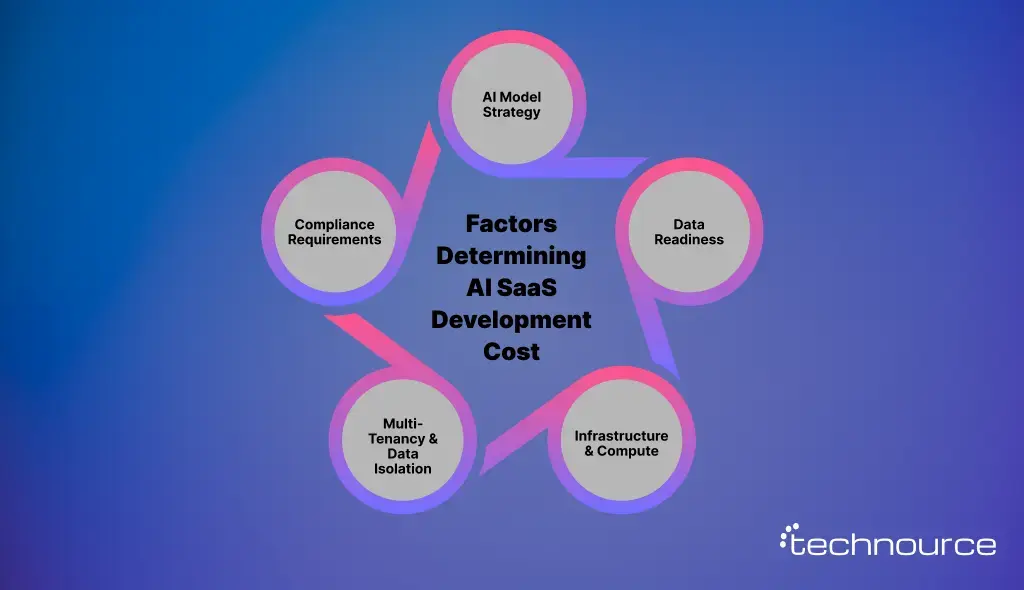
AI SaaS cost is hard to estimate without nailing down five decisions first: which AI models you use, how clean your data is, whether you need real-time inference, what your pricing model requires, and how much compliance work applies.
The global SaaS market is projected to be $465 billion in 2026 (Precedence Research).
Gartner forecasts that 40% of enterprise applications will include task-specific AI agents by the end of 2026, up from under 5% in 2025. The market is moving fast.
This guide gives you a complete picture of what AI SaaS development actually costs, broken down by phase, team, architecture decision, and the cost categories most guides quietly skip.
What Is AI SaaS Product Development?
AI SaaS means a cloud-hosted software product where AI is the core value driver, not a feature bolted on later.
Users pay a subscription fee through a SaaS subscription model. The AI layer handles the actual work: generating, analyzing, classifying, predicting, or automating something that would otherwise require human time.
This is different from standard SaaS engineering. Standard SaaS routes requests to a database. AI SaaS routes requests through model inference pipelines, manages vector search, monitors for model drift, and continuously manages token and compute costs.
Three things make AI SaaS more expensive: infrastructure runs hotter (GPUs, high-memory instances), data management is more complex (training data, embeddings, retrieval pipelines), and the product never stops changing (model updates, API deprecations, accuracy degradation).
AI SaaS Development Cost at a Glance
Costs range from $25,000 for a minimal API-integrated MVP to $600,000+ for a production-grade enterprise platform. The table below gives you a realistic starting point.
Product Type
Cost (USD)
Timeline
AI Approach
Basic AI MVP (API-integrated)
$25,000 – $80,000
6–14 weeks
Third-party APIs (OpenAI, Anthropic, Gemini)
Mid-complexity AI SaaS
$80,000 – $200,000
3–6 months
API + RAG + fine-tuning + custom workflows
Full-featured AI SaaS Platform
$200,000 – $400,000
6–10 months
Custom pipelines, proprietary data, multi-tenant
Enterprise AI SaaS
$400,000 – $600,000+
10–18 months
Custom/fine-tuned models, compliance, high-scale infra
These ranges assume an experienced team. Using a low-cost team with limited AI experience often makes the final cost higher, not lower, because of rework.
Key Factors That Determine Your AI SaaS Development Cost
The gap between a $25,000 AI SaaS MVP and a $600,000 enterprise platform comes down to a few critical decisions. Many of these decisions are made during the AI MVP development phase. Factors such as model strategy, data readiness, infrastructure requirements, and regulatory obligations have a direct impact on development timelines, scalability, and overall cost.
1. AI Model Strategy: Build vs. Buy vs. Fine-Tune
This single decision has more impact on your cost structure than anything else and is one of the biggest factors influencing the overall cost of developing AI for your SaaS platform.
Using a third-party API (OpenAI, Anthropic) costs little to start. It scales unpredictably as usage grows. Building a custom model gives you control but requires significant data and training investment upfront. Fine-tuning sits in the middle, with more control than pure API and less data requirement than training from scratch.
Approach
Upfront Cost
Per-Query Cost at Scale
Best For
Third-party LLM API
Low ($0–$5K setup)
High (token billing)
MVPs, early-stage validation
Fine-tuned open model (Llama, Mistral)
Medium ($15K–$60K)
Low (self-hosted)
Domain-specific apps, cost-sensitive at scale
Custom-trained model
High ($80K–$300K+)
Very Low (own infra)
Proprietary data advantage, large-scale platforms
Hybrid (API + RAG + fine-tune)
Medium-High ($40K–$120K)
Medium
Most production AI SaaS products
2. Data Readiness
Data is where most AI SaaS projects run over budget.
Clean, structured, labeled data = you are ahead of most teams. Siloed, unstructured, or inconsistent data = budget 20–35% of total development cost just for data engineering before any AI works.
When Technource built a document intelligence platform for a legal tech client, initial scoping assumed 3 weeks for data prep. Actual work took 9 weeks, because 60% of the training documents were inconsistent PDFs with no standardized metadata. The budget moved from $80,000 to $110,000 with zero scope changes.
3. Infrastructure and Compute
AI SaaS infrastructure costs more because it needs what standard web apps do not: GPU instances, vector databases (Pinecone, Weaviate, pgvector), and high-availability model serving.
For 500–2,000 active users: expect $3,000–$12,000/month in infrastructure. At 10,000+ users with real-time AI: $25,000–$80,000/month. This directly determines whether your unit economics work.
4. Multi-Tenancy and Data Isolation
Most AI SaaS products need a multi-tenant architecture, multiple customers on shared infrastructure with isolated data.
For AI SaaS, this is harder than standard SaaS. You may need per-tenant vector stores, per-tenant usage metering, and sometimes per-tenant fine-tuned models. Building this properly from day one costs $20,000–$40,000 extra upfront. Retrofitting it after launch costs 2–3x more.
5. Compliance Requirements
Healthcare AI SaaS needs HIPAA. Fintech AI needs SOC 2, often PCI DSS. EU products need GDPR baked into the data architecture.
Each compliance layer costs $15,000–$40,000 in initial implementation and $8,000–$20,000 per year in audits and maintenance.
AI SaaS Development Cost Breakdown by Phase
Most cost estimates cover only three phases. A real budget has five.
Phase 1: Discovery and Architecture: $5,000–$20,000
Discovery for AI SaaS covers decisions that are expensive to reverse: model selection, data architecture, infrastructure cost modeling, pricing model alignment, and compliance risk.
Skipping this phase is the most reliable predictor of cost overruns. Teams that arrive at development without these decisions locked in spend an average of 30% more on the overall project.
Phase 2: Data Engineering and AI Pipeline: $15,000–$120,000
The range here is entirely driven by your starting data condition.
Clean, structured data: $15,000–$25,000. Raw, siloed, or unlabeled data requiring significant annotation: $60,000–$120,000. Any team quoting this phase without auditing your actual data is guessing.
This is the actual SaaS application, frontend, API, authentication, billing, and the AI integration layer.
Frontend and API development for a mid-complexity product: $20,000–$60,000. AI integration layer (prompt management, model routing, response handling): $15,000–$80,000. Usage-based billing infrastructure: $10,000–$25,000 extra. Most founders underestimate the billing layer. Usage-based billing tied to AI token consumption requires metering, aggregation, and real-time display, none of it trivial.
Phase 4: Testing, Security, and Compliance: $10,000–$50,000
AI requires testing beyond standard QA: model accuracy evaluation, hallucination rate testing, adversarial testing (prompt injection), and load testing under concurrent inference.
Standard B2B security requirements: $10,000–$20,000. Add healthcare or fintech compliance on top: another $20,000–$30,000.
Setup includes production infrastructure, CI/CD for model and app updates, monitoring (performance, accuracy, cost), and alerting for model drift.
The recurring cost is where most budgets fail. Model retraining, API version updates, infrastructure scaling, and security patches cost 20–25% of initial development per year. A $100,000 build costs $20,000–$25,000/year minimum to maintain properly.
Team Structure and Hourly Rate Impact
Who builds your product is as important as what you build. AI SaaS requires ML engineering, data engineering, product engineering, and DevOps, skills that rarely all exist in one place.
Team Type
Hourly Rate
Best For
Risk
US/UK in-house team
$120–$250/hr
Regulated industries, complex IP
High cost, slow hiring
US/UK boutique agency
$100–$200/hr
Product-quality focus, fast start
Premium pricing
Eastern European agency
$50–$90/hr
Strong engineering, moderate cost
Timezone coordination needed
Indian product engineering firm
$25–$60/hr
Cost efficiency, large talent pool
Varies widely by firm quality
Assembled a freelance team
$20–$80/hr
Small MVP, short timeline
Coordination risk, no accountability
A Warning on the Freelance Route: AI development needs tight coordination between data engineers, ML engineers, and application developers. Distributed freelancers without unified accountability produce rework. That rework almost always costs more than the savings.
Your Pricing Model Determines Your Architecture Cost
This is one of the most overlooked cost drivers in AI SaaS. Your pricing model is not just a revenue decision; it is an architecture decision.
Pricing Model
Architecture Complexity
Extra Build Cost
Best Fit
Per-seat subscription
Low
$0–$5,000
Internal tools, team-based products
Usage-based (per API call/token)
High
$15,000–$30,000
Developer tools, high-volume inference
Outcome-based (per result)
Very High
$25,000–$50,000
RPA, contract analysis, document extraction
Tiered hybrid
Medium-High
$10,000–$25,000
Most B2B SaaS products
Usage-based billing requires a metering layer that tracks every AI operation per user, aggregates it in real time, and feeds it to your billing system.
Teams that launch on per-seat and migrate to usage-based post-launch spend $20,000–$50,000 retrofitting what they should have built initially.
Hidden Costs Most AI SaaS Estimates Miss
Many AI SaaS projects stay within budget during development but exceed expectations after launch. The reason is simple: several AI-specific expenses rarely appear in initial estimates. The hidden costs below can add tens of thousands of dollars to your total investment if they are not planned for from the start.
LLM API Cost Escalation
API pricing changes. OpenAI and Anthropic have both shifted pricing multiple times in 2025–2026.
Budget a 20–30% buffer on top of projected API costs in year one. A product processing 100,000 requests/month at $0.005 per request spends $500/month. If that rate doubles mid-year, which has happened, your cost doubles with no warning.
Model Deprecation and Migration
Every LLM API provider eventually deprecates models. When GPT-3.5-turbo was deprecated in 2024, teams with hardcoded integrations spent 2–4 weeks migrating, typically $5,000–$15,000 in unplanned work.
Building a model abstraction layer from the start costs $3,000–$6,000. It saves multiples of that on every future migration.
Prompt Engineering and Optimization
Prompt engineering is not free. A solid prompt library for a multi-feature AI SaaS product takes 3–6 weeks of senior engineering time.
At $60–$100/hour, that is $7,000–$24,000 of work. Almost no cost estimate line-itemizes it.
RLHF and Continuous Improvement
AI quality degrades over time if you do not retrain on new user feedback. Building a basic feedback loop, thumbs up/down with retraining hooks, costs $10,000–$20,000 to implement properly.
AI quality degrades over time if you do not retrain on new user feedback. Building a basic feedback loop, thumbs up/down with retraining hooks, costs $10,000–$20,000 to implement properly.
Build vs. Buy: API vs. Custom Model
For most early-stage AI SaaS products in 2026, third-party APIs are the right choice. Faster to start, no training data requirement, no model hosting overhead.
The exceptions are specific.
Scenario
Recommended Approach
Reason
Early-stage MVP, under $100K budget
Third-party API
Validation speed matters more than cost optimization at this stage
Domain-specific accuracy (medical, legal)
Fine-tuned open model
Generic models underperform on specialized vocabulary and logic
High volume, over 1M API calls/month
Self-hosted fine-tuned model
Hosting cost becomes cheaper than API billing at this scale
Proprietary data as a competitive advantage
Custom or fine-tuned model
Keeping training data out of third-party APIs is a strategic moat
Data residency or sovereignty requirements
Self-hosted model
API providers may not meet regulatory requirements for data location
Real-World AI SaaS Cost Examples
Many founders ask what successful AI SaaS companies spent before achieving traction. While exact numbers vary, the examples below illustrate how different AI product strategies, from API-based MVPs to enterprise AI platforms, translate into real-world development investments.
Jasper AI: Content Generation SaaS
Jasper reached $75M ARR within 18 months. But the MVP was deliberately constrained, built on GPT-3 APIs with a simple editor, document storage, and team workspace.
Estimated initial build: $150,000–$250,000 with a lean team of 8–10 engineers. They did not build a custom model first. They validated demand on API infrastructure, then invested in fine-tuning after proving willingness to pay.
Copy.ai: AI Writing Platform
Copy.ai launched in 2020 on GPT-3 APIs. The founding team built the MVP in 6 weeks and reached $1M ARR in 12 months.
Initial development cost: likely under $50,000. They scaled infrastructure investment as revenue grew, the right model when demand is unproven.
Harvey AI: Legal AI SaaS
Harvey raised $21M in its Series A to build AI tooling for law firms. This required custom fine-tuning on legal data, SOC 2 compliance, firm-specific data isolation, and workflow integrations.
Estimated initial production build: $400,000–$800,000. The premium was earned by domain fine-tuning, compliance requirements, and enterprise-grade multi-tenancy. This is what enterprise AI SaaS actually costs when built properly.
Risks and Challenges in AI SaaS Development
Even well-funded AI SaaS projects can encounter unexpected obstacles during development and after launch. From AI hallucinations and vendor lock-in to expanding scope and enterprise trust requirements, the challenges below can significantly impact both development costs and long-term product success.
Scope Creep from AI Capability Discovery
As your team builds and tests, they discover adjacent things the model can handle. Each new capability feels cheap because the AI already does the logic. What gets missed: evaluation, edge case testing, and UI changes, all of which add real cost.
Budget 15–20% scope buffer specifically for AI capability expansion. Or gate it through a formal change process.
AI Hallucination in Production
Language models generate confident-sounding, incorrect outputs. For B2B products in legal, medical, or fintech contexts, this creates liability.
Proper hallucination mitigation, RAG, output validation, confidence scoring, and human-in-the-loop for high-stakes decisions add $15,000–$40,000 to development cost. Budget for it explicitly.
Vendor Lock-In and API Risk
Building tightly on one LLM provider means that provider outages, pricing changes, or deprecations can disrupt your product with no notice.
A model abstraction layer, routing that can switch between providers or fall back to an open model, costs $5,000–$15,000 to build. It is one of the highest-ROI architectural decisions you can make early.
User Trust and AI Transparency
B2B buyers in 2026 ask hard questions: How does your model decide? Do you train on customer data? Can you explain a specific output?
Not having clear answers kills enterprise deals. Building proper explainability and data processing disclosures costs $8,000–$20,000. It also converts.
How to Plan Your AI SaaS Build
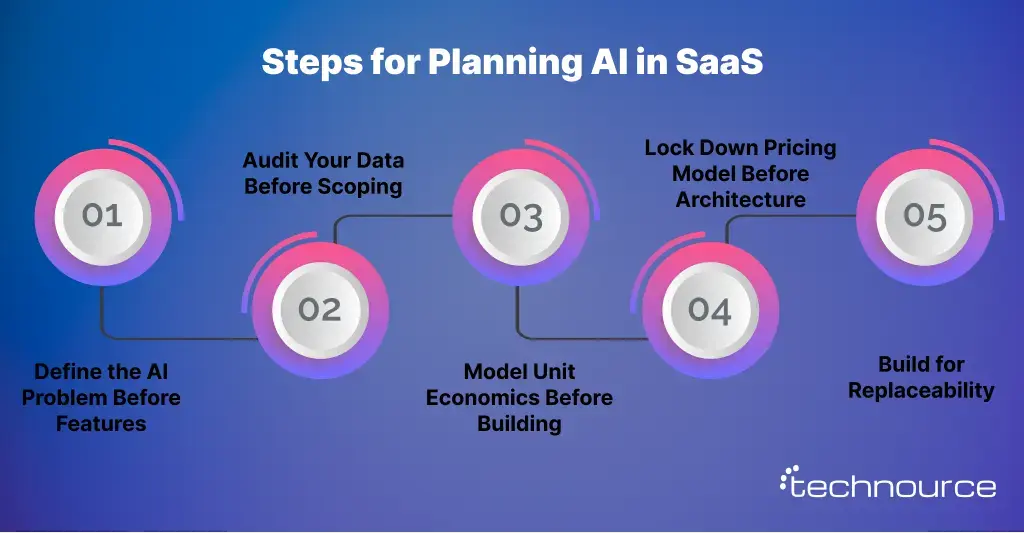
Accurate budgeting starts long before development begins. The most successful AI SaaS teams reduce risk by validating assumptions, auditing data, and planning their architecture before writing code. The steps below can help you build a more realistic roadmap and avoid costly changes later in the project.
Step 1: Define the AI Problem Before Features
Most scoping starts with features. Start with the AI problem instead: What decision does the AI make? What is the acceptable error rate? What data does it need?
Answering these questions before talking about features produces a dramatically more accurate cost estimate.
Step 2: Audit Your Data Before Scoping
Before any development quote means anything, you need to know what data you have, what format it is in, how clean it is, and how much exists.
Teams that do a proper data audit before scoping routinely revise their budget, sometimes down, more often up. The ones who skip it almost always revise upward mid-project.
Step 3: Model Unit Economics Before Building
Build a spreadsheet: cost per user at 100, 1,000, and 10,000 active users. Include AI inference, infrastructure, and support costs.
If the unit economics do not work at the scale you need, you will not solve it by building faster. You will solve it by changing your AI architecture or pricing model before writing code.
Step 4: Lock Down Pricing Model Before Architecture
Your pricing model determines your architecture. This must be decided before Phase 3 begins.
The most expensive mistake in AI SaaS: changing from per-seat to usage-based six months post-launch and discovering the metering infrastructure was never built.
Step 5: Build for Replaceability
Every model API you depend on will eventually change, deprecate, or reprice. Build abstraction layers for model providers, vector database choices, and cloud infrastructure.
This costs 10–15% more upfront. It consistently saves 2–3x that on future migrations.
Future Trends Affecting AI SaaS Costs
The architecture decisions you make today should account for where AI costs are heading, not just where they are now. Several industry shifts are already changing the economics of AI SaaS, creating both cost-saving opportunities and new investment requirements for growing platforms.
Open-Source Models Are Closing the Gap
In 2024, using an open-source model instead of GPT-4 meant accepting lower quality meaningfully. In 2026, that gap will have closed substantially for most use cases.
Meta’s Llama 3, Mistral Large, and Google’s Gemma 2 now perform at levels that make them viable for many AI SaaS applications. Self-hosting a fine-tuned open model at $2,000–$5,000/month becomes economically better than API billing above roughly 2–3 million tokens per day.
Inference Cost Compression
Inference costs have fallen roughly 10x in the past 18 months. Hardware efficiency is improving, and provider competition is intensifying.
By 2027–2028, Gartner projects AI inference will be cheap enough that compute becomes a minor component of margins for most use cases. Teams building now should design for the cost environment in 2–3 years, not just today.
Agentic AI Is the Next Major Cost Layer
Gartner forecasts 40% of enterprise applications will include task-specific AI agents by the end of 2026, up from under 5% in 2025.
Agentic AI, systems that plan, execute multi-step workflows, and operate autonomously, costs 30–60% more to build than standard LLM integration. Infrastructure costs are also higher due to longer, more complex inference chains.
McKinsey estimates generative AI could add $2.6–$4.4 trillion annually to the global economy. The investment will be worth it. Budget for it explicitly.
Why Technource for AI SaaS Product Development
Technource builds AI-powered SaaS platforms as a core practice, not as an extension of general web development.
The architectural decisions that separate a well-built AI SaaS product from an expensive rebuild are made in the first two weeks. We have made them enough times to get them right.
When we built a document automation platform for a fintech client, the brief was straightforward: extract structured data from loan applications and route it to the underwriting system. The complication was that 40% of documents were legacy PDFs scanned inconsistently over a decade.
Instead of training directly on inconsistent data, we built a preprocessing normalization layer first. It added 3 weeks to the project. It produced 91% extraction accuracy versus 67% with direct training. The client’s previous vendor had quoted without accounting for data preprocessing at all. Their number was lower. Our outcome was significantly better.
We work across fintech, healthcare, B2B automation, and CleanTech platforms. We build cost structures that account for the phases most agencies skip. We do not quote projects we cannot deliver accurately.
Conclusion
AI SaaS development costs $25,000 to $600,000+ in 2026. The number for your product depends on three things: your AI model strategy, your data readiness, and the architecture your pricing model requires.
The most expensive decisions are not made when you write the biggest checks. They are made in week one, when model strategy and data architecture get locked in.
Audit your data before scoping. Model your unit economics before committing to an architecture. Choose your pricing model before building the product or engaging software product development services. Build abstraction layers from the start.
FAQs
AI SaaS development costs typically range from $25,000 to $600,000+, depending on product complexity, AI architecture, compliance requirements, and scalability goals. ypical cost ranges include:
Basic AI MVP: $25,000–$80,000
Mid-complexity AI SaaS: $80,000–$200,000
Full-featured AI SaaS platform: $200,000–$400,000
Enterprise AI SaaS solution: $400,000–$600,000+
Products that require custom AI models, extensive integrations, or regulated-industry compliance generally fall at the higher end of the range.
AI SaaS costs 40–80% more than equivalent standard SaaS. The difference is data pipelines, GPU infrastructure, model management, AI-specific testing, and ongoing retraining, layers that do not exist in traditional SaaS engineering.
A typical AI SaaS MVP takes 6–14 weeks when built using third-party AI APIs and a focused feature set.
Timelines can extend to 3–6 months or more when the product requires:
Custom data pipelines
Fine-tuned or self-hosted AI models
Multi-tenant architecture
Enterprise integrations
Compliance requirements such as HIPAA or SOC 2
In most projects, data preparation is the largest contributor to timeline overruns.
For most early-stage products, third-party APIs are right, faster, and cheaper to start. Custom or fine-tuned models make sense above 2–3 million daily tokens, when domain accuracy requires it, or when data privacy prevents sending to third-party APIs.
Most companies should budget 20–25% of the initial development cost annually for maintenance and platform operations.
Common recurring expenses include:
AI model updates and retraining
API usage and token consumption
Cloud infrastructure and storage
Security updates and monitoring
Compliance audits and certifications
Feature enhancements and bug fixes
AI inference costs should be tracked separately because they scale directly with user activity.
Data readiness issues. Teams that scope data engineering without auditing actual data underestimate this phase by 2–4x consistently. The second most common cause: changing from per-seat to usage-based pricing post-launch, and discovering the metering infrastructure was never built.
Yes. Regulated industries require additional security, compliance, and governance measures that increase both development and maintenance costs. Typical compliance-related costs include:
HIPAA implementation: $20,000–$40,000+
SOC 2 preparation: $15,000–$40,000+
Annual compliance maintenance: $8,000–$20,000+
These investments are often necessary to win enterprise customers and meet industry regulations.
Well-architected AI SaaS products achieve 65–80% gross margins, comparable to traditional SaaS. Getting there requires careful infrastructure cost management and planning the API-to-self-hosted transition before it becomes urgent. Products that skip unit economics modeling often settle at 30–50% margins, which makes fundraising difficult.