Most businesses don’t have a productivity problem. They have a workflow problem.
Every day, teams lose hours to manual approvals, repetitive data entry, disconnected systems, and routine tasks that add little value but consume significant time.
As operations grow more complex, these inefficiencies become expensive, slowing decisions, increasing errors, and limiting scalability.
That hidden drag is exactly what the best AI consulting firms for workflow and ops automation are hired to remove. They turn repetitive operations into intelligent, self-running systems.
However, the market is crowded with firms promising AI expertise, automation capabilities, and rapid ROI. Yet many stop at strategy presentations or proof-of-concept demos, while only a handful consistently deliver automation systems that work in real-world business environments.
That’s why we’ve created this guide.
In this guide, you will learn:
How AI consulting firms actually automate workflows and operations
Signs your business is ready for workflow automation
Compare the 25 best AI consulting firms for workflow and ops automation
12 evaluation criteria, red flags, and questions to ask before hiring a firm
What it costs
Real automation use cases across industries
By the end of this guide, you will have a clear framework to shortlist, question, and select the best-fit AI workflow automation partner.
Key Takeaways
The best AI consulting firms for workflow and ops automation deliver working systems, not slide decks, and tie every engagement to measurable outcomes.
Strong partners combine RPA, intelligent process automation, and generative AI, then integrate it cleanly with your existing systems.
Mid-size, specialized firms often beat giant consultancies on speed, cost, and direct engineering access.
Selection should weigh production ownership, security, scalability, and proven ROI far more than brand size.
Costs range widely by scope, so match the engagement model to your workflow complexity, not to the cheapest quote.
What Are AI Consulting Firms for Workflow & Ops Automation?
AI consulting firms for workflow and operations automation help businesses reduce manual work and improve efficiency using AI-powered solutions.
They identify repetitive tasks, design automated workflows, implement the technology, and ensure everything runs smoothly over time.
Unlike traditional robotic process automation, which follows fixed rules and often fails when processes change, AI-powered automation can adapt to different situations. It can analyze data, understand documents and conversations, identify patterns, and make decisions with minimal human involvement.
These firms do more than build software. They help businesses find the right automation opportunities, connect AI with existing tools like CRM and ERP systems, and ensure everything remains secure, compliant, and scalable as the business grows.
In short, AI consulting firms help turn slow, manual processes into faster, smarter, and more efficient workflows.
5 Signs Your Business Needs AI Workflow Automation
Not every company is ready for automation, and not every workflow should be automated first. Here are five signs that tell your business needs AI workflow automation:
1. Repetitive Tasks Are Eating Your Team’s Time
When skilled people spend hours on data entry, copying records, or routing approvals, you are paying expert salaries for clerical work. Those tasks are predictable, high-volume, and perfect for automation.
2. Disconnected Systems Are Creating Data Silos
You probably run a CRM, an ERP, spreadsheets, and a few internal tools that do not talk to each other. So your people become the integration layer, manually moving data between systems.
3. Errors and Delays Keep Slipping Through
Manual processes fail in familiar ways, like duplicate invoices, missed approvals, and inconsistent records. As volume grows, those small mistakes compound into real cost and customer frustration.
4. You Have Data but No Clear Insight From It
Many businesses collect huge amounts of operational data yet struggle to act on it. If reporting is slow, manual, or always out of date, you are sitting on value you cannot use.
5. Competitors Are Already Scaling With AI
Still relying on manual work while competitors grow with AI? When rivals automate support, operations, and reporting, they move faster and cost less to run.
What AI Consulting Firms Actually Do for Workflow Automation
Here is what serious workflow automation consulting firms actually do:
1. Diagnose and Map Automation Opportunities
Good firms do not automate randomly. They study how work flows across your departments, find the repetitive and error-prone steps, and prioritize the ones with the highest return.
2. Design Intelligent, Adaptive Workflows
Once the targets are clear, the firm designs systems that go beyond simple triggers. They build multi-step workflows that process data, make decisions, and route work across tools. For teams comparing workflow orchestration approaches, understanding n8n vs LangGraph can help clarify which framework is better suited to different automation and AI-agent requirements.
3. Integrate AI With Existing Systems
Most automation lives or dies at integration. A capable partner connects AI to your CRM, ERP, databases, and internal apps through APIs and middleware, so data flows cleanly.
4. Build and Deploy Production-Ready Solutions
Many AI projects stall as impressive demos that never reach real users. Strong firms ship working systems into production, handling AI agents, automated workflow engines, and predictive platforms.
5. Govern, Secure, and Ensure Compliance
As automation touches sensitive data, governance becomes essential. The right firm builds in encryption, access controls, audit trails, and compliance with standards like GDPR and HIPAA.
6. Monitor, Optimize, and Scale
Automation is not a one-time delivery. Models drift, processes evolve, and volumes grow, so systems need monitoring and retraining.
25 Best AI Consulting Firms for Workflow and Ops Automation
Here is a side-by-side view of the shortlisted best AI consulting firms for workflow and ops automation, so you can match a firm’s core strength to your specific need:
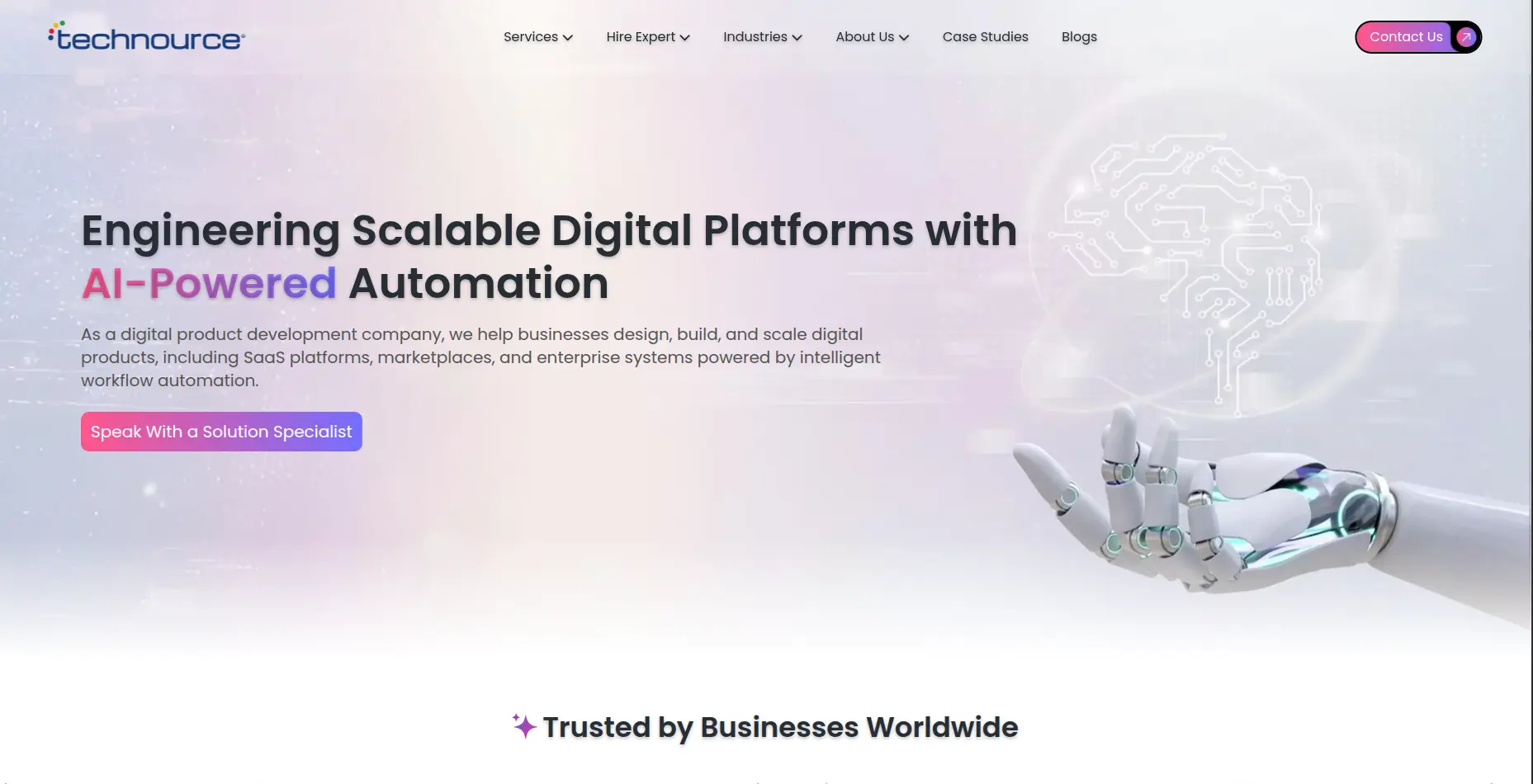
Technource is an AI-powered digital product engineering company that helps businesses turn manual operations into scalable, intelligent automation.
It brings 13+ years of experience, 1000+ projects delivered, 70+ tech experts, and 300+ clients served. That track record pairs deep delivery muscle with a clear focus on business outcomes.
What sets Technource apart is its end-to-end model. The team diagnoses where automation creates real value, then designs and ships AI automation systems that plug into existing CRM, ERP, and internal tools. Proof shows in the results. Its VoiceMate AI voice agent delivered 70% less human dependency and 80% faster response, while its Skyline build cut manual reporting by 90%.
The work spans AI consulting, AI agent development, chatbot development, generative AI, and data engineering.
For growing businesses that want production-ready automation without enterprise overhead, Technource offers a hands-on, cost-effective partner that scales with you.
Key Highlights:
13+ years in business with 1000+ projects delivered across 300+ clients
70+ in-house tech experts handling AI, automation, and data engineering
VoiceMate cut human dependency by 70% and sped response by 80%
End-to-end ownership from diagnosis and build to integration and support
Automation that plugs into existing CRM, ERP, and SaaS without a rip-and-replace
Best For: Startups, scale-ups, and enterprises that want practical, production-ready automation with measurable outcomes and hands-on delivery.
2. Codewave
Codewave is an AI and data solutions company focused on outcome-based delivery rather than billed hours. Its standout angle is a pricing model that ties payment to measurable business results, which appeals to teams burned by open-ended consulting engagements.
The firm has worked across healthcare, fintech, retail, and insurance, shipping workflow design, intelligent document processing, and custom AI agents. For mid-market businesses that want rapid deployment with results on the contract, Codewave is a credible, design-led pick.
Key Highlights:
Founded in 2013 in Bengaluru with a 150+ person team
400+ projects delivered across 15+ industries
Outcome-based ImpactIndex pricing tied to measurable business results
Every project starts with a structured design-thinking vision workshop
Offices across Canada, Australia, India, Singapore, and the UAE
Best For: Mid-market teams wanting rapid, design-led AI deployment with pricing tied to outcomes.
3. Optinov8
Optinov8 is a technology consulting firm that helps businesses modernize operations using AI and advanced digital solutions. Its real strength is legacy modernization, bringing automation to outdated systems without forcing a risky full rebuild.
With a team of specialists across multiple time zones and languages, the firm supports international clients while keeping costs reasonable. Companies stuck on aging operational systems will find Optinov8 a practical bridge into modern, AI-powered workflows.
Key Highlights:
Specializes in legacy modernization without a risky full rebuild
Global delivery across 10 time zones and 5 languages
Blends AI consulting, custom software, and system modernization
Cost-conscious delivery without sacrificing build quality
Best For: Organizations modernizing legacy operational systems while layering in AI-powered automation.
4. Kanerika
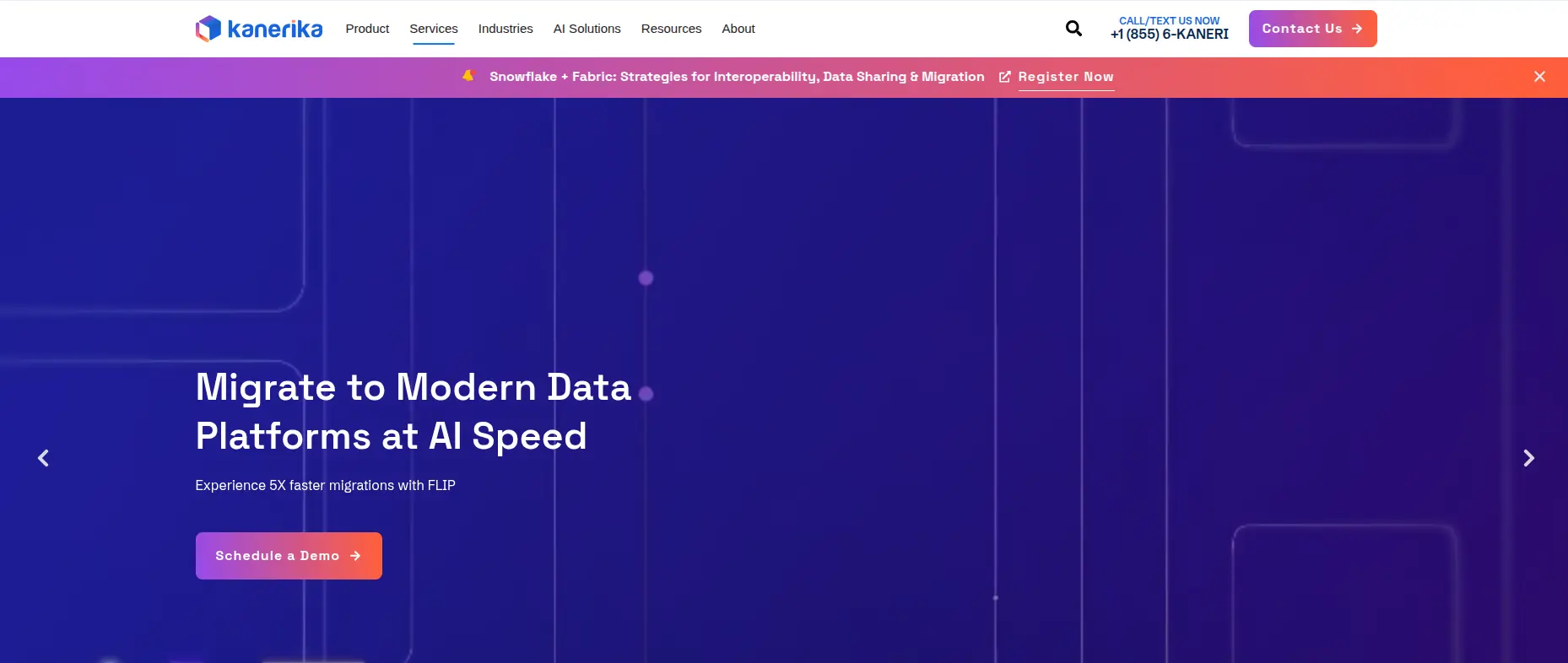
Kanerika focuses on agentic AI and intelligent process automation, with a proprietary workflow platform built for enterprise use. Its differentiator is autonomous agents that execute real operational tasks, not just answer questions or summarize documents.
The firm handles both consulting and technical implementation, covering AP automation, invoice processing, and data operations. For operations-heavy businesses that want intelligent systems with strong governance, Kanerika is a strong, automation-first choice.
Key Highlights:
Proprietary FLIP platform built for enterprise process automation
Production agents like Alan, Mike, Susan, and DokGPT handle real tasks
Microsoft, Databricks, and Snowflake partner status
CMMI-assessed, governance-focused delivery
Autonomous agents that execute multi-step workflows, not just answer queries.
Best For: Operations-heavy enterprises wanting autonomous agents that complete tasks across connected systems.
5. DataToBiz
DataToBiz is an ISO-certified, SOC 2-compliant AI and analytics firm known for fast deployment. Its signature claim is setting up workflow automation in 60 days or less, which suits teams that need quick wins without a multi-year program.
As a certified partner of Microsoft, AWS, and Google, the firm taps deep into platform ecosystems. It works with startups and enterprises alike, making it a reliable pick for businesses that want speed paired with credible governance.
Key Highlights:
Sets up workflow automation in 60 days or less
ISO-certified and SOC 2 compliant for sensitive data
Certified partner across Microsoft, AWS, and Google
Turns data-heavy operations into automated, insight-rich workflows
4.7 Glassdoor score signaling stable delivery teams
Best For: Startups and enterprises needing rapid, compliance-ready automation backed by strong data engineering.
6. HatchWorks AI
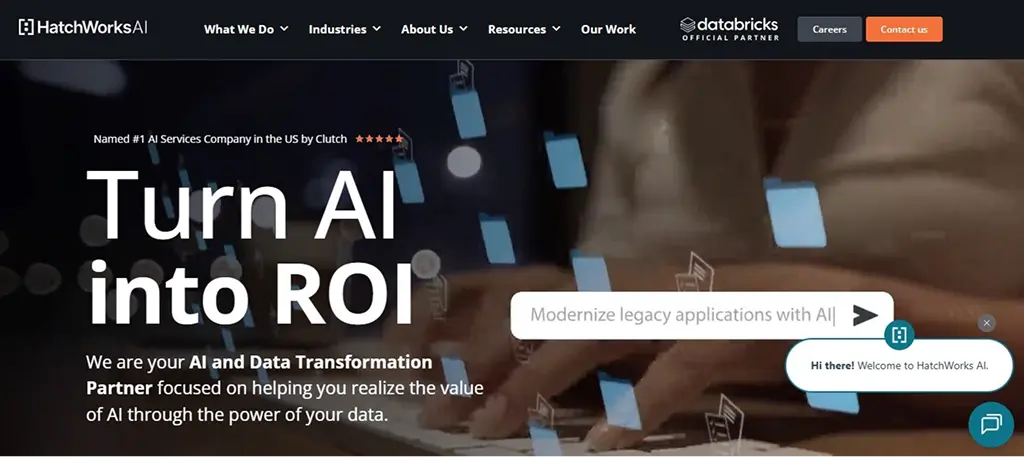
HatchWorks AI positions itself as the firm that turns AI into ROI by automating high-impact work and building AI-native products. Its strength is grounding automation in your own company data rather than generic public-model features.
The firm sits neatly between strategy consulting and pure engineering, with strong experience in data-heavy environments. For mid-market and enterprise teams wanting automation built on internal data, HatchWorks is a focused, results-driven partner.
Key Highlights:
Position AI around measurable ROI, not experiments
Builds automation on your own company data, not generic public models
Strong focus on the production of generative AI
Bridges strategy advisory and hands-on engineering
Nearshore Latin America teams for closer time-zone collaboration
Best For: Mid-market and enterprise teams wanting AI automations built on their own internal data.
7. LeewayHertz
LeewayHertz is one of the most recognized names in generative AI and AI agent development. Its differentiator is packaged vertical accelerators for finance, healthcare, retail, and supply chain that compress the early build phase.
The firm covers feasibility assessment, architecture, and hands-on development at scale. Product companies and tech-forward businesses that want to move fast on AI products will value its engineering depth and accelerator-led approach.
Key Highlights:
Founded in 2007 in San Francisco
Pre-built vertical accelerators for finance, healthcare, retail, and supply chain
250+ engineers for end-to-end AI product builds
Covers feasibility, architecture, model development, and deployment
Recognized depth in generative AI and autonomous agents
Best For:Product and tech-forward businesses wanting fast AI agent builds that fit a vertical accelerator.
Markovate builds intelligent automation systems designed to handle complex, multi-step business workflows. Its edge is autonomous platforms that analyze data, make decisions, and execute actions across multiple systems rather than simple task bots.
The firm reports strong delivery on generative AI, automated reporting, and decision-support tools. Mid-market businesses seeking advanced workflow automation with faster time-to-value will find Markovate a capable, automation-centric partner.
Key Highlights:
Toronto-based boutique with structured agency delivery
Builds multi-step systems that analyze, decide, and act across tools
Strong work in smart assistants and automated reporting
Positioned around faster time-to-value
Full-stack AI services spanning agents, chatbots, and generative AI
Best For: Mid-market businesses wanting advanced, multi-step workflow automation with quicker time-to-value.
9. Quantiphi
Quantiphi is an AI-native consultancy with one of the strongest MLOps practices among mid-tier firms. Its differentiator is delivering both the AI agent layer and the production ML platform underneath, under one vendor.
The firm is multi-cloud, with deep partnerships across Google Cloud, AWS, and NVIDIA. For businesses that want AI plus full lifecycle model management consolidated together, Quantiphi clears a higher engineering bar than most.
Key Highlights:
AI-native consultancy, not a generalist that added AI later
One of the stronger MLOps practices in the mid-tier
Premier partner with Google Cloud, AWS, and NVIDIA
Delivers both the AI agent layer and the production ML platform
4000+ specialists for enterprise-scale programs
Best For: Mid-to-large enterprises wanting AI plus a full MLOps lifecycle consolidated with one vendor.
10. Fractal Analytics
Fractal Analytics is a large pure-play AI and analytics firm focused on decision intelligence. Its distinctive angle pairs machine learning with behavioral science, on the belief that automation only matters if people actually adopt the recommendations.
The firm has decades of track record across financial services, consumer goods, and healthcare. Businesses that want automation tied to real decision adoption, not just model accuracy, will appreciate Fractal’s outcome-focused approach.
Key Highlights:
Founded in 2000 in Mumbai
Pairs machine learning with behavioral science so recommendations get adopted
Decision-intelligence focus that shifts operations from reactive to predictive
~4600 staff for large, multi-region programs
Heavy reinvestment into advanced AI R&D
Best For: Larger enterprises wanting AI and decision-science programs with a strong human-adoption layer.
11. ThoughtWorks
ThoughtWorks brings two decades of software-engineering discipline to AI delivery. Its strength is wrapping automation in rigorous practices like test-driven development, evolutionary architecture, and observability by default.
That discipline matters for teams burned by AI prototypes that never reached production. Businesses rebuilding automation with engineering rigor at the core will find ThoughtWorks a credible, reliability-first choice.
Key Highlights:
Founded in 1993 in Chicago, it is a pioneer of modern software practice
Wraps automation in test-driven development and evolutionary architecture
Builds monitoring and observability by default
11000+ people globally
Strong fit for teams whose past AI prototypes never shipped
Best For: Enterprises wanting AI automation built with rigorous, production-grade software engineering discipline.
12. Master of Code Global
Master of Code Global is one of the most specialized conversational AI firms in the market. Its differentiator is deep expertise in chatbots, voice agents, and customer-facing automation, refined well before the current AI cycle.
The firm covers dialogue design, intent handling, and escalation across web, mobile, and messaging. For businesses automating support, onboarding, or customer engagement at scale, it is a proven, conversation-led specialist.
Key Highlights:
Founded in 2004 in Toronto
Deep specialist in chatbots, voice agents, and customer-facing automation
ISO 27001 certified for enterprise security
500+ team members for large, multi-channel programs
Refined intent handling and brand-consistent escalation design
Best For: Customer-facing businesses building conversational AI, chatbots, or voice agents at scale.
13. Codebridge
Codebridge is an architecture-first firm built by founders with Big Four consulting roots. Its edge is putting diagnosis and architecture before code, which fits complex software workflows where framing the problem determines success.
The firm focuses on high-load systems, complex integrations, and regulated domains. Businesses that need senior advisory and engineering on the same contract will value Codebridge’s disciplined, consulting-led delivery.
Key Highlights:
Founders bring Big Four consulting discipline
An architecture-first method where design precedes any code
700+ projects delivered across complex builds
TutorAI case study reported up to 96% cost reduction
Strong fit for high-load, compliance-sensitive workflows
Best For: SaaS, HealthTech, and FinTech teams needing senior advisory and delivery on one contract.
14. deepsense.ai
deepsense.ai is a deep AI specialist focused on production-grade systems and ML engineering. Its strength is genuine depth in retrieval architectures, model evaluation, and AI infrastructure, rather than surface-level service claims.
The firm has shipped demanding systems, including a medical research assistant used across many countries. Technically demanding teams that need serious ML engineering will find deepsense.ai among the strongest specialist options.
Key Highlights:
Genuine depth in RAG architectures, model evaluation, and AI infrastructure
Builds production-grade systems, not surface-level proofs of concept
Delivered a medical research assistant used across 13 countries
Research-rooted team feeding practical engineering
Designs the AI infrastructure that complex models depend on
Best For: AI-first companies needing deep ML engineering, RAG systems, or production AI infrastructure.
15. SumatoSoft
SumatoSoft offers full-cycle AI software development with a focus on integrating automation into existing business systems. Its differentiator is strength in legacy integration, adding AI as a new layer rather than ripping out what already works.
The firm covers architecture, model fine-tuning, deployment, and compliance audits. Mid-market companies that want automation added to systems they already operate will find SumatoSoft a practical, integration-led fit.
Key Highlights:
Full-cycle AI development from architecture to compliance
Strong legacy integration, adding AI as a layer over working systems
Tailors automation to existing software instead of forcing a platform
High review scores across Clutch and similar platforms
Includes compliance audits to keep automated systems standards-ready
Best For: Companies with established systems wanting AI automation layered onto current operations.
16. Addepto
Addepto is a global AI consulting firm known for advanced machine learning and data-driven automation. Its edge is building custom AI models for specific workflows, instead of forcing a generic platform onto every problem.
The firm starts by mapping how data flows across an organization, then targets high-impact automation. Businesses that depend heavily on data-driven decision-making will value Addepto’s tailored, ML-first approach.
Key Highlights:
Founded in 2018 in Warsaw
Blue-chip clients including Rolls-Royce, Continental, Porsche, ABB, and Hertz
Featured by Forbes, Deloitte Fast 50, and the Financial Times
Built ContextClue, an AI document-analysis and knowledge assistant
Specializes in predictive analytics, computer vision, and explainable models
Best For: Data-driven organizations automating processes with machine learning and advanced analytics.
17. ThirdEye Data
ThirdEye Data specializes in intelligent solutions powered by large-scale data infrastructure. Its strength is combining AI with strong data engineering to process structured and unstructured data at high volume.
The firm builds predictive platforms and real-time data pipelines for data-intensive operations. Companies managing large, complex data ecosystems will find ThirdEye a trusted, infrastructure-heavy partner for automation.
Key Highlights:
Deep strength in large-scale data infrastructure and AI
Solutions and demos delivered across Microsoft environments
Processes structured and unstructured data at high volume
Builds predictive platforms and live data-processing pipelines
Architectures designed specifically for data-intensive operations
Best For: Data-intensive enterprises needing AI systems built on scalable data infrastructure.
18. Intellectyx
Intellectyx is an AI-first consulting and engineering firm specializing in AI agents and agentic workflows. Its differentiator is moving initiatives from proof-of-concept to production-ready automation with measurable impact.
The firm covers AI strategy, custom agents, predictive analytics, and data modernization. Businesses in SaaS, finance, and supply chain that want agentic automation will find Intellectyx a focused, execution-minded choice.
Key Highlights:
Founded in 2010 in Denver
Builds AI agents that move from pilot to production
100+ clients across SaaS, finance, and supply chain
Pairs data modernization with AI so automation actually works
Designed to ship measurable outcomes, not stall at the pilot stage
Best For: Enterprises wanting agentic workflows and AI agents taken from pilot to production.
19. VectorShift
VectorShift offers a no-code platform for businesses to build and deploy custom generative AI workflows. Its edge is accessibility, letting teams automate processes without heavy engineering resources.
The firm supports chatbot building, data extraction, and trigger-action automation with quality assurance built in. Teams that want to experiment with automation quickly and affordably will find VectorShift an approachable, low-barrier option.
Key Highlights:
No-code platform for building and deploying AI workflows
Covers chatbot building, data extraction, and trigger-action logic
Risk management and quality assurance are built into the flow
Low barrier to test high-ROI processes before committing
Designs the overall framework, components, and data flow for clients
Best For: Teams wanting no-code generative AI workflows with quality controls built in.
20. Persistent Systems
Persistent Systems is a digital engineering and enterprise modernization partner with strong intelligent automation capabilities. Its strength is streamlining workflows without disrupting core business functions, using AI and low-code platforms.
The firm emphasizes organic transformation and high ROI through swift, low-risk change. Businesses that want to modernize and automate while protecting existing operations will find Persistent a stable, enterprise-grade fit.
Key Highlights:
Pune-based, enterprise-scale digital engineering partner
Streamlines workflows using AI and low-code platforms
Focuses on change that does not disrupt core operations
ESG-conscious, sustainability-aware delivery
Combines legacy modernization with new automation
Best For: Enterprises wanting intelligent automation paired with broader systems modernization.
21. WeAreBrain
WeAreBrain is an international team that turns ideas into impactful, automated businesses. Its differentiator is an outcome-focused, value-driven model that combines strategy with end-to-end implementation.
The firm delivers tailored workflow automation that stays flexible and scalable as organizations grow. Businesses wanting a collaborative partner across strategy and delivery will find WeAreBrain a versatile, growth-oriented choice.
Key Highlights:
Amsterdam-based international team with distributed delivery
Outcome-focused model tied to business impact
Covers the full journey from idea to working system
Solutions designed to expand as the organization grows
Venture-builder heritage turning concepts into operating businesses
Best For: Businesses wanting tailored, scalable automation with end-to-end strategy and delivery support.
22. N-iX
N-iX is a large engineering firm with a serious AI and data practice and deep bench strength. Its edge is the ability to staff entire programs with 20 or more engineers without leaning on partner firms.
The firm covers Python AI engineering, Azure, AWS, and Databricks-based automation. Growing enterprises that need significant offshore engineering capacity will find N-iX a scalable, delivery-heavy partner.
Key Highlights:
Founded in 2002 in Lviv
2000+ engineers to staff full AI programs without partners
Strong Azure, AWS, and Databricks coverage
Covers Python AI engineering through deployment
Managed offshore model built for scaled, reliable delivery
Best For: Mid-market enterprises needing 20+ AI engineers on a managed offshore basis.
Brainpool AI connects businesses with a global network of AI researchers and academic experts. Its differentiator is blending academic research with practical implementation for cutting-edge automation.
The firm focuses on building custom AI capabilities so businesses keep control instead of relying only on off-the-shelf tools. Companies tackling complex, research-heavy automation problems will value Brainpool’s expertise-driven model.
Key Highlights:
Founded in 2017 as a research-led organization
Connects clients to a global network of AI researchers and data scientists
Blends academic rigor with practical implementation
Builds owned AI capabilities, not just off-the-shelf integrations
Strong on advanced deep-learning problems
Best For: Organizations seeking research-grade expertise for advanced AI and automation projects.
24. NineTwoThree AI Studio
NineTwoThree AI Studio builds custom AI products for funded startups and established brands. Its strength is a product studio model that delivers customer-facing AI products, not just internal automation.
The firm references strong delivery across internal ventures and client products, with solid review signals. Businesses building an AI-enabled product where the product itself is the deliverable will find NineTwoThree a fitting partner.
Key Highlights:
Product-studio model building customer-facing AI products
150+ products shipped across client and in-house ventures
Strong fit for funded startups and established brands
Cited for value, responsiveness, and on-budget delivery
Best For: Funded startups and brands building customer-facing AI products.
25. DataRoot Labs
DataRoot Labs is an AI R&D-focused firm that helps startups and growing businesses build intelligent products. Its edge is a research-driven culture suited to validating whether an AI capability is feasible before a full build.
The firm covers ML, data science, and prototype-to-product AI components with scalable architecture. Early-stage companies validating AI feasibility will find DataRoot Labs a credible, R&D-strong starting point.
Key Highlights:
AI R&D center that co-builds components into core products
Cyprus-based, with a fast-moving startup culture
Helps validate AI feasibility before a full build
Takes ML concepts from prototype to scalable architecture
Deep ML and data-science core for emerging products
Best For: Startups validating AI feasibility and building ML product components.
Now that you have seen the best AI consulting firms for workflow and ops automation, let’s look at how to judge any of these firms against your own needs.
12 Key Criteria for Choosing the Right AI Consulting Firm for Workflow Automation
The right partner depends on the shape of your workflow and the help your team actually needs. Use these twelve criteria to move from guessing to a confident, informed decision:
1. Proven Automation Track Record
Look past polished case studies for real, measurable outcomes like reduced processing time or fewer errors. A firm that has shipped similar automation before will move faster and make fewer mistakes.
2. Technical Depth Across RPA, IPA, and Generative AI
Strong partners cover the full spectrum, from rule-based RPA to intelligent process automation and generative AI. That range lets them handle both simple task automation and complex, decision-heavy workflows.
3. Industry and Domain Expertise
Automation behaves differently across industries because data, rules, and edge cases vary. A partner who knows your sector anticipates compliance needs and tricky exceptions before they become problems.
4. Integration With Your Existing Systems
Most automation succeeds or fails at integration, not at the model. Your partner should connect AI to your CRM, ERP, and internal tools through clean APIs and middleware.
5. Production Ownership, Not Just Strategy Decks
Some firms sell strategy and quietly hand off execution to a separate shop. You want a partner that builds, deploys, monitors, and improves the system end-to-end.
6. Data Security, Compliance, and Governance
Automation touches sensitive data, so security cannot be an afterthought. Your partner should follow strict governance, support standards like GDPR and HIPAA, and define clear access controls.
7. Scalability as Your Operations Grow
Your automation needs will evolve from a single workflow to many connected processes. The right partner designs systems that scale without a costly rebuild every time you grow.
8. Transparent Pricing and Engagement Models
You deserve full visibility into what you pay for, including development, infrastructure, and support. A reliable firm explains pricing clearly and offers flexible models like pilots or dedicated teams.
9. Clear ROI and Measurable Outcomes
A serious partner is comfortable defining success metrics before any work begins. Tie deliverables to outcomes like cost savings or faster cycles, not just hours logged.
10. Post-Deployment Support and Optimization
Launch is the beginning, not the finish line, because models drift and processes change. Your partner should offer monitoring, retraining, and ongoing optimization after go-live.
11. Communication and Direct Team Access
Clear communication keeps automation aligned as requirements evolve mid-project. You should be able to speak directly with the engineers building your system, not only account managers.
12. Team Stability and Delivery Maturity
A stable team ensures continuity and a deeper understanding of your systems over time. Frequent turnover slows progress because every new person needs to relearn the context.
Red Flags to Avoid When Choosing an AI Workflow Automation Partner
A few warning signs reliably separate serious firms from risky ones. Watch for these before you sign anything.
Buzzwords without depth: They talk AI fluently but cannot explain how models are trained, evaluated, or deployed in real environments.
No live production proof: They show polished demos but cannot point to systems running on real data with measurable outcomes.
Promises before understanding: They quote timelines and accuracy before deeply understanding your data, use case, and constraints.
Vague pricing: The numbers look attractive, but scope changes, scaling, and overruns are left undefined and unexplained.
Senior pitch, junior delivery: Experienced people sell the deal, then a less experienced team quietly executes the actual work.
No post-launch plan: The conversation ends at delivery, with no monitoring, retraining, or long-term ownership in sight.
Imp Questions to Ask Before Hiring an AI Consulting Firm
The right questions expose how a firm actually thinks and delivers under pressure. Ask these before you commit.
Can you show production systems, not just prototypes, that handle real data and deliver measurable results?
What experience do you have with my specific workflow, industry, and tech stack?
Can I speak directly with the engineers who will build and run my automation?
How do you handle integration with my existing CRM, ERP, and internal tools?
What security and compliance practices do you follow to protect my data and intellectual property?
How do you measure success, and what KPIs will we agree on before work begins?
What happens after launch in terms of monitoring, retraining, and ongoing support?
How do you handle scope changes, scaling, and cost adjustments during the project?
How Much Does AI Workflow & Ops Automation Cost?
Cost is one of the first questions every founder and operations lead asks, and the honest answer is that it varies widely. Pricing depends far more on scope and complexity than on any single rate card.
Here’s the estimated cost breakdown based on engagement type:
Engagement Type
Typical Range
Best Fit
Pilot or proof-of-value
$10,000 to $40,000
Validating one high-impact workflow
Mid-market automation build
$40,000 to $150,000
Multiple connected workflows
Enterprise transformation
$150,000 to $500,000+
Org-wide, multi-system automation
Hourly consulting
$25 to $250+ per hour
Flexible, scoped support
Key Factors that Drive the Cost Up or Down
Here are some key factors that affect the cost of AI workflow and ops automation:
Workflow complexity: Multi-step workflows with multiple integrations cost more than simple automation tasks.
Data readiness: Clean, organized data reduces implementation time, while poor-quality data requires additional preparation and cleanup.
Number of integrations: Connecting AI with CRMs, ERPs, databases, and other business tools can increase project scope and cost.
Compliance requirements: Industries with regulations such as HIPAA, GDPR, or SOC 2 often require additional security, governance, and audit measures.
Customization level: Highly tailored solutions generally cost more than using existing frameworks or pre-built components.
Engagement model: Dedicated teams, project-based contracts, and offshore delivery models all have different pricing structures.
For projects that involve autonomous or multi-step AI agents, AI agent development cost can vary depending on model complexity, integrations, data requirements, and the level of autonomy required.
AI Workflow Automation Use Cases by Industry
Here are some major use cases of AI workflow automation by industry:
Healthcare: AI automates patient onboarding, appointment scheduling, claims processing, and documentation. This reduces paperwork, improves accuracy, and helps healthcare teams focus more on patient care while delivering key benefits of workflow automation like faster service and fewer manual errors.
Fintech & Financial Services: AI handles KYC checks, fraud detection, loan processing, and reporting. It speeds up operations, reduces errors, and supports compliance requirements.
Retail & eCommerce: AI automates inventory tracking, order management, demand forecasting, and customer support. This helps businesses improve efficiency and customer experience.
Logistics & Supply Chain: AI streamlines shipment tracking, route planning, warehouse operations, and delivery management. It helps reduce delays and improve supply chain visibility.
Manufacturing: AI supports predictive maintenance, quality checks, production monitoring, and reporting. This helps reduce downtime, improve quality, and increase productivity.
Why Choose Technource for Workflow & Ops Automation
Choosing the right partner directly shapes how well your automation strategy performs over the long run.
Technource helps businesses streamline operations with practical, scalable AI systems that reduce manual effort and support real growth.
Here is what makes Technource stand out for workflow and ops automation:
Proven delivery at scale: 13+ years of experience, 1000+ projects delivered, 70+ tech experts, and 300+ clients served.
End-to-end ownership: From diagnosis and design through deployment, monitoring, and optimization, all under one roof.
Measurable outcomes: Real results like 70% less human dependency, 80% faster response, and 90% less manual reporting from delivered automation builds.
Secure and connected systems: Secure-by-design automation that integrates cleanly with your existing CRM, ERP, and internal tools.
Cost-effective scaling: Flexible engagement models that let you start lean, prove ROI, and scale with confidence.
Conclusion
Choosing the right AI partner is less about brand size and more about the system you need to automate. The best AI consulting firms for workflow and ops automation diagnose the right processes and build production-ready systems. They also stay involved as you scale. The wrong one leaves you with a strategy deck and a stalled prototype.
We hope this guide helped you understand what these firms do, how to evaluate them, and explore the 25 best AI consulting firms for workflow and ops automation that are worth your shortlist.
Now it’s your turn to assess your workflows, ask the hard questions, and pick a partner that delivers real, measurable value.
They are specialized partners that help businesses replace manual processes with intelligent, adaptive systems. They assess your operations, design the automation, integrate it with existing tools, and keep it running in production for measurable results.
Traditional automation follows fixed rules and breaks when a process changes. AI workflow automation uses machine learning and reasoning to read unstructured data, make decisions, and handle exceptions. As a result, it adapts to real conditions without constant human input.
Focus on proven delivery, technical depth, integration ability, production ownership, and clear ROI. Match the firm’s core strength to your specific workflow, ask for references in your industry, and confirm they own the system end-to-end.
Costs range widely by scope, from around $10,000 for a pilot to $500,000 or more for enterprise transformation. Complexity, data readiness, and compliance needs drive the total, so starting with a pilot helps control spend.
Timelines depend on complexity, but focused automations can deploy in weeks, while larger programs take several months. Some firms set up specific workflows in 60 days or less, so early scoping is essential for realistic planning.
Yes, capable firms connect automation with systems like Salesforce, SAP, and custom internal tools using APIs and middleware. Strong integration keeps data flowing across your stack without requiring a full and disruptive system replacement.
Mid-size, specialized firms often deliver faster, cost less, and offer direct engineering access for growing businesses. Large consultancies suit org-wide, multi-year transformations, but their pricing and overhead rarely fit lean, fast-moving teams.
Industries with high-volume, repeatable processes see the fastest returns, including healthcare, fintech, retail, logistics, and manufacturing. Tasks like claims processing, fraud checks, inventory updates, and reporting deliver clear efficiency gains quickly.