How to Build an AI Voice Agent in 2026: A Comprehensive Guide
Dhrumil Mistry
Published: Mar 13, 2026
Key Takeaways:
Understanding how to make an AI voice assistant is becoming increasingly important as the global voice recognition market is expected to reach $50 billion by 2029.
Voice assistants already reach 8.4 billion active devices in 2024, with more expected in the coming years.
In the US, 153.5 million people are expected to utilize AI-enabled voice assistants.
Multiple factors influence the overall development of AI voice agents, including tool and framework selection, app complexity, design, etc.
Technource is serving clients globally with smart, efficient, automated voice assistants to drive ultimate business growth.
When Starbucks launched an AI voice assistant in partnership with Alibaba in 2019, it ensured that voice ordering was personal, smart, and interactive. “Tmall Genie, the smart speaker, ushers a new era of digital customer engagement, bridges the gap between customer and Starbucks,” said Molly Liu, vice president and general manager, Digital Ventures, Starbucks China.
This isn’t a single story!
From fintech brands to healthcare service providers, businesses across multiple industries are thoughtfully embracing custom voice assistants to reshape, streamline, and automate operational processes.
One of the renowned AI voice assistants, Alexa, now has 100,000+ users. In 2025, Alexa introduced Alexa+, enabling users to talk naturally. This defines the global demand for AI voice agents.
According to Fortune Business Insights, the global conversational AI market was valued at $14.79 billion in 2025 and may reach $155.23 billion by 2035. This exponential growth is not only a modern trend but also defines AI voice assistant development for business as a critical enabler for any proactive, growth-focused, and tech-savvy organization.
If you’re running a business and need a Voice agent to streamline your business operations, only Googling “how to make an AI voice assistant” and surface-level information won’t help!
You need a comprehensive guide that provides meaningful insights. This blog will serve as a guide you can refer to anytime, even if you become a pro. From walking you through developing an AI voice agent to covering tools and techniques, we will make the process simpler.
Before we move into the core topic, let’s clear the basics first.
What is an AI Voice Agent?
Voice AI agents are the smart, advanced virtual assistants, powered by artificial intelligence. It understands, interprets, and responds to human speech, and performs multiple tasks such as providing valuable insights, answering questions, and completing actions through conversational interactions. Many organizations are now investing in AI agent development solutions to build customized voice agents that can automate customer support, internal workflows, and real-time decision-making processes.
Apart from speech engagement, these AI agents can also perform reasoning and extract and provide valuable information. Some popular examples of voice AI agents are Alexa, Siri, and Gemini- used by professionals to finish everyday tasks quickly and efficiently.
What are the Essential Components of AI Voice Agents?
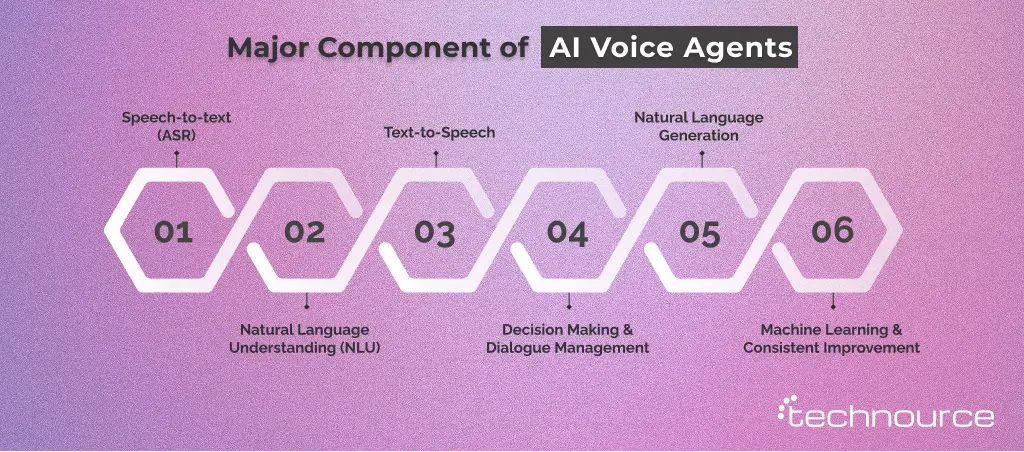
Voice AI agents are powered by three key technologies: natural language understanding, automatic speech recognition, and text-to-speech. When combined, they interpret intent and mimic human-like responses.
1. Speech-to-Text (ASR)
By transforming spoken language into written text, ASR (automatic speech recognition) handles multiple accents, filters out noise, and transcribes speech when users speak with an agent.
Language Capabilities- Global user support in their native languages.
Precision: Consistent user input transcription irrespective of noisy environments.
Adaptability: Can learn industry jargon and handle issues efficiently.
Automatic speech recognition captures the user’s spoken input and converts it into accurate text and background. It works in real time to make the conversation seamless. For example, “Check my current order numbers.” This simple text enables AI to work accordingly.
2. Natural Language Understanding (NLU)
Post language conversion, the AI brainstorming session begins. NLU enables the agent to understand what users want by selecting context and specific details such as product names, dates, or locations.
3. Text-to-Speech
This converts your brand’s AI voice agent into humanlike speech. This makes the interactions conversational and seamless. Smart TTS systems leverage neural networks to produce realistic speech. This makes interactions personalized and engaging through customizable languages and voices.
4. Decision Making & Dialogue Management
Once the objective is clear, the voice AI agent decides how to act accordingly. This step includes checking business outcomes and policies, reviewing history or past interactions, and connecting to APIs, tools, and databases. For example, if you ask, “What’s my current order status?” The agent queries the right database and retrieves the current order status.
5. Natural Language Generation
Once the action is taken, the system takes the help of LLMs to step into the action:
Curate responses that are conversational and natural.
Adapt style and tone to the situation.
It ensures that the answer is human, not robotic.
“The task is complete.” This is the wrong approach. Instead, the LLM steps in and responds: “Your appointment is rescheduled to Saturday at 11 am.”
6. Machine Learning and Consistent Improvement
Now, the system learns from every interaction. It analyzes the user request pattern and adapts to new ways of speaking. Moving forward, it enhances overall accuracy and speed over time. In many cases, these intelligent systems are designed and optimized with the expertise of a specialized machine learning development companyhat builds models capable of continuous learning and improvement. In a nutshell, the more users interact with the system, the smoother the experience becomes.
What are the Types of AI Voice Agents?
AI-powered custom voice assistants can perform a wide range of tasks based on your business needs. Here are some types:
Customer Support Voice Agents- Handles inbound customer queries and resolves them accordingly with less human intervention. Also, it can operate 24*7 without any downtime to reduce customer wait times.
Appointment Scheduling Agents: Automate bookings, send voice-based confirmations, and reschedule if needed.
Sales & Lead Qualification Agents: Engage prospects immediately through customized voice interactions.
Internal Operations Voice Agents: Provides quick IT support, automates internal workflows, and delivers real-time data access.
Virtual Receptionist Agents: Address and resolve the contact for callers, transfer calls to the correct department, and provide business information instantly.
What are the Top Benefits of AI-Powered Voice Assistants?
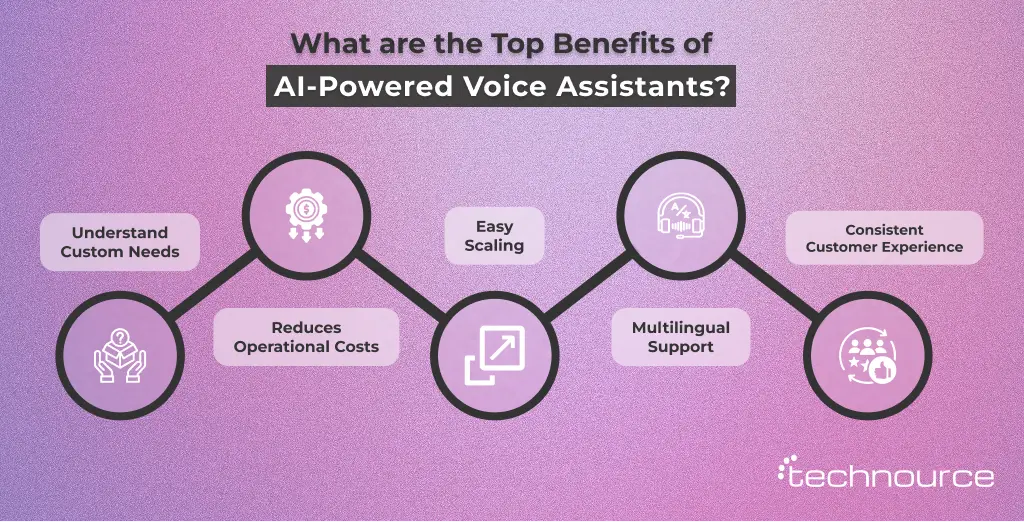
Multiple AI-based voice assistants offer benefits from various perspectives. Here are some notable benefits-
1. Understand Custom Needs
Addressing customer needs and resolving them are primary factors in consistent business growth. On that note, AI voice agents process information, eliminate extra time, and provide resolutions instantly by accessing multiple systems directly connected to customer history.
Faster enquiry resolution by understanding customer needs improves customer satisfaction. Moving forward, it contributes to operational efficiency across multiple support points within the organization.
Real Life Example: How is Airbnb’s AI-powered voice assistant understanding the customer needs and providing solutions accordingly?
Airbnb application provides help article retrieval through AI agents to minimize the need for human customer support and increase customer satisfaction. This smart, automated system automatically detects user issues and delivers the help article link through text message and app notification.
The experts have introduced a contact reason taxonomy to categorize enquiries. The intent detection model classifies calls into a contact reason category. For instance, if a caller mentions that “I want my refund in my original payment method”, the model outlines it as “Need to receive refund on original payment method” and forwards the same to the downstream components.
2. Reduced Operational Cost
The cost of hiring human agents may be high due to demand. However, AI voice agents can operate on a pay-per-use basis, typically costing less than a human agent. Therefore, operating on a pay-per-minute model typically costs 80-90% per interaction.
From Gartner’s perspective, advanced conversation AI will reduce customer issues by 80%, which may lead to 30% reduction in manual labor costs. This study indicates a reduction in operational costs through the proper incorporation of agentic AI.
Important note: Replacing human work isn’t the objective here, but to augment it with a careful approach.
Real Life Example: How Salesforce’s Agentic AI is Helping the Telecom Industry by Reducing Operational Cost?
Agentforce for communications is launched by Salesforce. It has five new prebuilt AI agents to foster communication with the user, requiring minimal human intervention.
It can pull live data from OSS or operations support systems, CRM, and business support systems to provide instant resolutions to customers.
For employees, Agentforce replaces manual data retrieval and transforms it into simple problem-solving scenarios.
3. Easy Scaling
AI agent voice scales at 3X speed to meet business growth and seasonal demands without the delays of hiring new talent. It maintains performance and delivers quality outputs, avoiding anomalies associated with human staff.
Flexible usage of AI voice assistants enables brands to scale across regions and departments by providing robust technical support.
According to SNSinsider, voice AI agents may reach $103.6 billion by 2032, underscoring how businesses are using voice AI as a primary infrastructure for scalable operations.
Real Life Example: How Amazon’s Alexa+ is Helping the Brand to Scale?
Alexa+ request triggers real-time AI processing and back-end data retrieval.
Offers Voice AI to allow natural, human-like conversational interactions to resolve queries quickly. The user simply speaks, and the system understands intent and retrieves relevant data to provide real-time responses.
Allows Amazon to handle tons of data simultaneously, allowing the service quality to remain constant.
4. Multilingual Support
If you have to serve diverse customers, AI voice agents will benefit, as it supports multiple dialects and languages. This eliminates the need to bring multilingual speaking talents and ensures localized customer interactions.
How Uber is Reducing Booking Friction with AI-Powered Voice Agents?
Enables a user to book rides by using voice commands. You can place your request, and the agent will help you to finish the booking process.
As Uber’s voice agent supports multiple languages, it can help diverse users with proper query resolution. This reduces booking friction and makes the process quicker and more efficient.
5. Consistent Customer Experience
The primary key to achieving customer satisfaction is to provide consistent customer service. Human agents may vary in speed, accuracy, and tone, but the artificial intelligence voice assistant delivers thorough outputs to every customer.
How Alibaba’s Chatbot Voice Assistant is Serving a Billion Customers?
Tmall and Taobao, two chatbot systems of Alibaba caters 2 million customers daily by monitoring transaction and conversational information. This enables the bots to assess service disputes and provide automated judgments.
The Alime bot is helping the end-user consumers employed in phone and online channels. It depends on the rich set of interface components that can provide cards, text dialogues, videos, graphics, and conversational interactions.
How to Build an AI Voice Agent: A Step-by-Step Guide
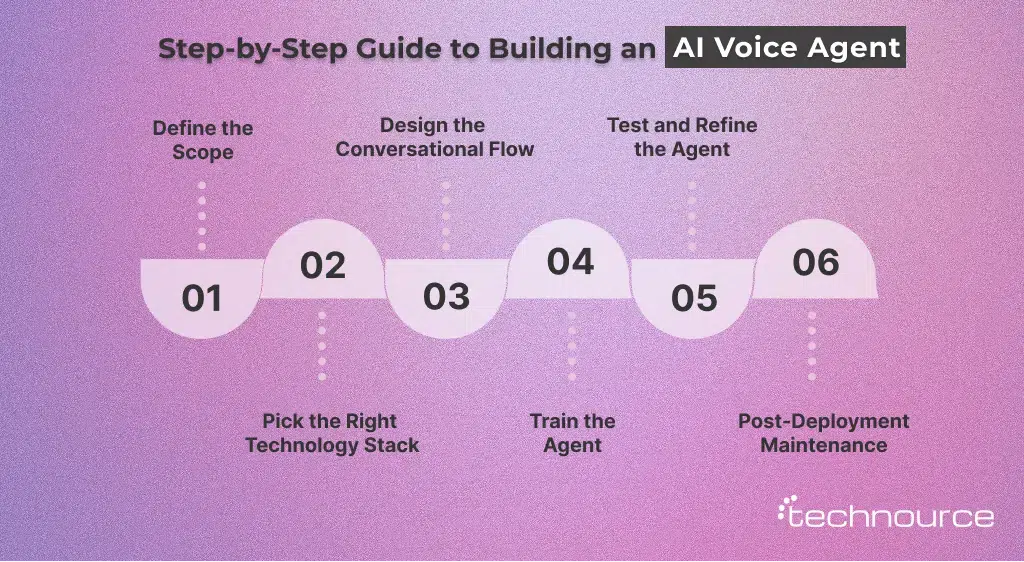
Building smart voice agents is not a single-step process. The journey is methodical and needs careful planning. Below are the steps for developing a custom AI voice assistant.
Step 1- Define the Scope
First and foremost, define the purpose behind developing an AI voice agent. Ask yourself these questions-
Will it handle customer queries?
Will it be used to schedule appointments?
Will it manage internal tasks?
Having a clear focus will help you to handle the rest. Determining the purpose and scope will help you understand the deliverables. Moving forward, this will set the stage for growth.
Step 2- Pick the Right Technology Stack
Choosing the right tools is essential for developing an AI voice agent that meets your business requirements. Here are quick points that you must consider when choosing a tech stack:
Customizable Platform: Look for tech stacks that can be used to develop simple yet functional AI agents. For example, a voice AI agent should handle complex workflows, such as guiding an agitated customer through troubleshooting issues.
Integration Option: The AI voice agent must connect with CRMs, ASRs, and ERPs to access valuable information.
Choosing the right tech stack defines the balance among flexibility, security, and scalability. This lays the groundwork for AI voice agents, which grow with your business.
Step 3- Design the Conversational Flow
The design of the AI chatbots’ conversational flow decides how effectively the voice agent communicates with the users. A clear flow enables users and agents to be engaged. Here are some best practices to grow the agent’s conversational flow:
Structuring scenarios, including greeting, confirming the intent
Handling complex issues if needed.
Avoid long TTS responses, which can frustrate users due to slower conversation.
Ensure the agent can handle interventions, repeat information, and define things as needed.
Step 4- Train the Agent
Training enables the AI voice agent to understand how people talk and how to respond quickly in real situations. Using real-world data helps the agent recognize how the conversation will unfold, adapt to variations, and become more accurate over time.
Here are the ways to train your AI agent:
Accumulate data: Develop a training dataset that uses past customer interactions that an agent may encounter.
Refine language model performance: Train an agent so that it can handle ASR-transcribed text, including variations in accents, phrasing, and mispronunciations.
Add Uncommon Queries: Add unusual queries to ensure the agent performs quickly across all the formats.
Enhance Edge Recognition: Train the agent to distinguish between multiple queries. Accurate intent assessment enables users to quickly get the right response.
Consistent training allows the agent to stay up to date with business needs, improve over time, and continuously deliver reliable, accurate responses.
Step 5- Test and Refine the Agent
Before deployment, test the agent thoroughly to ensure seamless conversation flow and accurate responses. Use the approach mentioned below to test:
Utilize real-time scenarios- Run realistic simulations to check how the agents are performing with multiple accents, inputs, and conversational flows. This ensures that the users can interact seamlessly.
Check ASR Accuracy: Ensure the speech-to-text system constantly captures voice input.
Test Across Multiple Scenarios: Check whether the agent works consistently across multiple platforms like websites, mobile apps, and voice-enabled devices.
Collect Feedback: Gather feedback from internal teams to detect issues and improve overall functionality.
Step 6- Post-Deployment Maintenance
Monitor performance metrics, assess user conversations, and use meaningful insights to retrain models and improve capabilities over time. Ensure that you’re setting up feedback loops by collecting user feedback, monitoring key metrics, and analyzing conversations.
Top Tools and Technologies to Build a Voice Assistant App in 2026
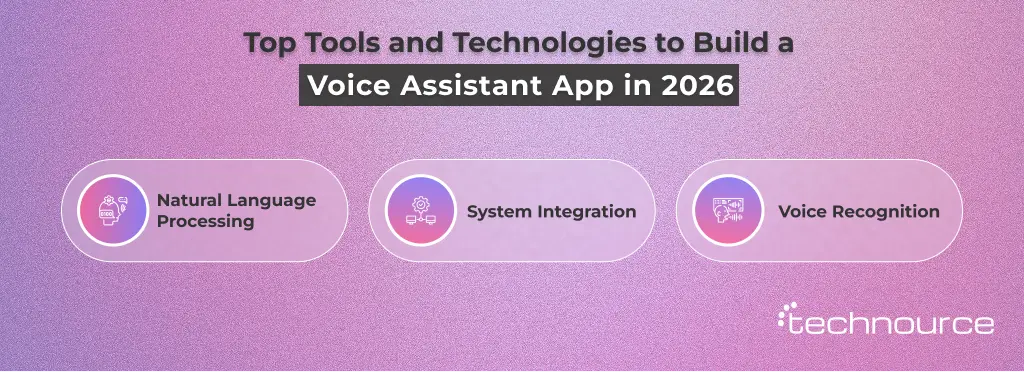
A voice AI agent for business won’t serve the purpose without utilizing the right tech stack. These frameworks and tools will work in sync to generate voice commands for human-like responses.
1. Natural Language Processing
This is the core of developing an AI-powered voice assistant app. This allows human speech processing, detects user intent, and extracts relevant details. Many organizations rely on advanced NLP development services to build systems that accurately interpret spoken language and respond intelligently. Moving ahead, it allows for the context of existing conversations, which follows under the umbrella of NLP.
2. System Integration
Develop your voice solution by integrating with your existing system, ERPs, CRMs, SCMs, etc. Every enterprise chooses its own reliable development platform. Some prefer GitHub, while others prefer CodeSandbox. This allows multiple developers to code consistently.
3. Voice Recognition
The speech recognition system generates quick responses by defining the tone and pitch of the generated response. To choose the right voice recognition tools, you must prioritize a system that can:
Transform user input with voice tone and diverse accents.
Connect with users and offer them multilingual support.
Maintain a consistent conversational flow
Evaluate industry-specific jargon and terminology.
Top Frameworks to Develop an AI Voice Assistant
Stream Python AI SDK: Helps developers to develop audio apps that can manage difficult voice AI services with less effort.
Eleven Labs: One of the leading platforms for developing conversational AI applications. This provides enterprises and developers with the building blocks to integrate low-latency AI voice agents.
Amazon Lex: This supports the development of conversational interfaces through text and voice, with deep AWS integration.
OpenAI- This enables developers to integrate voice services with their existing applications. With the TypeScript SDK and Python Agents SDK, you can add voice agents.
Deep Gram-This is a voice AI application development platform that allows developers to use the API to build audio applications with speech-to-speech, text-to-speech, and speech-to-text models.
Play.ai- Helps in developing smart voice apps for mobile and web. This platform enables engineers to develop voice agents for real estate, healthcare, food delivery, gaming, EdTech, etc.
AI Voice Agent Use Cases
Multiple industries are benefiting from the usage of AI voice agents. Here you go-
Retail
AI voice agents improve the shopping experience by providing quick, personalized support. Most retailers use AI to orchestrate customer service, accumulate feedback and cut costs. Here’s how a Shopify-integrated Chatbot enabled an electronics retailer to get their desired outcome-
To improve user experience and direct-to-consumer sales, a leading US electronic manufacturer brand partnered with Infobip and Master of Code Global to develop an AI voice agent with Shopify. This tool acts as a virtual shopping assistant that evaluates the buyer’s purchase history and provides customized recommendations.
Results:
73% improved session rate
80% CSAT score
$250+ average order value
Insurance
From receiving timely alerts to filing claims, AI voice agents are always on hand to provide assistance and tailored guidance. Let’s see how AXA, one of the globally renowned insurance companies, is incorporating the same into its daily tasks:
AXA
This insurance brand leverages NLP and ML to provide customers with thorough guidance. AXA handles 20,000+ conversations annually with its chatbots, routing enquiries, reducing wait times, and enabling agents to focus on complex cases.
Besides, it also offers self-service options to facilitate 200+ insurance cards every day. With the ability to consistently learn and improve, AXA’s bot can increase buyer retention.
Results:
58% better policy quote generation
72% better claims initiation
33% better coverage eligibility assessment
75% better policy explanation
Banking
With improvements in AI & ML models, this industry is becoming more personalized and accessible than before. AI voice agents are delivering secure transaction support and instant financial advice to improve operational efficacy. Here’s how Morgan Stanley, a leading global bank, is utilizing advanced AI technology:
Morgan Stanley
Developed on smart, automated GPT-4 technology, Stanley’s assistant provides lightning-fast access to a research database. Like search engines, it understands queries and presents insights accordingly.
Results
45% better bill payment assistance
31% quicker spending details
52% quicker and safer money transfers
43% quicker loan app support
Travel
According to Backlinko, 33% of travelers want AI assistants for quick bookings, while the rest find them great for managing journey details. On the same note, Luxury Escapes is personalizing deals with the help of AI. Here is how they’re doing it:
Luxury Escapes
To help customers find their desired travel solution, Luxury Escapes personalizes deals and orchestrates the booking experience. They developed a chatbot that enabled users to search for their dream vacation based on their preferences. Besides, the bot took a gamified approach, using the “Roll the Dice” game to generate destination inspiration. This boosted the sales number significantly.
Results
43% better help in flight booking
Smart, automated currency exchange calculations
Support for lost luggage
Bot for FAQs and troubleshooting
What are the Challenges in Developing AI Voice Agents?
Let’s be practical: developing voice AI agents poses a set of unique challenges. Here you go:
1. Data Quality and Access
AI agents need consistent, top-notch quality data to function efficiently, but most companies struggle with siloed data landscapes.
2. Context & Memory Management
AI chatbots consistently struggle to maintain memory and context across sessions. Most models reach the limits quickly, requiring complex truncation strategies. This risks information loss.
3. Cost and Resource Management
Frequent API calls and high-value operations may drive monthly expenses to $3000+ for vector storage. Consistent model optimization and monitoring add up to $5000 monthly in ongoing costs.
4. Performance Management
AI voice agents face significant challenges in operational reliability and consistency. The same output may produce different results, making other tasks difficult.
5. Security and Control
AI voice agents introduce new challenges, which traditional security measures may not address. Agentic AI is manipulated via prompt injection, yielding integrated systems and tools.
What is the Cost to Develop an AI Voice Agent in 2026?
Here is the pricing strategy based on the latest market developments:
Type of AI Agent
Estimated Cost (USD)
Entry Level AI Agent
$10,000-$25,000
Mid-Level AI Voice Agent
$30,000-$70,000
Advanced AI Agent
$90,000-$150,000
Enterprise AI Agent
$300,000+
Freelancers vs AI Development Company vs In-House
Approach
Speed
Cost
AI Development Agency
Fast
Medium
In-House Team
Medium
High
Freelancers
Variable
Low
Will Voice AI Change Everything? A Discussion with Mati Staniszewski, CEO and cofounder of ElevenLabs
Recently, the Co-founder of ElevenLabs was interviewed by Al Jazeera. It’s one of the rapidly growing companies developing voice AI agents that can perform a wide range of manual tasks within minutes. Here’s a short description from the interview:
Interviewer: In the last few years, the skyrocketing growth of artificial intelligence voice assistants has sparked discussion among tech evangelists.
Mati Staniszewski: Yeah! In the last few years, the rise of custom voice assistants has been massive. Multiple sectors are benefiting from the AI agent, as it can serve customers based on their requirements.
Interviewer: Does this help people in seamless accessibility?
Mati Staniszewski: Of course! It’s helping users understand, interpret, and determine certain scenarios, which may take 3x longer if done manually.
Interviewer: Do you think voice is the primary way people will interact with AI?
Mati Staniszewski: Maybe yes! Voice is one of the built-in ways humans communicate. In the future, people will simply talk to AI systems rather than type.
Based on Mati’s insights, it’s evident that the AI agent voice will become a fundamental interface for interacting with the latest technology.
Partner with Technource for Your Business AI Voice Assistant Development
If you’re still searching on Google “how to create my personal AI assistant” and drowning in the ocean of information, we’re here to help! We combine two primary components, such as your business goal and the right tech stack, to provide you with the smart, efficient, and transformative product that matters!
At Technource, our AI development services deliver the right value for your business requirements. With over 200+ AI-powered solutions delivered globally, we cut through the noise. Don’t believe only in our words! Let’s have a quick glimpse at some of our achieved results:
Customer-First Approach- Our happy customers are the cornerstone of our business success. That is why we follow the same approach across all AI agent development projects to maximize results.
Proven Track Record- We’ve already helped companies across multiple domains leverage smart, automated AI solutions. This makes our customer happier, while streamlining operations.
Follow Latest Compliance: Being a premier AI development company, we maintain all the data privacy standards, following HIPAA and GDPR.
Voice agents can manage hundreds of calls at a single time. This kills the wait times, which may annoy customers. Also, it works 24*7 without any breaks.
Developing an AI voice agent involves integrating a large language model, automatic speech recognition, and text-to-speech for real-time conversation.
Based on multiple parameters such as app complexity, development team size, and the tech stacks used, the cost of AI voice agents is determined.
Absolutely. You can develop your own AI assistant by using platforms like Lindy or Botpress. Also, you can customize them to manage and reschedule calls and emails, and automate tasks.
AI voice agents are widely used in industries like customer support, healthcare, banking, eCommerce, and real estate. They help businesses handle inquiries, schedule appointments, provide information, and automate routine communication with customers.
AI voice agents are more advanced than traditional IVR systems because they can understand natural language and respond conversationally. Unlike IVR menus that rely on button inputs, AI voice agents allow users to speak naturally and receive more accurate assistance.
Yes, AI voice agents can integrate with CRM systems, helpdesk platforms, scheduling tools, and other business software. This allows them to access customer data, update records, and provide more personalized responses during conversations.
Dhrumil Mistry is a tech expert and full-stack developer at Technource, skilled in PHP, Laravel, MySQL, and modern backend development. He contributes to building scalable, secure, and performance-focused digital solutions. Along with his backend expertise, he is proficient in frontend technologies such as React, Vue, and Next.js, enabling him to build seamless, responsive, and dynamic user interfaces. His interest in emerging technologies drives his work across AI/ML, data engineering, SaaS, blockchain, and IoT solutions, helping deliver innovative products for businesses.
Request Free Consultation
Amplify your business and take advantage of our expertise & experience to shape the future of your business.