



A prototype tests whether your idea makes sense. An MVP tests whether the market actually wants it. This guide breaks down the real difference between the two, what each costs and takes to build in 2026, and a simple framework to decide which to build first, so you validate the riskiest part of your idea for the least money.
- A prototype is a non-functional model that validates design and usability. An MVP is a working product that validates real market demand. They answer different questions.
- The cost gap is large: a prototype runs roughly $1,000–$15,000 over days to weeks; a functional MVP runs $15,000–$150,000+ over 6 weeks to 8 months.
- Build the one that attacks your biggest unknown first: technical risk (POC), usability risk (prototype), or market risk (MVP). Don’t spend MVP money on a prototype question.
- You can often skip the standalone prototype and fold it into the MVP’s first phase, unless one specific usability risk is large enough to test on its own.
- Getting this right matters: CB Insights’ 2026 analysis of 431 failed startups found 43% died from poor product-market fit, a pre-build problem, not a coding one.
Most product failures are decided before a single line of production code is written.
CB Insights analyzed 431 venture-backed startups that shut down since 2023. 43% failed because of poor product-market fit; they built something not enough people wanted. (Source: CB Insights, 2026)
“Ran out of capital” showed up in 70% of those failures. But CB Insights calls it the final cause of death, not the root problem. (Source: CB Insights, 2026)
The pattern is old and consistent. In an earlier review of 100+ post-mortems, 42% cited “no market need” as the top reason. Four times the data, a decade apart, the finding barely moved.
Other research points the same way. The Startup Genome report found 74% of high-growth startups fail from premature scaling, building too much, too soon, before the market confirmed the idea.
Here’s why that matters for the MVP vs prototype question. A prototype and an MVP validate different risks. Pick the wrong one first, and you spend months answering a question you didn’t need to ask yet.
This guide explains what separates the two, what each costs in 2026, and how to decide which to build first based on your idea’s biggest unknown.
MVP vs Prototype: What’s the Difference?
A prototype is an early, non-functional model that validates design, user flow, and concept. An MVP is a functional product with just enough core features for real users to adopt, use, and pay for. A prototype tests usability; an MVP tests market demand.
The difference comes down to one thing: functionality.
A prototype simulates the experience. Nothing real runs underneath.
An MVP is a working product, real features, real data, real users.
| Attribute | Prototype | MVP |
|---|---|---|
| Purpose | Validate concept, design, user flow | Validate market demand and willingness to pay |
| Functionality | Clickable mockup, no working backend | Working core features, end-to-end |
| Audience | Internal teams, designers, early testers, investors | Real users in the target market |
| Build time | Hours to a few weeks | 6 weeks to several months |
| Cost | Low, mostly design | Higher, engineering + infrastructure |
| Feedback type | Qualitative (usable? desirable?) | Quantitative (adoption, retention, revenue) |
| Typical tools | Figma, Adobe XD, Sketch, InVision | Code frameworks, no-code builders, backend |
| Output | Learning, discarded or reworked | Shippable product that evolves |
What Is a Prototype?
A prototype is a non-functional or semi-functional model of your product used to test design, user flow, and concept before development begins. It simulates how the product looks and feels but has no working backend. The prototype model in software engineering provides a structured way to use prototypes for validating requirements and refining a product before full development.
A prototype exists to answer one question: does this make sense to the people who’ll use it?
You build it fast, show it to users and stakeholders, and learn where the experience breaks.
Types of Prototypes
Prototypes range from rough to realistic. The right fidelity depends on what you’re testing.
| Fidelity | What it is | What it tests | Time |
|---|---|---|---|
| Low-fidelity | Paper sketches or wireframes | Structure and flow | Minutes–hours |
| Mid-fidelity | Greyscale clickable screens | Navigation and layout | Hours–days |
| High-fidelity | Polished, interactive, near-real UI | Look, feel, detailed interactions | Days–weeks |
What a Prototype Is Good For
Use a prototype when you need cheap, fast feedback on design and usability.
- Testing the user flow before development starts.
- Pitching investors with a visual concept and minimal cost.
- Aligning internal teams on scope and feature priorities.
- Comparing multiple design directions cheaply, before committing to one.
What a Prototype Can’t Tell You
A prototype can’t prove people will use or pay for your product. It has no real data, no performance, and no market signal; it shows intent, not behavior.
What Is an MVP (Minimum Viable Product)?
An MVP is the simplest working version of a product that delivers core value to real users, built to test whether the market actually wants it. It ships with the fewest features needed to prove one core hypothesis.
An MVP is not a stripped-down version of your full roadmap. It’s the smallest thing that tests your riskiest assumption with real users.
The term comes from Eric Ries’s Lean Startup method: build, measure, learn, fast.
What Makes a Product ‘Minimum’ and ‘Viable’
“Minimum” means one core feature loop, not ten. “Viable” means it actually works and delivers value.
Drop either half, and it’s not an MVP. Minimum without viable is a demo. Viable without minimum is just a slow, expensive product.
What an MVP Proves That a Prototype Can’t
An MVP measures behavior, not opinions.
It shows whether users adopt the product, come back, and pay. That’s the market signal a prototype can never produce.
MVP vs a Stripped-Down First Version
An MVP and a smaller “version 1” are not the same. A v1 is a smaller version of everything. An MVP is a complete version of one thing.
The MVP does its single job fully. A half-built v1 does many jobs poorly, and teaches you nothing clear.
Common Types of MVPs
The most common MVP types are the landing-page MVP, the concierge MVP, the Wizard of Oz MVP, and the single-feature MVP; each trades build effort for a different kind of market signal.
- Landing-page MVP: a page describing the product with a signup or pre-order button. Tests demand before you build.
- Concierge MVP: you deliver the service manually behind the scenes. Tests value without automation.
- Wizard of Oz MVP: users see a working product, but humans power it behind the curtain. Tests the experience before heavy engineering.
- Single-feature MVP: one core feature, fully built and shipped. Tests real adoption of the core loop.
Pick the lightest type that still produces a real signal. The goal is maximum learning for minimum build.
Prototype vs MVP vs Proof of Concept (POC)
A POC proves the technology can work, a prototype proves the experience makes sense, and an MVP proves the market wants it. They validate technical, design, and market risk, in that order.
Founders use these three terms interchangeably. They shouldn’t. Each answers a different question and is shown to a different audience.
| Stage | Question it answers | Who it’s for | User involvement | Cost |
|---|---|---|---|---|
| POC | Can we build it? | Internal engineers | None | Low |
| Prototype | Does the experience work? | Testers, investors | Limited | Low |
| MVP | Will people use and pay? | Real customers | High | Higher |
The typical sequence: POC → Prototype → MVP → Full Product.
You rarely need all three as separate steps. A standalone POC or prototype earns its place only when a specific technical or usability risk is big enough to test on its own.
Prototype vs MVP: Which Is Faster and Cheaper to Build?
A prototype is both faster and cheaper; it can be ready in hours to days for as little as $1,000, because it only needs design work. An MVP takes weeks to months and costs more because it requires real engineering, data handling, and deployment.
The reason is simple: a prototype simulates; an MVP runs.
A prototype needs a designer and a design tool. An MVP needs engineers, infrastructure, integrations, and testing.
That speed makes prototypes ideal for early, cheap learning. It also makes them the wrong tool for proving demand; no one pays to use a mockup.
So the real question isn’t which is faster. It’s which answer you need first, and whether the cheaper artifact can actually give it to you.
Build the one that attacks your biggest unknown first. If your main risk is whether the design works, build a prototype; if it’s whether the market wants it, build an MVP; if it’s whether the technology is even possible, build a POC first.
The right first step is not a fixed timeline. It’s a function of your riskiest assumption.
The right first step is not a fixed timeline. It’s a function of your riskiest assumption.
Ask one question: what is most likely to kill this product? Then validate that first.
Start With a Prototype When…
Your biggest risk is usability or design.
Signals: complex user flows, a new interaction model, or a design-heavy product where the experience is the product. You need to watch people navigate it before building anything real.
Start With an MVP When…
Your biggest risk is market demand.
Signals: you’re confident the design works and the tech is feasible, but you don’t know if people will adopt or pay. You need real behavior, not opinions. An MVP is your first true market test.
Start With a POC When…
Your biggest risk is technical feasibility.
Signals: a new AI model, a complex integration, or proprietary technology no one on your team has shipped before. Prove it can work before investing in design or market testing.
| Your biggest unknown | Build this first |
|---|---|
| Can the technology work? | Proof of Concept (POC) |
| Does the experience make sense? | Prototype |
| Will the market adopt and pay? | MVP |
Can You Skip the Prototype and Build an MVP Directly?
Yes, for many products you can fold the prototype into the MVP’s first design phase and skip it as a separate step, as long as no single usability risk is large enough to justify testing on its own.
A well-scoped MVP already starts with design. That design work often does the prototype’s job.
Skip the standalone prototype when:
- your user flows are standard and familiar,
- the design carries low risk, and
- your main unknown is market demand, not usability.
Keep the prototype as a separate step when:
- the interaction model is novel,
- the design is genuinely risky, or
- building the wrong experience into the MVP would be expensive to unwind.
The rule: don’t spend MVP money answering a prototype question, and don’t spend prototype time on a market you could test with a live product.
How Much Does a Prototype vs an MVP Cost?
A prototype typically costs $1,000–$15,000 and takes days to a few weeks, while MVP development costs typically range from $15,000–$150,000+ and takes 6 weeks to 8 months in 2026, depending on complexity.
The cost gap is the whole reason the “which first” question matters. Building an MVP to answer a design question wastes both time and budget.
| Build type | Typical cost (2026) | Timeline | What you get |
|---|---|---|---|
| Prototype | $6K – $12K | 1–3 weeks | Polished interactive UI |
| Simple MVP | $8K to $15K | 6–10 weeks | One core feature loop, live product |
| Mid-range MVP (SaaS/marketplace) | $20k to $30K | 10–16 weeks | Multi-user, payments, integrations |
| Complex / AI/fintech MVP | $10K to $50K | 4–8 months | Advanced logic, compliance, AI features |
For context, the average North American seed-stage startup raised $3.6M in 2025 (Crunchbase). Even a $150K complex MVP is roughly 4% of a typical seed round.
A key driver: complexity comes from backend logic and data architecture, not the number of screens.
Gartner projects 70% of new applications will use low-code or no-code platforms, one reason MVP economics keep improving. (Source: Gartner)
What pushes MVP cost up:
- more user roles and permission levels,
- third-party integrations and payment processing,
- AI or machine-learning features,
- compliance requirements (HIPAA, PCI, GDPR),
- native mobile alongside web, and real-time features.
What Tools Do You Use to Build a Prototype vs an MVP?
Prototypes are built with design tools like Figma, Adobe XD, and Uizard. MVPs are built with real development stacks, no-code builders for simple products, or code frameworks and backend services for anything complex.
The tool follows the goal: prototypes simulate an interface; MVPs run one.
| Attribute | Prototype | MVP |
|---|---|---|
| Design & flow | Figma, Adobe XD, Sketch, InVision | Included in the build phase |
| Fast, simple product | Uizard, Framer AI | No-code / low-code builders |
| Complex or scalable product | High-fidelity design in Figma | Code frameworks, APIs, cloud backend |
Choose full custom development when your MVP handles complex logic, bespoke integrations, or business-critical workflows. No-code fits standard flows and early traction tests.
How to Build an MVP: A Step-by-Step Process
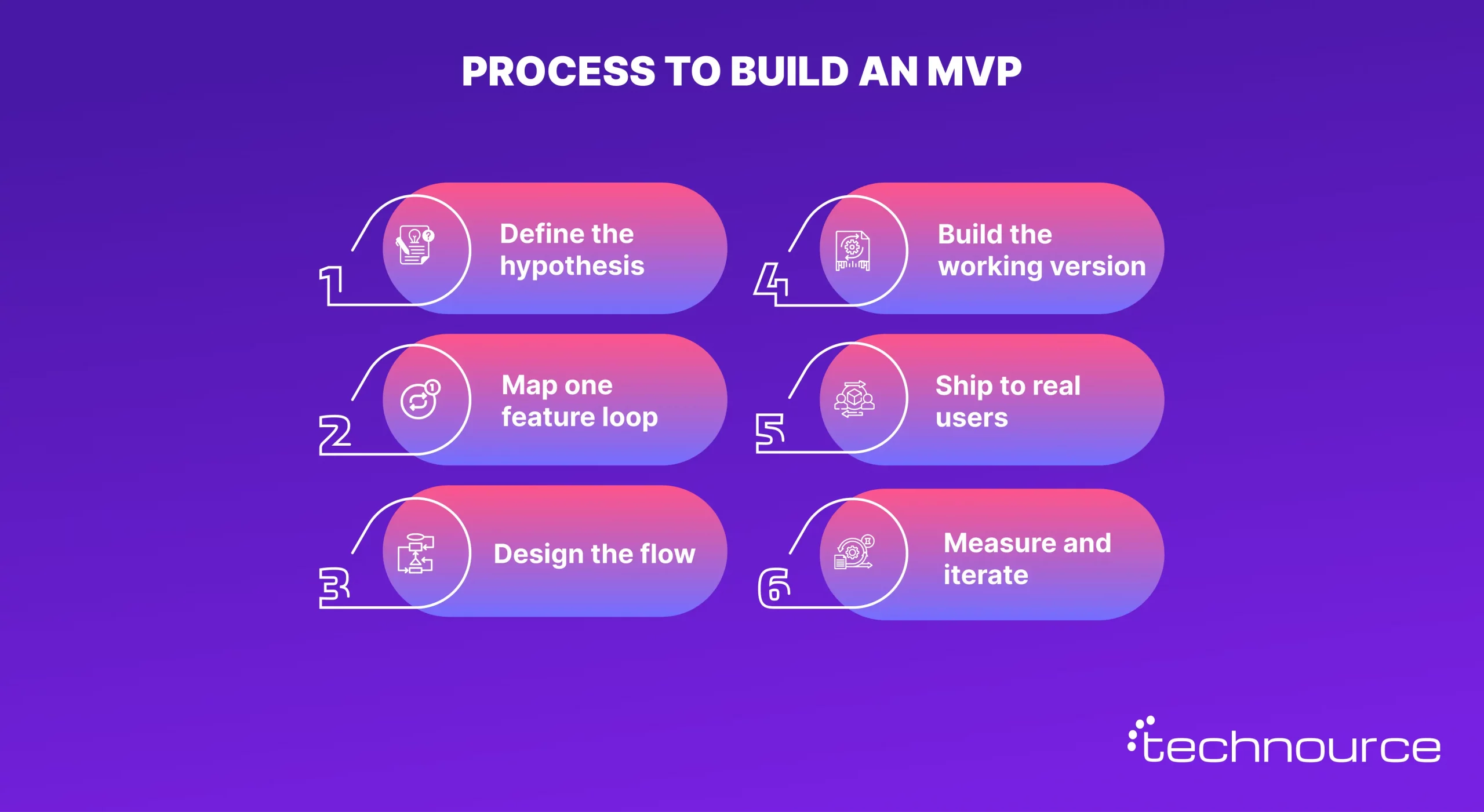
Building an MVP means isolating your riskiest assumption, building only the one feature loop that tests it, shipping to real users, and iterating on the data, usually in 6 to 12 weeks.
Define the single riskiest assumption as a testable statement. If you can’t write it down, you’re not ready to build.
Step 1: Define the hypothesis. Write your core hypothesis as one sentence.
Step 2: Map one feature loop. Identify the one workflow that delivers value. Cut everything else.
Step 3: Design the flow. A lightweight design pass; this is where a folded-in prototype lives.
Step 4: Build the working version. Real features, real data, deployed. No polish beyond what’s needed.
Step 5: Ship to real users. Put it in front of your target market, not friends or internal teams.
Step 6: Measure and iterate. Track adoption, retention, and willingness to pay. Improve one thing at a time.
The discipline that separates a 6-week MVP from a 6-month one: treat every feature request during the build as a question: does this help prove the hypothesis, or does it just feel important?
How MVP and Prototype Needs Differ by Industry
In regulated industries like fintech and healthcare, an MVP carries more weight than a prototype because compliance, security, and data handling can’t be validated with a mockup. In low-risk consumer products, a prototype often clears the biggest early risk on its own.
The right first build shifts with the dominant risk in your domain.
| Industry | Dominant early risk | Build first | Why |
|---|---|---|---|
| Fintech | Security, compliance, data integrity | POC or MVP | A mockup can’t prove KYC, transactions, or regulatory handling |
| Healthcare | Compliance, clinical accuracy, privacy | POC or MVP | HIPAA and clinical workflows need real, testable systems |
| Consumer app | Usability and adoption | Prototype → MVP | Experience is the product; test the flow cheaply first |
| B2B SaaS | Workflow fit and integration | MVP | Buyers validate real workflow value, not visuals |
| Marketplace | Two-sided demand | MVP | You need real supply-and-demand behavior, not a demo |
This is why “build a prototype first” is not universal advice. In a regulated build, the riskiest unknown is usually technical or compliance-related, and only working software can test it.
Signs You’re Ready to Move From a Prototype to an MVP
You’re ready to move from a prototype to an MVP when users understand and want the experience, the design has stabilized, and your remaining big question is whether people will actually adopt and pay.
- Users complete the core flow in testing without confusion.
- Stakeholders agree on scope and feature priorities.
- The design has stopped changing on every review.
- Your open questions are now about demand, retention, and pricing, not usability.
If you’re still redesigning the flow every week, stay in the prototype. Moving to an MVP too early bakes unresolved design risk into expensive code.
Real Examples: How Top Companies Used Prototypes and MVPs
Each of these companies validated its riskiest unknown first, at the lowest possible cost.
Airbnb: Testing Demand Before Building
The founders tested one assumption with a bare-bones website: would strangers pay to stay in someone’s home? The demand signal came first; the real platform followed.
Spotify: One Core Experience
Spotify launched with an MVP focused on a single thing: fast, reliable music streaming. It proved the core experience worked before expanding across devices and platforms.
OpenAI: POC to MVP
Early GPT models acted as a proof of concept that the architecture could generate coherent text. ChatGPT‘s public release worked as the MVP: real users, real feedback, one core interaction to validate.
The lesson across all three: they didn’t build the full product to learn the one thing they most needed to know.
How Long Should You Spend on a Prototype or an MVP?
Cap a prototype at one to two weeks and an MVP at eight to twelve weeks. If either runs longer, scope has crept, and you’re building past the question you set out to answer.
A prototype exists to get fast feedback. If it drags for a month, you’re polishing instead of learning.
An MVP exists to test the market. If it stretches past three months, it’s usually no longer minimum; it’s turning into the full product before you have proof.
Set the deadline before you start, and treat every new feature as a threat to it.
Common Mistakes Founders Make
The most common mistakes are building an MVP to answer a technical or design question, over-building features, treating the MVP as version one, and skipping validation entirely.
- Building the wrong artifact. Spending MVP budget to test feasibility or design that a cheaper POC or prototype would have answered.
- Over-building. Packing the MVP with features “users might want.” Each extra feature delays feedback and raises cost.
- Treating the MVP as the final product. An MVP is a learning tool, not v1. Polishing it too early wastes the learning.
- Skipping validation. Building on assumptions instead of evidence is the direct path to the 43% product-market-fit failure rate.
- Ignoring scalability. Early architecture choices that quietly block future growth and force a rebuild.
What to Do After You Validate Your Idea
Once your MVP or prototype validates the idea, turn the learning into a focused product roadmap, refine the core features, harden the architecture for scale, and expand based on real usage data.
Validation is the start of the build, not the end.
Keep collecting feedback from real users. Prioritize the improvements that deliver the most value, and add features one at a time.
If the idea doesn’t validate, that’s an early win, not a failure. Catching a weak assumption before a full build saves months of work and a large share of your budget.
Either way, your next decisions are based on evidence, which is the entire point of building lean.
Why Product-Market Fit Depends on Getting This Right
The 43% of startups that fail on product-market fit don’t fail because of bad code. They fail because they built the wrong thing, or the right thing in the wrong order.
That’s a pre-build process problem, not an engineering one.
In our product engineering work, the projects that succeed share one habit: they validate the riskiest assumption before committing to a full build.
A prototype de-risks the experience. An MVP de-risks the market. Why most MVPs fail often comes down to skipping validation or picking the wrong one, which is where the runway quietly disappears.
The information needed to avoid most failures usually exists before the product is built. Target customers could have said the problem wasn’t painful enough, that existing tools were fine, or that they wouldn’t pay the price. The teams that win go and ask first.
A prototype or an MVP is how you ask, cheaply, early, and with real evidence instead of a hunch. That’s the difference between building on proof and building on hope.
Why Choose Technource to Build Your MVP or Prototype
Technource is a product engineering company. We build working systems, not strategy decks.
We start with your riskiest assumption, then scope the smallest build that tests it: a prototype, an MVP, or a POC- so you validate for the least money.
- Product-first process: we help you pick the right artifact before writing code.
- Delivery ownership: we design, build, and ship to production; you own the code and the models.
- Speed without shortcuts: focused MVPs in weeks, not quarters, using AI-assisted engineering.
- Domain depth: fintech, healthcare, and SaaS builds where compliance and scalability matter.
Conclusion
The MVP vs prototype question isn’t about which is better. It’s about which validates your biggest unknown first.
A prototype proves the experience works. An MVP tests whether the market wants it. A POC proves the technology is feasible. Once you’ve validated your idea and are ready to turn it into a market-ready product, working with an experienced MVP development company can help you build a focused, testable MVP aligned with your business goals.
Match the build to your riskiest assumption. Validate cheaply. Then scale on evidence, not hope.

FAQs
No. A prototype is a non-functional model that tests design and usability, while an MVP is a working product that tests real market demand. A prototype simulates the experience; an MVP delivers it. Not always. If your design carries low risk and your main unknown is market demand, you can fold the design work into your MVP and skip the standalone prototype. Build a separate prototype only when usability is a major risk. Yes, for many products. A well-scoped MVP begins with a design phase that does the prototype’s job. Skip the standalone step when user flows are standard and you’re mainly testing whether people will adopt and pay. A prototype usually costs $6K – $12K and takes days to weeks. A functional MVP usually costs $15K–$150K+ and takes 6 weeks to 8 months in 2026, depending on complexity, integrations, and compliance needs. Most MVPs take 6 to 16 weeks. Simple single-feature builds land in 6–10 weeks, while multi-user SaaS or AI-heavy products take 10–16 weeks or more. A proof of concept comes first when technical feasibility is uncertain, followed by a prototype to validate the experience, then an MVP to test the market. The full sequence is POC → Prototype → MVP → Full Product, but most products only need one or two of these stages. A Figma design is a prototype. It simulates the interface and user flow but has no working backend, real data, or live users, so it validates design, not market demand.


