Top Profitable Real Estate App Ideas for Startups and Businesses
Sanjay Singh Rajpurohit
Published: Mar 20, 2026
The real estate industry is undergoing a major technological shift, with modern real estate app ideas playing a key role. From AI-powered property valuation tools to virtual property tours and smart property management systems, digital platforms are transforming how properties are bought, sold, and managed.
Key Takeaways:
The real estate technology sector is evolving rapidly, creating major opportunities for innovative real estate app ideas.
By 2026, AI-powered proptech solutions are expected to transform how properties are bought, sold, and managed.
Startups are increasingly building real estate mobile apps to simplify property transactions, automate operations, and improve customer experiences.
This guide explores 10 profitable proptech startup ideas for 2026, including AI property valuation apps, virtual property tour platforms, and intelligent real estate CRM software.
We also examine key proptech market trends and emerging technologies shaping the future of real estate innovation.
The proptech sector maintains its established presence while creating extensive growth prospects.
According to the IMARC report, Proptech market trends indicate that the global proptech market is expected to reach $125 billion by 2028, growing at a CAGR of 15.2%.
These real estate app ideas and proptech startup ideas solve real industry problems and create opportunities for startups building innovative real estate mobile apps. Many businesses also collaborate with a reliable real estate application development company to turn these ideas into scalable and feature-rich digital products.
In this guide, we explore 10 profitable real estate app ideas for 2026, along with insights into emerging proptech trends, AI-driven innovation, and key features required to build successful real estate applications.
Top 10 Real Estate App Ideas for 2026 (Profitable Proptech Startup Ideas)
Here are some of the most promising real estate mobile app ideas and proptech startup ideas for 2026:
1. AI-powered property valuation app
2. Virtual property tour app
3. Real estate CRM software for agents
4. Smart property management app
5. Mortgage calculator and loan comparison tool
6. Investment property analyzer
7. Neighborhood intelligence platform
8. Title and legal document management system
9. Tenant and buyer verification platform
10. Commercial real estate deal marketplace
Each of these real estate app ideas solves a major industry challenge and has strong potential for startups building proptech products.
1. AI-Powered Property Valuation Platform
The AI property valuation app uses machine learning technology to assess property values. The system uses historical sales records, property images, square footage information, building age details, current condition information, and neighborhood statistics to create property value assessments that take only seconds to complete.
The system uses real sale price data to enhance its prediction capabilities, which become better with each passing day. Such advancements are powered by modern AI development solutions that continuously improve model accuracy and scalability.
This solution enables real estate investors, wholesalers, agents, and lenders to obtain property value assessments that serve their business needs. The platform uses MLS databases, property record systems, and comparable sales data to deliver complete property value assessments.
Existing Competitors:
Current market solutions include:
Zillow Group – Zestimate algorithm
Redfin – proprietary valuation model
CoreLogic – Automated Valuation Models (AVMs)
Many existing platforms are complex and difficult for individual investors or wholesalers to use. Newer platforms like Reonomy and Loveprop are emerging by providing simpler valuation tools that are easier to understand and operate.
Market Opportunity:
Property valuations are done millions of times annually. Appraisers charge $400-600 per valuation.
If you can capture even 2% of this market at $9.99 per valuation, that’s significant recurring revenue. Professional investors show interest in the subscription model, which provides unlimited access for $49 per month.
2. Virtual Property Tour Engine
The virtual property tour app uses 3D photogrammetry, Matterport technology, and augmented reality (AR) to create immersive property walkthroughs, which users can access through their smartphones.
Users can view complete property areas, which include room dimension measurements, AR-based furniture placement simulations, and complete property experiences that simulate actual property visits.
This allows buyers to check properties without any help from agent coordination, resulting in saving time for both buyers and sellers. Such AI narrations highlight recent upgrades, architectural features, and other key selling points. The app can include virtual staging to show the potential of vacant or dated properties.
The present market situation creates considerable value because numerous buyers work from home, while others live in different countries, and others face time restrictions. The system eliminates most unnecessary physical showings that take place.
Existing Competitors: Matterport (dominant player with 4+ million properties scanned), PointGuide, Zillow 3D Home Tours, and Redfin’s tour technology. Most systems require agent involvement, while they do not provide AI-based analytical capabilities. The HomeMaker and RoomSketcher offer AR furniture placement.
Market Opportunity:Over 10 million properties are listed annually in the US alone. Agents struggle with scheduling multiple viewings. A $99-199 monthly subscription for agents would allow rapid business growth. The company generates additional income through 3D photography services, which charge between $300 and $500 for each property.
3. Intelligent Real Estate CRM
The real estate CRM software was developed from its foundational elements to provide real estate agents with a complete system that handles lead management, automated follow-ups, deal tracking, transaction management, and predictive analytics.
The real estate-specific CRM system operates differently from standard CRMs such as Salesforce and HubSpot because it provides complete support for the real estate process, which includes lead generation and property showings, offer management and inspection coordination, and closing logistics.
The platform should include lead scoring that tracks user interactions through their property viewing activities and time usage and communication responses, and it should deliver automated drip campaigns to develop leads, and it should connect to MLS data, and it should provide visual deal pipelines that display the current status of all transactions.
The system uses smart notifications to inform agents about hot prospects and their upcoming follow-up dates and essential deadlines. The system automatically records every communication through its connections to email, text, and phone systems, which ensures that all information remains accessible. You can check out our blog on custom real estate CRM software development for more detailed information.
Existing Competitors:
Current platforms in this space include:
Follow Up Boss
BoomTown
Top Producer
Real Geeks
kvCORE
Most of these platforms still require agent involvement and offer limited AI-based analytics. Some tools, like TheHomeMaker and RoomSketcher, provide AR furniture placement features.
Market Opportunity:
The United States contains more than 2 million real estate agents, who create a substantial market opportunity.
The company will earn substantial recurring revenue when it captures 5 percent of customers who pay $199 each month. The system needs to provide simple functionality that works together with the agent’s daily activities.
The existing CRMs create a corporate atmosphere that makes agents use spreadsheets for their work.
4. Smart Property Management Application
The application provides property management solutions that enable landlords to manage multiple properties using one dashboard. The system enables tenants to submit maintenance requests together with photographic evidence and textual descriptions, which the system automatically sorts and dispatches to service providers.
The platform also supports automated rent collection through:
ACH transactions
Credit card payments
Other digital payment methods
The application needs to have tenant screening features, which include background checks and credit checks, together with lease document storage and maintenance history tracking, and financial reporting dashboards that display cash flow, ROI, and property performance metrics.
Landlords can oversee empty apartments, handle resident changes, and organize their scheduled maintenance activities. The system provides messaging tools that let users contact tenants directly without needing to share their personal phone numbers.
Existing Competitors:
Current solutions in this market include:
AppFolio – dominant but enterprise-focused, starting at $400+ per month
Buildium
Rent Manager
PropertyShark
Landlord Studio
Platforms like TheKey and Zego focus primarily on tenant experiences but lack full property management dashboards. Athena has also emerged as a newer competitor targeting single-property landlords.
Market Opportunity:
The United States alone has over 10 million landlords, many of whom still manage properties manually.
The biggest opportunity lies with small landlords who own between two and ten properties.
A property management platform can generate revenue through:
Monthly subscription fees range from $29 to $79 per property
Payment processing fees of 1–2.5% on collected rent
This combination creates a scalable and profitable SaaS business model.
5. Mortgage Calculator and Loan Comparison Tool
The mortgage calculator app provides users with more than its basic monthly payment function.
The system enables users to compare current mortgage rates from multiple lenders while creating and testing various financial scenarios, which include changing down payment percentages, assessment of tax results, and PMI calculations, and automatic pre-qualification through lender partnerships.
The application needs to display loan amortization schedules, total interest charges, refinancing options, and comparisons of different loan programs, including FHA, Conventional, and VA programs. The program needs advanced features that enable users to find down payment assistance programs and identify first-time homebuyer incentives.
People use this tool to assist their friends because it enables them to make more informed financial choices, which creates a strong natural growth mechanism.
Existing Competitors:
Current solutions in this space include:
Bankrate – mortgage calculators and rate comparisons
LendingTree
Zillow Group – mortgage calculator tools
NerdWallet – financial calculators
Most of these tools exist as part of larger financial platforms and are not specifically designed as dedicated mortgage comparison apps.
Newer mortgage technology companies, such as Better.com and Blend Labs, focus more on lending services rather than mortgage comparison and shopping experiences.
Market Opportunity:
5+ million mortgages originate annually. The affiliate commissions that mortgage lenders pay range from 0.5% to 1% of the loan value, which results in costs between $1,500 and $3,000 for every $300,000 loan.
Some users might generate $50,000+ in monthly affiliate revenue. The distribution problem exists because you need to discover the way your customers will find your application.
6. Investment Property Analyzer
The real estate app concept utilizes AI technology to analyze thousands of properties and find investment possibilities that match specific customer requirements.
The system evaluates potential rental income through its assessment of property value growth trends, neighborhood development patterns, tenant acquisition needs, and cash-on-cash return estimates.
The algorithm assesses developing areas by studying demographic changes, commercial activities, public works initiatives, educational institution evaluation patterns, and criminal activity decline trends.
The system determines vital property elements through its assessment of cap rate and cash-on-cash return, cash flow predictions, and value growth potential for 5-10 years.
The app notifies investors whenever they meet their defined standards, which include a minimum 8% return requirement, preferred neighborhood selection, property classification, and budgetary constraints. The platform supports integration with MLS feeds, auction platforms, and off-market property transaction systems.
Existing Competitors:
Current platforms in this category include:
BiggerPockets Pro
Zillow for Investors
PropStream
JoinOurTeam
REISudo
Most existing solutions lack advanced AI-driven analysis features.
Enterprise platforms such as CoStar Group and CBRE provide powerful market data, but their tools are typically expensive and designed for institutional investors.
As a result, individual investors often struggle to access affordable and detailed property analysis tools.
Market Opportunity:
Serious real estate investors are constantly searching for profitable deals.
Many are willing to pay $99–$299 per month for a platform that helps them identify strong investment opportunities before competitors.
Revenue can be generated through:
Monthly investor subscriptions
Premium analytics tools
Deal notification services
Affiliate partnerships with off-market property transaction platforms
This combination creates a strong recurring revenue opportunity in the growing proptech investment tools market.
7. Neighborhood Intelligence Platform
A hyper-detailed real estate mobile app that provides neighborhood analysis far beyond Zillow’s basic guides. It aggregates school performance data (test scores, graduation rates, college placement), walkability and transit scores, crime statistics by intersection, demographic trends, price history by block (not just ZIP code), median rent by street, future development projects, and zoning information.
The platform visualizes how neighborhoods are changing: population growth/decline, income trends, demographic shifts, job growth nearby, and new construction pipelines. Users see why certain neighborhoods are poised to appreciate and which are declining.
For families relocating, the app answers every question: “Is this area family-friendly?” “What are schools like?”, Will my property appreciate?” For investors: “What’s the population growth rate?” “What’s the migration pattern?” “Any major employers nearby?”
Existing Competitors:
Some existing tools in this space include:
Zillow Group – Neighborhood Guide
Walk Score
CrimeReports
NeighborhoodScout
Naborly
Zillow and NeighborhoodScout currently dominate the market but often lack real-time data updates. Walk Score provides strong transit and walkability analysis, but does not include broader neighborhood intelligence.
At the moment, no single platform provides comprehensive and regularly updated neighborhood data across multiple dimensions.
Market Opportunity:
Homebuyers and real estate investors are increasingly willing to pay for detailed neighborhood insights.
Possible pricing models include:
$19.99/month for individual users
$199/month for investors or real estate agents
Additional revenue opportunities include:
Corporate subscriptions for relocation companies and real estate teams
Data licensing to other real estate platforms
Partnerships with relocation and HR service providers
With growing demand for data-driven real estate decisions, a comprehensive neighborhood intelligence platform could become a valuable proptech tool.
8. Title and Legal Document Management
A specialized real estate app that streamlines the document-intensive closing process. Instead of manual email chains and faxes, the system creates secure portals for each transaction. Buyers, sellers, lenders, and title companies upload documents directly. AI and OCR technology automatically extract critical information: loan amounts, interest rates, closing dates, required signatures, and document status.
The system intelligently flags missing documents, expired items, or discrepancies before closing day—preventing costly delays. All documents are encrypted, timestamped, and stored compliantly (FIRPTA, state regulations). Digital signature integration (DocuSign, eSignature) accelerates the process further.
Closing teams gain visibility into transaction status, document completeness, and timeline. Automatic reminders ensure nothing falls through the cracks. Post-closing, documents are archived for the life of the transaction.
Existing Competitors:
Some existing tools in this space include:
Simply Docs
dotloop (acquired by Zillow Group)
Various eClosing platforms
Notarize
While DocuSign dominates the digital signature market, it does not manage the entire closing workflow.
Many title companies still rely on custom-built systems, and the overall market remains fragmented with no single platform managing the entire document lifecycle.
Market Opportunity:
More than 5 million real estate transactions close every year.
Title companies, lenders, and real estate teams all manage complex document workflows, creating strong demand for specialized platforms.
Potential revenue models include:
Enterprise subscriptions are around $4,999/month for high-volume operations
Team plans ranging from $499–$999 per month
Transaction fees between $50 and $200 per closing
This combination can create a scalable SaaS platform serving both small teams and large real estate organizations.
9. Tenant and Buyer Verification System
A specialized background check and verification platform designed specifically for real estate applications. The system pulls credit scores, eviction history, rental payment records, income verification, employment history, and past landlord references through automated integrations.
The platform ensures compliance with the Fair Housing Act, FCRA regulations, and state-specific tenant laws. Results are presented in clear, legally-defensible formats that protect landlords from discrimination claims. Automated flagging identifies red flags (recent evictions, bankruptcies, income insufficient for rent) without subjective bias.
For homebuyers, it streamlines seller confidence. For landlords screening tenants, it reduces bad tenant risk by identifying problematic rental histories before lease signing.
Existing Competitors:
Some existing solutions include:
MyRental
Zillow Group tenant screening tools
Apartments.com background checks
Checkr
Checkmate
Most of these tools are offered as part of listing platforms or employment verification services rather than dedicated real estate screening systems.
Because landlords often need to use multiple services to complete verification, the market remains fragmented and presents an opportunity for a more comprehensive platform.
Market Opportunity:
More than 45 million rental applications are submitted every year, creating a massive demand for tenant verification services.
Potential pricing models include:
$24.99 per screening report
$99/month subscription plans for landlords managing multiple properties
Bulk screening services for property management companies are priced between $0.50 and $2 per report
The main challenge lies in integrating diverse data sources while maintaining full regulatory compliance.
10. Commercial Real Estate Deal Marketplace
A specialized platform for commercial real estate mobile apps connecting investors, brokers, and tenants in office, retail, industrial, and mixed-use properties. Unlike Zillow/Redfin (residential-focused), this targets the commercial segment, where direct relationships and deal complexity demand specialized infrastructure.
Brokers list available spaces with detailed specs: square footage, floor plans, lease rates, tenant mix, available date, and build-out allowances. Investors filter by: location, asset class, size, price, lease rate, tenant quality, and financial metrics. Tenants browse available spaces and connect directly with brokers.
The platform provides market analysis (comparable lease rates, tenant demand patterns, absorption rates), financial modeling tools (cap rate calculators, ROI analysis), and transaction management (LOI generation, document exchange, closing coordination).
Existing Competitors:
Some major platforms in this space include:
CoStar Group – LoopNet marketplace
CBRE technology platforms
JLL property technology tools
Zillow for commercial listings
Emerging startups such as VTS and PivotDesk
LoopNet currently dominates the market but is often considered expensive and heavily focused on institutional clients. This leaves smaller brokers and independent investors underserved.
Many newer platforms focus on specific niches such as office spaces, retail properties, or individual city markets rather than offering nationwide coverage.
Market Opportunity:
Commercial real estate deals are significantly larger than residential transactions. For example, the average office lease can range between $500,000 and $2 million or more.
Revenue opportunities include:
Premium broker listings around $1,999/month
Transaction support services
Data and analytics licensing for real estate firms
Although transaction volume is lower, the larger deal sizes make this market highly valuable. Key users include REITs, institutional investors, corporate tenants, and brokerage firms.
Type of Real Estate Apps
Real estate technology platforms provide services to multiple user groups who operate within the entire property ecosystem. Startups can identify their optimal business opportunity through real estate app development by learning about various real estate application types.
The proptech industry includes several main mobile application categories that operate in the real estate market.
App Type
Description
Example Use Cases
Property Listing Apps
Buyers and renters use platforms to search for properties, which they can filter according to their preferred location, price, and available amenities.
Zillow-like property marketplace
Real Estate CRM Apps
Tools that help with lead management capabilities, together with deal tracking functions and automated communication systems for interacting with buyers and sellers.
Agent lead management platform
Property Management Apps
Landlords use applications to control their tenant operations, which include rent collection, maintenance requests, and financial reporting activities.
Rental property management system
Virtual Property Tour Apps
Apps that enable buyers to explore homes remotely using 3D tours, AR, or VR experiences.
Remote property viewing platform
Real Estate Investment Apps
Platforms that help investors analyze rental yields, cap rates, and long-term property value growth.
Investment property analyzer
Mortgage & Financing Apps
Apps that help buyers calculate mortgage payments, compare lenders, and evaluate loan options.
Mortgage calculator and loan comparison app
Now that we’ve explored the most promising real estate app ideas and categories, let’s look at the emerging proptech market trends shaping the future of real estate technology.
Cost to Build a Real Estate App
The cost of real estate app development projects depends on three main factors, which are platform complexity, feature count, third-party service integration requirements, and the geographical location of the development team.
A simple MVP can be built relatively quickly, whereas real estate CRM systems and investment analytics tools need more sophisticated systems to operate.
Here is a general estimate for different types of real estate mobile apps. The estimate provides information about various types of real estate mobile applications.
App Complexity
Features Included
Estimated Development Cost
Basic App
Property listings, search filters, login, and map integration
AI property valuation, investment analytics, MLS integrations, automation
$120,000 – $250,000+
Factors That Affect Real Estate App Development Cost
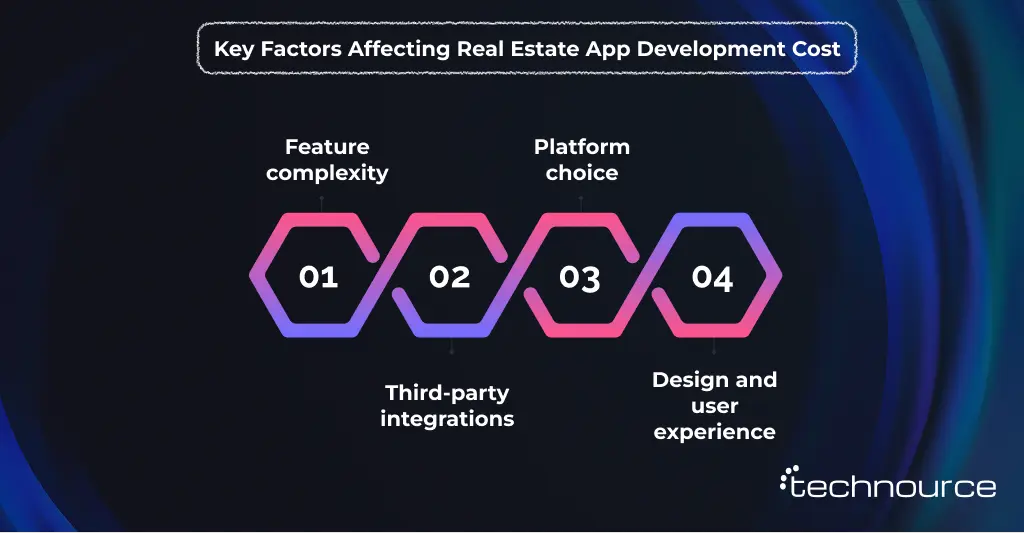
Several factors influence the total real estate app development cost:
1. Feature complexity
Developing advanced features, which include AI property valuation, predictive analytics, and automated lead scoring, requires developers to spend more time on their work.
2. Third-party integrations
The development process will take more time when developers need to integrate MLS databases, payment gateways, mapping services, and document signing platforms.
3. Platform choice
The development process will expand to cover all three platforms when developers create applications for iOS, Android, and web platforms.
Design and user experience
Real estate platforms require designers to create interactive maps, property galleries, and data visualizations, which need additional design development time.
Most startups should use the Minimum Viable Product approach for their initial launch. This allows founders to validate their real estate app idea before investing in a full-scale platform.
Technology Stack for Real Estate Apps
Choosing the right technology stack for real estate app development is essential for building scalable, secure, and high-performing proptech platforms. The technology stack determines how well the app handles property data, integrates with third-party services, and supports future feature expansion.
Below is a common technology stack used for modern real estate mobile apps.
Layer
Technologies Commonly Used
Frontend
React, Angular, Vue.js
Mobile Development
React Native, Flutter, Swift, Kotlin
Backend
Node.js, Python (Django), Ruby on Rails
Database
PostgreSQL, MongoDB, MySQL
Cloud Infrastructure
AWS, Google Cloud, Microsoft Azure
Maps & Location Services
Google Maps API, Mapbox
AI & Data Processing
TensorFlow, OpenAI APIs, Python ML libraries
Payment Integration
Stripe, PayPal
Authentication
OAuth, Firebase Authentication
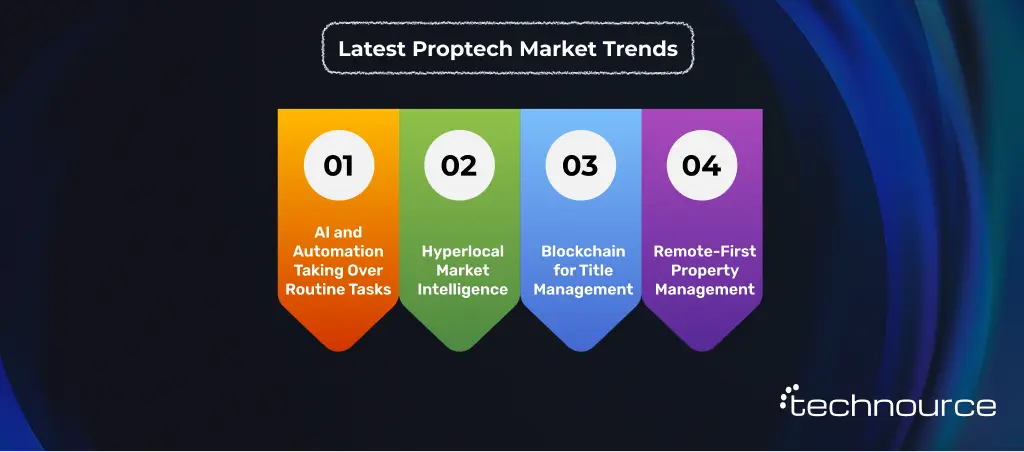
Emerging Proptech Market Trends for 2026
Understanding current proptech trends helps startups choose real estate app ideas that will remain relevant for years to come.
AI and Automation Taking Over Routine Tasks:
Machine learning models can perform three major functions: property image analysis, creating descriptions, and estimating market value with high accuracy. The real estate mobile apps market now considers this technology as essential for developers.
Hyperlocal Market Intelligence:
Buyers and investors need detailed information about specific areas,, which includes beyond basic neighborhood data. Apps that provide school ratings, crime statistics, demographic shifts, and investment potential are gaining serious traction. The future of real estate technology is local-first.
Blockchain for Title Management:
Developing a blockchain system for property records using advanced blockchain application development solutions enables market participants to verify ownership while enhancing transaction speeds within blockchain-based property systems.
Remote-First Property Management:
The remote property management system allows a smart property management app to handle tenant contact, maintenance requests, and rent payments without any problems.
The proptech market will reach a valuation of $125.5 billion by 2028, as per Statista’s PropTech Market Outlook, which also shows that AI and automation-based proptech solutions will become the primary adoption choice for 67% of companies.
Proptech Trend
Impact on Real Estate Startups
AI-powered analytics
Faster property valuation and market insights
Virtual property tours
Remote property viewing and faster sales
Blockchain property records
Secure ownership verification
Smart property management
Automated landlord operations
Key Integrations for Real Estate Apps
Most successful real estate mobile apps rely on several external integrations to deliver advanced features:
a) MLS and property data integrations
Multiple Listing Service (MLS) databases provide real-time property listings and market data.
b) Map and geolocation services
Interactive maps allow users to browse properties by location and compare nearby listings.
Machine learning models can help estimate property values, analyze investment opportunities, and recommend listings to users, especially when combined with advanced data analytics development services to extract actionable insights from large datasets.
Choosing the right architecture early ensures your proptech platform can scale as your user base grows.
Why Real Estate Startups Need App-Based Solutions in 2026
The digital transformation process has reached a point where businesses now need to adopt it as a mandatory requirement. The real estate development is mandatory because technology is essential for their upcoming business operations.
a) Customer Expectations Have Shifted:
Millennials and Gen Z expect the same seamless experience in real estate as they get from Uber, Netflix, or Amazon. A static website doesn’t cut it. Real estate mobile apps have become the standard requirement for users.
b) Efficiency Gains Are Massive:
Consider a real estate brokerage that operates with obsolete technologies. The company stores its client information across three different platforms: email, spreadsheets, and databases. The intelligent real estate CRM software solution for real estate enables businesses to manage their customer relationships through automated processes, which include lead tracking and contact management, thus reducing their transaction duration from multiple months to a few weeks.
c) Competitive Advantage Through Data:
AI real estate apps enable users to analyze markets, assess properties, and forecast investments, which creates a competitive advantage for users. This approach establishes user retention while supporting subscription-based revenue systems.
According to GoodFirms researchon real estate app development, a feature-rich real estate mobile app typically costs between $40,000 to $150,000 for MVP development depending on complexity and the number of real estate app ideas you’re implementing initially.
Which Real Estate App Idea Is Right for Your Startup?
Not every proptech idea fits every startup. The right choice depends on your target users, technical capabilities, and market access. Here’s a simple way to evaluate which idea may work best for your business.
Startup Focus
Suitable App Ideas
Real estate investors
AI property valuation app, investment property analyzer
Real estate agents and brokers
Real estate CRM software, virtual property tour app
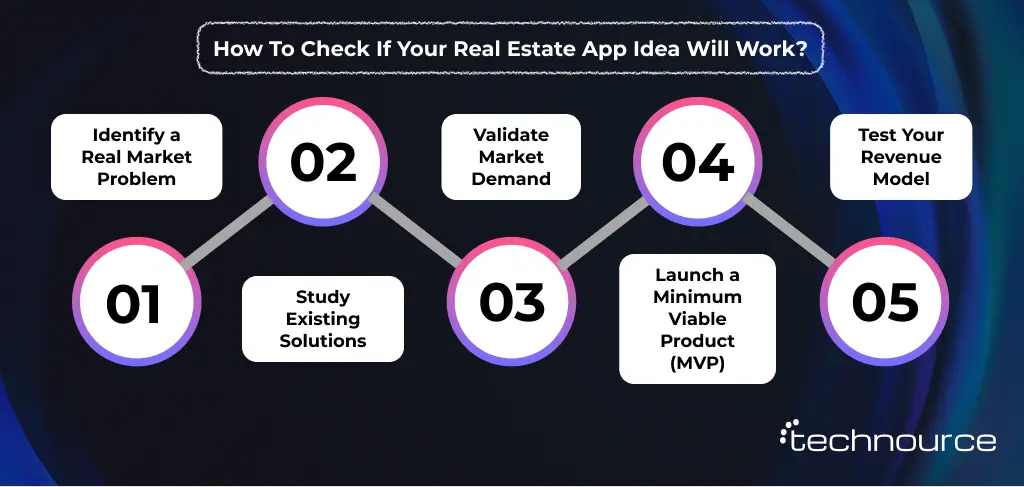
How to Validate a Real Estate App Idea Before Building
A successful proptech startup requires more than just an innovative concept. Building a real estate app requires significant time and resources, so it’s important to first validate that your idea solves a real market problem.
Here are a few practical steps startups can follow.
1. Identify a Real Market Problem
Real estate applications achieve success when they provide effective solutions to specific problems faced by agents, investors, landlords, and buyers. The research process requires interviewing prospective users to determine their difficulties in property management, transactions, and investment analysis.
2. Study Existing Solutions
Existing platforms need analysis to identify their missing features, pricing structures, and user experience shortcomings. The market presents opportunities, since current solutions remain overpriced and difficult to use, and are missing essential features.
3. Validate Market Demand
The research process requires keyword analysis and examination of online communities and industry forums to determine if users seek solutions that match your application concept.
4. Launch a Minimum Viable Product (MVP)
The process of MVP development begins with an MVP that includes essential features instead of creating the complete platform. The product development process benefits from user input, which will guide product improvements until the company reaches its growth phase.
5. Test Your Revenue Model
Test payment methods, which include subscription fees, transaction costs, and premium service charges, to discover whether your target audience will pay for your product.
Common Revenue Models for Real Estate Apps
Most successful real estate apps rely on a few proven monetization strategies. Choosing the right revenue model depends on your target users and the type of platform you build.
a) Subscription model
Many proptech platforms charge monthly subscription fees for access to premium tools, analytics, or property listings.
b) Transaction fees
Some real estate platforms generate revenue by charging a fee for completed property transactions, rental agreements, or financing referrals.
c) Affiliate partnerships
Mortgage calculators and investment tools often earn commissions through partnerships with lenders and financial institutions.
d) Data and analytics services
Advanced platforms monetize through data insights, market intelligence reports, or licensing property data to other real estate businesses.
How AI Is Powering the Next Generation of Real Estate Apps
AI Use Case
Example in Real Estate Apps
Benefits
Property Valuation
AI models estimate property prices using historical sales data
Faster and more accurate valuations
Lead Scoring
AI analyzes buyer behavior and search patterns
Higher conversion rates for agents
Image Recognition
AI analyzes property photos and detects features or conditions
Better listing descriptions and insights
Market Prediction
AI predicts neighborhood growth and price trends
Smarter investment decisions
Artificial intelligence in real estate isn’t about replacing agents; it’s about making them superhuman. These advancements clearly highlight the growing benefits of AI in real estate, transforming how agents, investors, and buyers make decisions. Here’s where AI is creating the most impact:
Property Valuations: Machine learning models trained on historical sales data, property features, and market trends can generate valuations that rival professional appraisers. AI property valuation apps are particularly valuable for investment analysis, where speed matters.
Lead Scoring and Matching: AI real estate apps can analyze buyer behavior, search patterns, and preferences to match them with properties they’re likely to purchase. This increases conversion rates for agents using intelligent real estate CRM software.
Image Recognition and Description Generation: AI can analyze property photos to identify style (modern, farmhouse, minimalist), condition assessment, and even estimate renovation costs. It can then auto-generate compelling property descriptions.
Market Prediction: Predictive models identify emerging neighborhoods before prices spike, helping investors spot opportunities early. This capability is increasingly becoming a core feature of proptech market trends analysis tools.
Key Features Every Successful Real Estate App Should Have
To build a competitive and user-friendly platform, it’s essential to include features that enhance usability, engagement, and decision-making. Below are the key features that define a successful real estate app.
Must-Have Core Features
These are the essential capabilities that most real estate platforms require.
Advanced property search filters
Users should be able to filter listings by price, location, property type, amenities, and investment metrics.
Map-based property browsing
Interactive maps allow users to explore properties visually and quickly compare nearby listings.
Real-time notifications
Alerts notify users when new listings match their preferences or when prices change.
Integrated chat or communication tools
Direct communication between buyers, agents, and landlords improves response time and customer experience.
Advanced Features That Differentiate Your App
These features help real estate apps stand out in a competitive proptech market.
AI-powered property insights
AI can analyze property data and provide investment insights, price predictions, and recommendation systems.
Virtual property tours and AR tools
Augmented reality and 3D tours allow buyers to explore properties remotely.
Investment analytics dashboards
Investors benefit from tools like ROI calculators, rental yield analysis, and market trend insights.
Secure document storage
Encrypted document storage ensures safe access to contracts, inspection reports, and legal paperwork.
Challenges in Building Real Estate Apps and How to Overcome Them
Building in proptech isn’t without hurdles. Understanding these challenges now saves you from costly mistakes:
a) Data Accuracy and Compliance:
Real estate involves legal obligations. Property data must be accurate, and you must comply with Fair Housing laws. Solution: Partner with authoritative MLS providers and conduct regular data audits. Build in compliance checks from day one.
b) User Adoption in a Fragmented Market:
Agents are creatures of habit. Getting them to switch systems is hard. Solution: Build integrations with existing tools (Zillow, Redfin, MLS platforms) so adoption feels like an add-on, not a replacement.
c) Building Network Effects:
Real estate CRM software and marketplace apps need both buyers and sellers (or agents and brokers). A one-sided marketplace has no value. Solution: Start in a tight vertical or geographic market where you can achieve density quickly.
d) Competing Against Entrenched Players:
Zillow and Redfin have massive resources. Solution: Focus on underserved segments, commercial real estate, investment properties, or specific geographic markets where you can dominate before scaling.
e) Data Licensing and MLS Access
The process of obtaining real estate data access presents numerous challenges. Property platforms use Multiple Listing Service (MLS) databases but must obtain licenses and follow strict regulations that govern their data usage. Startups need to plan for these integrations early to avoid delays during development.
f) High Customer Acquisition Costs
Real estate platforms experience elevated expenses for marketing and customer acquisition. The established platforms Zillow Group and Redfin create significant competition challenges for most real estate platforms. Many successful proptech startups achieve success by targeting niche markets and providing specialized services instead of competing against major marketplaces.
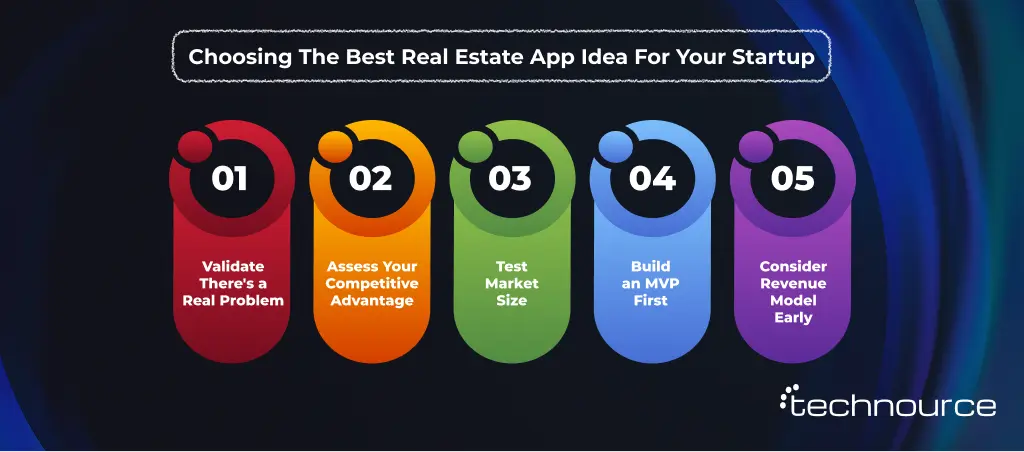
How to Choose the Right Real Estate App Idea for Your Startup
With so many proptech startup ideas available, how do you pick the right one? Here’s a framework:
1. Validate There’s a Real Problem:
Don’t build real estate app ideas based on assumptions. Interview 30-50 potential users. Do they consistently complain about the same problem? Do they say they’d pay to solve it? If the answer is unclear, keep looking.
2. Assess Your Competitive Advantage:
Why can you do this better than existing solutions? Is it domain expertise? Access to proprietary data? Better UX design? Be honest here.
3. Test Market Size:
Use tools like Google Trends and keyword search volume to validate demand for your real estate mobile apps concept. Sufficient search volume indicates genuine interest.
Build an MVP First:
Don’t spend six months building your vision. Launch a stripped-down version in 4-8 weeks. Test with real users and iterate based on feedback.
Will you charge agents? Buyers? Take a commission? Subscription model? Your choice affects product strategy and market positioning.
How Technource Helps You Build Future-Ready Real Estate Apps
Building a successful real estate app requires more than good coding. It requires expertise in real estate app development, understanding of proptech market trends, and experience navigating the complexities of the industry.
At Technource As a custom software development company, we specialize in building real estate mobile apps that users actually want to use. Our team has built AI property valuation apps, smart property management apps, virtual property tour apps, and intelligent real estate CRM software solutions for startups and enterprises.
We understand the specific challenges of real estate app ideas development—from regulatory compliance to MLS integration to user adoption. We’ve worked on everything from mortgage calculator apps to investment analysis platforms that leverage artificial intelligence in real estate.
Our approach is straightforward: we start with discovery to understand your proptech startup idea, validate assumptions through user research, build an MVP quickly, and scale based on market feedback. We’re not interested in building features that don’t matter, only those that move your business forward.
Your real estate startup app idea deserves a team that gets the industry. Whether you need help refining your concept, building your MVP, or scaling for growth, we’re here to help.
Key Insights for Building Successful Real Estate Apps
The proptech industry is evolving rapidly, creating new opportunities for startups and technology companies building innovative real estate platforms. Here are the key insights from this guide.
Real estate mobile apps are becoming essential for property transactions, investment analysis, and property management.
AI in real estate is transforming how property valuations, lead scoring, and market predictions are performed.
Startups can build profitable platforms by focusing on specific real estate app ideas, such as property valuation tools, investment analyzers, or smart property management systems.
The cost to build a real estate app varies depending on complexity, ranging from basic MVPs to advanced AI-powered platforms.
Choosing the right technology stack for real estate app development ensures scalability, performance, and long-term growth.
Successful proptech startups focus on solving a real industry problem, validating their idea early, and launching an MVP before scaling.
Conclusion
Many real estate mobile app ideas and proptech startup ideas are emerging as technology continues to transform the property industry. Proptech market trends indicate explosive growth ahead.
If you have a solid real estate app idea, a clear understanding of your target market, and the persistence to iterate, 2026 is an excellent time to launch.
The winners in proptech aren’t necessarily the ones with the most funding or the biggest teams. They’re the ones who understood a specific, painful problem and built something elegant to solve it.
Whether it’s an AI property valuation app that saves time on appraisals, a virtual property tour app that eliminates pointless in-person viewings, or a smart property management app that eliminates landlord headaches, focused solutions win.
Start with validation. Build your MVP lean. Get user feedback quickly. Iterate relentlessly. That’s the path to building a successful real estate mobile app in 2026.
AI property valuation apps, smart property management apps, and vertical-specific real estate CRM software solutions show the strongest unit economics. These solve specific problems with a high willingness to pay. Real estate mobile apps targeting commercial property or investor-specific niches also show strong profitability when they capture sufficient market share.
The cost of real estate app development varies widely based on features and complexity. An MVP for a simple mortgage calculator app might cost $30,000-$50,000. A fully-featured real estate CRM software or AI property valuation app could range from $80,000 to $200,000+. The key is starting lean and expanding based on user demand.
Artificial intelligence in real estate is used for property valuation, lead scoring, image analysis, market prediction, and automated property descriptions. AI real estate apps leverage machine learning to identify patterns in pricing, predict market trends, and match buyers with properties. AI property valuation apps are particularly popular for investment analysis.
Yes, if built with a clear focus. Real estate app ideas that solve specific problems for underserved segments show strong potential. The key is choosing an angle where you can establish a competitive advantage, whether through AI in real estate, better UX, or superior data. Avoid trying to be “the Zillow for” every market.
A real estate mobile app should include advanced property search filters, map-based browsing, property galleries, and real-time notifications. Many modern platforms also offer virtual property tours, AI-powered recommendations, and built-in chat systems that allow buyers, agents, and landlords to communicate easily.
An MVP for real estate mobile apps can be built in 3-6 months with a focused team. A fully-featured application with integrations and robust real estate CRM software functionality typically takes 6-12 months. Speed depends on feature scope, complexity of integrations (MLS, CRM), and your team’s experience with real estate app development.
Real estate apps typically generate revenue through subscription plans, listing fees, transaction commissions, and affiliate partnerships with lenders. Some platforms also earn revenue from advertising, premium analytics tools, or property data services for real estate professionals.
Mr. Sanjay Singh Rajpurohit is the Founder and CEO of Technource, a visionary leader with deep expertise in AI, web, mobile, and custom software development. With a strong foundation in education and over a decade of entrepreneurial experience, he guides his team in delivering scalable, innovative digital solutions across industries. He focuses on building future-ready products by integrating cutting-edge technologies and fostering a culture of continuous improvement. In June 2024, he was honored with the “Mister Ahmedabad Personality” title, recognizing his impactful presence beyond the tech world.
Request Free Consultation
Amplify your business and take advantage of our expertise & experience to shape the future of your business.