AI agents are changing how businesses operate. Unlike traditional software that waits for instructions, AI agents can analyze information, make decisions, and take action with minimal human intervention.
From automating customer support to streamlining enterprise workflows, they are becoming a competitive advantage across industries.
The challenge is not deciding whether to adopt AI agents. It is choosing the right development partner.
While many companies now claim to offer AI agent development services, only a few have the technical expertise to build secure, scalable, and production-ready systems that deliver measurable business results.
So, if your roadmap already has an agent line item, the next decision is who builds it.
Because the partner you pick will decide your speed, your cost, and whether your agent ever reaches production.
To help you make the right choice, we evaluated the top 20 AI agent development companies based on their technical capabilities, industry experience, integration expertise, pricing, and proven client outcomes.
In this guide, you’ll discover:
What AI agents are and how they work
Why businesses hire AI agent development companies
The top 20 AI agent development companies
Real AI agent use cases across industries
What development costs are and how to budget
How to choose the right partner and red flags to avoid
By the end of this guide, you’ll have a clear framework to compare AI agent development companies and confidently select the best partner for your goals and budget.
What Are AI Agents?
An AI agent is a software system that can understand information, make decisions, and perform tasks with minimal human intervention.
Unlike traditional software that follows fixed rules, AI agents can analyze situations, adapt to new inputs, and take the best action to achieve a goal.
Think of an AI agent as a digital employee. It gathers information, reasons through different options, and completes tasks by interacting with applications, tools, and APIs.
This ability to think, decide, and act is what makes AI agents more powerful than traditional chatbots and automation tools.
How Do AI Agents Work?
AI agents follow a simple four-step process: perceive, think, act, and learn. They collect information, decide the best action, perform the task, and improve over time based on feedback.
Here’s how the process works:
Perception and Input: Collects data from sources such as text, voice, documents, APIs, databases, or sensors.
Reasoning and Planning: Analyzes the input, evaluates different options, and decides the best action to achieve the goal.
Action: Executes tasks by interacting with business applications, APIs, CRMs, ERPs, or other connected systems.
Learning and Improvement: Learns from previous interactions, stores useful context, and continuously improves its performance over time.
How AI Agents Differ From Chatbots and RPA
People often confuse agents with chatbots or robotic process automation, yet the gap is wide. The table below shows where each one fits, so you can match the right tool to your problem.
What Do AI Agent Development Companies Actually Do?
Beyond writing code, strong AI agent development companies deliver a full lifecycle of work. Knowing what to expect helps you tell a real partner from a vendor that only ships prototypes. These are the seven services that matter most:
1. AI Strategy and Use-Case Discovery
Good partners start with your goals, not the technology, and that order matters. They audit your workflows and find where an agent creates time or cost savings. They prioritise the use cases most likely to pay off. This prevents building something impressive that nobody needs, and a clear scope protects your budget.
2. Custom AI Agent Development
This is the heart of the work, where the agent is built around your specific tasks. The team selects the right model, fine-tunes where needed, and shapes the reasoning to your business rules. The result is a custom AI agent that fits your process, not a generic bot. Tailored builds outperform off-the-shelf tools on complex work.
3. Multi-Agent System Orchestration
For larger workflows, partners build systems where several agents collaborate and hand off tasks. Each agent owns a role, and an orchestration layer keeps them in sync with fallback logic when something fails. This design handles multi-step processes that a single agent would fumble. It also makes the whole system easier to scale and maintain.
4. Enterprise Systems Integration
An agent earns its keep only when it plugs into your real tools. Development teams connect agents to CRMs, ERPs, SaaS platforms, APIs, and data layers so they can read and act in real time. They handle the testing and security that safe integration demands. Done well, the agent becomes a working part of your connected ecosystems.
5. Security, Governance, and Data Compliance
Responsible teams treat security as a first-class part of the build. They add encryption, role-based access, monitoring, and explainability so you can trust and trace every agent decision. They also map your work to the right compliance standards before launch, not after. This governance turns a risky experiment into a dependable system.
6. Testing, Training, and Optimization
Before anything ships, strong partners test the agent against real scenarios and edge cases. They check accuracy, latency, and how the agent behaves when inputs get messy or unexpected. Then they tune prompts, data, and logic until performance is steady. This discipline is what keeps your agent reliable under real production pressure.
7. Post-Deployment Support and Scaling
The launch is the beginning, not the finish line. A committed partner monitors the agent, re-trains it as data shifts, and adds capacity as usage grows. They also help your team adopt the system so it actually gets used. This long-term support is what protects the value of your investment over time.
8 Reasons Why Businesses Hire AI Agent Development Companies
Building agents in-house sounds appealing until you hit the reality of machine learning, integration, and constant upkeep. That is why most teams partner with specialists, and why the demand for AI agent development companies keeps rising.
Here are the eight reasons buyers give most often.
1. Faster Time to Production
Speed is the first reason, and often the deciding one. Experienced partners already own tested frameworks and integration patterns, so they skip months of trial and error. Your team focuses on strategy and adoption instead of debugging foundations. You reach users sooner and improve before competitors even launch.
2. Access to Specialized AI Talent
Most companies do not have experienced large language model and AI agent engineers on the bench. A specialist partner fills that gap with people who have shipped production systems before. You get senior skills on demand, without long hiring cycles. For a lean team, this access alone often justifies the engagement.
3. Lower Build and Compliance Risk
A poorly built agent can leak data, make biased calls, or break under load, and those mistakes are costly. Seasoned AI agent development companies bring guardrails, governance, and proven architecture that cut that risk from day one. They have seen the failure modes you are about to face, which protects your budget and reputation.
4. Deep Systems Integration
An agent that cannot reach your tools is just a clever demo. The real work is connecting it to your CRM, ERP, and internal APIs without disrupting operations. Skilled partners handle this cleanly, so the agent acts inside your stack. Our roundup of AI workflow automation tools shows how much smoother connected systems run.
5. Security, Governance, and Compliance
When agents touch sensitive data, security cannot be an afterthought. Strong teams build in encryption, access control, audit trails, and a human-in-the-loop where it matters. They also align with standards like GDPR, HIPAA, and SOC 2 when your industry demands it. This secure-by-design approach keeps you compliant and keeps trust intact.
6. Multi-Agent Architecture That Scales
Many real problems need several agents working together, not one giant agent. Specialists design multi-agent systems where each agent has a clear role and coordinates to finish complex work. This structure scales far better as your use cases grow. You can pair it with AI automation services to handle repetitive steps.
7. Ongoing Tuning and Optimization
An agent is never truly finished, because your business keeps changing around it. The right partner stays involved after launch, fixing issues, updating prompts, and retraining so accuracy holds. Without this care, performance drops quietly until the system feels unreliable. Continuous tuning is what keeps an agent valuable long after the first release.
8. Cost-Effective Delivery vs In-House Teams
Building a full AI team in a Western market is slow and expensive for an early-stage company. A capable offshore or nearshore partner gives you the same senior skill at a more cost-effective rate. That flexibility lets you scale up or down without payroll risk. For many founders, it is the difference between shipping now and waiting.
Below is a quick comparison of the top AI agent development companies, followed by a deeper profile of each. The list opens with Technource, then covers nineteen strong, mid-sized specialists that genuinely compete on agent delivery.
Company
Headquarters
Best For
Standout Strength
Technource
USA & India
Full-stack AI agent product builds
Agents inside SaaS, marketplaces, and enterprise systems
LeewayHertz
USA
Enterprise generative AI
Model-agnostic agents on your own data
Markovate
USA
Production-ready delivery
Ship’s systems, not endless pilots
SoluLab
USA
AI plus blockchain
Multi-agent and Web3 in one build
Master of Code Global
USA & Canada
Conversational AI
Support agents across every channel
Kanerika
USA & India
Data-heavy enterprises
Agents on clean, governed data
Azilen Technologies
USA & India
Governed enterprise agents
Monitoring, bias control, and certifications
Simform
USA
Cloud-native AI
Agents on top of AWS and Azure
Azumo
USA
Nearshore delivery
Full US-hours timezone overlap
InnovationM
India
Conversational and voice AI
End-to-end custom AI builds
CONTUS Tech
India & USA
Predictable timelines
Fixed proof-of-concept and deployment windows
Suffescom Solutions
USA & India
Mid-market budgets
Value pricing without enterprise rates
SolGuruz
India & USA
Process automation agents
Enterprise-aware back-office automation
RaftLabs
Ireland
Voice and multimodal agents
Multi-channel agents that act and learn
ScalaCode
India & USA
Transparent pricing
Published the rate card and a fast first version
Appventurez
India & USA
Design-led agent builds
Strategy, design, and engineering together
WebClues Infotech
India, USA & UAE
Multi-region delivery
Broad service coverage across regions
Intellectyx
USA
Production-proven agents
Data and AI focus on live deployments
Riseup Labs
Bangladesh
Build plus operations
Development paired with automation and BPO
Developer Bazaar Technologies
India
Early-stage startups
Product-team mindset from PoC to launch
Let’s explore each company in detail!
1. Technource
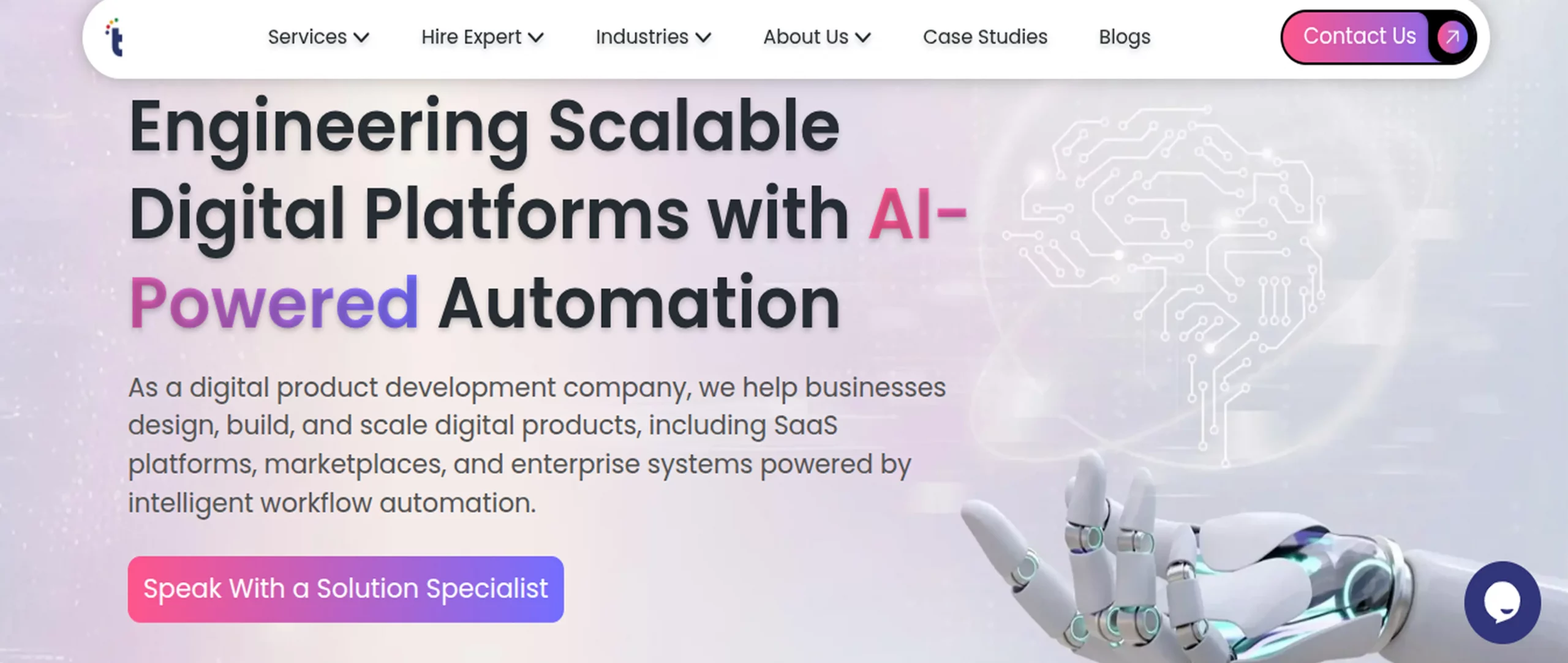
Technource is an AI-powered digital product engineering company that builds intelligent agents to run inside real products. As a leading name among AI agent development companies, it helps founders and enterprises design and deploy agents that drive measurable efficiency and automation.
The team of architects is developing multi-agent automation systems that collaborate, reason, and act across SaaS platforms, marketplaces, and enterprise systems. Its outcome-first approach is why clients keep scaling with it rather than restarting elsewhere.
What sets Technource apart is depth across the full lifecycle, from strategy and architecture to integration, testing, and long-term support. The team pairs modern large language models with secure-by-design engineering, so agents are robust in production, not just impressive in a demo.
Key Highlights:
13+ years of digital product engineering experience
1000+ projects delivered worldwide
70+ in-house tech experts across AI, data, and engineering
300+ clients served across the USA, UK, Canada, and beyond
Best For: Businesses that want agents engineered into scalable digital platforms with end-to-end ownership and real accountability.
2. LeewayHertz
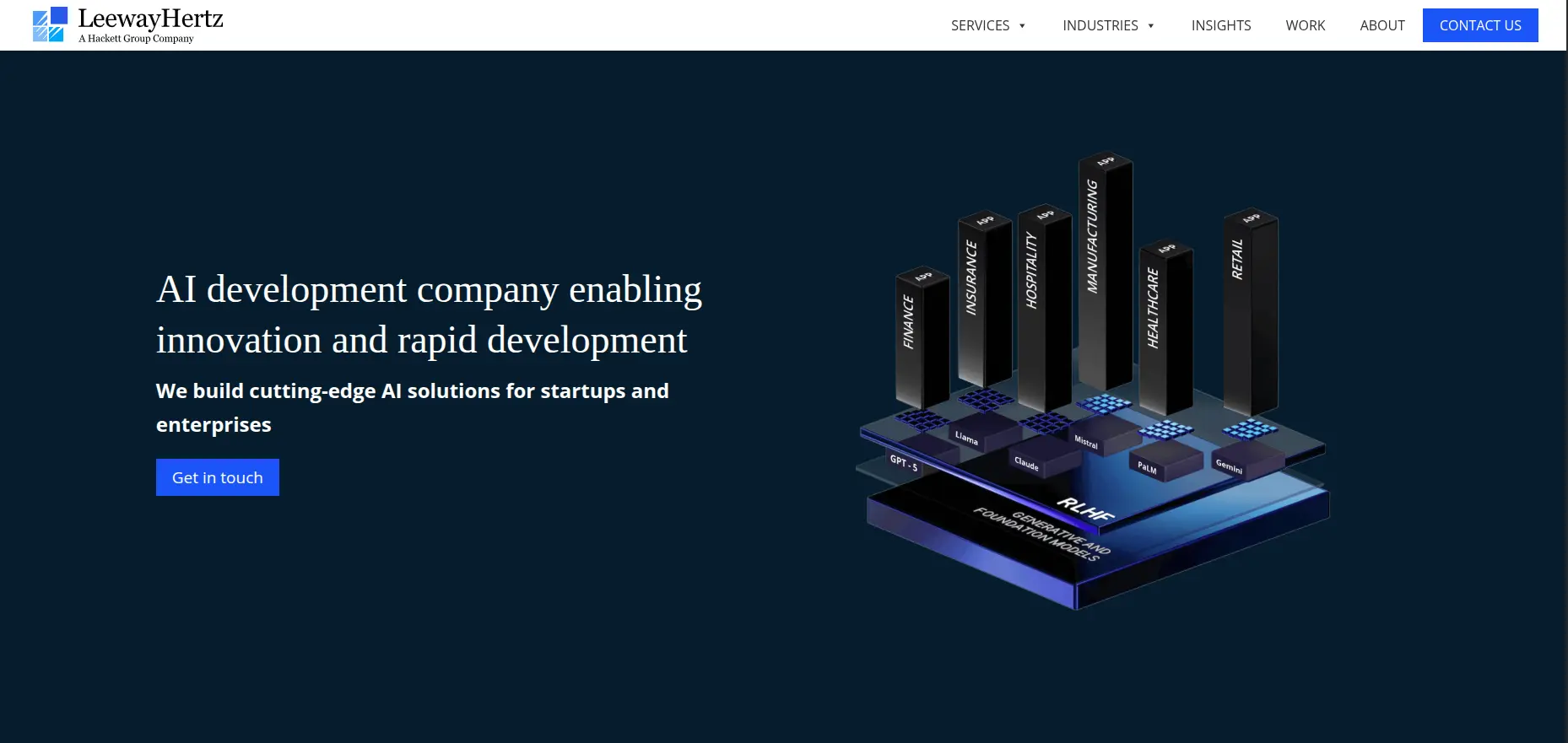
LeewayHertz is a well-known enterprise generative AI firm that blends strategic advisory with deep engineering. Its proprietary platform lets organisations build agents on their own data across multiple model providers, which suits complex enterprise environments. The firm covers strategy, architecture, fine-tuning, retrieval, and implementation in one engagement.
Best For: Large enterprises that need model-agnostic agents and proven, high-stakes delivery.
3. Markovate
Markovate focuses on shipping production-ready AI systems rather than proofs of concept that never launch. The team specialises in agentic AI, voice agents, and computer vision, with notable work in healthcare and fintech. Its practical, execution-first style helps clients avoid long discovery phases.
Best For: Mid-market teams with a clear use case that need a partner who delivers fast.
4. SoluLab
SoluLab pairs multi-agent development with strong blockchain expertise, a rare combination. It builds agents that can touch crypto, supply chain, or decentralised data while keeping a sensible budget. The team serves fintech, supply chain, and product clients well.
Best For: Budget-aware teams that need AI agents and Web3 capability in one build.
5. Master of Code Global
Master of Code Global is a conversational AI specialist with a large real-world chatbot footprint. Its framework and customer-facing experience power support, lead, and engagement agents across web, mobile, and messaging. The firm is trusted by major consumer brands for high-volume interactions.
Best For:Customer-facing businesses focused on support automation at scale.
6. Kanerika
Kanerika stands out by combining agentic AI with deep data engineering. Its platform streamlines data pipelines, governance, and business processes so agents run on trustworthy data rather than messy inputs. This directly tackles the data problem that sinks many AI projects.
Best For: Enterprises whose AI plans are blocked by siloed or inconsistent data.
7. Azilen Technologies
Azilen is an enterprise AI product engineering firm with a strong agentic platform. The team emphasises monitoring, bias control, and compliance, backed by recognised security certifications. It builds agents that connect to ERPs, CRMs, and APIs while staying governed.
Best For: Enterprises that want governed, monitored agents with audit-ready delivery.
8. Simform
Simform brings a strong cloud-native foundation to its AI agent work. The team usually layers agents on top of AWS or Azure architectures it has already built, so cloud and AI come from one place. This unity reduces friction for hyperscaler-heavy stacks.
Best For: Teams whose primary stack is on AWS or Azure and want one partner for both layers.
9. Azumo
Azumo delivers AI agents through nearshore teams with full overlap with US business hours. Its practice covers agents, machine learning pipelines, and generative AI integration. The timezone alignment and English-language collaboration keep projects moving in real time.
Best For: Teams that treat real-time timezone overlap as non-negotiable.
10. InnovationM
InnovationM provides end-to-end AI development with real strength in conversational and voice agents. The team builds custom agents, generative AI solutions, and intelligent automation that integrate with existing workflows. It works closely with startups, SMEs, and enterprises alike.
Best For: Buyers who want custom conversational AI and enterprise-grade adoption.
11. CONTUS Tech
CONTUS Tech specialises in conversational and multi-agent systems built for specific industries. The firm is known for predictable delivery, with defined proof-of-concept and deployment windows. Its agents work across voice, email, and chat to keep workflows consistent.
Best For: Buyers who value predictable timelines and omnichannel agents.
12. Suffescom Solutions
Suffescom Solutions focuses on mid-market AI agent delivery at competitive pricing. It has shipped agents across e-commerce, fintech, and SaaS with a solid execution record. The firm gives value-conscious buyers real delivery without enterprise consultancy rates.
Best For: Mid-market budgets that want agent delivery without premium pricing.
13. SolGuruz
SolGuruz builds production-ready agents that research, reason, and act inside existing tools. Its work centres on back-office automation, customer assistants, and ERP or CRM integration with enterprise-aware architecture. The team keeps a practical, outcome-driven focus.
Best For: Teams that need process-automation agents wired into their stack.
14. RaftLabs
RaftLabs designs voice-first and multimodal agents that act, learn, and slot into business tools. The team builds custom agents for lead capture, support, and process automation across channels. Its multi-agent systems coordinate to finish complex tasks.
Best For: Buyers who want voice and multi-channel agent workflows.
15. ScalaCode
ScalaCode is one of the few firms that publishes a transparent rate card and ships a first version quickly. The team works fluently with retrieval, multi-agent systems, and modern model stacks. Fast delivery and clear pricing make it easy to start with low risk.
Best For: Teams that want a fast, transparently priced first production build.
16. Appventurez
Appventurez blends strategy, design, and engineering for conversational and generative AI agents. The team builds agents for healthcare, fintech, and software companies with a focus on a smooth user experience. It serves both startups and enterprises.
Best For: Buyers who want design-led agent builds with strong product thinking.
17. WebClues Infotech
WebClues Infotech builds custom AI agents with a broad, multi-region presence across India, the USA, and the UAE. The firm covers AI development, integration, and enterprise systems work under one roof. Its wide service range suits varied delivery needs.
Best For: Buyers who want multi-region delivery and broad service coverage.
18. Intellectyx
Intellectyx is a data, digital, and AI firm with a clear focus on agents that reach production. The team brings experience integrating agents with enterprise systems and operational tools. Its data heritage helps agents run on solid foundations.
Best For: Data-driven enterprises that want production-proven agents.
19. Riseup Labs
Riseup Labs pairs custom AI agent development with automation and BPO capability. This blend lets clients get both a built agent and the operational support to run it. The team works with global clients across the full delivery cycle.
Best For: Teams that want agent development plus operational backing.
20. Developer Bazaar Technologies
Developer Bazaar Technologies builds agentic AI for early-stage startups with a product-team mindset. It takes clients from proof-of-concept to full agent implementation rather than acting like a body shop. The focus stays on practical, scalable delivery.
Best For: Series A to B startups that want a product partner, not just coders.
How We Selected the Top AI Agent Development Companies
Many companies now offer AI agent development services, but not all have the expertise to build reliable, production-ready AI solutions. To create this list, we evaluated each company using seven practical criteria that businesses should consider before choosing a development partner.
1. Production Experience
We prioritized companies with a proven track record of building and deploying AI agents in real business environments. Hands-on experience is a strong indicator of reliable delivery.
2. Technical Expertise
We looked for companies with strong capabilities in large language models (LLMs), multi-agent systems, AI frameworks, and modern development practices to handle complex AI projects.
3. Industry Experience
Companies with experience across industries such as healthcare, finance, retail, manufacturing, and logistics scored higher because they understand industry-specific challenges and compliance requirements.
4. Integration Capabilities
A good AI agent should work seamlessly with your existing software. We evaluated each company’s ability to integrate AI agents with CRMs, ERPs, APIs, databases, cloud platforms, and other business tools.
5. Security and Compliance
Since AI agents often work with sensitive business data, we favored companies that follow strong security practices, data governance, and industry compliance standards.
6. Pricing Transparency
We considered how clearly companies explain their pricing, project scope, and engagement models. Transparent pricing helps businesses plan their budgets and avoid unexpected costs.
7. Proven Client Results
Finally, we reviewed client testimonials, case studies, and measurable business outcomes. Companies with consistent delivery and successful AI implementations ranked higher in our evaluation.
AI Agent Use Cases Across Industries
AI agents are helping businesses automate complex tasks, improve efficiency, and make faster decisions. Here are some of the most common use cases across industries:
1. Healthcare
In healthcare, AI agents answer patient queries, schedule appointments, analyze medical records, and automate administrative tasks, allowing healthcare teams to focus more on patient care.
2. Fintech and Insurance
In finance, AI agents detect fraud, automate customer onboarding, support compliance, generate reports, and provide 24/7 customer assistance.
3. Retail and eCommerce
In retail and e-commerce, AI agents personalize shopping experiences, manage orders, handle returns, automate customer support, and optimize inventory management.
4. Logistics and Supply Chain
In logistics, AI agents track shipments, optimize delivery routes, automate warehouse operations, and improve supply chain visibility.
5. Manufacturing
In manufacturing, AI agents monitor equipment, predict maintenance needs, automate reporting, and optimize production processes to reduce downtime.
6. Real Estate
In real estate, AI agents qualify leads, answer property inquiries, schedule viewings, automate follow-ups, and streamline document management.
AI Agent Development Cost: What to Budget
Cost is one of the first questions buyers ask AI agent development companies, and the honest answer is that it depends on the scope. Still, clear ranges help you plan. The table below gives indicative general ranges, not a fixed quote.
Engagement Type
Typical Timeline
Indicative Cost Range
Single-task agent (FAQ, summarizer)
3 to 5 weeks
$15,000 to $40,000
RAG or workflow agent
6 to 10 weeks
$40,000 to $90,000
Multi-agent enterprise system
3 to 6 months
$90,000 to $250,000+
Dedicated AI engineer (monthly)
Ongoing
$4,000 to $12,000 per engineer
The final cost of AI agent development depends on several factors, including:
Agent Complexity: More advanced AI agents with multi-step reasoning, decision-making, and automation require more development time and cost than simple task-specific agents.
Integrations and Data: Connecting AI agents with CRMs, ERPs, APIs, and databases, and preparing high-quality data can significantly impact the overall project cost.
AI Models and Infrastructure: The choice of AI models, cloud infrastructure, hosting, and expected usage directly affects both development and long-term operating costs.
Security and Compliance: Projects involving sensitive data or industry regulations such as HIPAA, GDPR, or SOC 2 require additional security, governance, and compliance measures, increasing the overall budget.
AI Agent Development Platforms vs Development Companies
Not every project needs a custom build, so it helps to know the difference. A platform sells software you configure yourself, while AI agent development companies build the agent for you.
Picking the wrong path wastes the budget and creates integration debt.
Factor
AI Agent Platform
Development Company
Build effort
Configure it yourself
Built for you end-to-end
Customisation
Limited to platform options
Full control over behaviour
Integration depth
Light, prebuilt connectors
Deep, across your whole stack
Governance
Vendor-controlled
Tailored to your compliance needs
Best fit
Simple, single workflows
Complex, production-grade systems
When a Platform Is Enough
Choose an AI agent platform if you:
Need a simple AI agent for a single task or workflow
Want a no-code or low-code solution for faster deployment
Require only basic integrations with existing tools
Have a small team with limited development resources
Prefer speed and lower upfront costs over deep customization
When You Need a Development Partner
Choose an AI agent development company if you:
Need a custom AI agent tailored to your business processes
Require multi-agent systems or advanced AI capabilities
Need deep integrations with CRMs, ERPs, APIs, or internal systems
Have strict security, compliance, or governance requirements
Want a scalable, production-ready solution with ongoing support
How to Choose the Right AI Agent Development Company
There is no single best firm, only the best fit for your stage, stack, and goals. Use this framework to move from guesswork to a confident decision among AI agent development companies. These six factors matter most.
1. Match the Partner to Your Stage
A seed-stage startup and a large enterprise need very different partners. Early teams want speed, clear pricing, and a product mindset, while enterprises want scale, governance, and references. Match the firm to where you actually are, not where you hope to be. The right fit here saves time and money throughout the build.
2. Demand Real Production References
Ask for systems that are live, handling real data, and delivering measurable results. Polished demos and proofs of concept do not prove a team can ship and maintain agents. Two solid references in your sector tell you more than any sales deck. Production proof is the single strongest signal of reliability.
3. Test Technical and Integration Depth
Push past the pitch and ask how the team trains, evaluates, and integrates agents. A capable partner explains its model choices, retrieval approach, and integration plan clearly. If answers stay vague, the execution will likely be vague too. Depth here predicts how well your hardest problems get solved.
4. Confirm Security and Compliance Posture
Since agents touch sensitive data, security must be built in from the start. Ask about encryption, access control, audit trails, and the standards they follow. A mature partner treats this as core, not an afterthought. Getting it right early prevents serious problems later.
5. Insist on Pricing Transparency
You should understand exactly what you are paying for and how scope changes affect cost. Firms that explain pricing clearly help you budget and avoid hidden overruns. Our guide on alternatives to big AI consulting firms shows why transparent partners win. Clear pricing signals a healthy relationship, as does access to senior AI consulting input.
6. Start With a Paid Pilot
Before a long engagement, run a small paid pilot to test real capability. A pilot reveals technical skill, communication, and delivery speed without betting the whole budget. It lets you walk away if the work does not match the pitch. This single step removes most of the risk from your decision.
Red Flags to Avoid When Hiring an AI Agent Development Company
Watch out for these warning signs when evaluating AI agent development companies:
No Proven Production Experience: The company talks about AI but cannot show real-world AI agent deployments, case studies, or measurable results.
Limited Technical Expertise: They lack experience with multi-agent systems, AI frameworks, integrations, or modern LLM technologies.
Unclear Pricing: Pricing is vague, hidden, or changes frequently without a clear explanation of the project scope.
Weak Security and Compliance: The company does not clearly address data security, governance, compliance, or privacy requirements.
No Post-Launch Support:They focus only on development and offer little or no support for monitoring, maintenance, or optimization after deployment.
Mismatch Between Sales and Delivery Teams: Senior experts handle sales meetings, but the actual project is assigned to inexperienced developers without proper oversight.
Why Technource Is a Trusted AI Agent Development Partner
Choosing the right AI agent development partner is about more than technical expertise. You need a team that understands your business goals, builds secure and scalable AI solutions, and supports you beyond deployment.
Technource combines AI engineering, product development, and enterprise integration expertise to deliver production-ready AI agents that create measurable business value. The team builds AI-powered systems grounded in business outcomes, not hype, and backs every project with end-to-end ownership.
Here is why businesses choose Technource:
Proven scale: 13+ years of experience, 1000+ projects, 70+ tech experts, and 300+ clients served
Real agent delivery: Multi-agent automation built into SaaS platforms, marketplaces, and enterprise systems
Outcome focus: A multilingual AI call agent that cut human dependency by 70% and improved response speed by 80%
Secure-by-design engineering: Encryption, governance, and compliance built in from the start
End-to-end ownership: Strategy, architecture, development, integration, testing, and long-term support under one roof
Global reach: Trusted delivery across the USA, UK, Canada, and beyond, with strong India engineering heritage
Conclusion
The market for the top AI agent development companies is crowded, but the signal is clear once you know what to look for. The right partner is not the loudest or the cheapest.
It is the one that ships agents into production, integrates them cleanly, secures them properly, and supports them long after launch.
We hope this guide helped you understand the top AI agent development companies and what they actually do. You also saw what they cost and how to choose between them. You now have a comparison table, real use cases, a cost picture, and a framework to avoid expensive mistakes.
Now it is your turn to move from research to action. Evaluate your use case, ask the right questions, and start with a partner that proves capability before you commit.
To take the next step with confidence, connect with our experts to build and scale your AI agents the right way.
FAQs
Cost depends on complexity, integrations, and data readiness. A simple single-task agent often runs from $15,000 to $40,000, while a multi-agent enterprise system can reach $90,000 to $250,000 or more. Dedicated engineers are usually billed monthly per person.
A focused single-task agent can ship in 3 to 5 weeks. A retrieval or workflow agent usually takes 6 to 10 weeks, and a full multi-agent enterprise system runs 3 to 6 months. Faster firms compress these timelines without cutting quality.
A chatbot follows scripts and answers questions within set rules. An AI agent reasons, plans, and takes action across systems to reach a goal, adapting as conditions change. In short, chatbots respond, while agents decide and execute.
A platform suits simple, contained agents you configure yourself and want to launch quickly. A development company is the better choice for complex, custom, production-grade systems that need integration, governance, and scale. Match the path to the complexity of your use case.
Ask for live systems handling real data, not demos or proofs of concept. Request references in your industry with measurable outcomes like faster response or fewer errors. A strong partner also explains its data pipelines and deployment approach clearly.
Yes, most firms offer both fully managed delivery and staff-augmentation models. In augmentation, their engineers slot into your team for a set period. This flexibility lets you keep internal control while adding specialist agent skills.
Healthcare, fintech, retail, logistics, manufacturing, and real estate see the biggest gains. These sectors rely on automation, real-time decisions, and data analysis, which agents handle well. Any workflow with repetitive, multi-step tasks is a strong candidate.
Plan for ongoing monitoring, retraining, and prompt updates as your data shifts. Build in encryption, access control, and human oversight from the start. A committed partner supports this lifecycle so performance and trust hold over time.