Every founder with an AI idea faces the same question. Should you spend months building a full product, or first prove the idea works in just a few weeks? That one decision can determine whether your startup moves forward or wastes valuable time and budget.
This is where AI MVP development services make all the difference. The right partner helps you turn a rough idea into a working AI product that real users can test and validate.
However, the challenge is choosing the right development partner. Some companies specialize in rapid validation, while others focus on enterprise-grade AI products. Picking the wrong one can lead to missed deadlines, budget overruns, and an MVP that never delivers real value.
So, how do you choose the right AI MVP development services provider?
In this guide, you’ll learn:
What AI MVP Development Services include and why startups need them
The top 15 AI MVP development companies, compared side by side
How to choose the right AI development partner for your startup
Common mistakes and red flags to avoid before hiring
The complete AI MVP development process from idea to launch
Realistic AI MVP development costs and the factors that affect pricing
By the end of this guide, you’ll know exactly how to choose the right AI MVP development partner and confidently turn your AI idea into a working product that is ready for real users.
What Is AI MVP Development?
An AI MVP is the smallest version of your product that still proves one thing clearly. It shows that an intelligent feature, like a recommendation engine or a smart assistant, solves a real problem for real users.
Instead of building everything, you build the core slice that carries the most risk.
A normal MVP mostly tests whether people want your product. An AI MVP carries a heavier job because it also has to prove that the model behaves well on messy, real-world data.
Think of it like a test drive before the full road trip. You are not shipping a finished vehicle; you are checking that the engine and the AI core run smoothly enough to trust.
If you want the broader picture first, our guide on how to build an MVP walks through the fundamentals.
What AI MVP Development Services Actually Include
Every successful AI MVP follows a structured approach. Here are the key services you should expect from a reliable AI MVP development partner:
1. AI Use Case Discovery and Validation
Before anyone writes code, a good team helps you pick the right problem to solve with AI. They pressure-test your idea against real user pain and ask whether AI even adds value here. This step alone saves many founders from building something clever that nobody needs.
2. Rapid Prototyping and AI MVP Design
Next, they turn your idea into something you can see and click within weeks. You get wireframes, user flows, and a working prototype that makes the concept feel real. This early version helps you gather feedback long before heavy engineering begins.
3. LLM and Generative AI Integration
Most modern AI MVPs lean on existing models rather than training one from scratch. Your partner connects tools like large language models through clean, secure APIs. This is where generative AI MVP development turns a plain app into a genuinely smart one. When you need custom models, our AI development services cover that too.
4. Data Engineering and Model Development
AI only works as well as the data behind it. So the team cleans, structures, and prepares your data so the model can actually learn from it. When a custom model is needed, they build, train, and tune it for your specific use case.
5. MLOps, Deployment, and Scaling
Building a model is one thing, and running it reliably in front of real users is another challenge entirely. Good partners set up the pipelines that deploy, monitor, and retrain your AI. That way, it stays accurate as usage grows.
6. Post-Launch Support and Model Iteration
Your AI MVP is a starting line, not a finish line. After launch, the team watches how the model performs and refines it using real feedback. This steady loop of learning is what slowly turns a rough MVP into a product people rely on.
AI MVP vs Traditional MVP: What Actually Changes
It helps to see the two side by side. A traditional MVP and an AI MVP share the same goal, which is fast validation. But they differ in what they must prove and how they are built.
Dimension
Traditional MVP
AI MVP
Core question
Do users want this product?
Does the AI work, and do users want it?
Main risk
Market demand
Model accuracy plus market demand
Data needs
Light works on day one
Heavy, the model learns from data
Build approach
Conventional code and logic
Code plus models, APIs, and pipelines
Time to first version
A few weeks
A few weeks to a couple of months
Ongoing cost
Mostly stable
Usage-based, scales with model calls
In short, an AI MVP asks you to validate two bets at once. That is harder, but it is also why AI-powered MVP development can build a much stronger moat when it works.
Why Startups Invest in AI MVP Development Services
AI MVPs offer much more than faster development. Here are the biggest reasons startups choose this approach:
1. Faster Time to Market
Speed is often the difference between leading a market and chasing it. A focused AI MVP gets your product in front of users in weeks, not many months. That head start lets you learn, adjust, and raise money while competitors are still planning.
2. Lower Risk of Building the Wrong Product
Most startups fail because they build something nobody truly needs. According to CB Insights, a lack of market need is the top reason startups shut down. An AI MVP tests that demand early, so you fail cheaply or succeed with real proof.
3. Production-Grade AI From Day One
A weekend prototype often falls apart the moment real users arrive. Serious AI MVP development services build on solid foundations that can scale later. You get something that feels rough on the edges but is reliable at its core.
4. Predictable Budgets and Cost Control
Open-ended AI projects can quietly swallow your entire runway. A scoped MVP fixes the budget and the timeline before work starts. This clarity is a big reason founders trust experienced partners over cheap, vague quotes.
5. On-Demand AI Talent
Hiring a full AI team is slow, costly, and risky at an early stage. With the right partner, you tap senior data and AI engineers only when you need them. You get deep expertise without the long-term payroll commitment.
6. Built-In Data Readiness and Governance
AI lives or dies on data, and messy data sinks many projects. A strong team prepares your data and sets up basic governance from the start. That means cleaner inputs, safer handling, and a model you can actually trust.
7. Investor-Ready Proof of Traction
Investors no longer fund slide decks and bold promises alone. A working AI MVP with real usage shows that your idea has legs. That kind of evidence makes fundraising conversations far easier and far shorter.
8. A Clear Path From MVP to Scale
The best MVPs are built with the next stage already in mind. Good partners avoid shortcuts that would force a painful rebuild later. So when traction arrives, you scale up smoothly instead of starting over.
Top 15 AI MVP Development Services Providers for Startups
Below are the 15 firms we rate most highly for AI MVP development services for startups.
Company
Best For / Standout
Headquarters
Technource
Production-ready AI MVPs with fixed scope and pricing
USA and India
LeewayHertz
Enterprise generative AI and its ZBrain platform
USA
Markovate
Generative AI products for growth-stage startups
USA and India
Inoxoft
AI-enabled engineering with strong client reviews
USA and Poland
S-PRO
Full-cycle AI and ML with a careful, staged approach
Switzerland
DATAFOREST
Data engineering and MLOps for data-heavy MVPs
USA
KITRUM
Fast generative AI MVPs for lean startup teams
USA
Kanerika
Agentic AI and its FLIP automation platform
USA
Valere
AI-native products built crawl, walk, run
USA
SoluLab
AI and blockchain builds from ex-enterprise founders
USA
10Clouds
AI product design with agents and custom GPTs
Poland
Upsilon
Budget-friendly generative AI MVPs for early startups
USA
Appinventiv
AI-powered MVPs built to scale fast
USA and India
ELEKS
AI-driven, enterprise-grade MVP engineering
Estonia
Brainvire
AI-driven MVPs with digital transformation depth
USA and India
Let’s explore each company in detail!
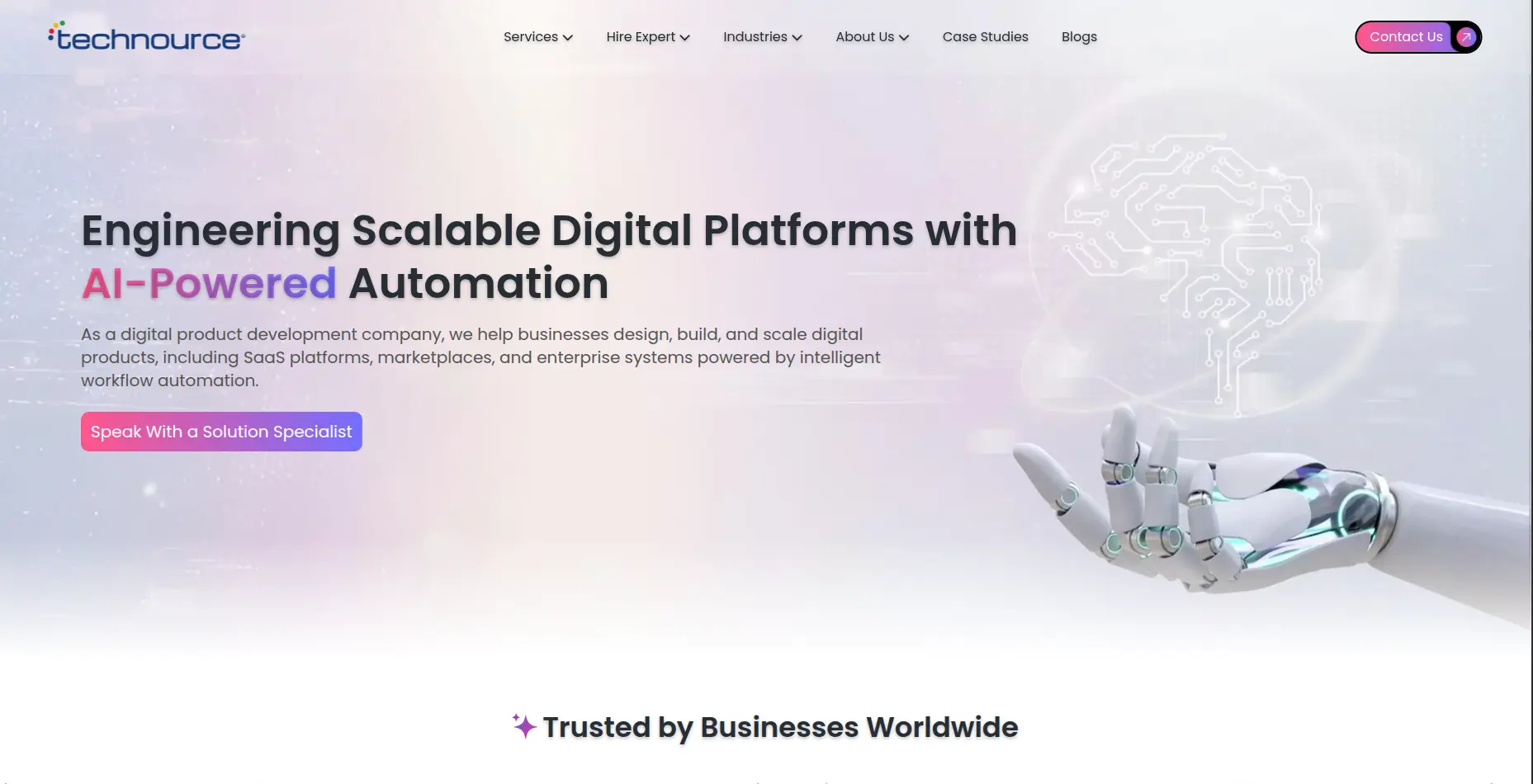
1. Technource
Technource is a digital product engineering company that helps startups turn AI ideas into real, working products.
It brings 13+ years in software, 1,000+ projects delivered, and 70+ tech experts on staff. That is a depth early teams rarely find in one place. The focus stays firmly on production-ready AI MVPs, not throwaway demos.
Technource stands out because it treats your MVP as the first step of a long journey, not a one-off project. The team scopes the work tightly, fixes the budget upfront, and builds on foundations that scale.
That mix of speed, transparency, and engineering depth is exactly what founders need.
Key Highlights
13+ years of software and product engineering experience
1,000+ projects delivered across industries and stages
70+ in-house tech experts spanning AI, data, and product
500+ clients served worldwide, with 85% staying on after the MVP phase
Clients have raised over $50M in funding using MVPs built by the team
98% on-time delivery, backed by fixed scope and clear pricing
At a Glance
Best for: Startups that want a production-ready AI MVP with predictable delivery
Core strengths: Use case validation, generative AI integration, data engineering, and MLOps
Engagement: Fixed-scope MVPs, dedicated teams, and long-term scaling support
Markets: United States and Europe, served from the USA and India
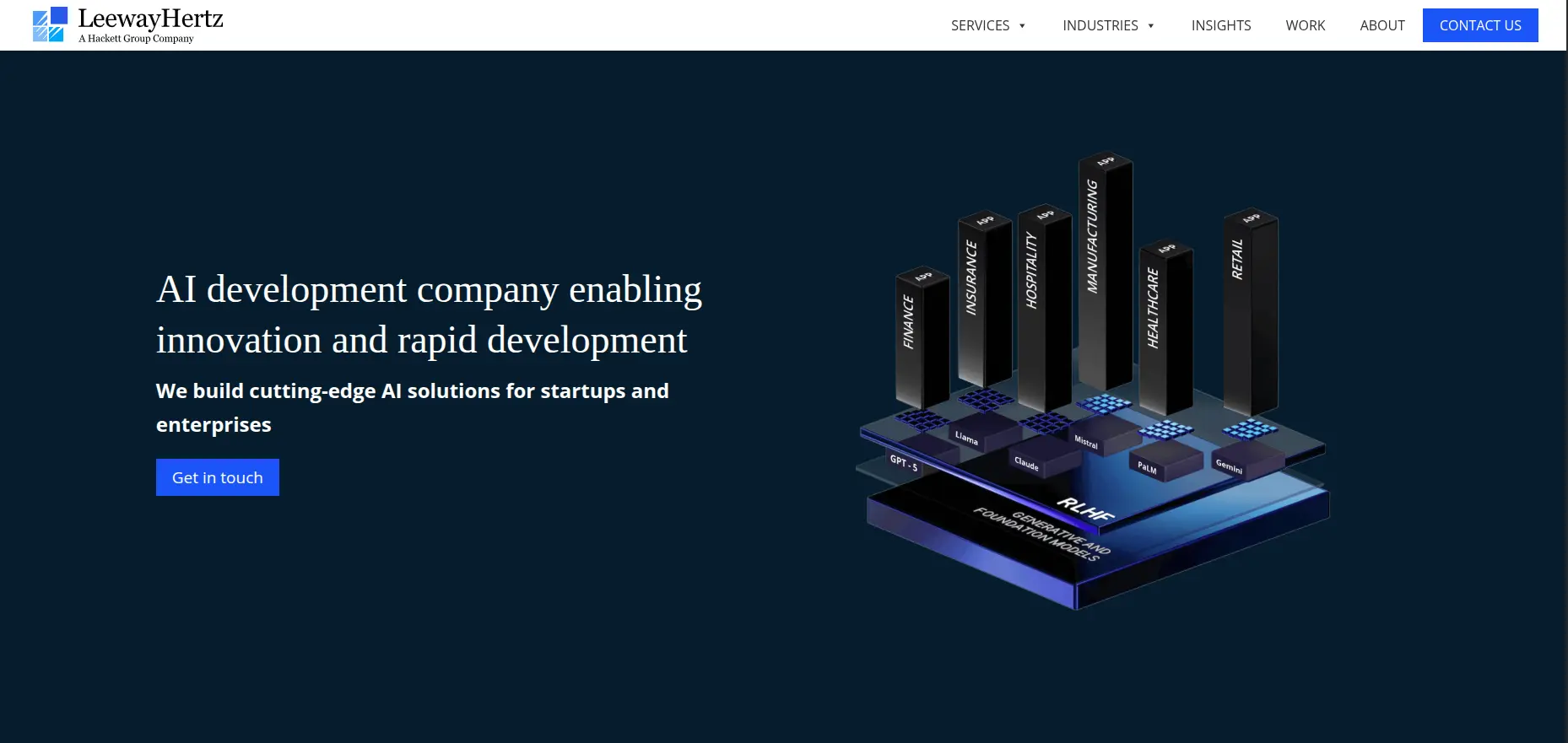
2. LeewayHertz
LeewayHertz is an enterprise-focused AI firm known for serious, large-scale generative AI work. Its standout asset is ZBrain, an in-house platform that speeds up building custom AI applications. For startups with bigger ambitions and enterprise-style needs, it offers real depth.
Best for: Startups building enterprise-grade generative AI products
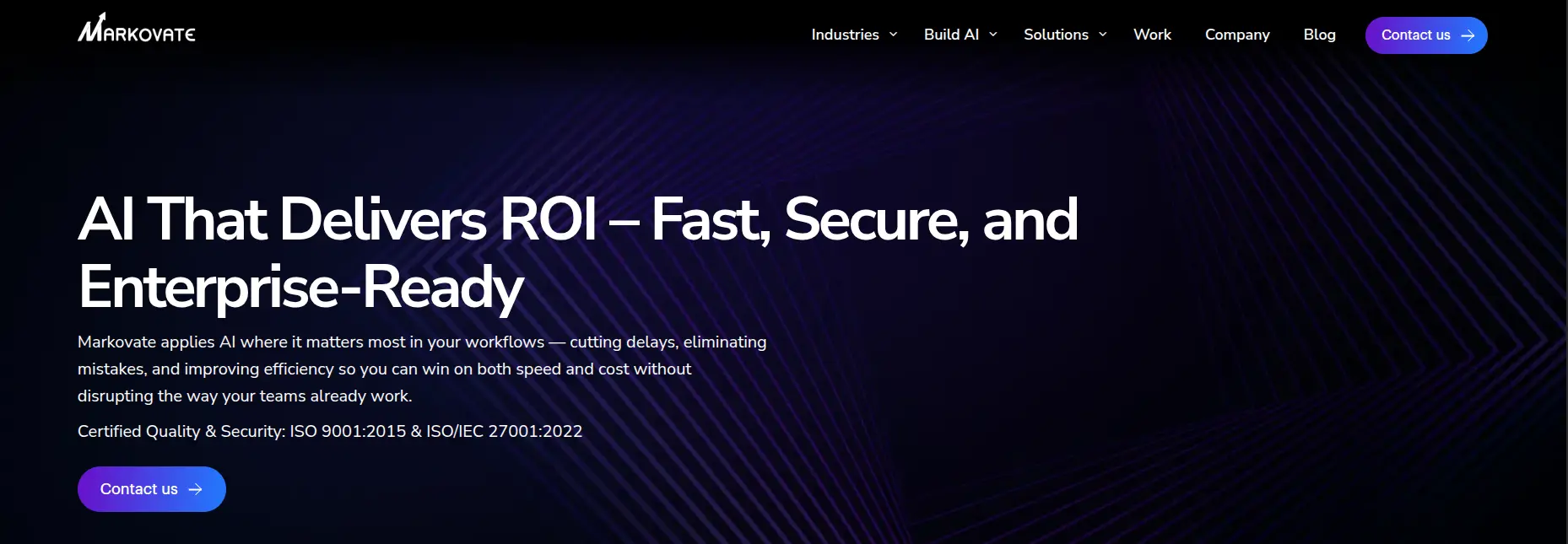
3. Markovate
Markovate works across the United States and India, focusing on generative AI products for growth-minded teams. It blends product strategy with hands-on AI engineering, which suits founders who want a thinking partner. Its sweet spot is mid-stage startups ready to scale an idea.
Best for: Growth-stage startups scaling a validated AI idea
4. Inoxoft
Inoxoft is an engineering-led firm with a reputation for reliability and strong client reviews. It builds AI-enabled software with a steady, quality-first mindset rather than chasing hype. Founders who value dependable delivery tend to feel at home here.
Best for: Startups that prize reliability and clean engineering
5. S-PRO
S-PRO takes a careful, staged approach to AI and machine learning projects. It guides clients from a small proof of concept toward a full MVP step by step. This measured style fits founders who want to reduce risk before scaling spend.
Best for: Founders who prefer a staged, risk-managed build
6. DATAFOREST
DATAFOREST shines when your product depends heavily on data. Its core strength is data engineering and MLOps, the unglamorous work that makes AI reliable. For data-rich MVPs, that focus can be the deciding factor.
Best for: Data-heavy AI MVPs that need strong pipelines
7. KITRUM
KITRUM is built for speed, turning generative AI MVPs around quickly for lean teams. It suits founders who need momentum and a working product fast. Its nimble style works well when time matters more than heavy custom modeling.
Best for: Lean startups that need a fast generative AI MVP
8. Kanerika
Kanerika focuses on agentic AI, where software agents handle multi-step tasks on their own. Its FLIP platform helps automate workflows inside products and operations. Founders exploring autonomous, agent-driven features will find real expertise here.
Best for: Startups building agentic, workflow-automation AI
9. Valere
Valere describes itself as AI-native and builds products in clear stages. Its crawl, walk, run method introduces intelligence gradually as the product matures. This keeps early versions simple while leaving room to grow smarter over time.
Best for: Founders who want AI layered in gradually
10. SoluLab
SoluLab blends AI with blockchain and is led by founders with enterprise backgrounds. That mix suits products where trust, transparency, or tokens matter alongside intelligence. Teams exploring both technologies under one roof gain a clear advantage.
Best for: Startups combining AI with blockchain features
11. 10Clouds
10Clouds pairs polished product design with modern AI capabilities. It builds AI agents and even custom GPT-style assistants for client products. Founders who care about both user experience and intelligence will appreciate the balance.
Best for: Design-conscious startups adding AI agents
12. Upsilon
Upsilon is a friendly choice for early founders watching every dollar. It focuses on generative AI MVPs at startup-friendly budgets. For pre-seed and seed teams, accessible pricing can be a real lifeline.
Best for: Early startups on a tight budget
13. Appinventiv
Appinventiv is a large, well-known firm that builds AI-powered MVPs designed to scale fast. Its size means deep resources and broad capability across platforms. Founders planning aggressive growth may value that horsepower, if the budget allows.
Best for: Ambitious startups planning rapid scale
14. ELEKS
ELEKS brings enterprise-grade engineering discipline to AI MVP work. It is known for rigorous quality and complex, high-stakes builds. Founders who need serious technical depth and structure will feel supported here.
Best for: Startups needing enterprise-level engineering rigor
15. Brainvire
Brainvire combines AI-driven development with broad digital transformation experience. It suits founders who want an MVP today and a wider tech roadmap tomorrow. That bigger-picture view can help products evolve well beyond launch.
Best for: Startups wanting AI plus a transformation roadmap
How We Selected the Top AI MVP Development Companies
Not every AI development company delivers the same value. Here are the key factors we used to evaluate and rank these providers:
1. Proven AI and MVP Track Record
We looked for firms that have actually shipped AI products, not just talked about them. Real case studies and live launches carry far more weight than buzzwords. A partner who has done this before will spot pitfalls you cannot yet see.
2. End-to-End Capability, From Data to MLOps
AI MVPs touch data, models, design, and deployment all at once. So we favored teams that handle the full stack under one roof. This avoids the costly gaps that appear when too many vendors are involved.
3. Security, Compliance, and Governance
Even an early product can handle sensitive user data. We checked for firms that take security and compliance seriously from the start. Clear certifications and data practices were a strong signal of maturity here.
4. Verified Client Outcomes and Reviews
Marketing claims are easy, but happy clients are hard to fake. We weighed independent reviews and measurable results over polished promises. Consistent praise across platforms told us a firm delivers what it sells.
5. Delivery Speed and Pricing Transparency
An MVP that takes forever defeats its own purpose. We valued partners who move quickly and quote openly. Clear timelines and honest pricing protect your runway and your peace of mind.
The AI MVP Development Process: From Idea to Launch
Building an AI MVP is easier when you follow a clear process. Each step helps reduce risk, control costs, and move your idea closer to a successful product. Here are the six key steps from idea to launch:
Step 1: Discovery and AI Use Case Validation
The first step is understanding the problem you want to solve and deciding whether AI is the right solution. Your development team identifies your target users, their biggest challenges, and the value your AI feature will provide. This helps validate your idea before development begins and prevents costly mistakes later.
Step 2: Data Assessment and Readiness
AI is only as good as the data behind it. The team reviews your existing data, cleans it if needed, and fills any gaps before development starts. Preparing high-quality data early improves the performance and accuracy of your AI MVP.
Step 3: MVP Scoping and Feature Prioritization
Now it’s time to decide what goes into the first version of your product. The focus stays on the must-have features that validate your idea, while less important features are saved for future updates. This keeps your MVP simple, faster to build, and within budget.
Step 4: Prototype and AI Model Development
With the scope finalized, the team starts building your AI MVP. Developers create the product interface while AI engineers integrate existing models or build custom AI for your use case. Regular progress updates ensure you can review and improve the product throughout development.
Step 5: Integration, Testing, and Evaluation
Before launch, every part of the product is tested to make sure it works smoothly. The team checks AI accuracy, product performance, security, and user experience, then fixes any issues before releasing the MVP.
Step 6: Deployment and Post-Launch Improvement
Once testing is complete, your AI MVP is launched for real users. The team monitors user feedback and AI performance, then continues improving the product through regular updates. This helps your MVP grow into a reliable, scalable AI product over time.
Now that you understand how an AI MVP is built, let’s look at how to choose the right AI MVP development company for your startup.
How to Choose the Right AI MVP Development Company
Choosing the right partner can make or break your AI MVP. Here are the most important factors to consider before making a decision:
1. Relevant AI and Domain Experience
Look for a team that has built AI products similar to yours before. Experience in your space means fewer surprises and smarter shortcuts along the way. Ask for examples that match your use case, not just a generic portfolio.
2. Full-Stack AI Capability
Your partner should handle data, models, design, and deployment together. When one team owns the whole flow, fewer things slip through the cracks. This end-to-end strength is a hallmark of strong AI MVP development services.
3. A Clear, Validation-First Process
Great partners start with discovery, not with code. They push you to validate the idea before building heavily, which protects your budget from costly detours. For a fuller view, our guide on MVP app development for startups is a useful companion.
4. Transparent Pricing and Timelines
Vague quotes today often become painful surprises tomorrow. The right firm gives you a clear scope, a fixed budget, and honest dates. This openness is one of the strongest signs of a trustworthy team.
5. Strong Communication and Collaboration
You will work closely with this team for weeks or months. So regular updates, plain language, and quick replies really matter. A partner who communicates well feels less like a vendor and more like your own team.
6. Security and Compliance Readiness
Even an early product can touch sensitive user data. Choose a firm that bakes in security and basic compliance from the start. Clear data practices protect both your users and your reputation.
7. A Built-In Path to Scale
Your MVP should not trap you in a corner later on. Pick a partner who builds with the next stage already in mind. That foresight lets you grow smoothly once your idea proves itself.
How Much Do AI MVP Development Services Cost?
Cost is often the first question founders ask, and rightly so. The honest answer is that it depends on scope, data, and complexity. Still, these ranges give you a realistic starting point for AI MVP development cost.
MVP Type
Typical Timeline
Indicative Cost
AI-only feature MVP (single smart feature)
4 to 6 weeks
$15,000 to $40,000
Full-product AI MVP (app plus AI core)
2 to 4 months
$40,000 to $90,000
Regulated or data-heavy AI MVP
3 to 5 months
$90,000 to $150,000+
Discovery and validation sprint
1 to 2 weeks
$5,000 to $12,000
These are starting ranges, not fixed quotes. Your final number depends on several factors, including:
Data quality and preparation: Cleaning, organizing, and preparing data can increase development costs.
AI model complexity: Custom AI models cost more than using existing AI APIs.
Third-party integrations: Connecting your MVP with multiple tools, platforms, or APIs adds to the overall cost.
Project scope: More features and advanced AI capabilities require a larger budget.
6 Common Mistakes Startups Make When Building an AI MVP
Even with a great partner, founders can trip themselves up. These mistakes come from inside the startup, not the vendor. Avoid them, and your AI MVP has a far better shot.
1. Over-Scoping the First Version
It is tempting to cram every idea into version one. But a bloated MVP costs more, ships late, and proves much less. Keep the scope ruthlessly small and let real users guide what comes next.
2. Skipping Discovery to Save Time
Rushing past discovery feels efficient, yet it rarely is. Without it, you risk building something polished that nobody wants. A short validation phase saves far more time than it ever costs.
3. Treating the MVP as the Final Product
An MVP is a learning tool, not a finished launch. Founders who expect perfection get frustrated by the rough edges. Embrace the early version as a fast way to learn, then improve it.
4. Setting No Cost Ceiling
AI work can expand endlessly if you let it run loose. Without a clear budget cap, costs and timelines start to drift. Fix your spending limit upfront so the project stays grounded in reality.
5. Over-Engineering the Data Layer
Some teams build a perfect data system before testing demand. That heavy effort is wasted if users never show up. Start with just enough data to prove the idea, then invest more later.
6. Ignoring Post-Launch Iteration
Launching is the start of the real work, not the end. Founders who stop improving lose their momentum quickly. Plan from day one to learn from users and refine the AI steadily.
Some warning signs may seem minor at first, but they can lead to delays, higher costs, and a failed MVP. Watch out for these red flags before choosing an AI MVP development partner:
No real AI case studies: Ask for live AI products, case studies, and measurable results. A strong portfolio proves real experience.
Vague or changing pricing: Avoid companies that cannot provide a clear scope, timeline, and fixed budget from the beginning.
Skipping discovery and validation: A reliable partner validates your idea before writing code to reduce the risk of building the wrong product.
Ignoring your data: If they do not ask about your data quality, availability, or readiness, it is a major warning sign. AI success depends on good data.
Promising perfect AI accuracy: No AI model is 100% accurate. Be cautious of unrealistic claims or guaranteed results.
Poor communication: Slow responses and unclear updates during the sales process often become bigger problems after the project starts.
No scaling plan: Your MVP should be built with future growth in mind. Avoid partners who have no roadmap beyond the initial launch.
Questions to Ask Before Hiring an AI MVP Development Company
Before you sign, a few sharp questions reveal a lot. Use this quick checklist in your very first calls. The answers separate strong AI MVP development services from weak ones fast.
1. Can you show AI products you have shipped for startups like mine?
2. How do you validate an AI idea before building it?
3. What does your data preparation process look like in practice?
4. How do you measure and improve model accuracy over time?
5. What is the fixed scope, budget, and timeline for my MVP?
6. How do you handle security and data privacy?
7. What happens after launch, and how do we scale together?
8. What happens after launch, and how do we scale together?
Why Choose Technource for AI MVP Development
Many companies can build an AI MVP, but only a few know how to build one that is ready to grow. Here is what makes Technource the preferred choice for startups.
Technource brings together everything strong AI MVP development services should offer in one place. It has 13+ years of experience, 1,000+ projects, and 70+ tech experts. That depth lets the team build AI MVPs that hold up in production. From SaaS development to full AI products, the focus stays on results that founders can measure.
Production-ready builds: Your AI MVP rests on foundations that scale, not throwaway demos.
Fixed scope and pricing: You get a clear budget and timeline before work starts, with no surprises.
End-to-end AI capability: One team handles data, models, design, and deployment together.
Proven outcomes: Clients have raised over $50M using MVPs built by the team, with 98% on-time delivery.
Long-term partnership: 85% of clients stay on after the MVP phase to scale with the same team.
Conclusion
Building an AI product is a big investment, but it does not have to start with a big risk. The right AI MVP Development Services help you validate your idea, launch faster, control costs, and gather real user feedback before investing in a full-scale product.
We hope this guide has helped you understand how AI MVP development works, what it costs, how to choose the right development partner, and which companies are worth considering. Now it is your turn to take the next step.
If you have an AI idea, start by building a focused MVP, learn from real users, and improve as you grow. Choosing the right partner today can save you months of development time and thousands of dollars tomorrow.
FAQs
AI MVP development services help startups build the smallest working version of an AI product. They cover idea validation, data preparation, model integration, design, and deployment. The goal is to prove your AI idea works and that users want it, without a full, costly build.
Most AI MVPs take a few weeks to a couple of months. A single smart feature can ship in four to six weeks. Larger or data-heavy products usually need two to four months, depending on complexity and data readiness.
AI MVP development cost typically ranges from $15,000 to $90,000 for most startups. A simple AI feature sits at the lower end, while full or regulated products cost more. Data work, model complexity, and integrations are the biggest factors that move the price.
Most early startups should start with existing AI APIs. They are faster, cheaper, and reduce technical risk at the MVP stage. A custom model makes more sense later, once you have proven demand and need a unique edge.
A regular MVP mainly tests whether users want your product. An AI MVP must also prove that the model works on real data. That extra layer makes AI-powered MVP development more demanding, but also more valuable when it succeeds.
Look for relevant AI experience, full-stack capability, and transparent pricing. Check real case studies, client reviews, and a clear, validation-first process. A strong MVP development company for startups will also plan for security and future scale.
You need enough relevant, good-quality data for the model to learn from. Sometimes you already have it, and sometimes the team helps you source or clean it. Starting with just enough data to prove the idea is smarter than overbuilding early.
Yes, a well-built AI MVP is designed to grow with you. Good partners avoid shortcuts that would force a painful rebuild later. With solid foundations, you can scale from a simple MVP into a full, production-grade product.