AI automation in ecommerce uses AI to run repetitive store tasks, from support replies to stock forecasts, with people reviewing the exceptions. Below are 20 proven workflows across storefront, catalog, service, operations, and risk. Each one comes with a typical build timeline, the cost tier it fits, and real results from brands like Amazon, Pandora, and Klarna. You also get a rollout plan and three Technource case studies.
Key Takeaways
AI automation in ecommerce pays off workflow by workflow, not as one big program. 88% of organizations use AI, but only about one-third have scaled it beyond pilots (McKinsey, 2025).
Most single-workflow builds take 2–12 weeks and fit Technource’s PoC tier ($5,000–$10,000) or AI MVP tier ($10,000–$50,000). Multi-store programs with ERP integration fall in the Enterprise MVP tier ($60,000–$100,000).
Customer-facing AI already shows hard numbers. Pandora’s AI agent resolves about 60% of service inquiries without a human (Digiday, 2025). Amazon says Rufus users are 60% more likely to complete a purchase (Fortune, 2025).
The quickest wins are high-volume, easy-to-measure tasks: order-status replies, cart recovery and product content.
AI features only perform on clean data and connected systems. Technource’s Equipt, Tojarcom and Telepath builds show how integration-led automation removes manual order, shipping and service work (see case studies below).
Online shoppers now meet AI before they meet your store.
During the 2025 holiday season, AI tools and agents influenced about $262 billion, or 20%, of global online sales (Salesforce, 2026).
Traffic from generative AI tools to US retail sites grew nearly 700% year over year in the same period (Adobe, 2026).
Behind the storefront, the pressure looks different.
Support queues spike at peak. Catalogs grow faster than content teams. Many mid-size stores still run returns, fraud checks, and stock updates on spreadsheets.
That is where AI automation earns its place. Not as a chatbot bolted onto the homepage, but as a set of workflows that each remove one specific manual task.
What Is AI Automation in Ecommerce?
AI automation in ecommerce is the use of machine learning and large language models to run store tasks that need judgment, such as answering customers, writing product content, forecasting stock, and flagging fraud. Unlike rule-based automation, it handles messy inputs and escalates exceptions to people.
Most stores already automate something. Order confirmation emails and low-stock alerts are good examples.
Those follow fixed rules. AI adds the ability to read, classify, predict, and generate. Our guide to AI in ecommerce covers the wider use cases.
Factor
Rule-based automation
AI automation
AI agents
What it does
Follows fixed if-then rules
Predicts, classifies, and generates
Plans and completes multi-step tasks
Example
Send an email when an order ships
Write 500 product descriptions
Process a return from request to refund
Handles messy input
No
Yes
Yes
Human role
Sets the rules
Reviews outputs
Approves exceptions
Main risk
Breaks on edge cases
Wrong or off-brand output
Wrong action in a live system
The strongest setups combine all three. Rules handle predictable steps, AI handles judgment, and people handle exceptions.
This layered model is how we design AI-powered workflow automation for ecommerce and SaaS teams.
Why Are Ecommerce Teams Turning to AI Automation Now?
Ecommerce teams are adopting AI automation because peak-season workloads now outgrow manual teams, while shoppers expect instant answers. At the same time, most companies still struggle to move AI past the pilot stage.
Adoption Is High, Scaling Is Low
88% of organizations use AI in at least one business function (McKinsey, 2025).
Yet only about one-third have started scaling it across the business. Most are still in pilots.
McKinsey’s research links real financial impact to redesigning workflows, not just adding tools. That is the core idea behind this list.
Manual Work Breaks at Peak
Holiday peaks expose every manual step in support and fulfillment.
In 2025, AI agents handled a 142% surge in tasks like returns and shipping updates during the holiday season (Salesforce, 2026).
Stores without that layer hire temporary staff, extend response times, or both. Our AI in ecommerce statistics roundup tracks more of these shifts.
The 20 AI Automation Workflows at a Glance
The 20 workflows below cover five areas of an ecommerce business: storefront, catalog, customer service, operations, and risk. Typical build timelines range from 2 to 12 weeks per workflow.
#
Workflow
Area
Typical timeline
Starting tier
1
AI shopping assistant
Storefront
6–10 weeks
AI MVP
2
AI product search and discovery
Storefront
4–8 weeks
AI MVP
3
Personalized recommendations
Storefront
4–8 weeks
AI MVP
4
Cart abandonment recovery
Storefront
2–4 weeks
PoC
5
Dynamic pricing and promotions
Storefront
6–10 weeks
AI MVP
6
Product description generation
Catalog
2–4 weeks
PoC
7
Attribute extraction and catalog enrichment
Catalog
3–6 weeks
PoC
8
Image processing and visual search
Catalog
6–10 weeks
AI MVP
9
Review moderation and summaries
Catalog
2–4 weeks
PoC
10
Tier-1 AI support agent
Service
4–8 weeks
AI MVP
11
Order status (WISMO) automation
Service
2–4 weeks
PoC
12
Ticket triage and routing
Service
2–4 weeks
PoC
13
Returns and refund automation
Service
4–6 weeks
AI MVP
14
Demand forecasting and replenishment
Operations
8–12 weeks
AI MVP
15
Multi-channel inventory sync
Operations
3–6 weeks
PoC
16
Order routing and shipping labels
Operations
4–8 weeks
AI MVP
17
Supplier PO and invoice processing
Operations
3–6 weeks
PoC
18
Fraud and return-abuse detection
Risk
6–10 weeks
AI MVP
19
Segmentation and lifecycle campaigns
Marketing
4–6 weeks
AI MVP
20
Reporting and reconciliation
Finance
4–6 weeks
PoC
Tier key: PoC tier = $5,000–$10,000. AI MVP tier = $10,000–$50,000. Details are in the cost section below.
Not sure which of these 20 workflows will pay back first?
These workflows sit closest to revenue, so they are the easiest to measure.
1. AI Shopping Assistant
An AI shopping assistant answers product questions in plain language and guides shoppers to the right item, using your catalog, reviews, and policies as its only sources.
Real result: 250 million customers used Amazon’s Rufus in 2025. Users were 60% more likely to complete a purchase, and Amazon expects over $10 billion in annualized incremental sales (Fortune, 2025).
Watch out: Ground every answer in live data. A confident wrong reply about size or compatibility creates a return.
2. AI Product Search and Discovery
AI search understands intent, synonyms, and typos, so a query like “waterproof kids boots under $50” returns relevant products instead of zero results.
Semantic search finds the match. A ranking layer then weighs stock, margin, and past conversion.
Typical timeline: 4–8 weeks
Starting cost tier: AI MVP ($10,000–$50,000)
KPI to track: Zero-result searches, search exit rate, and search-to-purchase conversion.
Watch out: Search quality depends on structured attributes. Fix catalog data first (see workflow 7).
3. Personalized Product Recommendations
Recommendation models suggest products based on browsing, purchase history, and similar shoppers, on product pages, in the cart, and in email.
Typical timeline: 4–8 weeks
Starting cost tier: AI MVP ($10,000–$50,000)
KPI to track: Average order value, attach rate, and revenue per visitor.
Watch out: New products and first-time visitors have no history. Keep rule-based fallbacks such as bestsellers per category.
4. Cart Abandonment Recovery
AI cart recovery decides when, where, and what to send to a shopper who left items behind, instead of sending everyone the same email.
About 70% of online carts are abandoned (Baymard Institute, latest available meta-analysis). The model scores purchase intent, picks email, SMS, or on-site messaging, and limits discounts to shoppers who need one.
Typical timeline: 2–4 weeks
Starting cost tier: PoC ($5,000–$10,000)
Technource example: Telepath uses automated reminders, discounts, and time-limited offers to recover carts.
Watch out: Do not train shoppers to abandon carts for a coupon. Cap incentives and test against a control group.
5. Dynamic Pricing and Promotion Optimization
Dynamic pricing models adjust prices or discounts based on demand, competitor prices, stock levels, and margin rules you define.
Typical timeline: 6–10 weeks
Starting cost tier: AI MVP ($10,000–$50,000)
KPI to track: Gross margin, sell-through rate, and markdown spend.
Watch out: Set price floors, ceilings, and human approval for large changes. Review local pricing and consumer-protection rules before automating price changes.
Catalog and Content Workflows
Product data feeds search, ads, marketplaces, and AI assistants. These workflows keep it complete and consistent.
6. Product Description Generation
Generative AI drafts product titles, descriptions, and bullet points from supplier data, specs, and images, in your brand voice.
Typical timeline: 2–4 weeks
Starting cost tier: PoC ($5,000–$10,000)
KPI to track: Time per SKU, SKUs published per week, and organic traffic to product pages.
Watch out: A person must review claims about materials, safety, or health. The model must never invent a spec.
7. Attribute Extraction and Catalog Enrichment
AI reads messy supplier feeds and fills structured attributes such as size, color, material, and compatibility.
Search, filters, recommendations, and marketplace feeds all depend on these fields.
Typical timeline: 3–6 weeks
Starting cost tier: PoC ($5,000–$10,000)
Technource example: Equipt uses category-specific listing fields so every product is complete and searchable (see case study below).
Watch out: Define your attribute schema before you automate. AI fills fields well, but it cannot decide which fields you need.
8. Product Image Processing and Visual Search
Computer vision removes backgrounds, creates image variants, tags product photos, and lets shoppers search with a picture.
Typical timeline: 6–10 weeks
Starting cost tier: AI MVP ($10,000–$50,000)
KPI to track: Image production cost per SKU and visual search conversion.
Watch out: Generated lifestyle images must match the real product. Misleading visuals lead to returns and complaints.
9. Review Moderation and Summaries
AI screens new reviews for spam and policy violations, then summarizes what buyers say about fit, quality, and use.
Typical timeline: 2–4 weeks
Starting cost tier: PoC ($5,000–$10,000)
KPI to track: Moderation time, review-to-publish time, and conversion on pages with summaries.
Watch out: Never hide genuine negative reviews. That damages trust and can breach consumer-protection rules in many markets.
A tier-1 AI support agent answers common questions and completes simple actions, such as address changes or order lookups. It passes complex cases to a person with the full context.
Typical timeline: 4–8 weeks
Starting cost tier: AI MVP ($10,000–$50,000)
Real results: Pandora’s agent, Clara, resolves about 60% of inquiries without escalation, up from about 40% with its earlier chatbot, and contributed to a 10% rise in net promoter score (Digiday, 2025). Klarna says its AI assistant does work equal to about 850 full-time agents and has saved around $60 million (CXM, 2025).
Watch out: Always offer a fast, visible path to a human. Customers forgive a handoff faster than a loop.
11. Order Status (WISMO) Automation
WISMO automation answers “where is my order?” instantly by pulling live carrier and order data into chat, email, or SMS.
Proactive delay alerts go out before the customer asks, which stops tickets at the source.
Typical timeline: 2–4 weeks
Starting cost tier: PoC ($5,000–$10,000)
KPI to track: Share of order-status tickets resolved without an agent and first response time.
Watch out: Tracking data is only as good as your carrier integrations. Map every carrier status code before launch.
12. Ticket Triage and Routing
AI reads each incoming ticket, tags intent, sentiment, and urgency, drafts a reply, and routes it to the right queue.
Typical timeline: 2–4 weeks
Starting cost tier: PoC ($5,000–$10,000)
KPI to track: Time to first assignment, misrouted tickets, and agent handle time.
Watch out: Start in “suggest” mode, where agents approve drafts. Move to auto-send only for categories with proven accuracy.
13. Returns and Refund Automation
AI returns automation checks eligibility, offers an exchange or store credit, creates the label, and triggers the refund when the item is scanned.
Typical timeline: 4–6 weeks
Starting cost tier: AI MVP ($10,000–$50,000)
KPI to track: More than $181 billion of global online holiday purchases had already been returned by the end of the 2025 season (Salesforce, 2026).
Watch out: Keep a person on high-value and suspicious returns (see workflow 18).
Operations and Fulfillment Workflows
These workflows depend on clean data flowing between your storefront, order management, warehouse, and ERP systems.
AI demand forecasting predicts SKU-level demand from sales history, seasonality, promotions, and external signals, then drafts purchase orders for approval.
Typical timeline: 8–12 weeks
Starting cost tier: AI MVP ($10,000–$50,000)
KPI to track: Forecast error, stockout rate, and inventory days on hand.
Watch out: Models need enough clean history to learn seasonality. New SKUs need rules or similar-product proxies.
15. Multi-Channel Inventory Sync
AI-assisted inventory sync keeps stock levels aligned across your store, marketplaces, and warehouses, and flags mismatches before they cause overselling. It works best on top of a reliable inventory management system.
Typical timeline: 3–6 weeks
Starting cost tier: PoC ($5,000–$10,000)
KPI to track: Oversell incidents, sync delays, and manual stock adjustments per week.
Watch out: Decide which system is the single source of truth for stock before you connect anything.
16. Order Routing and Shipping Label Automation
Order routing automation picks the best warehouse and carrier for each order based on stock, cost, and delivery promise, then creates labels and tracking.
Typical timeline: 4–8 weeks
Starting cost tier: AI MVP ($10,000–$50,000)
KPI to track: Equipt auto-calculates shipping charges and generates labels through Royal Mail and Evri integrations (see case study below).
Watch out: Carrier APIs change. Build monitoring and fallback rules so orders never stall silently.
17. Supplier PO and Invoice Processing
Document AI extracts line items from supplier invoices and purchase orders, matches them to receipts and flags mismatches for finance.
Typical timeline: 3–6 weeks weeks
Starting cost tier: PoC ($5,000–$10,000)
KPI to track: Invoices processed per hour, match exception rate, and late-payment fees.
Watch out: Keep approval thresholds. Auto-approve only exact matches within agreed tolerances.
Risk, Marketing and Finance Workflows
These workflows protect margin and turn store data into decisions.
18. Fraud and Return-Abuse Detection
AI fraud detection scores orders and returns in real time using device, behavior, and history signals, and sends risky cases to review. See how IDVerify cut manual KYC verification time by 49% with AI identity checks.
Typical timeline: 6–10 weeks weeks
Starting cost tier: AI MVP ($10,000–$50,000)
KPI to track: 9% of all returns are fraudulent, and 85% of retailers say they use AI to detect or prevent return fraud ().
AI groups customers by predicted lifetime value, churn risk, and product affinity, then triggers tailored email, SMS, and ad audiences.
Typical timeline: 4–6 weeks weeks
Starting cost tier: AI MVP ($10,000–$50,000)
KPI to track: Repeat purchase rate, churn rate, and campaign revenue per recipient.
Watch out: Consent and data-use rules such as GDPR and CCPA apply. Check your legal basis for each data source.
20. Reporting, Reconciliation and AI Analyst
An AI analyst answers questions like “why did margin drop last week?” from store, ad, and finance data, and automates payout and payment reconciliation. Our SkylineStay project cut manual reporting time by 78%.
Typical timeline: 4–6 weeks weeks
Starting cost tier: PoC ($5,000–$10,000)
KPI to track: Hours spent on weekly reporting and reconciliation errors found per month.
Watch out: Give the AI read-only access to finance data. Humans sign off on anything that changes the books.
How Much Does AI Automation in Ecommerce Cost?
A single AI automation workflow for an ecommerce store typically costs $5,000–$10,000 as a proof of concept or $10,000–$50,000 as a production AI MVP. Our AI MVP development cost guide breaks down that tier. Multi-store programs with deep ERP and order management integration fall in the $60,000–$100,000 Enterprise MVP tier.
Tier
Price
What it covers
Example workflows
Typical timeline
Proof of Concept (PoC)
$5,000–$10,000
One workflow, one channel, light integration
Cart recovery, product descriptions, WISMO
2–6 weeks
AI MVP
$10,000–$50,000
Production workflow with integrations, monitoring, and human review
Support agent, AI search, demand forecasting
4–12 weeks
Enterprise MVP
$60,000–$100,000
Several workflows across stores, ERP, OMS, and warehouse systems
Combined service, returns, and fulfillment automation
Phased, scoped per program
What Pushes the Cost Up or Down
Integrations: Each extra system (OMS, ERP, WMS, CRM, carriers) adds build and testing time. Scoping these early is part of any AI integration services engagement.
Data quality: Clean product and order data shortens the build. Messy data adds a cleanup phase.
Volume and speed: Real-time decisions at checkout cost more than overnight batch jobs.
Human review tools: Approval screens and audit logs add scope but reduce risk.
Compliance: Payment data, personal data, and regional rules shape architecture choices.
Ongoing Costs to Budget For
Ongoing costs depend on your project and your order and conversation volume.
Plan for AI model API usage, cloud hosting, monitoring, prompt and model updates, and maintenance as your catalog and policies change.
Want a fixed-scope estimate for your first AI workflow?
Most ecommerce AI workflows go live in 2–12 weeks: 2–6 weeks for a proof of concept and 4–12 weeks for a production AI MVP. Integrations and data quality decide where a project lands in that range.
Typical Phases for an AI MVP Workflow
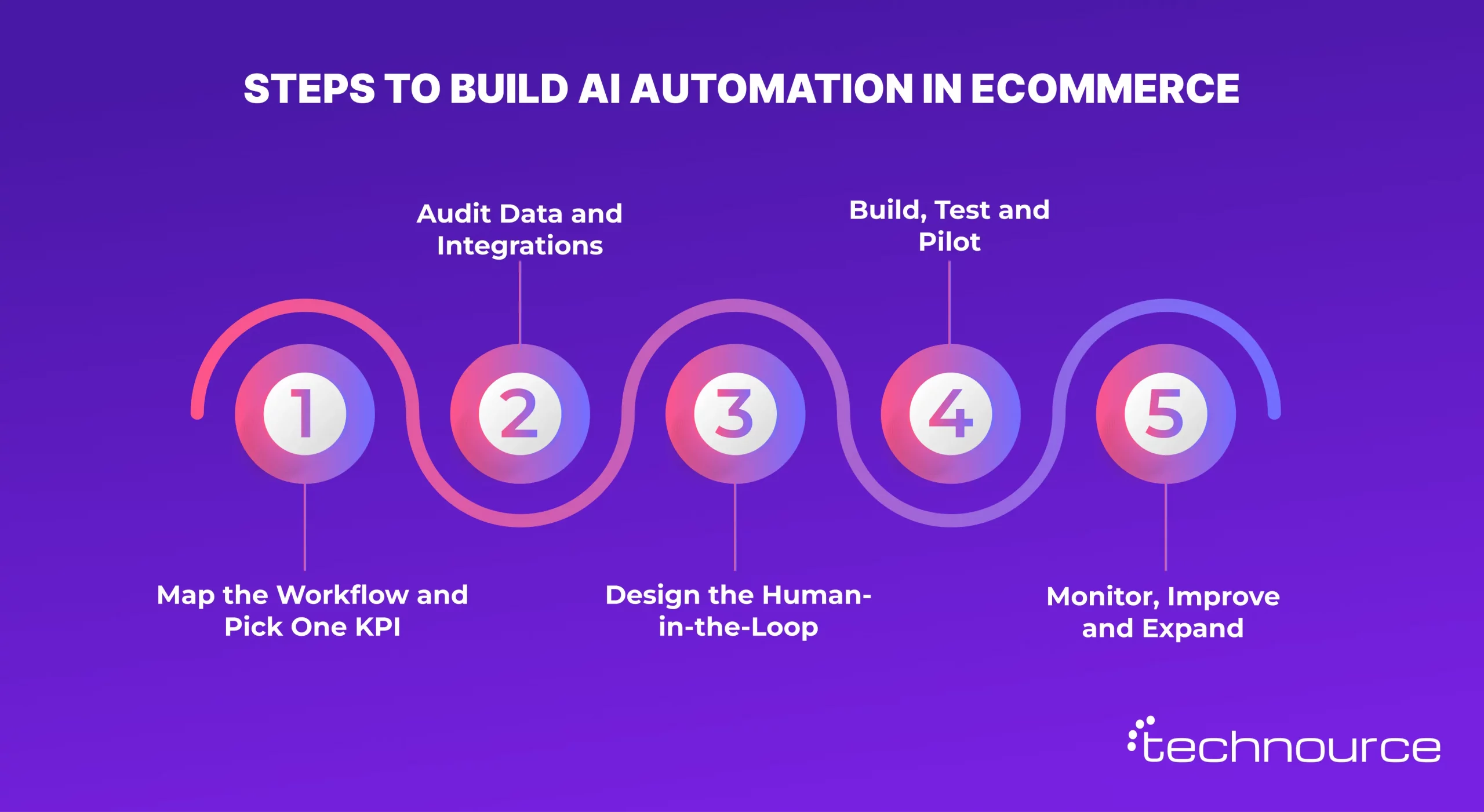
A production AI workflow moves through five phases, from data audit to live monitoring. Together, the first four phases take 4–12 weeks, matching the AI MVP timeline above.
Phase
What happens
Duration
1. Discovery and data audit
Map the workflow, define one KPI, check data quality
1–2 weeks
2. Integration
Connect the store, OMS, carriers, and other systems
1–3 weeks
3. Build and tuning
Build logic, prompts or models, plus review screens
1–4 weeks
4. Pilot
Run on live traffic with human review
1–3 weeks
5. Scale and monitor
Expand coverage, track the KPI, retrain as needed
Ongoing
Proofs of concept compress discovery and pilot into a shorter cycle.
Measure Before You Launch
Capture at least 4 weeks of baseline data before go-live. Track ticket volume, handle time, conversion or error rate, depending on the workflow.
Compare the same KPIs 8–12 weeks after go-live. Without a baseline, no one can prove the ROI.
Build vs Buy: Off-the-Shelf Apps or Custom AI Workflows?
Buy an off-the-shelf app when the workflow is standard and lives inside one platform. Build a custom AI workflow when it crosses several systems, uses proprietary data, or gives you a competitive edge.
Factor
Off-the-shelf app
Custom AI workflow
Setup time
Days
2–12 weeks
Upfront cost
Monthly subscription
PoC ($5,000–$10,000) or AI MVP ($10,000–$50,000) tier
Process fit
Generic process
Your exact process and rules
Data access
Limited to the app’s data
Store, OMS, ERP, and CRM together
Ownership
Vendor owns the logic
You own the code and logic
Vendor risk
Pricing and roadmap changes
Low; you control the roadmap
Best for
Review requests, basic email flows
Support agents, returns, forecasting, fraud
Many stores run a hybrid. Apps handle commodity tasks, while custom workflows connect them and handle the logic that makes the business different. Our guide to AI workflow automation tools compares the leading options.
Which Ecommerce Workflows Should You Automate First?
Start with workflows that are high-volume, rule-heavy, and easy to measure, such as order-status replies, cart recovery, and product content. Leave pricing, forecasting, and fraud scoring for later phases, once your data and integrations are stable.
OpenAI and other LLM APIs, retrieval (RAG) pipelines, AI agents, computer vision
Backend
Node.js, Python, PHP, Laravel, .NET
Data
PostgreSQL, MySQL, MongoDB, Redis
Integrations
Stripe, PayPal, Razorpay, carrier APIs, ERP and CRM APIs, REST and GraphQL
Cloud and DevOps
AWS, Microsoft Azure, Google Cloud, Docker, Kubernetes, CI/CD
Technource Case Studies: Ecommerce Automation With Measurable Results
These projects focus on the automation layer that AI features depend on: clean data, connected systems, and automated handoffs.
How Technource Built Equipt, a UK Equestrian Marketplace With 65% Faster Product Discovery
We built Equipt, a B2C marketplace for the UK equestrian community. Buyers needed to find the right saddle, boots, or feed quickly.
Sellers wanted a simple way to list, ship, and get paid. Listings were inconsistent across categories, and the platform had no logistics system of its own.
Technource built dynamic categories with custom form fields, so sellers only see the fields that matter for their product. We integrated Royal Mail, Evri and TrackingMore to auto-calculate shipping charges, generate labels and track parcels.
Stripe Connect handles seller payouts, refunds and disputes. GDPR consent, data export and deletion flows protect user data. The stack included Laravel, Flutter, MySQL, Stripe, Royal Mail, Evri and TrackingMore.
Measurable Result
65% faster product discovery with advanced filters
70% better order and dispute handling efficiency
Automated shipping charge calculation and label generation for sellers
Complete, searchable listings across every product category
Live on web, Android and iOS
How Technource Built Tojarcom, a Cross-Border Shopping Platform With 60% Better Customer Service Efficiency
We built Tojarcom, an ecommerce platform that lets customers in Jordan, the UAE, and Saudi Arabia buy from US and European stores that do not ship to their region.
Every order passed through six roles, from customer service to delivery. Vendor order data arrived in different formats, and customers had little visibility once items shipped.
Technource integrated Google Programmable Search Engine to pull products from many vendor sites into one searchable interface. The Slice API fetches vendor order and shipping data automatically, so staff no longer enter it by hand.
DHL AWB integration provides real-time tracking. A cost workflow shows customers six price components before they pay. The stack included Laravel, Angular, MySQL, Google Programmable Search Engine, DHL AWB API, and Slice API.
Measurable Result
60% improved customer service efficiency
65% faster cross-border shopping
Manual vendor order entry replaced by automated data retrieval
Real-time shipment tracking with DHL Air Waybill numbers
Full cost breakdown shown upfront: product, handling, shipping, tax, customs and clearance
How Technource Built Telepath, a Branded Online Pharmacy Platform With 65% Faster E-Prescribing Approvals
We built Telepath, a SaaS pharmacy platform that lets healthcare organizations launch branded online pharmacies with e-prescriptions and telehealth.
Each organization needed its own branded portal, secure prescribing, and smooth handoffs to pharmacies and shipping partners. Abandoned carts were also costing sales.
Technource built a multi-tenant architecture that gives each organization its own portal on a subdomain or custom domain. We integrated DoseSpot for e-prescribing, Agora for virtual consults, and Carepoint, TransitionRx, and Easypost for pharmacy coordination and shipment tracking.
Automated cart workflows send reminders, discounts, and time-limited offers. The stack included React.js, Node.js, MySQL, AWS S3, DoseSpot, Agora, Carepoint, TransitionRx, Easypost, and Paytheory.
Measurable Result
65% faster e-prescribing approvals
Multiple organizations running independent branded pharmacies from one shared platform
Connected pharmacy and shipping workflows with real-time order tracking
Audit logs and pharmacy order tracking for compliance
Integrated payments and automated cart recovery to improve purchase conversions
The most common challenges are messy product data, fragile integrations, inaccurate AI answers, over-automation, privacy compliance, and runaway usage costs. Each one is manageable with clear guardrails set before launch.
Challenge
What goes wrong
How to prevent it
Messy product data
AI search and content miss or invent attributes
Enrich the catalog first (workflow 7)
Fragile integrations
Automation stops when an API changes
One integration layer, monitoring and alerts
Inaccurate AI answers
Wrong size, price, or policy information
Ground answers in live data and block unsupported claims
Over-automation
Customers cannot reach a person
Clear escalation paths and human approval for high-value refunds
Privacy and compliance
Customer data used without a valid basis
Consent records, data minimization, and a GDPR or CCPA review; keep card data out of AI prompts
Runaway usage costs
AI API bills grow with traffic
Caching, smaller models for simple tasks and usage alerts
What Are the Future Trends in Ecommerce AI Automation?
Ecommerce AI automation is moving from single chatbots to connected AI agents, discovery that starts outside your website and catalogs designed for machines as well as people.
Shoppers Arrive Pre-Qualified by AI
AI referrals to US retail sites converted 31% better than other traffic sources during the 2025 holiday season (Adobe, 2026).
Stores with clean, structured product data are easier for AI assistants to read and recommend.
Retailers Run Their Own Shopping Agents
Retailers that deployed their own AI agents grew holiday sales 6.2% year over year, versus 3.9% for those that did not ().
AI Agents Move Into Back-Office Work
62% of organizations are at least experimenting with AI agents, and 23% are scaling them in at least one function (McKinsey, 2025).
Expect agents to take on more returns, purchasing, and reconciliation, always with human approval on money-moving steps.
Why Choose Technource for Ecommerce AI Automation
Product engineering, not plug-ins: We build AI-powered workflow automation into your platform, so it fits your process instead of forcing a new one.
Deep commerce integrations: Shopify, Magento, WooCommerce, BigCommerce, payment gateways, carriers, ERP, and CRM.
Human-in-the-loop by design: Every workflow has clear rules for what AI decides and what people approve.
One KPI per workflow: We agree on the metric before we write code, then report against it.
You own the result: Code, prompts, models, and documentation belong to you.
Proven delivery: 14+ years in software product development, 1,000+ projects delivered and 200+ ecommerce solutions built.
Conclusion
AI automation in ecommerce works best as a series of focused workflows, each with one owner, one KPI, and a clear human handoff.
Start with high-volume tasks like order status, cart recovery, and product content. Most take 2–12 weeks and fit the PoC ($5,000–$10,000) or AI MVP ($10,000–$50,000) tier.
Expand into returns, forecasting, and fraud once your data and integrations are stable.
Technource is a product engineering company that builds AI-powered SaaS platforms, digital commerce systems, and AI workflow automation services for brands, marketplaces, and retailers.
To map your first three workflows with real timelines and costs, contact us for a free consultation.
Ready to move one workflow from manual to automated in weeks?
It is the use of machine learning and large language models to run store tasks that need judgment, such as support replies, product content, stock forecasts, and fraud checks. Adoption is already mainstream: AI and agents influenced about $262 billion, or 20%, of global online holiday sales in 2025 (Salesforce, 2026). People still review exceptions and high-risk decisions.
Cost depends on scope, integrations, and data quality. Technource’s tiers are:
Proof of concept:$5,000–$10,000 for one workflow
AI MVP:$10,000–$50,000 for a production workflow
Enterprise MVP:$60,000–$100,000 for multi-store programs
Ongoing API, cloud, and maintenance costs depend on your volume.
Most workflows go live in 2–12 weeks. A proof of concept, such as cart recovery or order-status replies, takes 2–6 weeks. A production AI MVP, such as a support agent or demand forecasting, takes 4–12 weeks. Data quality and the number of connected systems decide where you land in that range.
Start with high-volume, easy-to-measure tasks. Cart recovery is a strong first pick because about 70% of online carts are abandoned (Baymard Institute). Order-status replies and product descriptions are also quick wins, typically taking 2–4 weeks each. Leave dynamic pricing, forecasting, and fraud scoring for later, once your data is clean.
No. AI can take over most repetitive tickets, but people still handle complex, emotional, and high-value cases. Klarna says its AI assistant does the work of about 850 full-time agents and has saved around $60 million (CXM, 2025). Even so, the best setups keep a clear, fast path to a human.
Yes. AI workflows connect through platform APIs, webhooks, and apps, so they work with Shopify, Magento, WooCommerce, BigCommerce, and custom stores. Integration with your store, OMS, and carriers usually takes 1–3 weeks. API limits and data access differ by platform, so check them during discovery. OurMagento vs Shopify vs WooCommercecomparison explains how the platforms differ.
AI prevents returns through better sizing advice, accurate content, and honest images. After purchase, it scores each return for fraud risk and auto-approves low-risk cases. That matters because 9% of returns are fraudulent (NRF and Happy Returns, 2025). Suspicious or high-value returns should still go to a person.
Buy an app when the task is standard and lives inside one platform, such as review requests. Build custom when the workflow spans your store, OMS, ERP, and CRM, or uses proprietary data. Custom workflows start at the $5,000–$10,000 PoC tier and give you full ownership of the code and logic.
Capture at least 4 weeks of baseline data, then compare the same KPIs 8–12 weeks after go-live. Useful KPIs include:
Tickets resolved without an agent
Recovered cart revenue
Time to publish a new SKU
Forecast error and stockout rate
Shoppers increasingly start in AI tools and arrive ready to buy. Traffic from generative AI tools to US retail sites grew nearly 700% during the 2025 holiday season, and those visits converted 31% better than other traffic (Adobe, 2026). Structured product data makes your catalog easier for AI assistants to recommend.


 AI ConsultingStrategic AI Roadmaps