
This guide explains how to plan and build an AI recommendation engine for ecommerce in 2026. It covers the architecture layers, the data you need, build vs. buy options, cost tiers from PoC to enterprise, and a simple ROI formula. You will also see two Technource case studies, JobMingle and Tojarcom, with measured results.
Key Takeaways
- An AI recommendation engine for ecommerce costs $5,000–$10,000 for a PoC, $10,000–$50,000 for an AI MVP, and $60,000–$100,000 for an enterprise-grade build.
- A PoC takes 3–4 weeks. Most AI MVPs launch in 10–14 weeks, and enterprise builds take 4–6 months.
- Start with a hybrid model on batch data and prove lift against a holdout group. Add real-time personalization only after the first placements pay off.
- Data is the biggest risk. Gartner predicts that through 2026, organizations will abandon 60% of AI projects not supported by AI-ready data (Gartner, 2025).
- Technource’s JobMingle matching engine improved job placement accuracy by 60%, and the Tojarcom eCommerce platform made cross-border shopping 65% faster.
Shoppers now expect an online store to show the right product before they search for it. An AI recommendation engine for ecommerce is how most stores meet that expectation.
Demand is clear. According to Amperity‘s 2026 State of Personalization in Retail report, 83% of US adults want personalization, and 74% are more likely to buy when they get it.
Spending is following that demand. According to Fortune Business Insights, the global recommendation engine market is worth about $10.2 billion in 2026.
Yet many recommendation projects stall after the demo. The model works in a notebook, but the events are messy, new products never get shown, and nobody can prove the widget made money.
The stores that win treat the engine as a product: clean data, a clear architecture, one measured placement at a time, and a budget tied to revenue lift.
What Is an AI Recommendation Engine for Ecommerce?
An AI recommendation engine for ecommerce is software that uses machine learning to predict which products each shopper is most likely to view, add to cart, or buy. It shows those products on the homepage, product pages, cart, search results, and emails, and it updates its picks as shopper behavior changes.
Rule-based widgets such as ‘best sellers’ show the same items to everyone. An AI engine ranks products for each shopper, each session, and each placement.
Technource builds these engines as part of our AI development services, connecting the model to the store, the catalog, and the analytics stack.
| Recommendation Type | Where It Appears | Example |
|---|---|---|
| Personalized picks | Homepage, app home | ‘Recommended for you’ row |
| Similar items | Product page | ‘You may also like’ carousel |
| Frequently bought together | Product page, cart | Phone, case, and charger bundle |
| Complete the look | Product page | Shoes and belt matched to a jacket |
| Recently viewed | Homepage, email | Items from the last session |
| Alternatives | Out-of-stock page | Closest in-stock substitute |
| Personalized search ranking | Search results | Results reordered by shopper intent |
How Does an AI Recommendation Engine Work?
An AI recommendation engine works in four stages. It collects behavior and catalog data, generates a short list of candidate products, ranks them for the current shopper, and filters the list with business rules before display.
- Collect: The store tracks views, searches, add-to-cart events, and purchases, and joins them with catalog attributes.
- Generate candidates: Fast models narrow thousands of products to a few hundred, using co-purchase patterns or product similarity.
- Rank: A heavier model scores each candidate for this shopper, this session, and this placement.
- Filter and serve: Business rules remove out-of-stock, restricted, or low-margin items, and an API returns the final list in milliseconds.
Every click and purchase on a recommendation feeds the next training run, so the engine improves with use.
Why Are Ecommerce Brands Investing in AI Recommendation Engines?
Ecommerce brands invest in AI recommendation engines to lift conversion, raise average order value, and help shoppers find products faster in large catalogs. According to Attentive‘s 2026 Personalization Trends report, 73% of shoppers are more likely to purchase when recommendations match their needs and preferences.
| Benefit | What Changes | Evidence |
|---|---|---|
| Higher conversion | Shoppers see relevant products sooner, so fewer sessions end without a cart | Measured as conversion lift against a holdout group |
| Higher average order value | Bundles and add-ons put more units in each order | Bought-together placements on product pages and cart |
| Faster discovery | Shoppers stop scrolling long category pages | 70% of shoppers feel overwhelmed or uncertain online (Attentive, 2026) |
| Stronger email and app results | Triggered messages carry products the shopper actually viewed | 30% median CTR increase for brands with recommendations in triggered emails (Attentive, 2026) |
| Less merchandising work | Teams stop hand-picking related products for every SKU | Manual rules shrink to brand, margin, and stock filters |
| Long-tail sales | Niche products reach the shoppers who want them | Catalog coverage shows the share of SKUs recommended |
Benefits for Shoppers
- Less searching, because relevant products appear on the first screen.
- Useful substitutes when an item is out of stock or the wrong size.
- Reminders of products they viewed, so they can pick up where they left off.
- Bundles that cover everything they need in one order.
Benefits for Ecommerce Teams
- Higher revenue per session from the same traffic and ad spend.
- Fewer manual merchandising rules to maintain across thousands of SKUs.
- Clear data on which products sell together, which feeds pricing and bundling.
- More exposure for slow-moving stock without blanket discounts.
Planning an AI recommendation engine but not sure where to start?

What Are the Main Types of Recommendation Engines?
The six main types of recommendation engines are collaborative filtering, content-based filtering, hybrid models, session-based models, rule-based systems, and embedding or LLM-based models. Most e-commerce stores get the best results from a hybrid that combines behavior data with product attributes.
| Approach | How It Works | Best For | Main Weakness |
|---|---|---|---|
| Collaborative filtering | Recommends what shoppers with similar behavior bought | Stores with repeat visitors and steady traffic | Weak for new products and new users |
| Content-based filtering | Matches products with similar attributes, text, or images | Large catalogs with rich product data | Picks can feel repetitive |
| Hybrid model | Blends behavior signals with product attributes | Most mid-size and large stores | More work to build and tune |
| Session-based model | Predicts the next item from clicks in the current session | Anonymous traffic and fast-moving catalogs | Needs high event volume |
| Rule-based / association rules | Uses fixed rules or bought-together counts | Bundles, small catalogs, a first baseline | No real personalization |
| Embedding / LLM-based | Turns products and queries into vectors and matches meaning | Natural-language search and cold-start items | Higher compute cost; needs guardrails |
Choosing the approach is only one part of machine learning development services. Feature design, training pipelines, and evaluation decide whether the model holds up in production.
Multi-vendor stores feel the cold-start problem most, since an AI-powered marketplace app adds new listings every day.
Where Should Recommendations Appear in Your Store?
Recommendations should appear first on the product page and cart, where purchase intent is highest. Add the homepage, search results, and triggered emails next, launching one or two placements at a time and measuring lift before you expand.
| Placement | Recommendation Type | Goal |
|---|---|---|
| Product page | Similar items, bought together | Raise order value, reduce exits |
| Cart | Add-ons and accessories | Raise order value before checkout |
| Homepage | Personalized picks, recently viewed | Faster discovery, more return visits |
| Search results | Personalized ranking | Higher search conversion |
| Category pages | Re-ranked listings | Surface relevant long-tail items |
| Out-of-stock page | Closest alternatives | Save the sale |
| Triggered email and push | Browse and cart reminders | Bring shoppers back |
| Post-purchase | Replenishment, complementary items | Drive repeat orders |
Avoid stacking four recommendation widgets on one page. Each extra widget splits attention and makes lift harder to measure.
Which AI Features Are Worth Building Into a Recommendation Engine?
The AI features most worth building first are real-time session personalization, embedding-based similarity, cold-start fallbacks, and dynamic bundles. LLM re-ranking and conversational recommendations add value later, once the core engine shows measurable lift.
| AI Feature | What It Does | Risk / Impact |
|---|---|---|
| Real-time session personalization | Updates picks after each click in the session | High impact on anonymous traffic; needs streaming data |
| Embedding similarity (text and image) | Finds look-alike products by meaning or visual style | Strong for new items; adds vector storage cost |
| Cold-start fallback logic | Uses popularity, category, and attributes until behavior data exists | Low risk; protects new products and new users |
| Dynamic bundles | Builds bought-together sets from co-purchase data | Raises order value; check margin and stock first |
| LLM re-ranking and explanations | Reorders a short list and adds a one-line reason | Better relevance; watch latency and cost per call |
| Conversational recommendations | Answers shopper requests in plain language | High engagement; must be grounded in live catalog data |
| Contextual bandits | Shifts traffic between strategies based on live results | Faster optimization; needs careful guardrails |
In the JobMingle project, early AI matches didn’t align with user intent. We fixed it by weighting skill keywords, experience, and activity patterns, and match accuracy improved over time.
The same weighting approach works for product signals such as recency, category affinity, and price band.
Not sure which AI features will actually lift your conversion rate?

What Does AI Recommendation Engine Architecture Look Like?
A production AI recommendation engine architecture has eight layers: event tracking, a data pipeline and warehouse, a feature store, candidate generation, a ranking model, a business rules layer, a serving API with a cache, and monitoring with feedback. Each layer can start simple and scale on its own.
| Layer | What It Does | Common Tools |
|---|---|---|
| 1. Event tracking | Captures views, searches, carts, and purchases with one schema | Segment, Snowplow, GA4, custom SDK |
| 2. Data pipeline and warehouse | Cleans, joins, and stores events with catalog data | Kafka, Airflow, dbt, BigQuery, Snowflake, Redshift |
| 3. Feature store | Keeps shopper and product features identical for training and serving | Feast, Redis, Tecton |
| 4. Candidate generation | Narrows the catalog to a few hundred items fast | Matrix factorization, two-tower models, vector search |
| 5. Ranking model | Scores candidates for the shopper, session, and placement | LightGBM, XGBoost, deep ranking models |
| 6. Business rules | Removes out-of-stock or low-margin items and applies campaign boosts | Rules service linked to inventory and pricing |
| 7. Serving API and cache | Returns results in milliseconds and caches popular lists | FastAPI, Node.js, Redis, CDN edge cache |
| 8. Monitoring and feedback | Tracks CTR, lift, latency, and drift, and schedules retraining | MLflow, Grafana, Evidently, A/B testing tool |
Layers 1–3 are mostly data architecture and pipelines work, not modeling. Teams that skip this work spend months debugging wrong recommendations because the events are wrong.
Batch vs Real-Time Recommendations
Batch recommendations are computed on a schedule, usually nightly, and served from a cache. Real-time recommendations are computed or re-ranked during the session, using the shopper’s latest clicks.
| Factor | Batch | Real-Time |
|---|---|---|
| Freshness | Updated hourly or nightly | Updated after each click |
| Infrastructure | Warehouse plus scheduled jobs | Streaming pipeline plus low-latency serving |
| Running cost | Lower | Higher |
| Best for | Email, logged-in homepage, similar items | Anonymous sessions, search, flash sales |
| Build complexity | Lower | Higher |
Technource’s Recommendation
Start with a batch, then add real-time where it pays. Most stores get their first measurable lift from nightly batch recommendations on the product page and cart.
Move to real-time re-ranking when anonymous sessions make up most of your traffic, or when your catalog changes daily.
What Data Do You Need to Build a Recommendation Engine?
A recommendation engine needs three kinds of data: behavior events such as views, searches, add-to-cart actions, and purchases; product catalog data such as category, price, attributes, text, and images; and context such as device, time, and traffic source. Clean, consistently tagged events matter more than data volume.
Data quality decides most outcomes. According to Gartner, organizations will abandon 60% of AI projects not supported by AI-ready data through 2026.
| Data Type | Examples | Why It Matters |
|---|---|---|
| Behavior events | Product views, searches, add-to-cart, purchases, returns | Core signal for collaborative and session models |
| Catalog data | Category, brand, price, size, color, description, images | Powers content-based and cold-start picks |
| Transaction history | Orders, baskets, repeat purchases | Finds bought-together and replenishment patterns |
| Context | Device, time, location, campaign source | Adjusts picks to the moment |
| Inventory and margin | Stock levels, margin bands, promotions | Lets rules hide unavailable or unprofitable items |
| Explicit feedback | Ratings, reviews, wishlists | Separates real preference from accidental clicks |
Most stores already hold this data in the platform, the analytics tool, and the ERP. The work is joining it through a reliable ETL or ELT pipeline, so training and serving see the same numbers.
How to Solve the Cold-Start Problem
The cold-start problem happens when a new shopper or a new product has no behavior history, so collaborative models have nothing to learn from. Solve it with fallbacks that use what you already know.
- New shoppers: Show trending items by category, traffic source, or location, then switch to session-based picks after the first few clicks.
- New products: Use attributes plus text and image embeddings to place them next to similar items that already sell.
- New stores: Start with rule-based bundles and popularity, and log clean events from day one.
- Exploration: Reserve a small share of slots to test new items, so the engine doesn’t only push best sellers.
Data Readiness Checklist
Run this check before you budget for modeling:
- Every event carries a user or session ID, product ID, timestamp, and device.
- Product IDs match across the store, analytics, and ERP.
- Categories and attributes are complete for most SKUs.
- Bot traffic and internal test orders are filtered out.
- Consent status is stored with each shopper profile.
- Several months of order history are available for training.
Which Privacy Rules Apply to Recommendation Data?
Recommendation engines use personal data, so GDPR applies to shoppers in the EU, CCPA/CPRA applies to California residents, and other US state privacy laws apply in their states. Online platforms in the EU that use recommender systems also face transparency rules under the Digital Services Act.
This section is general information, not legal or regulatory advice.
| Regulation | Region | Applies When | Key Requirement |
|---|---|---|---|
| GDPR | EU / EEA | You process personal data of people in the EU | Lawful basis for profiling, consent for tracking cookies, right to object |
| CCPA / CPRA | California, US | You meet the law’s business thresholds | Notice at collection; right to opt out of sale or sharing of personal information |
| Other US state privacy laws | Several US states | You meet each state’s thresholds | Opt-out rights for targeted advertising and profiling in many states |
| Digital Services Act | EU | You run an online platform with recommender systems | Explain main ranking parameters; very large platforms must offer a non-profiling option |
Privacy-safe design starts with consent-aware events, data minimization, and clear retention periods. Keep sensitive personal categories out of recommendation features entirely.
Confirm your obligations with qualified privacy counsel before launch, especially if you sell across regions.
Which Integrations Does a Recommendation Engine Need?
A recommendation engine needs integrations with your ecommerce platform, analytics or CDP, search, email and push tools, inventory or ERP, pricing, and A/B testing. Most connect through REST APIs, webhooks, and platform SDKs.
| Integration | Standard or Tool | Typical Use |
|---|---|---|
| Ecommerce platform | Shopify, Adobe Commerce (Magento), WooCommerce, commercetools | Pull catalog and orders; render widgets |
| Analytics / CDP | GA4, Segment, Snowplow | Stream behavior events |
| Search | Algolia, Elasticsearch, OpenSearch | Personalized search ranking |
| Email and push | Klaviyo, Braze, Iterable | Recommendations in triggered messages |
| Inventory / ERP | NetSuite, SAP, custom ERP via API | Hide out-of-stock items |
| Pricing and promotions | Pricing engine, promotion service | Apply margin and campaign rules |
| A/B testing | Optimizely, in-house experiment service | Measure lift against a holdout |
Integration is where many projects slip, because each system names products and customers differently. Our AI integration services map those IDs once, so the engine, the store, and the email tool agree on every SKU.
What Tech Stack Is Best for an AI Recommendation Engine?
Most 2026 AI recommendation engines use Python for modeling, PyTorch or TensorFlow Recommenders for deep models, LightGBM or XGBoost for ranking, a vector database for embeddings, Redis for low-latency serving, and a cloud warehouse such as BigQuery, Snowflake, or Redshift.
| Layer | Common Choices | Note |
|---|---|---|
| Modeling | Python, PyTorch, TensorFlow Recommenders, LightFM, implicit | Start with proven libraries before custom architectures |
| Ranking | LightGBM, XGBoost, deep ranking models | Gradient boosting is a strong first ranker |
| Embeddings and vector search | pgvector, Pinecone, OpenSearch, Vertex AI Vector Search | Needed for similarity and semantic search |
| Data and pipelines | Kafka, Airflow, dbt, BigQuery, Snowflake, Redshift | Use what your analytics team already runs |
| Serving | FastAPI or Node.js, Redis, Kubernetes | Keep latency low enough for page loads |
| MLOps | MLflow, Weights & Biases, Evidently | Track experiments and model drift |
| Managed alternatives | Amazon Personalize, Google Vertex AI Search for commerce | Faster start; less control over ranking logic |
How to Build an AI Recommendation Engine for Ecommerce: Step-by-Step
Building an AI recommendation engine for ecommerce takes seven steps, from goals to monitoring. The phases overlap, so a focused AI MVP typically launches in 10–14 weeks.
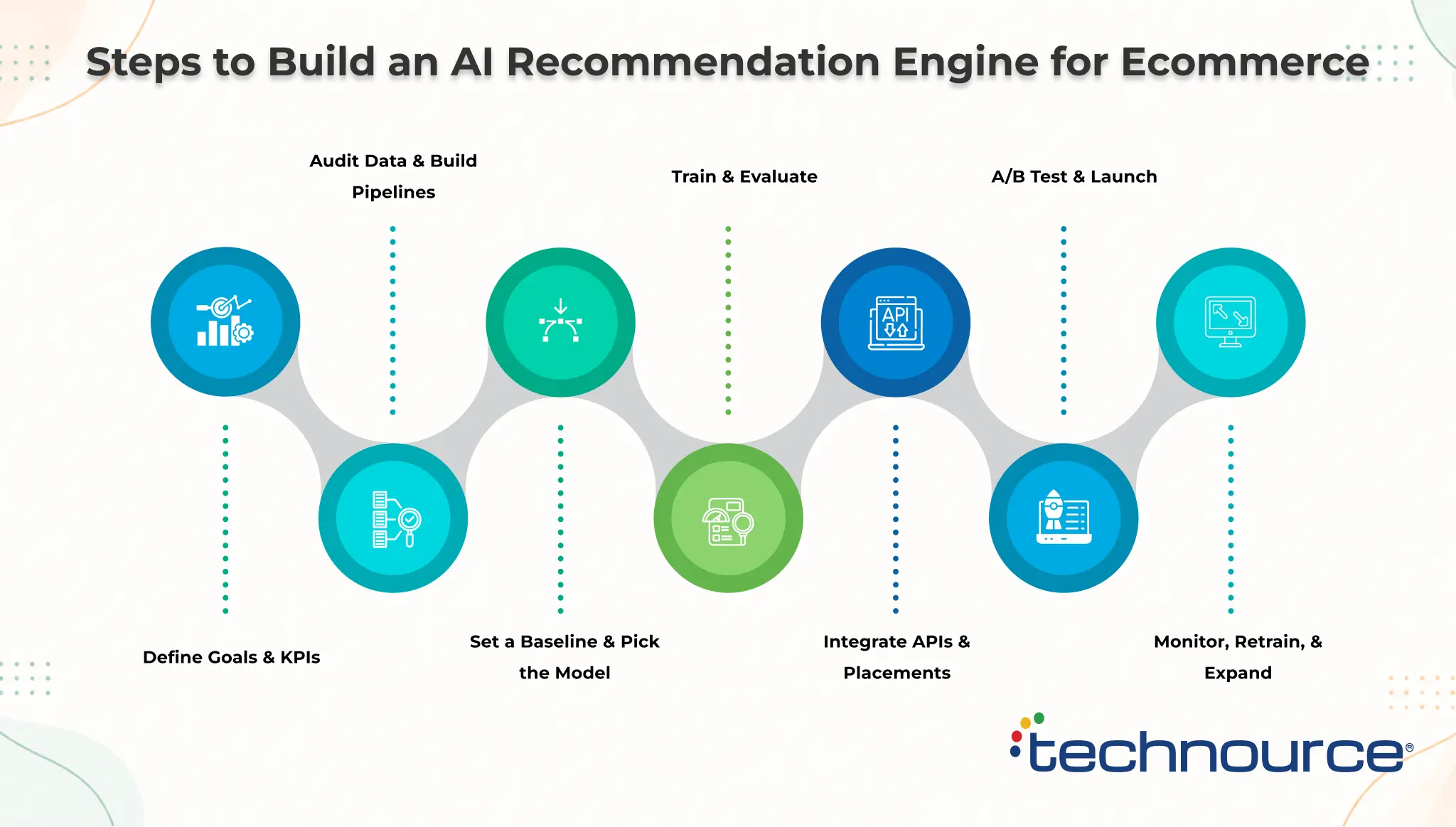
Step 1: Define Goals and KPIs (1 Week)
Pick one business goal per placement, such as higher order value on the cart or higher conversion on the product page.
Set the primary KPI and the holdout design now. Without a control group, you can’t prove the engine made money.
Step 2: Audit Data and Build Pipelines (2–3 Weeks)
Map every event and catalog field, fix ID mismatches, and remove bot traffic.
Build one pipeline that feeds both training and serving, so features stay identical in both.
Step 3: Set a Baseline and Pick the Model (1 Week)
Launch a simple baseline first, such as best sellers by category or bought-together counts.
Every AI model must beat this baseline offline before it reaches shoppers. Keeping the first release this small is the same discipline behind good MVP development services.
Step 4: Train and Evaluate (2–3 Weeks)
Train the candidate and ranking models on historical data, holding back the most recent weeks for testing.
Measure offline with precision@k, recall@k, and NDCG, and check coverage so the engine doesn’t only push best sellers.
Step 5: Integrate APIs and Placements (2–3 Weeks)
Expose the engine through a recommendation API, connect inventory and pricing rules, and build the widgets.
Add a final guardrail that checks stock and price at render time, so shoppers never see an item they can’t buy.
Step 6: A/B Test and Launch (2–3 Weeks)
Split traffic between the engine and the baseline, and run the test until the result is statistically significant.
Roll out the winning version placement by placement, starting where purchase intent is highest.
Step 7: Monitor, Retrain, and Expand (Ongoing)
Retrain on a fixed schedule, watch for drift after big catalog or season changes, and track latency at peak traffic.
Add new placements, real-time features, or LLM re-ranking only when the current ones show stable lift.
How Much Does an AI Recommendation Engine Cost?
An AI recommendation engine for ecommerce costs $5,000–$10,000 for a PoC, $10,000–$50,000 for an AI MVP, and $60,000–$100,000 for an enterprise-grade build. The final price depends on data readiness, the number of placements, real-time needs, and integrations.
| Build Type | Typical Scope | Cost (USD) | Timeline |
|---|---|---|---|
| PoC | Offline model on your data, one simulated placement, lift estimate | $5,000–$10,000 | 3–4 weeks |
| AI MVP | Hybrid model, 1–3 live placements, API, A/B test, basic dashboard | $10,000–$50,000 | 10–14 weeks |
| Enterprise MVP | Real-time personalization, multiple channels, search re-ranking, ERP integration, MLOps | $60,000–$100,000 | 4–6 months |
The same drivers shape any AI app development cost: data work, model choice, integrations, and the team behind them.
What Drives Recommendation Engine Cost?
Data readiness drives recommendation engine cost more than the choice of algorithm does.
| Cost Driver | Why It Adds Cost |
|---|---|
| Data cleanup and event tracking | Broken IDs and missing events must be fixed before training |
| Number of placements and channels | Each placement needs its own logic, UI, and test |
| Real-time vs batch | Streaming pipelines and low-latency serving add infrastructure |
| Catalog size and change rate | Large or fast-changing catalogs need embeddings and frequent retraining |
| Integrations | ERP, search, and email tools each need mapping and testing |
| LLM features | Conversational and explanation features add prompt design, guardrails, and API usage |
| Compliance | Consent handling, data minimization, and audit logs add work |
Hidden and Ongoing Costs to Budget
Ongoing costs depend on traffic, catalog size, and retraining frequency, so budget them per project rather than as a fixed number.
- Cloud compute and storage for training runs, feature stores, and vector indexes.
- Serving and caching that scale with traffic peaks such as holiday sales.
- Third-party APIs for LLM calls, managed recommendation services, or a CDP.
- Retraining and monitoring after catalog, season, or pricing changes.
- Maintenance for platform updates, new placements, and fixes.
Want a real number for your recommendation engine, based on your data and placements?
How Do You Calculate Recommendation Engine ROI?
Calculate recommendation engine ROI by comparing revenue from shoppers who saw recommendations with a holdout group that did not, then subtracting build and running costs. The formula is ROI = (incremental profit − total cost) ÷ total cost.
Incremental revenue comes from the A/B test: sessions in the test multiplied by the difference in revenue per session between the two groups. Convert it to profit with your gross margin before you compare it with cost.
Illustrative example only. Replace every number with your own A/B test results and margins.
| Input | Example Value | Note |
|---|---|---|
| Monthly sessions in test | 500,000 | Store traffic |
| Revenue per session, holdout | $2.00 | Measured without recommendations |
| Revenue per session, with engine | $2.10 | Measured in the A/B test |
| Monthly incremental revenue | $50,000 | 500,000 × $0.10 |
| Gross margin | 40% | Your blended product margin |
| Monthly incremental gross profit | $20,000 | $50,000 × 40% |
| AI MVP build cost | $40,000 | Within the $10,000–$50,000 tier |
| Payback on build cost | 2 months | Before monthly running costs |
Subtract your monthly running costs from the gross profit line. If the engine still pays back within a year, expand to the next placement.
Measure lift with a holdout, not widget clicks. Attribution that credits every click overstates impact, because some shoppers would have bought anyway.
Build vs Buy: Should You Build a Custom Recommendation Engine?
Buy a SaaS plugin if you run a standard Shopify or WooCommerce store and need recommendations within weeks. Build custom when you need control over ranking logic, one model across web, app, and email, or rules that plugins can’t apply to your catalog and business model.
| Factor | Custom Build | SaaS Plugin | Managed Cloud API |
|---|---|---|---|
| Time to launch | 10–14 weeks for an AI MVP | Days to weeks | Weeks, plus integration work |
| Upfront cost | $10,000–$50,000 for an AI MVP | Low setup, then monthly fees | Integration build plus usage fees |
| Control over ranking | Full | Limited to vendor settings | Partial; model logic is hidden |
| Data ownership | Full; model trained on your data | Data shared with the vendor | Data stays in your cloud account |
| Fit for complex or B2B catalogs | Strong | Weak to medium | Medium |
| Ongoing cost pattern | Cloud and maintenance | Fees often grow with traffic or revenue | Usage pricing grows with traffic |
Technource’s Recommendation
Start with a plugin if you are still proving that recommendations matter for your store.
Move to a custom or hybrid build when plugin fees grow with revenue, when you need one model across web, app, and email, or when ranking must respect margin, stock, or B2B pricing rules.
What Are the Biggest Challenges in Building a Recommendation Engine?
The biggest challenges in building a recommendation engine are poor data quality, cold start, popularity bias, latency, and proving incremental revenue. Most of them are data and measurement problems, not model problems.
| Challenge | Real Consequence | How to Solve It |
|---|---|---|
| Messy or missing events | Wrong recommendations and wasted training runs | One event schema, ID mapping, bot filtering |
| Cold start | New products never get shown | Attribute and embedding fallbacks, exploration slots |
| Popularity bias | Every shopper sees the same best sellers | Diversity and coverage targets in ranking |
| Stale inventory | Out-of-stock items appear in widgets | Stock check at render time |
| Slow responses | Pages load slower and widgets get skipped | Precompute, cache, and set latency budgets |
| Weak measurement | No proof of ROI, so budget gets cut | Holdout groups and A/B tests from day one |
| Privacy gaps | Legal risk and loss of shopper trust | Consent-aware tracking and data minimization |
These issues mirror the wider reasons why AI projects fail: unclear goals, weak data, and no plan for production.
Common Mistakes to Avoid When Building a Recommendation Engine
The three most common mistakes are starting with a complex model, launching too many placements at once, and skipping the holdout test.
- Starting with deep learning: A gradient-boosted ranker or simple hybrid often performs close to it at a fraction of the cost.
- Launching everywhere at once: Five placements in one release make it impossible to tell which one works.
- Measuring clicks, not revenue: Widget CTR can rise while revenue per session stays flat.
- Ignoring business rules: Pushing low-margin or out-of-stock items erodes profit and trust.
- Training once and walking away: Seasons, catalogs, and prices change, and models drift with them.
- Treating privacy as an afterthought: Retrofitting consent into tracking costs more than designing it in.
Which KPIs Should You Track After Launch?
Track revenue per session and conversion lift against a holdout first. Then track recommendation CTR, add-to-cart rate from recommendations, average order value, catalog coverage, latency, and model drift.
| KPI | What It Shows | How to Measure |
|---|---|---|
| Revenue per session lift | True business impact | A/B test against a holdout group |
| Conversion rate lift | Whether shoppers buy more often | A/B test against a holdout group |
| Average order value | Bundle and add-on effect | Orders with vs without recommendation clicks |
| Recommendation CTR | Relevance of the items shown | Clicks ÷ widget impressions |
| Add-to-cart rate from recommendations | Purchase intent created | Add-to-cart events from widgets ÷ widget clicks |
| Catalog coverage | Share of products ever recommended | Unique SKUs shown ÷ active SKUs |
| p95 latency | Speed at peak load | API monitoring dashboard |
| Model drift | Performance decay over time | Offline metrics on fresh data at each retrain |
How to Choose an AI Recommendation Engine Development Company
Choose a development company that has shipped recommendation or matching systems to production, starts with your data rather than a model pitch, and commits to measuring lift against a holdout. Ask for live examples and a clear plan for cold start.
| Question to Ask | Good Answer | Red Flag |
|---|---|---|
| What recommendation or matching systems have you shipped? | Live products with measured results | Only demos or notebooks |
| How will you measure success? | Revenue per session lift against a holdout | Widget clicks only |
| How do you handle cold start? | Clear fallbacks for new users and products | ‘The model will learn over time’ |
| Who owns the code, model, and data? | You own all three | Vendor-locked model |
| How do you connect inventory and pricing? | Render-time rules and API integration | No plan for stock or margin |
| What does post-launch support include? | Retraining, monitoring, and new placements | Handover and exit |
Technource has 14+ years in business and is rated 4.9/5 on Clutch and 4.9/5 on GoodFirms.
What Are the Future Trends in AI Recommendation Engines?
The five main trends in AI recommendation engines are conversational recommendations, AI shopping assistants, multimodal visual search, privacy-first personalization on first-party data, and real-time serving closer to the shopper.
Conversational Recommendations
Shoppers increasingly describe what they need in plain language instead of using filters. An LLM turns the request into a query, and the recommendation engine returns grounded, in-stock products.
Grounding is a design decision, and choosing between MCP and RAG shapes how the model reaches live catalog data.
AI Shopping Assistants
Assistants will compare products, apply limits such as budget or size, and build a cart for the shopper to approve. They still depend on the same ranking, inventory, and pricing layers underneath.
Multimodal and Visual Search
Image embeddings let shoppers upload a photo and find similar items. The same embeddings fix cold start for products with good images but no sales yet.
First-Party, Privacy-First Personalization
As third-party tracking fades, recommendation quality depends on consented first-party events and logged-in experiences. Stores that design consent into tracking now will have better training data later.
Real-Time Serving at the Edge
More ranking now runs near the shopper, at the CDN or inside the app, to cut latency on mobile. Precomputed candidates plus light on-device re-ranking is a common pattern.
How Technource Delivers Measurable Results in AI-Powered Products
Technource, an AI-powered product engineering company with 14+ years in business, has shipped AI matching and eCommerce discovery platforms that run in production on web and mobile. The two projects below show how weighted matching signals and unified product discovery turn into measurable business results.
How Technource Built JobMingle, an AI Job Matching Platform That Improved Placement Accuracy by 60%
We built JobMingle, an AI-powered recruitment platform for an Australian HR tech client, with web and mobile apps for candidates and employers. Early testing showed that AI job recommendations were not consistently aligning with candidate intent or skill level.
We rebuilt the matching logic with weighted parameters, including skill keywords, years of experience, and job activity patterns, inside a role-based architecture for admins, employers, and candidates. The stack included React.js, Laravel, Flutter, MySQL, and AWS, secured with JWT, SSL, and encryption.
Measurable Result
- 60% improvement in job placement accuracy.
- 65% faster candidate screening process.
- 70% higher employer engagement rate.
- GDPR and data privacy controls built into the platform, reported at 100% on the case study page.
- Live on the web, Android, and iOS.
Matching candidates to jobs uses the same logic as matching shoppers to products: weighted signals, cold-start fallbacks, and a feedback loop.
How Technource Built Tojarcom, a Cross-Border eCommerce Platform That Made Shopping 65% Faster
We built Tojarcom, an eCommerce platform that lets customers in Jordan, the UAE, and Saudi Arabia buy from US and European stores that don’t ship to their region. The client needed one place to discover products across many vendors, with clear costs and reliable tracking.
We integrated Google Programmable Search Engine for product discovery across vendor sites, the DHL AWB API for shipment tracking, and the Slice API to fetch order data from vendors. A cost workflow shows six pricing components upfront, and role-based dashboards move each order from customer service to delivery. The stack included Laravel, Angular, and MySQL.
Measurable Result
- 65% faster cross-border shopping.
- 60% improved customer service efficiency.
- 50% growth in customer trust and retention.
- 100% seamless omni-channel experience.
Unified product discovery across a large, mixed catalog is the foundation every recommendation engine builds on.
Technource’s Approach to AI Recommendation Engines
- Data before models: We audit events and IDs first, because clean data decides most of the outcome.
- One placement, one metric: Each release targets one placement and one KPI, measured against a holdout.
- Baseline first: Every model must beat a simple baseline before it reaches shoppers.
- Rules where the money is: Stock, margin, and pricing rules run at render time.
- Measure after launch: Retraining, drift checks, and new placements continue after go-live.
Conclusion
Three decisions shape every AI recommendation engine for ecommerce: whether your data is ready, whether to build or buy, and how you will prove lift.
Get those right, and a focused AI MVP can launch in 10–14 weeks with a budget you can defend.
Technource is an AI-powered product engineering company that builds recommendation, search, and eCommerce development solutions around your own data.
If you are ready to scope your recommendation engine, contact us for a short consultation that maps your data, placements, and budget.
Ready to turn your store data into a recommendation engine that pays for itself?
FAQs
An AI recommendation engine costs $5,000–$10,000 for a proof of concept and $10,000–$50,000 for an AI MVP with one to three live placements. Enterprise-grade builds with real-time personalization, search re-ranking, and ERP integration cost $60,000–$100,000. Data cleanup, integrations, and LLM features decide where your project lands within these tiers. A proof of concept takes 3–4 weeks. Most AI MVPs launch in 10–14 weeks, covering goals, data pipelines, model training, integration, and an A/B test. Enterprise builds with real-time features and multiple channels take 4–6 months. The data audit alone usually takes 2–3 weeks, so start it early. Buy a SaaS plugin if you run a standard Shopify or WooCommerce store and want recommendations within weeks. Build custom, starting at $10,000-$50,000 for an AI MVP, when you need control over ranking, one model across web, app, and email, or margin and stock rules that plugins can’t apply. You need behavior events, catalog data, and context. Events include views, searches, add-to-cart actions, and purchases. Catalog data covers category, price, attributes, text, and images. Context includes device, time, and traffic source. Plan 2–3 weeks to audit and clean this data, because consistent IDs matter more than raw volume. A hybrid model works best for most stores because it blends behavior data with product attributes. Of the six main approaches, collaborative filtering suits repeat visitors, content-based filtering handles new products, and session-based models serve anonymous traffic. Start with a simple baseline, then add a gradient-boosted ranker before trying deep learning. Engines handle cold start with fallbacks. New users see trending items by category, location, or traffic source, then get session-based picks after a few clicks. New products are matched using attributes plus text and image embeddings, one of the seven AI features worth building. A small share of exploration slots keeps new items visible. Measure ROI against a holdout group that doesn’t see recommendations. In the illustrative example, a $0.10 lift in revenue per session across 500,000 monthly session adds $50,000 in monthly revenue. At a 40% gross margin, that pays back a $40,000 AI MVP build in 2 months, before running costs. Yes, when they are relevant and measured properly. According to Amperity’s 2026 State of Personalization in Retail report, 74% of US adults are more likely to buy when they get personalization. Results vary by store, so prove the lift with an A/B test against a holdout before adding more placements. Yes, if they process personal data of covered people. GDPR applies to shoppers in the EU and requires a lawful basis for profiling and consent for tracking cookies. CCPA/CPRA gives California residents the right to opt out of the sale or sharing of personal information. Treat this as general information and confirm obligations with privacy counsel.
Related Insights and Articles