Hiring a senior SaaS engineer in the US can take three to six months and a six-figure salary. Every week that seat stays empty, your roadmap slips a little further. This guide ranks the best nearshore software development outsourcing companies for SaaS in 2026, breaks down real costs, and shows you how to tell a delivery partner apart from a staffing agency.
Key Takeaways
Nearshore SaaS development rates run $25–$92/hour in 2026, roughly 50–70% less han comparable US-based teams, depending on country and seniority.
Deloitte’s Global Outsourcing Survey found that agility and access to talent, not cost, are now the top drivers behind outsourcing decisions, a shift that favors nearshore over far-offshore models.
Full outsourcing and staff augmentation are not the same model. Confusing them is the most common mistake SaaS founders make when shortlisting partners.
Mexico, Brazil, Colombia, and Argentina handle most LATAM nearshore SaaS work, and each carries a different rate, talent depth, and compliance profile.
IP ownership and security certifications (SOC 2, ISO 27001, HIPAA, where relevant) need to be confirmed in the contract, never assumed from a sales call.
A widening talent gap is pushing this decision.
ManPowerGroup’s 2025 workforce survey found that say they can’t find the skilled talent they need, and senior SaaS engineering is one of the hardest roles to fill domestically.
Nearshore outsourcing closes that gap without the 9–13-hour time-zone wall that offshore models in Asia create. You get engineers working inside your business hours, in daily standups, on your sprint cadence.
According to Grand View Research, the global nearshore outsourcing market alone is now estimated at roughly $650 billion, a signal of just how mainstream this model has become for product teams, not a niche cost-cutting tactic anymore.
Quick Comparison: Best Nearshore SaaS Development Companies (2026)
The right pick depends on your stage and what you’re trying to solve, not a single “best” name. Here’s the fast version before the full breakdown below.
Company
Best For
Key Limitation
Estimated Cost
Technource
Full-cycle AI-powered SaaS product engineering
Smaller bench than large multinational firms
$30–$65/hr
BairesDev
Scale-first, broad technical coverage
Less hands-on for early-stage product strategy
$40–$80/hr
Intellias
Enterprise SaaS, compliance, legacy modernization
Slower onboarding for small MVP-stage teams
$45–$85/hr
DBB Software
MVP-to-scale strategic partner
Smaller team size limits very large builds
$25–$49/hr
Cheesecake Labs
Combined web, mobile, and product design
Less depth in backend-heavy enterprise systems
$40–$75/hr
Selleo
Discovery-through-MVP product thinking
Best fit narrows for non-product-led teams
$35–$70/hr
CHatchWorks AI
AI-native SaaS and data-heavy products
Less suited to simple CRUD-only builds
$45–$90/hr
N-iX
Large-scale enterprise engagements
Overkill for single-product early startups
$50–$92/hr
First Factory
SOC 2/HIPAA-aligned regulated SaaS
Premium pricing for compliance overhead
$50–$85/hr
Rootstrap
Capacity extension for strong in-house teams
Needs an existing internal team to plug into
$40–$75/hr
Rates above reflect 2026 LATAM agency benchmarks, not local-market salaries, which typically run lower. Treat them as planning ranges, not quotes.
What Is Nearshore Software Development Outsourcing?
Nearshore software development outsourcing means handing full or partial ownership of a software build to a company based in a nearby country, usually within one to three time zones of yours. For US companies, that’s mostly Latin America. For UK and EU companies, it’s usually Eastern Europe.
In many cases, businesses prefer working with a custom software development company that can take ownership beyond just coding and contribute to architecture and delivery.
The model sits between onshore and offshore. You get most of offshore’s cost savings without the 9–13 hour overlap gap that makes daily collaboration painful.
Nearshore Outsourcing vs. Staff Augmentation vs. Offshore
Not every nearshore provider works the same way, and this is where most buyer confusion starts.
Understanding different software development models helps clarify whether you need full delivery ownership or just additional engineering capacity.
Model
Who Owns Delivery
Best For
Typical Engagement
Nearshore outsourcing
The partner owns architecture, build, QA, and deployment
Teams without in-house engineering leadership for this build
Dedicated team or fixed-scope project
Nearshore staff augmentation
You own the delivery; the partner places individual engineers
Teams with strong in-house leads who need more hands
Individual placements inside your org
Offshore outsourcing
Similar to nearshore, but the team sits 9+ time zones away
Cost-sensitive builds without daily real-time collaboration needs
Dedicated team or project-based
A lot of “nearshore outsourcing” content online is actually written by recruiting platforms describing staff augmentation. That’s a different buying decision. If you need a partner to own the roadmap, not just fill a seat, filter for full-delivery providers specifically.
How We Evaluated These Companies
Every company on this list was checked against five criteria, not popularity or marketing spend.
For AI-enabled SaaS platforms, some teams also evaluate providers offering AI consulting solutions to ensure future scalability and intelligent feature integration.
Delivery Ownership Model: Does the company run full-cycle builds, or place individual contractors?
Proven SaaS-specific Work: not just web apps with “SaaS” added to the homepage.
Security and Compliance Posture: SOC 2, ISO 27001, or HIPAA, where the use case calls for it.
Pricing Transparency: Published or quickly confirmable rate ranges, not vague “contact us” pricing.
Team Retention and Continuity: How often engineers rotate off a project mid-build.
The 10 Best Nearshore Software Development Companies for SaaS
The best nearshore software development partners do more than provide engineering capacity. They help SaaS companies accelerate product delivery, reduce development risks, and scale efficiently. Here’s a closer look at the top providers for 2026.
1. Technource
Technource runs full-cycle SaaS product engineering, owning everything from architecture through deployment under one team.
The team also supports companies that are building AI software to their SaaS platforms, helping automate workflows and improve operational efficiency.
For a freight management SaaS platform, Technource implemented a microservices-based architecture to support real-time shipment tracking, route optimization, and seamless third-party integrations. This approach improved operational efficiency by 40%, reduced system bottlenecks during peak usage, and enabled the product to go live within six months.
The team works across SaaS Development and AI-powered workflow automation, which matters for SaaS founders who need the product to do more than CRUD operations. Engagement starts with a scoping call, not a fixed-price quote before anyone has seen your codebase or data model.
BairesDev is built for scale. The company maintains a large, broad-skill engineering bench, which makes it a fit for SaaS companies that need to staff up fast across multiple technical domains at once.
The tradeoff is depth of early-stage product strategy involvement. BairesDev works best when you already know your architecture and need execution capacity, not when you need a partner to help define the product itself.
Intellias sits closer to enterprise and later-stage SaaS than early MVP work. The company has real depth in compliance-heavy builds and legacy system modernization, which matters once your SaaS product needs to pass enterprise security reviews.
Onboarding takes longer than in smaller nearshore shops. That’s the cost of working with a firm built for regulated, complex environments rather than fast MVP iteration.
Key Factor
Details
Best For
Enterprise SaaS and digital transformation projects
Engagement Model
Dedicated teams, project-based delivery
Core Services
Software Engineering, Cloud Solutions, Data & Analytics
Estimated Rates
$45–$85/hour
Ideal Company Size
Mid-market and enterprise organizations
Key Strength
Strong compliance and legacy modernization expertise
Industry Focus
Automotive, Fintech, Telecom, Enterprise SaaS
4. DBB Software
DBB Software positions itself as a strategic partner rather than pure execution, helping validate product ideas before committing engineering hours to them. Rates run $25–$49/hour, among the more accessible options on this list for early-stage SaaS teams.
The team size is smaller than the multinational firms here, which limits how much DBB can absorb in very large, multi-team builds. For a single SaaS product moving from MVP to scale, that’s rarely a constraint.
Key Factor
Details
Best For
MVP development and SaaS product validation
Engagement Model
Dedicated product teams
Core Services
SaaS Development, Product Discovery, AI Integration
Estimated Rates
$25–$49/hour
Ideal Company Size
Early-stage startups and SMBs
Key Strength
Product-focused approach for startup growth
Industry Focus
SaaS, AI Startups, Marketplaces
5. Cheesecake Labs
Cheesecake Labs combines software engineering with product design under one roof, which works well for SaaS products where the user experience is as much a differentiator as the backend logic. The company has built mobile and web products across iOS, Android, and next-generation interfaces.
Backend-heavy, infrastructure-intensive enterprise systems aren’t the core strength here. If your SaaS product is closer to a polished consumer-facing tool than a data-pipeline-heavy platform, this is a stronger match.
Key Factor
Details
Best For
Digital products requiring strong UX and mobile experiences
Engagement Model
Dedicated teams, project-based delivery
Core Services
Mobile Development, Product Design, Web Development
Estimated Rates
$40–$75/hour
Ideal Company Size
Startups and digital-first businesses
Key Strength
Strong blend of engineering and product design
Industry Focus
SaaS, Consumer Apps, Healthcare, Retail
6. Selleo
Selleo‘s model connects discovery, MVP delivery, and ongoing support inside a single working relationship, which removes the handoff gap that happens when one vendor builds the MVP and another takes over maintenance. That continuity matters for SaaS founders who plan to iterate fast post-launch.
The fit narrows if your team isn’t product-led. Selleo’s process assumes active collaboration on product decisions, not a hands-off build-to-spec arrangement.
HatchWorks AI is built around AI-native SaaS delivery, products where the roadmap depends on data science, model integration, or emerging AI capabilities rather than standard CRUD functionality. For SaaS companies building AI features into the core product, that specialization shows up in how fast they move from concept to working model.
Simple, non-AI SaaS builds don’t need this level of AI specialization, and you may pay a premium for a capability you’re not using yet.
Key Factor
Details
Best For
AI-native SaaS platforms and data-driven products
Engagement Model
Dedicated teams, AI consulting
Core Services
AI Development, Data Engineering, SaaS Development
Estimated Rates
$45–$90/hour
Ideal Company Size
Growth-stage startups and enterprises
Key Strength
Specialized expertise in AI-powered product development
Industry Focus
AI SaaS, Analytics, Enterprise Software
8. N-iX
N-iX has over 20 years of domain experience and has served more than 160 clients internationally, giving it more institutional process maturity than most nearshore shops. That track record matters for enterprise SaaS buyers who need vendor stability guarantees.
That scale is overkill for a single-product early-stage startup. N-iX’s processes and minimum engagement sizes are built for larger, longer-term enterprise relationships.
Key Factor
Details
Best For
Large-scale enterprise software initiatives
Engagement Model
Dedicated teams, managed services
Core Services
Software Engineering, Cloud Services, Data Platforms
Estimated Rates
$50–$92/hour
Ideal Company Size
Enterprise organizations
Key Strength
Proven experience managing complex global projects
Industry Focus
Enterprise SaaS, Telecom, Finance, Manufacturing
9. First Factory
First Factory runs SOC 2- and HIPAA-aligned development teams from Costa Rica, with 6–8 hours of daily overlap with US teams. For SaaS products in healthcare, fintech, or any regulated space, that compliance posture is the deciding factor, not a nice-to-have.
Compliance infrastructure costs money, and First Factory’s rates reflect that overhead. For SaaS products without regulatory requirements, you may be paying for certifications you don’t need.
Key Factor
Details
Best For
Compliance-focused SaaS development
Engagement Model
Dedicated development teams
Core Services
Custom Software Development, QA, DevOps
Estimated Rates
$50–$85/hour
Ideal Company Size
Healthcare, Fintech, and regulated businesses
Key Strength
SOC 2 and HIPAA-aligned delivery processes
Industry Focus
Healthcare, Fintech, Regulated SaaS
10. Rootstrap
Rootstrap is built to extend an existing in-house team rather than replace product leadership. That makes it a strong fit when your internal engineering team is already capable and just needs more hands to hit roadmap velocity.
The model assumes you already have product and technical leadership in place. If you’re looking for a partner to own the roadmap end-to-end, this isn’t that.
Key Factor
Details
Best For
Extending existing product and engineering teams
Engagement Model
Staff augmentation, dedicated teams
Core Services
Product Development, Mobile Apps, Web Applications
Estimated Rates
$40–$75/hour
Ideal Company Size
Growth-stage startups and established businesses
Key Strength
Seamless integration with in-house engineering teams
Industry Focus
SaaS, Fintech, Consumer Technology
Nearshore vs. Offshore Outsourcing for SaaS: Which Fits?
Nearshore fits SaaS teams that need daily real-time collaboration; offshore fits teams optimizing purely for the lowest possible hourly rate. The difference comes down to time-zone overlap, not just cost.
Offshore destinations like India typically run $25–$45/hour for senior engineers, roughly 40–50% below LATAM nearshore rates. But the 9–13 hour time-zone gap removes real-time standups, same-day blocker resolution, and live sprint planning.
For agile SaaS teams shipping iteratively, that velocity cost usually outweighs the rate savings within the first two quarters. For back-office or non-time-sensitive workstreams, offshore can still make sense.
Engagement Models: Dedicated Team, Fixed Scope, or Staff Augmentation?
Not all outsourcing engagements work the same way. Dedicated teams, fixed-scope projects, and staff augmentation each solve different business challenges. The right choice depends on your internal technical leadership, project complexity, and long-term product goals.
Model
How It Works
Best For
Risk
Dedicated team
Partner assigns a consistent team that works only on your product
Long-term SaaS roadmaps need continuity
Low, if retention is strong
Fixed scope / project-based
Defined deliverable, defined price, defined timeline
Well-scoped MVPs or single features
Scope creep if requirements shift mid-build
Staff augmentation
Individual engineers join your existing team and process
Teams with strong internal leadership need capacity
You own all delivery risk and management overhead
Most SaaS startups without a strong internal engineering lead get more value from a dedicated team than staff augmentation. You’re buying delivery ownership, not just hours.
What Does Nearshore SaaS Development Cost in 2026?
Nearshore SaaS development in Latin America runs $25–$92 per hour in 2026, depending on country, seniority, and specialization. That’s a 50–70% reduction versus comparable US-based talent.
Role
Hourly Rate (2026)
Junior developer
$18–$35/hr
Mid-level developer
$28–$50/hr
Senior developer
$50–$80/hr
AI/ML specialist
$45–$90/hr
Mexico offers the tightest time-zone overlap with US teams and runs $30–$55/hour. Brazil and Argentina run slightly lower on average but bring deep specialist talent in data science and backend engineering.
The hourly rate is only one layer of total cost. Onboarding time, rework from unclear specs, and the hours your own team spends managing the relationship all add to the real number — and they rarely show up in the initial quote.
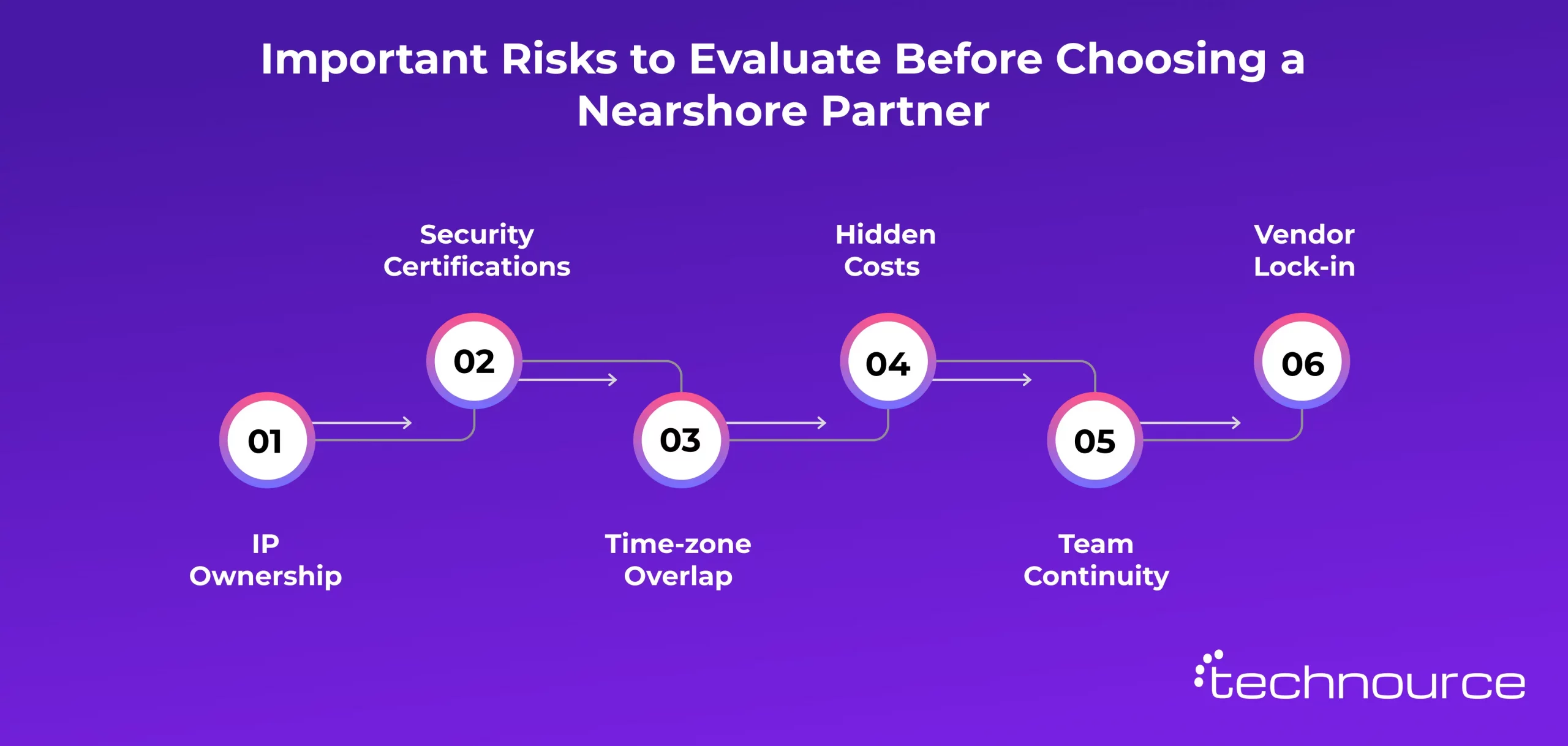
Risks to Watch Before You Sign a Nearshore Outsourcing Contract
Every outsourcing relationship carries risk. The difference between a good and bad outcome is whether you address these before signing, not after.
IP Ownership: Confirm in writing that all code, designs, and data pipelines transfer to you on payment, not just on project completion.
Security Certifications: Ask for SOC 2 or ISO 27001 documentation directly. A claim of being “secure” without a certificate is not proof.
Time-zone Overlap: Verify the actual working hours of the assigned team, not just the country they’re based in.
Hidden Costs: Clarify what’s included in the hourly rate: project management, QA, infrastructure setup, and post-launch support are often billed separately.
Team Continuity: Ask how often engineers rotate off active projects. High turnover mid-build is one of the most common causes of SaaS timeline slippage.
Vendor Lock-in: Confirm you retain access to source code repositories and documentation independent of the vendor relationship.
None of these is a reason to avoid nearshore outsourcing. There are reasons to put specifics in the contract instead of taking them on faith.
How to Choose the Right Nearshore Partner for Your SaaS Roadmap
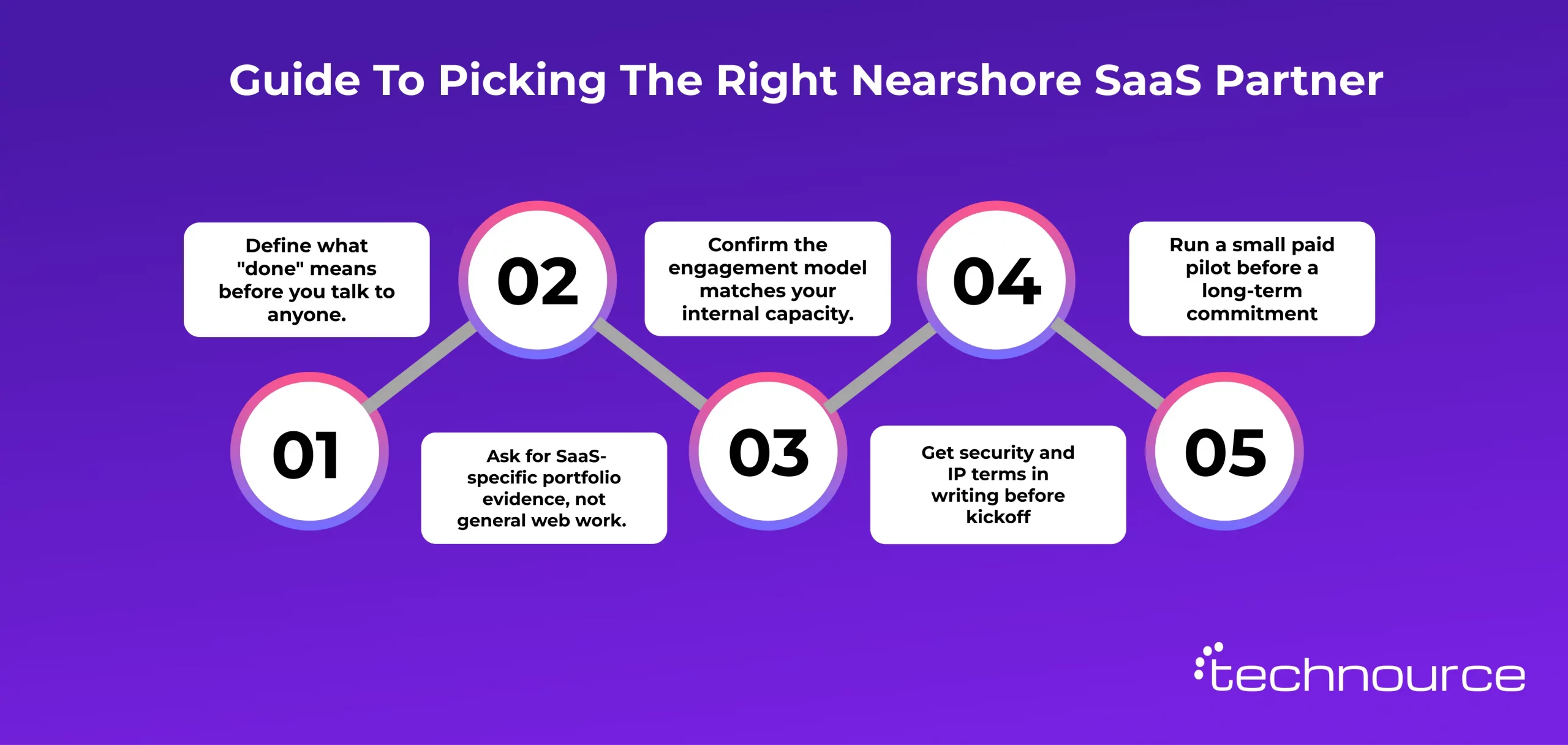
Choosing a nearshore development partner isn’t just about comparing hourly rates. The right partner should align with your product goals, delivery expectations, and long-term growth plans. These five steps can help you evaluate providers more effectively and avoid costly mistakes during the selection process.
Step 1: Define what “done” means before you talk to anyone.
Write down the specific outcome you need: a shipped MVP, a scaled feature, or a compliance certification, before requesting quotes. Vague briefs get vague (and inflated) estimates. What goes wrong: founders skip this step, get quoted on guesswork, and then face scope disputes three weeks into the build.
Step 2: Ask for SaaS-specific portfolio evidence, not general web work.
A company that’s built fifty marketing websites isn’t the same as one that’s built ten multi-tenant SaaS platforms. Ask for two to three relevant examples with named outcomes. What goes wrong: teams accept generic case studies that don’t reflect SaaS-specific challenges like multi-tenancy, billing logic, or usage-based pricing models.
Step 3: Confirm the engagement model matches your internal capacity.
If you don’t have a technical lead in-house, you need a dedicated team that owns delivery, not staff augmentation. What goes wrong: founders without engineering leadership hire staff augmentation, then discover they’re responsible for architecture decisions they’re not equipped to make.
Step 4: Get security and IP terms in writing before kickoff
Request SOC 2 documentation and IP transfer language directly in the contract, not as a verbal assurance. What goes wrong: teams proceed on a sales call’s reassurance, then discover ambiguous IP clauses only when trying to switch vendors later.
Step 5: Run a small paid pilot before a long-term commitment
A two-to-four-week paid pilot on a real (small) piece of scope reveals communication quality, code standards, and responsiveness faster than any reference call. What goes wrong: companies skip the pilot, sign a 12-month contract, and discover fit problems too late to exit cheaply.
Conclusion
Picking a nearshore SaaS development partner comes down to three decisions: matching the engagement model to your internal capacity, confirming security and IP terms before you sign, and verifying SaaS-specific delivery experience instead of general web development history.
Get those three right, and the cost savings nearshore offers become real, not theoretical. Get them wrong, and even a “cheap” rate ends up costing more in rework and delay.
Nearshore software development outsourcing means a company in a nearby country, usually one to three time zones away, builds or owns part of your software product. For US companies, that’s typically Latin America. It combines real-time collaboration with meaningful cost savings versus onshore hiring.
Nearshore keeps your team within a few hours of your time zone, enabling daily standups and live collaboration. Offshore, typically in Asia, offers lower rates but a 9–13 hour time gap that removes real-time interaction. For agile SaaS teams, the overlap usually matters more than the rate difference.
Nearshore SaaS development costs $25–$92 per hour in 2026, depending on country and seniority, which is roughly 50–70% less than comparable US-based teams. Junior developers run $18–$35/hr, while senior engineers and AI specialists run $50–$90/hr.
IP ownership should transfer fully to you upon payment, but this must be stated explicitly in the contract; it isn’t automatic. Always request written IP transfer language and confirm source code repository access before signing.
In staff augmentation, you own the delivery, and the partner places individual engineers into your existing team and process. In full outsourcing, the partner owns architecture, build, QA, and deployment end-to-end. Teams without in-house technical leadership generally need full outsourcing, not staff augmentation.
Check for SaaS-specific portfolio evidence (not general web work), confirmed security certifications like SOC 2, transparent pricing, and low team turnover. Run a small paid pilot before signing a long-term contract, as it reveals fit faster than reference calls alone.


 AI ConsultingStrategic AI Roadmaps