
Blog Summary
This guide explains how cleantech MVP development works and how to validate an energy or sustainability product before you scale. You will see costs, timelines, hardware-light validation methods, the standards a pilot needs and how to design a pilot that converts into a purchase, plus two Technource cleantech case studies with measured results.
Key Takeaways
- Cleantech MVP development costs $8,000–$15,000 for a simple, software-first MVP, $20,000–$30,000 for a mid-complexity MVP with device data and $30,000–$50,000+ for a complex MVP with several device protocols. Enterprise MVPs cost $60,000–$100,000.
- A simple cleantech MVP is pilot-ready in 8–10 weeks and a mid-complexity MVP in 12–16 weeks. A field pilot at the buyer’s site then runs 6–10 weeks.
- The key rule: validate the pilot-to-purchase step, not just the technology. Agree the success metric, measurement baseline and next-step contract terms with the buyer before the pilot starts.
- Pilots are where most cleantech products stall. About 70% of US corporate buyers and cleantech startups say fewer than half of their cleantech pilots converted to scaled deployment over the past two years (Deloitte, 2026).
- Technource cleantech builds delivered 65% faster waste collection (Clean Medic) and 65% faster response time for environmental adjustments (Digital Biologix).
Most teams that start cleantech MVP development already know their technology works. The harder question is whether a buyer will pay for it at scale.
Capital is still flowing, but investors are choosing carefully. Climate tech venture and growth investment rose 8% to over $40 billion in 2025, while deal count fell 18% (Sightline Climate, 2026).
Buyers are spending too. According to the IEA, around $2.2 trillion is expected to go to grids, storage, low-emissions fuels, nuclear, renewables, efficiency and electrification in 2026, against about $1.2 trillion for oil, gas and coal.
Energy and sustainability products still face a harder path than most software. Long utility sales cycles, device integrations and disputes over measured savings can stall a promising product for months.
What Is Cleantech MVP Development?
Cleantech MVP development, also called climate tech MVP development, is the process of building the smallest working version of an energy, climate or sustainability product to prove that it works, that buyers will pay for it and that it fits a real site. A cleantech MVP usually combines software, such as dashboards, analytics and workflows, with data from meters, sensors or existing equipment.
A cleantech MVP has to prove three things at once:
- Technical proof: the product reads real site data and delivers the promised result, such as lower energy use or faster reporting.
- Commercial proof: a named buyer agrees on what success looks like and what happens after the pilot.
- Operational proof: the product fits the site’s devices, protocols and reporting rules without manual workarounds.
Most teams start with a software-first build so they can learn before committing to hardware. Our MVP development services follow the same order: test the riskiest assumption first, then add devices and integrations.
Why Do Cleantech Startups Need an MVP Before They Scale?
Cleantech startups need an MVP because buyers, investors and utilities now ask for measured field results before they commit capital or sign a contract. An MVP produces that evidence in 8–16 weeks for a fraction of the cost of a full platform.
| Benefit | What Changes | How It Works |
|---|---|---|
| Lower capital risk | You spend on the riskiest assumption first | A software-first MVP tests demand before any hardware or manufacturing spend |
| Faster buyer proof | Pilots start with measured results | Dashboards and reports show savings against an agreed baseline |
| Stronger fundraising story | Investors see field data, not projections | Pilot data feeds the pitch deck and the diligence room |
| Clearer product scope | Features follow real site needs | Pilot feedback shows which features operators actually use |
| Easier reporting later | Data structures fit reporting rules from day one | Energy and emissions data follow standards such as the GHG Protocol |
The market rewards products that prove value early. According to Grand View Research, the global energy management systems market was worth about $61 billion in 2025 and is projected to reach about $159 billion by 2033.
Proof still decides who wins that spend. Buyers now want measured pilot results before they commit to a wider rollout.
Benefits for Founders and Investors
Founders get a cheaper way to test the riskiest assumption, whether that is buyer demand, data quality or a pricing model.
Investors get field data they can check. A pilot dashboard that shows verified savings answers more diligence questions than a technical white paper.
Teams also learn which segment to sell to first, such as commercial buildings, utilities or EV fleet operators.
Benefits for Utility and Corporate Buyers
Buyers can test a new product on one site without a long procurement cycle or a large upfront commitment.
Procurement, operations and sustainability teams see the same results in one place. Shared numbers make the internal case for scale easier to win.
Buyers also get early influence over the roadmap, so the scaled product fits their systems and approval process.
Planning a cleantech product but not sure what to validate first?

Cleantech PoC vs Pilot vs MVP: What’s the Difference?
A cleantech PoC proves the core idea works technically, an MVP proves real users get value from a working product, and a pilot proves the product delivers measured results at a buyer’s site under agreed terms. Most cleantech teams move through all three, in that order.
| Criteria | PoC | MVP | Pilot |
|---|---|---|---|
| Main question | Can it work? | Will users get value? | Will the buyer pay to scale? |
| Who uses it | Internal team | Early users or design partners | A named buyer at a real site |
| Data | Sample or historical data | Real data from a few sources | Live site data against a baseline |
| Typical cost | $3,000–$8,000 | $8,000–$50,000+ | $12,000–$25,000 (IoT pilot deployment) |
| Typical timeline | 1–3 weeks | 8–24 weeks | 6–10 weeks |
| Output | Feasibility answer | Working product | Scale decision and next-step contract |
The cleantech PoC vs MVP choice matters more than in most sectors, because the difference between a PoC and an MVP shows up fast on real sites. A PoC built on lab data rarely survives contact with real meters, weather and site conditions.
Technource’s Recommendation
Prove the software works on real data before you pay for a site pilot. Run a short PoC on historical meter or sensor data, then build the MVP only around the outputs buyers react to.
What Are the Main Types of Cleantech MVPs?
Cleantech MVPs fall into six main types, from data-only analytics tools that need no new hardware to IoT monitoring products that connect sensors at a pilot site. The right type depends on what you need to prove first and how much equipment the buyer must install.
| MVP Type | Example Product | What It Validates | Hardware Needed |
|---|---|---|---|
| Data-only analytics | Energy benchmarking from utility bills or meter exports | Demand for insights and savings | None |
| Software layer on existing hardware | EV charging or battery storage management on installed devices | Control logic and operator workflows | Existing devices only |
| IoT monitoring | Sensor-based monitoring for HVAC, solar or water assets | Data quality and alert value | Sensors and gateways |
| Carbon and ESG reporting | Scope 1, 2 and 3 emissions tracking | Reporting accuracy and time saved | None |
| Marketplace or platform | Recycling, waste collection or energy trading platform | Two-sided demand and transaction flow | Optional (QR codes, scales) |
| Digital twin or simulation | Virtual model of a site, grid asset or greenhouse | Performance before physical rollout | None at first |
Monitoring products are the most common starting point. A focused energy management software MVP can show consumption patterns and likely savings from existing meter data before any new sensors go in.
How Do You Validate a Cleantech Product Without Building Hardware First?
Most cleantech products can be validated without new hardware by using existing meter and utility data, a digital twin of the site, or a concierge pilot where your team performs part of the service manually. These methods test demand and data value in weeks, before you commit to device design or manufacturing.
Data-Only MVP Using Existing Meters and Utility Data
Many sites already produce the data you need. Smart meters, building management systems, inverters and chargers export readings that a software MVP can ingest.
In the US, utility usage data is often available through the Green Button standard, which lets customers download or share their energy consumption.
Start with 6–12 months of historical data where you can get it. A savings estimate on real history is stronger evidence than a projection.
Low-cost devices can fill data gaps too. In the Clean Medic project, QR-coded containers and Bluetooth-enabled scales replaced paper logs, so every pickup created a digital record without custom hardware.
Digital Twin and Simulation MVP
A digital twin is a software model of a physical site or asset that behaves like the real thing under different conditions.
Use a twin to test control strategies, such as when to charge a battery or pre-cool a building, before you touch live equipment. Buyers see projected results on their own site layout, which shortens the first sales conversation.
Keep the twin narrow. Model the one asset or decision your product improves, not the whole facility.
Concierge and Wizard-of-Oz Pilots
In a concierge pilot, your team delivers part of the result manually while the software handles the rest. An analyst might review alerts or prepare an emissions report before you automate that step.
The approach tests whether buyers value the outcome before you spend on automation. Automate only the steps buyers use every week.
What Features Should a Cleantech MVP Include?
A cleantech MVP needs data ingestion from meters or devices, a live dashboard, alerts, baseline and savings reporting, and role-based access for operators and buyers. Ship the 4–6 features that prove your core claim first and leave everything else for the scaled product.
| Feature | Who Uses It | Why It Matters |
|---|---|---|
| Data ingestion (meters, APIs, devices) | System | Every result depends on clean, complete data |
| Live monitoring dashboard | Operators, site managers | Shows performance in real time during the pilot |
| Alerts and notifications | Operators, maintenance teams | Turns data into action on faults or thresholds |
| Baseline and savings reporting | Buyers, finance teams | Proves value against an agreed starting point |
| Role-based access | Admins, buyers, partners | Keeps site data visible only to the right people |
| Audit log and data export | Compliance, sustainability teams | Supports reporting and buyer due diligence |
| Simple mobile view | Field technicians | Lets on-site staff act without a laptop |
Simple interfaces matter more than feature count. In the Digital Biologix project, non-technical greenhouse operators needed to run complex environmental devices from one app, so the interface design came first.
Which AI Features Are Worth Building Into a Cleantech MVP?
The AI features worth building into a cleantech MVP are energy forecasting, anomaly detection, predictive maintenance and automated reporting, because each one ties directly to a measurable saving. Add AI only where you already have enough clean data to train or tune a model.
The upside is large. According to the IEA, existing AI applications could save over 13 exajoules of energy by 2035, equal to about 3% of global final energy consumption, if their use scales up.
| AI Feature | What It Does | Risk / Impact |
|---|---|---|
| Load and generation forecasting | Predicts demand, solar output or charging load | High impact; needs months of history |
| Anomaly detection | Flags faults, leaks or abnormal consumption | Fast value; tune thresholds to avoid alert fatigue |
| Predictive maintenance | Estimates failure risk for inverters, batteries or HVAC | High value; needs failure history to be credible |
| Automated ESG reporting | Drafts emissions and energy reports from source data | Saves analyst time; needs human review |
| Optimization recommendations | Suggests setpoints or charging schedules | Medium risk; start with advice, not automatic control |
Teams that already run solar or storage assets often start with predictive maintenance for solar and battery storage, since downtime has a clear dollar cost.
Reporting is a strong second use case. AI-powered workflow automation can pull meter data, apply emission factors and draft reports for a sustainability lead to review.
An AI MVP costs $10,000–$50,000, depending on data readiness and model scope.
Want AI forecasting in your pilot without inflating the MVP budget?

Which Standards and Integrations Does a Cleantech MVP Need?
A cleantech MVP needs only the standards its pilot site already uses: typically one device protocol such as Modbus or MQTT, one domain standard such as OCPP for EV chargers or OpenADR for demand response, and a reporting standard such as the GHG Protocol for emissions data. Confirm the site’s protocols during discovery, before you write integration code.
| Integration | Standard or Tool | Typical Use |
|---|---|---|
| Device and sensor data | Modbus, MQTT, OPC UA | Reading meters, inverters and industrial equipment |
| EV charging | OCPP | Managing chargers and charging sessions |
| Demand response | OpenADR | Receiving grid signals to shift or reduce load |
| Substation and grid assets | IEC 61850 | Communicating with utility substation equipment |
| Solar and storage inverters | SunSpec Modbus | Standard data models for distributed energy devices |
| Utility usage data (US) | Green Button | Importing customer energy consumption |
| Emissions accounting | GHG Protocol | Structuring Scope 1, 2 and 3 data |
| Energy management practice | ISO 50001 | Aligning reports with energy management systems |
Device protocols are where pilot timelines slip most. Experienced IoT integration services map each device’s protocol and data format during discovery, so the build does not stall on site.
Products that touch grid operations may also face cybersecurity requirements, such as NERC CIP for some utility systems. Ask your pilot partner early which rules its IT and security teams will apply.
This section is general information, not legal or regulatory advice. Confirm which standards, utility rules and reporting requirements apply to your product and market with qualified advisors.
Not sure which standards your pilot site will require?
What Tech Stack Is Best for a Cleantech MVP?
Most cleantech MVPs use React or Next.js for dashboards, Flutter or React Native for mobile apps, a Node.js, Python or Go backend, a time-series database such as TimescaleDB or InfluxDB, and AWS IoT Core or Azure IoT Hub for device connectivity. Python is the usual choice for forecasting and analytics models.
| Layer | Common Choices | Note |
|---|---|---|
| Web dashboard | React, Next.js | Fast charts and role-based views |
| Mobile app | Flutter, React Native | One codebase for iOS and Android field apps |
| Backend | Node.js, Python, Go | Python suits analytics; Go suits high-volume device data |
| Time-series data | TimescaleDB, InfluxDB | Built for meter and sensor readings |
| Streaming | Apache Kafka, MQTT broker | Handles bursts of device messages |
| Device connectivity | AWS IoT Core, Azure IoT Hub | Secure device onboarding and messaging |
| AI and analytics | Python, PyTorch, Amazon SageMaker | Forecasting and anomaly models |
| Maps and geospatial | Mapbox, Google Maps Platform, PostGIS | Site, asset and charger mapping |
| Cloud | AWS, Azure, Google Cloud | Pick the cloud your pilot buyer already approves |
How to Build a Cleantech MVP: Step-by-Step
Building a cleantech MVP takes eight steps, from buyer discovery to a scale decision after the field pilot. A simple MVP is pilot-ready in 8–10 weeks because discovery, validation design and prototyping run before and alongside the build, and a field pilot then adds 6–10 weeks.
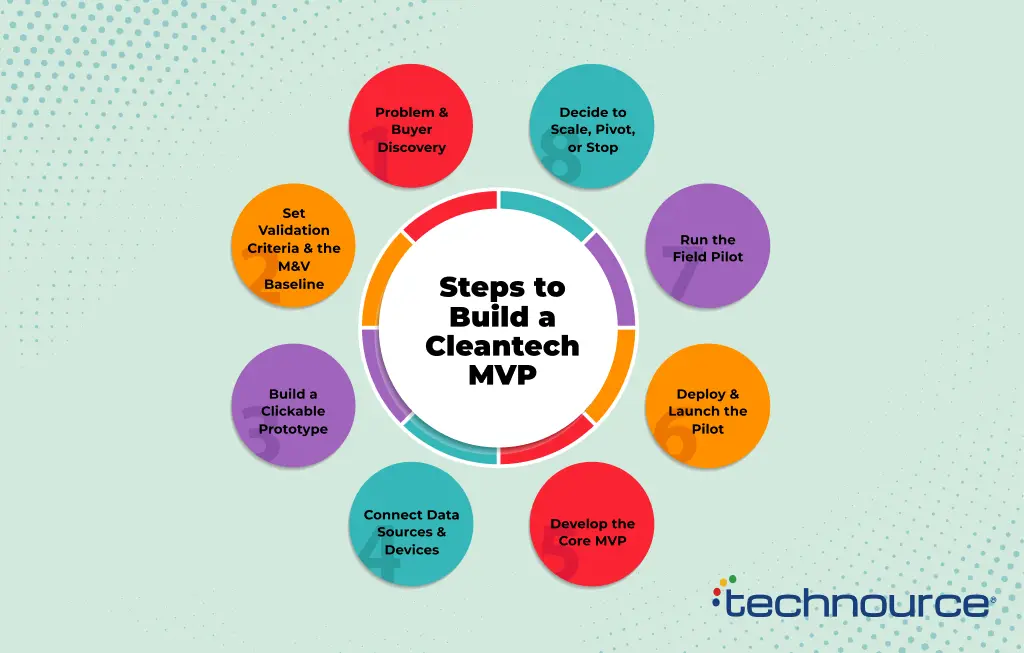
Step 1: Problem and Buyer Discovery (1–2 Weeks, Included in the 8–10 Week Total)
Interview the people who would sign, use and maintain the product: site managers, sustainability leads, procurement and finance.
Map the site’s data sources, device protocols and IT approval process. Leave with one named design partner and one measurable problem.
Step 2: Set Validation Criteria and the M&V Baseline (Overlaps Discovery)
Agree what success means before you build. Define the metric, the baseline period and the target, for example a set reduction in peak demand against the last 12 months.
Use a recognized measurement and verification method, such as IPMVP, when savings drive the buying decision.
Step 3: Build a Clickable Prototype (Overlaps Discovery)
Turn the key screens into a clickable prototype and test them with real operators. A prototype costs $6,000–$12,000 and catches workflow problems before the core screens are built.
Step 4: Connect Data Sources and Devices (Inside the Build)
Connect historical data first, then live feeds. Test each device protocol on a bench device or with a site export before field deployment.
Plan for messy data. Gaps, unit mismatches and time-zone errors appear in almost every pilot dataset.
Step 5: Develop the Core MVP (Most of the 8–10 Weeks for a Simple MVP)
Build the 4–6 features that prove the core claim, starting with the dashboard, alerts and savings report.
Work in two-week sprints and demo each one to the design partner. For a simple MVP, the build fills most of the 8–10 weeks after discovery. A mid-complexity MVP’s build runs within its 12–16 week timeline, and complex MVPs with several device protocols take 16–24 weeks overall.
Step 6: Deploy and Launch the Pilot (3–5 Days)
Deploy to the buyer’s approved cloud, onboard users and confirm that live data matches the baseline source.
Train site staff before go-live so setup errors do not distort early results.
Step 7: Run the Field Pilot (6–10 Weeks)
Track the agreed metric every week and share a short report with every stakeholder who will approve the next step.
Fix data and workflow issues quickly, but add new features only if the buyer’s success criteria depend on them.
Step 8: Decide to Scale, Pivot, or Stop
Compare results with the agreed criteria and present a scale proposal with pricing, rollout plan and contract terms.
A pilot that hits its targets still needs a plan for growth, and scaling from MVP to MMP and version 1.0 calls for different architecture and support decisions than the pilot did.
How Do You Design a Pilot That Converts Into a Purchase?
A cleantech pilot program converts into a purchase when the buyer agrees, before the pilot starts, on the success metric, the measurement baseline, the decision owner and the commercial terms that follow a successful result. Pilots without these four elements tend to end with a positive report and no contract.
The conversion gap is real. About 70% of corporate buyers and startups surveyed by Deloitte said fewer than half of their cleantech pilots converted to scaled deployment over the past two years.
Buyers also told Deloitte what helps: 54% cite demonstrated technical reliability during the pilot as a top enabler, and 53% cite alignment across procurement, operations, sustainability and finance. Structure matters too, with 60% of corporate buyers favoring structured pilots with clear next-step criteria.
| Pilot Element | What to Agree Upfront | Why Buyers Care |
|---|---|---|
| Success metric | One primary KPI and target | Removes debate about results at the end |
| Baseline | Data source and baseline period | Makes savings credible to finance |
| Decision owner | Who approves scale, and by when | Stops the pilot stalling after a good result |
| Scope and duration | Sites, assets and a 6–10 week window | Keeps cost and effort predictable |
| Data access | What data you can read and store | Avoids late security reviews |
| Next-step terms | Pricing and rollout if targets are met | Turns success into a purchase order |
Technource’s Recommendation
Write the success criteria and next-step terms into the pilot agreement before the first device goes live. A pilot that ends with an agreed scale price is worth more than one with better results and no commitment.
How Much Does Cleantech MVP Development Cost?
Cleantech MVP development costs $8,000–$15,000 for a simple MVP, $20,000–$30,000 for a mid-complexity MVP and $30,000–$50,000+ for a complex MVP, while enterprise MVPs cost $60,000–$100,000. A PoC costs $3,000–$8,000 and an IoT pilot deployment costs $12,000–$25,000.
| Build Type | Cleantech Scope | Cost (USD) | Timeline |
|---|---|---|---|
| PoC | Feasibility test on historical meter or sensor data | $3,000–$8,000 | 1–3 weeks |
| Prototype | Clickable dashboard and operator workflow | $6,000–$12,000 | 2–4 weeks |
| Simple MVP | Software-first analytics or reporting on existing data | $8,000–$15,000 | 8–10 weeks |
| Mid-complexity MVP | Dashboard, alerts and one or two device integrations | $20,000–$30,000 | 12–16 weeks |
| Complex MVP | Several device protocols, control logic and a mobile app | $30,000–$50,000+ | 16–24 weeks |
| AI MVP | Forecasting, anomaly detection or automated reporting | $10,000–$50,000 | Scope-based |
| IoT pilot deployment | Connected devices and a live dashboard at a pilot site | $12,000–$25,000 | 6–10 weeks |
| Enterprise MVP | Multi-site build with enterprise security and integrations | $60,000–$100,000 | Scope-based |
Device integrations and data cleanup push a cleantech build up the tiers faster than any other factor, a pattern the full MVP development cost breakdown shows across industries.
What Drives Cleantech MVP Cost?
The number of device protocols, the quality of site data and whether the MVP sends commands to equipment drive cleantech MVP cost more than screen count. Each factor below can move a build from the $8,000–$15,000 simple tier into the $20,000–$30,000 mid-complexity tier.
| Cost Driver | Why It Adds Cost |
|---|---|
| Number of device protocols | Each protocol needs mapping, testing and error handling |
| Data quality | Gaps and unit errors need cleanup pipelines |
| Real-time control | Sending commands to devices needs safety checks and fallbacks |
| AI models | Forecasting and anomaly detection need data preparation and tuning |
| Reporting standards | GHG Protocol or utility formats add validation logic |
| Security reviews | Utility and enterprise buyers often require security documentation |
| Number of user roles | Each role adds screens, permissions and testing |
Hidden and Ongoing Costs to Budget
Budget beyond the build. Ongoing costs depend on project scope, so confirm each one during discovery.
- Hardware and installation: sensors, gateways and site labor for IoT pilots.
- Connectivity: cellular or LoRaWAN data plans for remote devices.
- Cloud and data storage: time-series data grows quickly as you add sites and devices.
- Third-party APIs: weather, utility data and mapping services often charge per call or per site.
- Certification and testing: some hardware and grid-connected products need lab or interoperability testing.
- Maintenance: bug fixes, device firmware changes and security updates after launch.
Want a realistic cost range for your cleantech MVP and pilot?
Build vs Buy: Should You Build Custom Cleantech MVP Software?
Build custom cleantech MVP software when the software itself is your product, such as unique analytics, control logic or reporting. Buy or configure off-the-shelf tools when you only need standard monitoring to support a hardware-led product.
| Factor | Custom Build | Off-the-Shelf | Hybrid |
|---|---|---|---|
| Differentiation | Full control of your core logic | Same features as competitors | Custom core, standard modules |
| Speed to pilot | 8–16 weeks | Days to weeks for setup | Depends on the modules reused |
| Upfront cost | $8,000–$50,000+ | Low, with recurring fees | Lower than a full custom build |
| IP ownership | You own the code | Vendor owns the platform | You own the core |
| Device fit | Built for your devices | Limited to supported devices | Custom connectors where needed |
| Best when | Software is the product | Hardware or service is the product | You need speed and some differentiation |
Technource’s Recommendation
Start hybrid when a standard IoT platform already covers device connectivity, and build custom only the analytics or workflow buyers pay for. Bring more of the stack in-house once per-site license fees exceed the cost of running your own component.
What Are the Biggest Challenges in Cleantech MVP Development?
The biggest challenges in cleantech MVP development are messy site data, device protocol integration, long buyer approval cycles and unclear measurement of savings. Each challenge can add weeks to a 6–10 week pilot unless the team plans for it during discovery.
| Challenge | Real Consequence | How to Solve It |
|---|---|---|
| Messy or missing site data | Savings cannot be proven | Audit data sources in discovery and build cleanup into the pipeline |
| Device protocol variety | Integration delays on site | Map protocols early and test with bench devices or exports |
| Long buyer approval cycles | Pilot ends with no decision | Name the decision owner and date in the pilot agreement |
| Disputed savings claims | Finance rejects the business case | Agree the baseline and M&V method before go-live |
| Security reviews | Late blockers from IT teams | Share architecture and data handling documents upfront |
| Hardware dependency | Software waits on manufacturing | Validate with existing devices or a digital twin first |
Common Mistakes to Avoid in Cleantech MVP Development
The most common cleantech MVP mistakes are building hardware before validating demand, running pilots without agreed success criteria, and adding features the pilot does not need. Six mistakes come up again and again:
- Hardware first, demand later: custom devices lock in cost before you know buyers will pay.
- Pilots without exit criteria: a pilot with no agreed metric or decision date rarely becomes a contract.
- Too many integrations: supporting every protocol in the MVP delays the one site that matters.
- No baseline: savings without an agreed baseline are opinions, not evidence.
- Full automation too early: automatic device control raises risk, so start with recommendations.
- Screens built for engineers: site operators need simple views and clear alerts.
Which KPIs Prove a Cleantech MVP Is Ready to Scale?
The KPIs that prove a cleantech MVP is ready to scale are verified savings against the baseline, pilot-to-contract conversion, data completeness, weekly active operators and cost to deploy each new site. Track them from the first week of the pilot, not after it ends.
| KPI | What It Shows | How to Measure |
|---|---|---|
| Verified savings vs baseline | Whether the core claim holds | Energy, cost or emissions against the agreed baseline period |
| Pilot-to-contract conversion | Commercial traction | Signed scale agreements divided by completed pilots |
| Data completeness | Reliability of results | Share of expected readings received each day |
| Weekly active operators | Real adoption on site | Unique users acting on alerts or reports each week |
| Alert accuracy | Trust in the system | Confirmed issues divided by total alerts |
| Cost per site deployed | Unit economics at scale | Hardware, setup and onboarding cost per new site |
| Letters of intent | Demand beyond the pilot | Signed LOIs from buyers outside the pilot |
Product teams can pair these with standard MVP success metrics such as activation and retention to show product-market fit.
How to Choose a Cleantech MVP Development Company
Choose a cleantech MVP development company that has shipped energy or IoT products to real sites, can name the protocols it has integrated and will tie the build to your pilot’s success criteria. Ask for case studies with measured results, not only screenshots.
| Question to Ask | Good Answer | Red Flag |
|---|---|---|
| Which device protocols have you integrated? | Names specific protocols and projects | We can integrate anything |
| How do you handle messy site data? | Describes cleanup and validation steps | No mention of data quality |
| Can you show measured results? | Case studies with percentages | Only design screenshots |
| How do you scope the pilot? | Ties features to buyer success criteria | Starts with a long feature list |
| Who owns the code and data? | You own both | Vague or vendor-owned IP |
| What happens after the pilot? | Clear plan to scale or hand over | No post-pilot support model |
Technource brings 14+ years in product engineering, 1,000+ projects delivered and 50+ cleantech projects delivered. Clients rate Technource 4.9/5 on Clutch and 4.9/5 on GoodFirms, with a 98% client satisfaction rate.
What Are the Future Trends in Cleantech MVP Development?
The main cleantech MVP trends to watch are AI-native energy software, grid flexibility products, automated carbon data and digital twins that replace early hardware pilots. Each trend lowers the cost of proving value before scale.
AI-Native Energy Software
New energy products are being designed around forecasting and anomaly detection from day one, rather than adding AI later.
AI is also competing with energy for capital: the share of venture funding going to AI rose to almost 30% in 2025, while energy start-up VC fell for a third straight year to $27 billion, according to the IEA.
Grid Flexibility and Demand Response Products
Rising electricity demand is pushing utilities to pay for flexibility, such as shifting EV charging, dispatching batteries and moving building loads away from peak hours.
MVPs in this space need OpenADR support and clear proof of the load shifted during each event.
Automated Carbon and Scope 3 Data
Corporate buyers want emissions data they can audit. MVPs that pull activity data from source systems and apply GHG Protocol methods cut manual reporting work.
Digital Twins Replacing Early Hardware Pilots
Digital twins let teams test control strategies on a virtual site before installing equipment. Expect more pilots to start with a twin and move to hardware only after the buyer sees projected results.
How Technource Delivers Measurable Results in Cleantech
Technource has delivered 50+ cleantech projects, from waste management platforms to IoT control systems. The two projects below show how a focused first build produces measured results.
How Technource Built Clean Medic, a Medical Waste Management Platform With 65% Faster Waste Collection
We built Clean Medic, a digital platform that modernizes medical waste management in Indonesia for a provider with strong government ties. Waste tracking relied on paper forms, pickups were poorly scheduled, and producers struggled to prove their waste had been safely incinerated.
We built role-based mobile apps and portals for producers, drivers, warehouses and incineration factories, all connected to one back office. QR-coded containers and Bluetooth-enabled scales record every step, a tour-scheduling algorithm groups nearby pickups, and the platform issues digital incineration certificates automatically. The stack includes Laravel, React.js, MySQL, Flutter, Firebase, Google Maps and the MidTrans payment gateway.
Measurable Result
Clean Medic delivered these results across waste collection, tracking and compliance:
- 65% faster waste collection
- 55% improved tracking accuracy
- 50% lower operational errors
- 70% better compliance and safety
- Digital chain-of-custody records from pickup to incineration
How Technource Built Digital Biologix, a Smart Greenhouse IoT Platform With 65% Faster Environmental Adjustments
We built Digital Biologix, a smart automation platform that lets greenhouse owners monitor and control their environmental systems remotely. The client needed to manage multiple environmental controller (EC) devices, and the people running the greenhouses were not technical users.
We built a mobile app that connects to the EC devices over IoT, shows temperature, humidity, lighting and CO₂ levels in real time, automates schedules and sends alerts when conditions drift. The interface turns complex device functions into simple controls for growers.
Measurable Result
Digital Biologix delivered these results for greenhouse operators:
- 65% faster response time for environmental adjustments
- 80% reduction in manual greenhouse management
- 55% increase in operational efficiency
- 100% real-time data visibility via IoT connectivity
Technource’s Approach to Cleantech MVPs
Five principles shape every cleantech MVP we build, from waste management platforms to IoT control systems. Each one keeps the first release focused on the proof a buyer needs before signing.
- Validate before hardware: we prove demand on existing data before anyone designs a device.
- One site, one metric: every MVP is scoped around a single pilot site and one success KPI.
- Protocols mapped in discovery: device and data standards are confirmed before integration code is written.
- Measurement built in: baselines and savings reports ship with the first release, not after the pilot.
- Built to scale: architecture choices leave room for more sites, devices and AI features once the pilot converts.
Conclusion
Cleantech MVP development succeeds when three decisions are made early: what to prove first, how to prove it without heavy hardware, and what the buyer commits to if the pilot works.
With those decisions in place, cost and timeline stop being guesswork, and a pilot becomes a path to a contract.
Technource is an AI-powered product engineering company and a cleantech software development company that builds MVPs, IoT integrations and AI-powered workflow automation for energy and sustainability products.
If you are ready to scope your cleantech MVP, contact us for a short consultation that maps your validation plan, pilot design, budget and timeline.
Ready to turn your cleantech idea into a pilot buyers sign off on?
FAQs
A simple, software-first cleantech MVP costs $8,000–$15,000. A mid-complexity MVP with dashboards, alerts and one or two device integrations costs $20,000–$30,000, and a complex MVP with several device protocols costs $30,000–$50,000+. Enterprise MVPs cost $60,000–$100,000, while a PoC on historical data costs $3,000–$8,000. A simple cleantech MVP takes 8–10 weeks and a mid-complexity MVP takes 12–16 weeks, because discovery and prototyping run before and alongside the build. Complex MVPs with several device protocols take 16–24 weeks. A field pilot at the buyer’s site then runs 6–10 weeks before the scale decision. Yes. Most cleantech products can be validated with existing meter, inverter or utility data, a digital twin of the site, or a concierge pilot where your team handles part of the work manually. A software-first simple MVP costs $8,000–$15,000 and tests demand before you commit to device design or manufacturing. A PoC proves the idea works technically in 1–3 weeks, usually on historical data. An MVP proves users get value from a working product in 8–24 weeks. A pilot proves measured results at a buyer’s site over 6–10 weeks under agreed terms. Most cleantech teams move through all three in that order. Start with buyer interviews, then test a data-only MVP on the buyer’s own meter or utility data to show likely savings. Ask for a named design partner, an agreed success metric and a letter of intent before building more. A PoC on historical data costs $3,000–$8,000 and answers the feasibility question first. Verified savings against an agreed baseline is the most important metric. Add pilot-to-contract conversion, data completeness, weekly active operators, alert accuracy and cost per site deployed. Track each one from the first week of a 6–10 week pilot so the scale decision rests on evidence, not opinion. An energy software MVP should support only the standards its pilot site uses. Common choices are Modbus or MQTT for device data, OCPP for EV chargers, OpenADR for demand response, SunSpec for inverters and the GHG Protocol for emissions data. Confirm protocols in the 1–2 week discovery phase, before integration starts. Agree four things before go-live: one success metric, a measurement baseline, the person who approves scale and the commercial terms if targets are met. Buyers favor this structure. According to Deloitte (2026), 60% of corporate buyers prefer structured pilots with clear next-step criteria. A typical cleantech pilot runs 6–10 weeks. No. Data-only analytics, carbon reporting and marketplace MVPs often need no new devices. An IoT MVP for cleantech becomes necessary when the product depends on live sensor data or device control at the site. An IoT pilot deployment costs $12,000–$25,000 and takes 6–10 weeks, so start with existing data where you can. Build custom when the software is your product, such as unique analytics, control logic or reporting. Use off-the-shelf tools when monitoring only supports a hardware-led product. Many startups start hybrid, building a custom core for $8,000–$50,000+ on top of a standard IoT platform for device connectivity.
Related Insights and Articles