
Short Summary
After an MVP proves demand, the next step is a Minimum Marketable Product (MMP) that customers will pay for. Then comes version 1.0, a release that runs reliably without daily firefighting. Below, you will find the readiness signals to check, how to scope each stage, which technical shortcuts to fix, what it costs, how long it takes, and 3 Technource case studies.
Key Takeaways
- What comes after the MVP is a two-step climb: an MMP that earns revenue, then a version 1.0 built for reliable, repeatable use.
- Scale on evidence, not momentum. In full-year 2025 data, median SaaS net revenue retention was 102% and gross revenue retention 84% (Aleph × Benchmarkit, 2026). Use them as reference points once you charge.
- Fix technical debt selectively. Debt absorbs 21%–40% of IT spending (Deloitte, 2026), so pay down the debt that threatens reliability, security, or the core workflow first.
- The window is short. Among startups that shut down, the median time from last raise to closure was 22 months (CB Insights, 2026). Plan the MMP and version 1.0 inside one funding cycle.
- Know the starting budget. Technource builds a simple MVP for $8,000–$15,000, a mid-complexity MVP for $20,000–$30,000, and a complex MVP for $30,000–$50,000. MMP and version 1.0 budgets are scoped from your validated MVP.
Launching an MVP feels like the finish line. In practice, it is the starting gun.
Demand for software keeps growing. Gartner expects worldwide IT spending to reach about $6.4 trillion in 2026, up around 14% (Gartner, 2026).
A bigger market does not make room for weak products, though.
CB Insights reviewed 431 VC-backed startups that shut down since 2023. 70% ran out of capital, but the root causes behind the cash crunch included poor product-market fit (43%) and bad timing (29%) (CB Insights, 2026).
Many of those teams had shipped something. They stalled in the gap between a working MVP and a product customers pay for and rely on.
That gap is where founders make their most expensive calls: what to build next, what to fix, and what to leave alone. Getting them right is the difference between a pilot and a business.
What Comes After the MVP?
After the MVP comes the Minimum Marketable Product (MMP), the first version customers pay for, and then version 1.0, the stable release built for repeatable use at growing scale. Some consumer products add a Minimum Lovable Product (MLP) between the two to win on experience.
Each stage answers a different business question.
| Stage | Core question | Main audience | You are done when |
|---|---|---|---|
| MVP | Does anyone need this? | Early adopters | Users return and give consistent feedback on the core problem |
| MMP | Will people pay for it? | First paying segment | Customers pay without heavy discounts or founder hand-holding |
| MLP (optional) | Will people choose it over alternatives? | Crowded consumer markets | Users recommend it, and engagement rises |
| Version 1.0 | Can it run without constant rescue? | The wider target market | The core workflow is stable, onboarding is self-serve, and support load is predictable |
| Scale | Can growth be repeated efficiently? | New segments and regions | Acquisition and expansion follow a predictable pattern |
The order matters. Skipping the MMP usually means scaling a product nobody has paid for yet.
Skipping version 1.0 creates the opposite problem: paying customers on a product that breaks under real use.
What Is a Minimum Marketable Product (MMP)?
A Minimum Marketable Product (MMP) is the smallest version of a product that a defined customer segment will pay for, with billing, onboarding, and support in place. It turns what you learned from the MVP into revenue.
The MVP tests a hypothesis. The MMP validates a business model.
An MMP is not a bigger MVP. It is a sharper one, built for one segment that has already shown real interest.
What Must an MMP Include?
An MMP needs five components an MVP can usually skip: billing, self-serve onboarding, basic support, baseline security, and product analytics.
| Component | Why it matters | MVP shortcut it replaces |
|---|---|---|
| Billing and pricing | Payment validates demand better than any survey | Manual invoices or free access |
| Self-serve onboarding | Users must reach value without a founder on the call | Founder-led demos and setup |
| Basic support | Paying users expect answers within a known time | Personal email or chat threads |
| Baseline security | Paying customers bring real data and real risk | Shared admin logins, weak access control |
| Product analytics | You need to see activation, conversion, and churn | Spreadsheets and guesswork |
Where Does the Minimum Lovable Product (MLP) Fit?
A Minimum Lovable Product (MLP) is a version designed to be preferred, not just usable. It adds polish, delight, and one or two standout features.
It earns its place in crowded consumer categories where users can switch in seconds.
Most B2B products can skip a separate MLP stage. They fold experience improvements into version 1.0 instead.
What Is Version 1.0 in Product Development?
Version 1.0 is the first complete, stable release of a product, built so customers can rely on the core workflow every day without the team stepping in. It adds reliability, monitoring, scalability, and a repeatable signup or sales motion on top of the MMP.
An MMP proves people will pay. Version 1.0 shows they will stay.
It is not “every feature on the roadmap”. A strong version 1.0 is complete for one segment, not for everyone.
What Does Version 1.0 Usually Include?
Version 1.0 usually includes a finished core workflow, self-serve onboarding, access controls, monitoring, automated testing, pricing tiers, and documentation.
- A finished core workflow, with edge cases and error states handled
- Self-serve onboarding with a clear first-value moment
- Role-based access and audit trails where buyers expect them
- Monitoring, alerting, automated backups and a tested recovery plan
- Automated tests and a CI/CD pipeline for safe, frequent releases
- Pricing tiers with a clear upgrade path
- Help documentation and in-app guidance
MVP vs MMP vs MLP vs Version 1.0: What Is the Difference?
An MVP tests demand, an MMP earns revenue, an MLP wins preference, and version 1.0 delivers reliability for a growing user base. They differ in goal, scope, audience, quality bar, and how success is measured.
| Factor | MVP | MMP | MLP | Version 1.0 |
|---|---|---|---|---|
| Goal | Validate the problem | Validate the business | Win user preference | Deliver reliable, repeatable value |
| Scope | One core workflow | Core workflow + billing, onboarding, support | MMP + standout experience | Complete workflow for one segment |
| Audience | Early adopters | First paying segment | Users with many options | The wider target market |
| Quality bar | Works for testing | Safe to charge for | Pleasant to use | Stable under daily load |
| Monetization | Often free or pilot | Paid plans start | Paid, with upsell | Tiered pricing and expansion |
| Key metric | Activation, qualitative feedback | Conversion to paid, early churn | Referrals, satisfaction | Retention cohorts, revenue retention, uptime |
| Typical risk | Building the wrong thing | Charging too little | Polishing too early | Scaling on fragile code |
How Do You Know Your MVP Is Ready for the Next Stage?
Your MVP is ready to move on when users return without prompting, a clear segment shows willingness to pay, and support requests shift from bug reports to feature requests. One strong signal is not enough; look for three or more pointing the same way.
Signals You Are Ready to Build the MMP
| Signal | What to look for | How to measure it |
|---|---|---|
| Repeat usage | Retention curves flatten instead of falling to zero | Weekly or monthly retention cohorts |
| Willingness to pay | Users accept a price, sign a pilot contract, or pre-pay | Pricing conversations and paid pilots |
| A clear segment | One user type gets far more value than the rest | Usage and retention split by segment |
| Pull for features | Requests extend the core workflow instead of changing it | Tagged feature requests and support tickets |
| Organic referrals | New users arrive through existing users | Signup source tracking |
For the KPIs behind each signal, see our guide to MVP success metrics.
Revenue Retention Benchmarks to Keep in Perspective
Revenue retention becomes the clearest signal once you start charging.
Across full-year 2025 data, the median SaaS company posted 102% net revenue retention (NRR) and 84% gross revenue retention (GRR) (Aleph × Benchmarkit, 2026).
Smaller companies sit lower. Businesses under $5M ARR posted a median NRR of 94% in the same benchmark (Aleph × Benchmarkit, 2026).
So for an early product, getting close to 100% NRR is a strong result. Do not hold an MMP to the standards of a scaled company. Our SaaS retention benchmarks break these numbers down further.
Signs You Should Stay in MVP Mode
Stay in MVP mode if users drop off fast, the core flow keeps changing, or nobody will pay yet.
- Most users stop using the product after the first week
- The main user flow changes almost every sprint
- Users say they like it, but nobody accepts a price
- Most support tickets are bugs, not requests
- You cannot name your best-fit customer segment
Our Recommendation
Write your “ready to move on” criteria before you look at the data.
Pick 3–5 signals, set a threshold for each, and review them on a fixed date. This stops the team from moving the goalposts after launch.
MVP live, but not sure what to build next?

How to Move From MVP to MMP: Step-by-Step
To move from MVP to MMP, decide on evidence whether to scale, iterate, or pivot, then define one paying segment, scope only what that segment needs, add billing, rebuild onboarding, and cover security basics before launch. The six steps below follow that order.
If your MVP was built as a quick prototype, start with a code review. Our MVP development team can assess whether the current build can carry paying users or needs targeted rework.
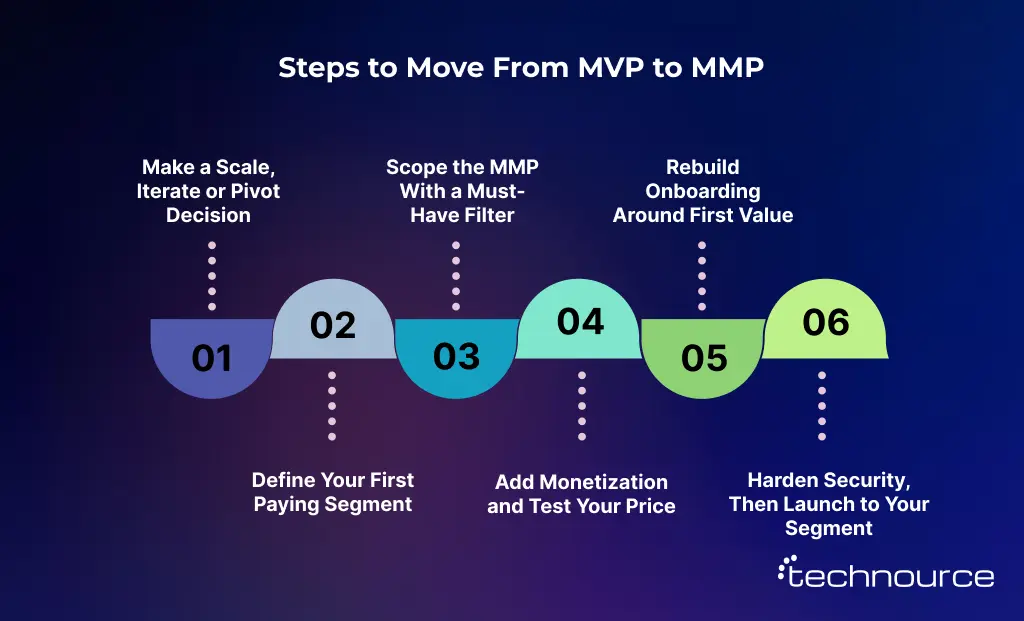
Step 1: Make a Scale, Iterate or Pivot Decision
Use your readiness signals to make one clear call. Avoid a vague “keep building”.
| Decision | When it fits | Next move |
|---|---|---|
| Scale to MMP | Three or more readiness signals are positive | Define the paying segment and scope the MMP |
| Iterate | Users engage, but activation or retention is weak | Run 2–3 focused experiments on the core flow |
| Pivot | Usage is low across segments, and pricing tests fail | Revisit the problem, the segment, or the solution |
Step 2: Define Your First Paying Segment
An MMP is marketable to someone specific. Name that customer before you write a single ticket.
- Who pays: the role or company type with the strongest usage
- What problem: the one job they hire your product to do
- Who owns the budget: the person who approves the purchase
- What they use today: the tool, spreadsheet, or agency you replace
Step 3: Scope the MMP With a Must-Have Filter
Apply one test to every backlog item: if removing it would stop your segment from paying, it is a must-have.
| Priority | What belongs here | Example (B2B SaaS) |
|---|---|---|
| Must have | Features the segment will not pay without | Billing, roles, data export, the core workflow end to end |
| Should have | Features that reduce churn in the first 90 days | Email notifications, templates, a basic dashboard |
| Could have | Features that help sales but not retention | Custom branding, extra integrations |
| Won’t have (yet) | Features for other segments or later scale | Enterprise SSO, advanced analytics, marketplace add-ons |
Step 4: Add Monetization and Test Your Price
Pricing is not a launch detail. Unsustainable unit economics appeared in 19% of the shutdowns CB Insights analyzed (CB Insights, 2026).
Build the billing layer properly at this stage:
- Subscription plans, trials and one-time payments, as your model needs
- Invoices, taxes and receipts in the formats your buyers expect
- Failed-payment retries and card-update reminders
- A simple way to change plans, so upgrades do not need a sales call
Test a real price with your first segment. Free access teaches you about interest, not about value.
Step 5: Rebuild Onboarding Around First Value
Define the activation event: the moment a new user first gets the result they came for.
Then remove every step between signup and that moment that does not need to be there.
- Use templates or sample data, so users never start from a blank screen
- Add guided setup for the 2–3 settings that matter most
- Use AI-powered workflow automation to pre-fill data, send timely nudges, and route support requests
- Track where new users drop off, and fix the biggest drop first
Step 6: Harden Security, Then Launch to Your Segment
Paying customers bring real data. Close the obvious gaps before you invite them in.
- Role-based access control and individual admin accounts
- Encryption in transit and at rest
- Audit logs for sensitive actions
- Automated backups and a tested restore
If you handle health, payment, or personal data, confirm which rules apply to your product, such as HIPAA, PCI DSS, or GDPR. Then build the safeguards they require before launch.
Launch to your defined segment first. A narrow release gives you cleaner data and fewer support fires.
How to Go From MMP to Version 1.0
Going from MMP to version 1.0 means turning a product that earns revenue into one that keeps it: complete the core workflow, pay down the debt that threatens reliability, upgrade architecture where load demands it, and build the operations to run it daily.
Complete the Core Workflow, Not the Wishlist
Look at where paying users get stuck, work around the product or contact support.
Those gaps define version 1.0. A long list of new feature ideas does not.
Handle edge cases, error states, and empty states. These rarely appear in demos, but they shape daily use.
Pay Down the Technical Debt That Matters
Technical debt is expensive at every size. Deloitte estimates it absorbs 21%–40% of an organization’s IT spending (Deloitte, 2026).
Some MVP debt is healthy. It bought you speed. The goal is to fix the debt that now creates recurring risk.
| Debt type | Fix before version 1.0 if | It can wait if |
|---|---|---|
| Data model | It cannot represent new customer types or pricing | It fits the next 12 months of roadmap |
| Security | It exposes customer data or admin access | Never: fix security debt first |
| Performance | Core pages or jobs slow down as usage grows | Load is far below current capacity |
| Test coverage | Releases regularly break the core workflow | The area is rarely changed |
| Code structure | Small changes take days and cause side effects | The code is messy but stable |
Upgrade Architecture Only Where Load Demands It
Most version 1.0 products do not need microservices. A well-structured modular application is usually faster to build and cheaper to run.
Upgrade where real usage shows strain:
- Background job queues for reports, imports, emails, and AI tasks
- Caching for frequent reads such as dashboards and catalogs
- Tenant isolation for B2B SaaS, so one customer’s data and load never affect another
- Auto-scaling for products with sharp traffic spikes
For SaaS products, this is also the point to confirm your tenancy and billing model. Our SaaS application development services cover multi-tenant architecture, subscription billing, and role-based access for this stage.
Build the Operating Layer
Version 1.0 needs operations, not just features. Customers notice downtime faster than new buttons.
- CI/CD pipelines with automated tests on every release
- Error tracking, uptime alerts, and performance dashboards
- An incident runbook that names who responds and how
- Defined support hours and response targets
Make Growth Repeatable
Version 1.0 should grow revenue from existing customers, not only from new ones.
That matters for efficiency. In 2025 SaaS benchmark data, expansion cost about $0.80 per dollar of new ARR, against $1.63 for winning new customers (Aleph × Benchmarkit, 2026).
Build tiered plans, in-app upgrade prompts, and usage visibility, so customers can see when they need more.
What Technical Changes Does Scaling an MVP Require?
Scaling an MVP usually means replacing a set of common shortcuts, such as manual deployments, missing tests, shared admin logins, no backups, and no monitoring. Fix the ones that affect paying users before the MMP, and the rest before version 1.0.
| MVP shortcut | Upgrade | Fix by |
|---|---|---|
| Manual deployments | CI/CD pipeline with automated checks | MMP |
| Few or no automated tests | Unit and integration tests on the core workflow | MMP |
| Shared admin logins | Role-based access control and audit logs | MMP |
| Hard-coded settings and secrets | Environment configuration and a secrets manager | MMP |
| Single database with no backups | Automated backups and a tested restore | MMP |
| No monitoring | Error tracking, uptime alerts, and performance dashboards | Version 1.0 |
| Heavy tasks run during user requests | Background job queues | Version 1.0 |
| Customer data in one shared space | Tenant isolation (B2B SaaS) | Version 1.0 |
| No caching | Caching for frequent reads | Scale stage |
Technource’s Approach
Start post-MVP work with a code and architecture review, not a feature list.
Sort every shortcut into three buckets: fix before paying users, fix before version 1.0, or leave for now. The budget then goes to risk, not polish.
Is your MVP code ready for real growth?

Should You Rebuild or Refactor Your MVP?
Refactor when the core data model and architecture still fit the product you now plan to build. Rebuild only when they block the MMP or version 1.0 and fixing them would cost more than starting over.
In most cases, refactoring is cheaper and less risky. It keeps what works and lets you ship improvements in stages.
| Factor | Refactor if | Rebuild if |
|---|---|---|
| Data model | It can be extended for new users and pricing | It cannot represent your core business objects |
| Technology stack | It is mainstream and well supported | It is outdated, unsupported, or a dead-end no-code tool |
| Test coverage | Key flows have some tests | Nothing is tested, and every change breaks something |
| Team knowledge | Someone understands the codebase | Nobody can safely change it |
| Security | Gaps can be closed with targeted fixes | Security issues are built into the design |
| Timeline pressure | You need paying users soon | You have runway to rebuild and validate again |
Remember the cost of starting over. Technource scopes a new MVP build at 8–24 weeks, depending on complexity, and a rebuild repeats much of that work.
No-code MVPs are a common exception. They are fast to validate but often need a custom rebuild once workflows, integrations, or data volumes grow.
What Are the Most Common Mistakes After the MVP?
The most common post-MVP mistakes are scaling before retention is proven, chasing every feature request, delaying pricing, rebuilding too early, over-engineering infrastructure, and hiring ahead of evidence.
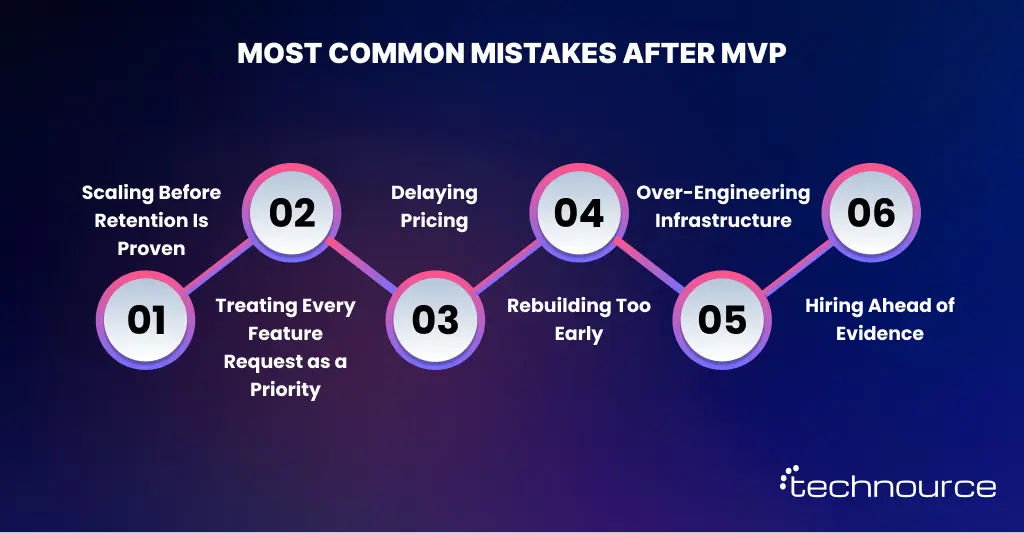
1. Scaling Before Retention Is Proven
More marketing spend cannot fix a leaky product. It only brings more users who leave.
Runway is the real constraint here. Among startups that shut down, the median time from last raise to closure was 22 months (CB Insights, 2026).
2. Treating Every Feature Request as a Priority
Five customers asking for the same thing may matter. One loud customer with a niche request may not.
Group requests by the problem behind them before you score anything. Our guide on how to prioritize app features for MVP development covers this step.
3. Delaying Pricing
Teams often keep the product free “until it is ready”. The result is a user base that never planned to pay.
4. Rebuilding Too Early
A full rewrite feels clean, but it pauses learning for months. Refactor first unless the architecture truly blocks you.
5. Over-Engineering Infrastructure
Designing for millions of users while struggling to keep your first thousand wastes budget. Match infrastructure to current demand plus one stage ahead.
6. Hiring Ahead of Evidence
Large teams raise burn and slow decisions. Add people when a proven workflow needs more capacity, not to find one.
How Long Does It Take to Go From MVP to Version 1.0?
Moving from a validated MVP to version 1.0 typically takes about 4–9 months: roughly 6–12 weeks to build and launch the MMP, then 3–6 months to reach a stable version 1.0. Scope, team size, and how much MVP code you can reuse decide where you land.
| Stage | Typical timeline | Main work |
|---|---|---|
| Simple MVP | 8–10 weeks | One core feature, one platform, limited integrations |
| Mid-complexity MVP | 12–16 weeks | Multiple features, accounts, payments, and integrations |
| Complex MVP | 16–24 weeks | Multi-platform, advanced backend logic or compliance needs |
| Post-launch validation | 4–8 weeks | Collect retention cohorts, test pricing, interview users |
| MMP | 6–12 weeks | Billing, onboarding, support, security basics, analytics |
| Version 1.0 | 3–6 months | Complete workflow, debt paydown, monitoring, scale-ready architecture |
Timelines shrink when the MVP code is reusable and the paying segment is already clear. They grow when compliance reviews, data migration, or a rebuild enter the plan.
How Much Does It Cost to Scale From MVP to MMP and Version 1.0?
With Technource, an MVP costs $8,000–$15,000 (simple), $20,000–$30,000 (mid-complexity), or $30,000–$50,000 (complex), and an AI MVP costs $10,000–$50,000. MMP and version 1.0 budgets depend on how much MVP code can be reused, so they are scoped after a code review. For the earlier stage, see our MVP development cost breakdown.
| Stage | Technource price | Timeline |
|---|---|---|
| Simple MVP | $8,000–$15,000 | 8–10 weeks |
| Mid-complexity MVP | $20,000–$30,000 | 12–16 weeks |
| Complex MVP | $30,000–$50,000 | 16–24 weeks |
| AI MVP | $10,000–$50,000 | Scoped per project |
What Drives Post-MVP Cost?
Post-MVP cost depends mainly on code reuse, integrations, compliance, platforms, and AI features.
- Reusable MVP code: more reuse means less rework
- Integrations: payments, CRM, ERP, shipping, or identity providers
- Compliance: regulated data adds design, testing, and documentation work
- Platforms: web, iOS and Android each add build and QA effort
- AI features: model selection, evaluation, and cost-per-request tuning
- Data migration: moving MVP data into a new structure safely
What Ongoing Costs Should You Plan For?
Budget separately for cloud hosting, third-party APIs, monitoring tools, and maintenance.
These depend on usage and the project, so review them monthly as your user base grows. Our SaaS maintenance and support guide breaks these costs down.
Need a clear budget for your next stage?
Post-MVP Priorities by Product Type
Post-MVP priorities depend on the business model: SaaS products focus on billing and multi-tenancy, marketplaces on payments and trust, mobile apps on retention and performance, AI products on accuracy and unit cost, and internal tools on permissions and integrations.
| Product type | MMP priority | Version 1.0 priority | Key metric |
|---|---|---|---|
| B2B SaaS | Billing, onboarding, roles | Tenant isolation, SSO, audit logs, integrations | Gross and net revenue retention |
| Marketplace | Payments, payouts, listing quality | Trust and safety, disputes, search | Repeat transactions |
| Mobile app | Store-ready UX, push notifications, analytics | Performance, offline support, crash reduction | Day-30 retention |
| AI product | Accuracy on the core task, guardrails | Evaluation pipeline, cost per request, human review | Task success rate, unit cost |
| Internal workflow tool | Core automation, permissions | Integrations, audit trails, AI-powered workflow automation | Hours saved, team adoption |
Future Trends Shaping the Post-MVP Playbook
Three trends are changing what comes after the MVP: AI-powered workflow automation built into products, pricing that grows with usage, and AI-assisted development that speeds delivery but needs stronger review.
AI-Powered Workflow Automation Moves Into the Core Product
Buyers now expect products to remove manual work, not just organize it.
After the MVP, start with 1–2 workflows tied to a metric you already track, such as onboarding time or support volume. Prove the gain, then expand. Our custom AI automation solutions start with this kind of narrow, measurable workflow.
Usage-Based Pricing Lifts Expansion
Pricing model now shapes retention. Usage-based SaaS companies posted a median NRR of 108%, compared with 98% for seat-based companies (Aleph × Benchmarkit, 2026).
If customers get more value as they use more, test a consumption-linked component in your MMP or version 1.0 pricing. Our SaaS subscription model guide compares the main pricing options.
AI-Assisted Development Needs Stronger Review
AI coding tools help teams ship faster. They also make it easier to add code nobody fully understands.
Peer review, automated tests, and clear architecture decisions matter more at version 1.0, not less.
Compliance Moves Earlier in the Roadmap
Data protection expectations now reach early-stage products. Enterprise buyers ask security questions before the first contract.
Plan access controls, audit logs, and data handling into the MMP, rather than retrofitting them later.
Technource’s Approach: From MVP to Version 1.0
Technource treats the post-MVP phase as product engineering: one plan that connects product decisions, code quality and business metrics.
| Phase | What happens | Output |
|---|---|---|
| 1. Product and code review | Review usage data, feedback, and the MVP codebase | Readiness assessment and shortcut list |
| 2. MMP scope and pricing | Define the paying segment, must-haves, and billing model | Prioritized MMP backlog |
| 3. MMP build | Build in sprints with demos and reprioritization | MMP live for the first paying segment |
| 4. Hardening for version 1.0 | Pay down key debt, add monitoring, CI/CD, and scaling upgrades | Stable version 1.0 release |
| 5. Launch and iterate | Track retention, add AI-powered workflow automation where it saves time | Data-backed roadmap for the scale stage |
Technource Case Studies: Building for Paying Users and Scale
These projects show three post-MVP priorities in practice: monetization in a marketplace, multi-tenancy in SaaS, and performance under load in fintech.
How Technource Built Equipt, an Equestrian Marketplace With 65% Faster Product Discovery
We built Equipt, a UK-based marketplace where buyers and sellers trade equestrian gear.
Very different products, from saddles to feed, required structured listings. The startup also needed shipping without its own logistics network, GDPR-ready data controls, and secure seller payouts.
Technource built dynamic categories with custom form fields, so sellers only see the fields their product needs.
We integrated Royal Mail, Evri and TrackingMore for shipping charges, labels and tracking, and Stripe Connect for seller payouts, refunds and disputes. Sellers can buy add-ons such as featured listings, which gives the platform revenue beyond transactions.
The stack included Laravel, Flutter, MySQL, Stripe, Royal Mail, Evri and TrackingMore.
Measurable Result
- 65% faster product discovery with advanced filters
- 70% better order and dispute handling efficiency
- Automated shipping charges, label generation and tracking for sellers
- Paid seller add-ons, such as featured listings and extended ad duration
- GDPR controls, including consent at signup, data export and deletion, and encrypted storage
How Technource Built Telepath, a Multi-Tenant Online Pharmacy Platform With 65% Faster E-Prescribing Approvals
We built Telepath, a SaaS pharmacy platform that lets healthcare organizations launch branded online pharmacies with e-prescriptions and telehealth.
Each provider needed its own portal, secure prescribing, and smooth handoffs to dispensing and shipping partners.
Technource built a multi-tenant architecture that runs every tenant on a separate subdomain or custom domain.
We integrated DoseSpot for secure e-prescribing, Agora for telehealth consults, and Carepoint, TransitionRx, and Easypost for pharmacy coordination and shipment tracking. Flexible sign-up flows let each organization control patient onboarding.
The stack included React.js, Node.js, MySQL, AWS S3, DoseSpot, Agora, Carepoint, TransitionRx, Easypost, and Paytheory.
Measurable Result
- 65% faster e-prescribing approvals
- 90% transparent onboarding with flexible sign-up flows
- Multiple organizations running independent branded pharmacies from one shared platform
- Connected pharmacy and shipping workflows with real-time order tracking
- Audit logs and pharmacy order tracking to support compliance
- Integrated payments and automated cart recovery to improve purchase conversions
How Technource Built SuitMe, a Crypto Trading and Staking Platform With 70% Faster Transaction Processing
We built SuitMe, a crypto exchange for a client in Spain where users trade, swap, and stake multiple cryptocurrencies with fiat support.
Trading peaks during volatile markets, so the platform had to absorb sudden load without downtime, keep prices in sync, and process fiat and crypto transfers securely.
Technource integrated BitGo APIs for trading and staking, with a caching layer that refreshes price feeds every second. Token-based authentication, encryption, and KYC verification protect every transfer.
A microservices architecture with AWS auto-scaling and load balancing handles traffic surges. The stack included Next.js, Node.js, Express.js, Flutter, MySQL, BitGo, AWS, Kubernetes, and Docker.
Measurable Result
- 70% faster crypto and fiat transaction processing
- Live price feeds refreshed every second through a caching layer
- Auto-scaling infrastructure built for trading spikes
- KYC verification, encryption and token-based authentication on transfers
- Automated recurring buys and daily staking reward updates
Why Choose Technource for Post-MVP Product Engineering?
With 14+ years of experience and 1,000+ projects delivered, Technource helps founders take products from first release to a stable, scalable platform.
- One team from MVP to version 1.0: product strategy, UI/UX, engineering, QA, and DevOps under one roof
- Review before rebuild: we assess your existing code first and reuse what works
- SaaS and platform depth: multi-tenancy, subscription billing, roles and integrations
- AI-powered workflow automation: built into products where it saves measurable time
- Transparent scope: changes are estimated and agreed with you before any work starts
Explore our software product development services to see how we plan, build, and scale digital products end to end.
Conclusion
An MVP answers one question: does anyone need this?
The next two stages ask harder ones. Will customers pay, and can they rely on the product every day? The MMP tests the first, and version 1.0 delivers the second.
Move between stages on evidence. Fix the debt that threatens paying users, upgrade architecture only where load demands it, and keep scope tied to one segment.
Technource is a product engineering company that builds SaaS platforms, digital products, and AI-powered workflow automation from MVP through version 1.0 and beyond. If you are deciding what to build after your MVP, contact our MVP software development company for a practical next-stage plan.
Want results like these for your product?
FAQs
A Minimum Marketable Product (MMP) comes next: the first version a defined segment will pay for. Version 1.0 follows: the stable release built for daily use. Moving from a validated MVP to version 1.0 typically takes about 4–9 months, depending on scope and how much MVP code you can reuse. An MVP tests whether people need the product. An MMP checks whether they will pay for it. To get there, an MMP adds five components an MVP can skip: billing, self-serve onboarding, basic support, baseline security, and product analytics. The MVP proves the problem; the MMP proves the business. Version 1.0 is the first complete, stable release built for repeatable use. It finishes the core workflow, adds monitoring, automated tests and backups, and supports self-serve onboarding. Plan roughly 3–6 months after the MMP launch to reach it. It should be complete for one customer segment, not packed with every requested feature. Look for three or more signals pointing the same way: repeat usage, willingness to pay, a clear best-fit segment, feature requests that extend the core workflow, and referrals. Once you charge, track revenue retention. Companies under $5M ARR posted a median net revenue retention of 94% (Aleph × Benchmarkit, 2026), so near 100% is a strong early result. Most fail because demand or economics never firm up. Among 431 VC-backed shutdowns since 2023, 70% ran out of capital, but deeper causes included poor product-market fit (43%) and bad timing (29%) (CB Insights, 2026). Scaling before retention is proven burns runway on the wrong stage. Our guide on why most MVPs fail covers the early warning signs. It typically takes about 4–9 months after the MVP is validated. Plan around 6–12 weeks to build and launch the MMP, then 3–6 months to harden it into version 1.0. Reusable MVP code, a clear paying segment, and a stable core workflow shorten the timeline. A rebuild lengthens it. With Technource, an MVP costs $8,000–$15,000 (simple), $20,000–$30,000 (mid-complexity), or $30,000–$50,000 (complex), and an AI MVP costs $10,000–$50,000. MMP and version 1.0 budgets depend on reusable code, integrations, and compliance needs. Cloud, API, and maintenance costs are extra and vary by project. Refactor if the data model and architecture still fit the product you now plan to build. Rebuild only when they block the MMP or version 1.0 and fixing them would cost more than starting over. A full rewrite repeats much of the original build time, which Technource scopes at 8–24 weeks for an MVP, depending on complexity. Often, yes. Free or discounted MVP pricing rarely reflects the value of a finished product. Test a paid plan with your MMP segment and consider a consumption-linked component. Usage-based SaaS companies posted a median net revenue retention of 108%, compared with 98% for seat-based companies (Aleph × Benchmarkit, 2026). Add it where it shortens the path to value or removes repeated manual work, such as onboarding data entry, support triage, or reporting. Start with 1–2 workflows tied to a metric you already track, prove the gain, then expand. Treat AI features like any other feature: tested, monitored, and reviewed for cost per request.
Related Insights and Articles