Building an MVP is not just about having a great idea. It is also about choosing the right team to bring that idea to life.
Many startups fail because they hire the wrong development partner. Projects get delayed, budgets go out of control, communication becomes frustrating, and the final product does not meet expectations.
The right MVP development partner can help you launch faster, avoid costly mistakes, and build a product that real users want. The wrong partner can waste months of time and thousands of dollars.
So, how do you find a team you can trust?
In this guide, you’ll learn:
Criteria for selecting a reliable software development partner for an MVP
When it makes sense to hire an external team
In-house vs freelancer vs development partner comparisons
Red flags you should never ignore
Important questions to ask before signing a contract
Typical MVP development costs
A simple framework to compare and shortlist partners
By the end, you’ll know exactly what to look for in a software development partner and how to choose one with confidence.
What Is a Software Development Partner for an MVP?
A software development partner for an MVP does more than just write code. They help you turn your idea into a working product that real users can test and use.
Unlike a vendor that simply builds the features you ask for, a good partner works with you to decide what should be built first, what can wait, and how to launch faster with less risk.
They help you focus on the features that matter most and avoid wasting time and money on unnecessary development.
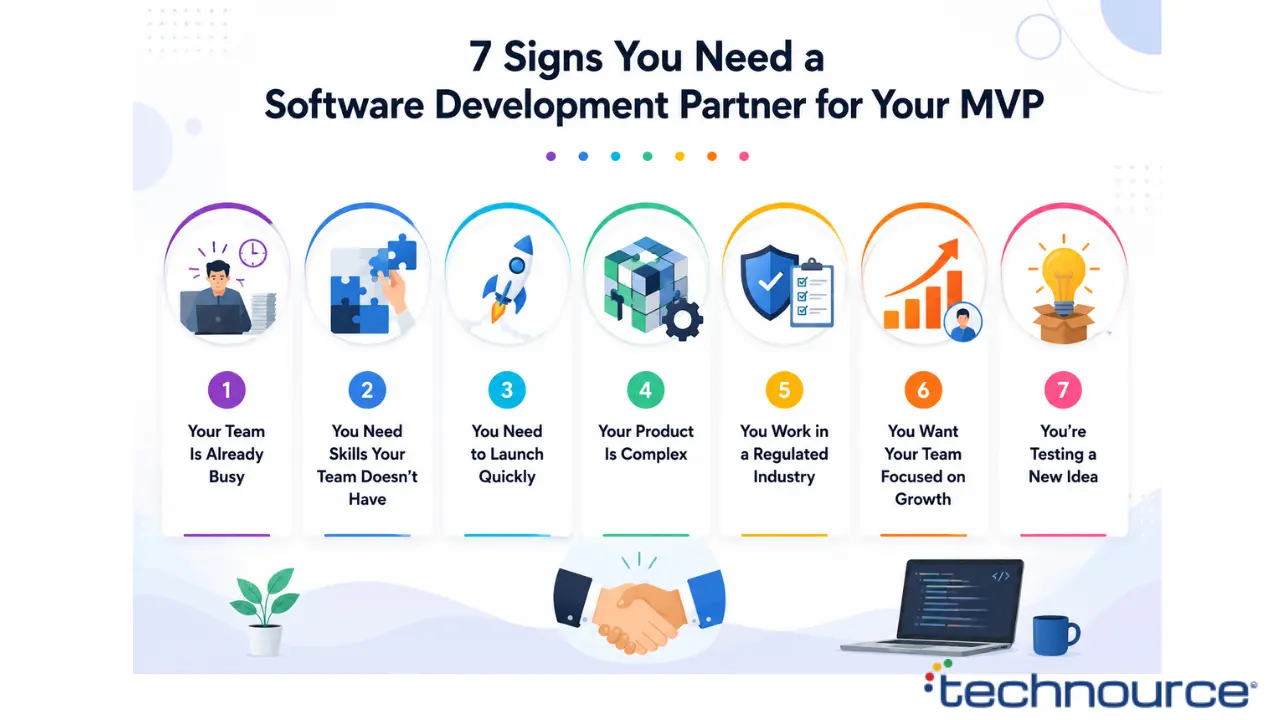
7 Signs You Need a Software Development Partner for Your MVP
Here are seven signs that it’s time to hire a software development partner for your MVP:
1. Your Team Is Already Busy
If your developers are fully occupied with existing projects, adding an MVP can slow everything down. A development partner helps you move faster with building an MVP without overloading your team.
2. You Need Skills Your Team Doesn’t Have
Some MVPs require expertise in areas like AI, machine learning, cloud infrastructure, or complex integrations. An experienced partner brings those skills from day one.
3. You Need to Launch Quickly
Whether you’re preparing for funding, a pilot program, or a market opportunity, speed matters. A development partner can help you build and launch faster.
4. Your Product Is Complex
Products with multiple integrations, large amounts of data, or advanced functionality can be challenging to build. A partner with relevant experience helps reduce risk and avoid costly mistakes.
5. You Work in a Regulated Industry
Industries like healthcare, finance, and insurance have strict compliance requirements. A partner familiar with these regulations can help you avoid security and compliance issues.
6. You Want Your Team Focused on Growth
Your internal team should focus on strategy, customers, and business growth. Outsourcing development allows them to spend more time on high-value work.
7. You’re Testing a New Idea
When launching a new product or entering a new market, you need a simple MVP that can be tested quickly. A good partner helps you build only what’s needed to validate the idea and gather user feedback.
In-House vs Freelancer vs Development Partner for an MVP
Before you evaluate vendors, decide what kind of help you actually need. Each model carries a different trade-off in speed, cost, and accountability, and the right fit shifts as software development trends evolve.
Factor
In-House Team
Freelancers
Development Partner
Speed to launch
Slow to hire and ramp
Fast to start, hard to coordinate
Fast, with a ready team
Cost model
High fixed salaries and overhead
Low rate, variable quality
Predictable and value-driven
Scalability
Limited and slow to scale
Difficult to scale as one unit
Flexible, scales up or down
Accountability
Full internal control
Fragmented ownership
Single accountable team
IP and security
Fully controlled
Depends on each contract
Governed by clear agreements
Best for
Long-term core product
Small, well-defined tasks
MVP to scale, end-to-end
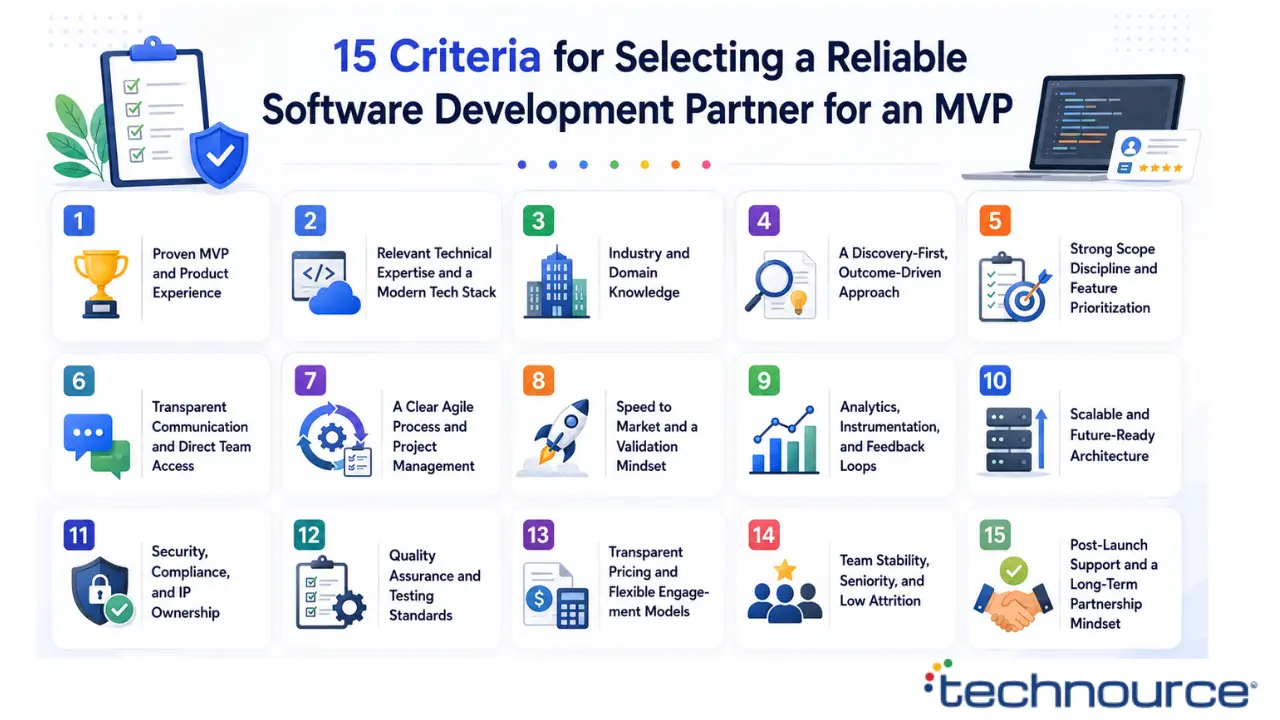
15 Criteria for Selecting a Reliable Software Development Partner for an MVP
These criteria for selecting a reliable software development partner for an MVP separate teams that ship from teams that stall. Work through each one before you commit.
1. Proven MVP and Product Experience
Building an MVP is its own discipline. It rewards speed, ruthless prioritization, and comfort with changing ideas, which is very different from building large, fixed-scope systems. Look for a team with real MVP case studies that show the problem solved, the features shipped first, and the results after launch. A partner who has done this before guides you safely through the uncertainty.
2. Relevant Technical Expertise and a Modern Tech Stack
Surface skills are not enough. Your partner should have hands-on depth in the exact languages, frameworks, and cloud platforms your product needs. Ask what systems they have built recently and how those systems held up as they scaled. Proven, well-supported technology beats trendy choices, so favor a partner who tracks emerging technologies without chasing hype.
3. Industry and Domain Knowledge
Your market is never generic, and neither is your product. A partner who knows your industry anticipates the workflows, edge cases, and compliance needs before they become expensive problems. That fluency shortens discovery, reduces back-and-forth, and leads to smarter product decisions. You spend less time explaining the basics and more time building what matters.
4. A Discovery-First, Outcome-Driven Approach
The best partners do not start with code. They start with questions about your users, your goals, and the riskiest assumption you need to test. A team that runs a proper discovery before estimating shows real product thinking. If a vendor commits to timelines and prices before understanding your problem, treat it as a warning.
5. Strong Scope Discipline and Feature Prioritization
Most MVPs fail by trying to do too much. A reliable partner pushes back on your feature list and helps you focus only on what proves the core idea. Look for teams that use clear prioritization, like must-have versus nice-to-have, to keep the build lean. That discipline protects both your budget and your timeline.
6. Transparent Communication and Direct Team Access
Clear communication keeps an MVP aligned as requirements shift. You should be able to talk directly with the engineers building your product, not only an account manager. Watch how they handle unclear requirements and whether they flag risks early. Reactive, vague communication almost always turns into rework and missed deadlines.
7. A Clear Agile Process and Project Management
Even strong engineers struggle without strong coordination. Your partner should run structured sprints, share progress openly, and adapt quickly when priorities change. Ask how they track work, run demos, and manage risk inside each sprint. A disciplined, transparent process is what keeps your project predictable from idea to launch.
8. Speed to Market and a Validation Mindset
For an MVP, speed is not optional. A capable partner already has the workflows and reusable building blocks to ship a working version fast, then refine it with real feedback. They measure success by how quickly you learn, not how many features they add. That mindset keeps you ahead of slower competitors.
9. Analytics, Instrumentation, and Feedback Loops
You cannot improve what you do not measure. A reliable partner wires analytics, funnels, and feedback into the first release so your decisions come from data, not opinions. They help you read user behavior and turn it into your next set of priorities. Without this, your MVP launches blind and learns nothing.
10. Scalable and Future-Ready Architecture
Your MVP should be simple, but never fragile. A good partner designs an architecture that handles growth without forcing a costly rebuild the moment traction arrives. They plan for more users and new features from the start, while avoiding over-engineering. That balance lets you scale with confidence when the time comes.
11. Security, Compliance, and IP Ownership
Security cannot be an afterthought, and neither can ownership. Your partner should follow secure coding practices, protect sensitive data, and meet standards like GDPR or HIPAA where they apply. Just as important, your contract must confirm that you own the code, data, and intellectual property. Settle this on day one, never later.
12. Quality Assurance and Testing Standards
In an MVP, quality means confidence that your next change will not break the last one. A strong partner treats testing as part of development, combining automated checks with manual validation on the flows that matter most. They keep separate environments and a clean release process. Rushed or unclear testing is a sign to dig deeper.
13. Transparent Pricing and Flexible Engagement Models
You should always know what you are paying for and why. A reliable partner explains pricing clearly, separates one-time build from ongoing costs, and offers models that fit your stage. Vague proposals and unclear change requests usually hide future budget pain. Focus on value and clarity, not the lowest quote on the table.
14. Team Stability, Seniority, and Low Attrition
A project is only as steady as the people behind it. Frequent team changes slow everything down because every new member needs time to learn your system. Ask who will actually work on your build, how senior they are, and how the company retains talent. Stability keeps momentum and protects the knowledge your product depends on.
15. Post-Launch Support and a Long-Term Partnership Mindset
Launch is the start of the real work, not the end. Once users arrive, you will need fixes, refinements, and new features based on what you learn. A reliable partner stays involved with clear support, knowledge transfer, and a plan to scale. Choose a team that wants a long-term partnership, not a quick handoff.
Now that you have seen what a strong partner looks like, let’s take a look at the warning signs that should make you walk away.
Red Flags to Watch For When Choosing an MVP Development Partner
Watch for these warning signs before hiring an MVP development partner:
Promises made too quickly without understanding your product, users, or requirements.
Senior experts handle the sales call, but junior developers handle the project.
Unclear pricing with hidden costs for testing, support, or additional features.
No proven track record of building and launching successful products.
Poor communication or slow responses during the sales process.
No clear security, compliance, or IP ownership policies.
A one-size-fits-all approach that ignores your unique business needs.
No post-launch support plan for maintenance, updates, and future growth.
10 Questions to Ask Before You Choose an MVP Development Partner
Here are the ten most important questions to ask before you choose an MVP development partner:
1. Can you show real MVPs you took from idea to launch, including the results and the challenges?
2. Who exactly will work on my product, and how senior are they?
3. Can I speak directly with the engineers, not just an account manager?
4. How do you decide which features to build first and which to cut?
5. What does your development process look like from discovery to launch?
6. How do you handle data, security, and compliance for sensitive products?
7. Who owns the source code, data, and intellectual property at the end?
8. How do you measure success and instrument the product for real feedback?
9. How do you handle scope changes, scaling, and shifting priorities mid-build?
10. What does your support look like after launch, and how do you scale the team?
How Much Does It Cost to Build an MVP With a Development Partner?
Cost depends far more on complexity and scope than on any single rate. Budget is one important piece of the criteria for selecting a reliable software development partner for an MVP. Here is how MVP development costs usually break down, with no surprises.
MVP Type
Typical Scope
Indicative Cost Range
Typical Timeline
Simple MVP
Core features, basic flows
$15,000 to $50,000
2 to 4 months
Mid-Level MVP
Multiple features and integrations
$50,000 to $150,000
23 to 6 months
Complex MVP
Advanced features and compliance
$150,000 and up
6 months and beyond
What Drives MVP Development Cost?
Several factors affect the cost of building an MVP:
Number of features included in the product
Feature complexity and custom functionality
Third-party integrations, such as payment gateways or APIs
Team size and experience level
UI/UX design requirements
Security and compliance needs for regulated industries
The best way to keep costs under control is to focus on essential features first and add more only after validating your idea with real users.
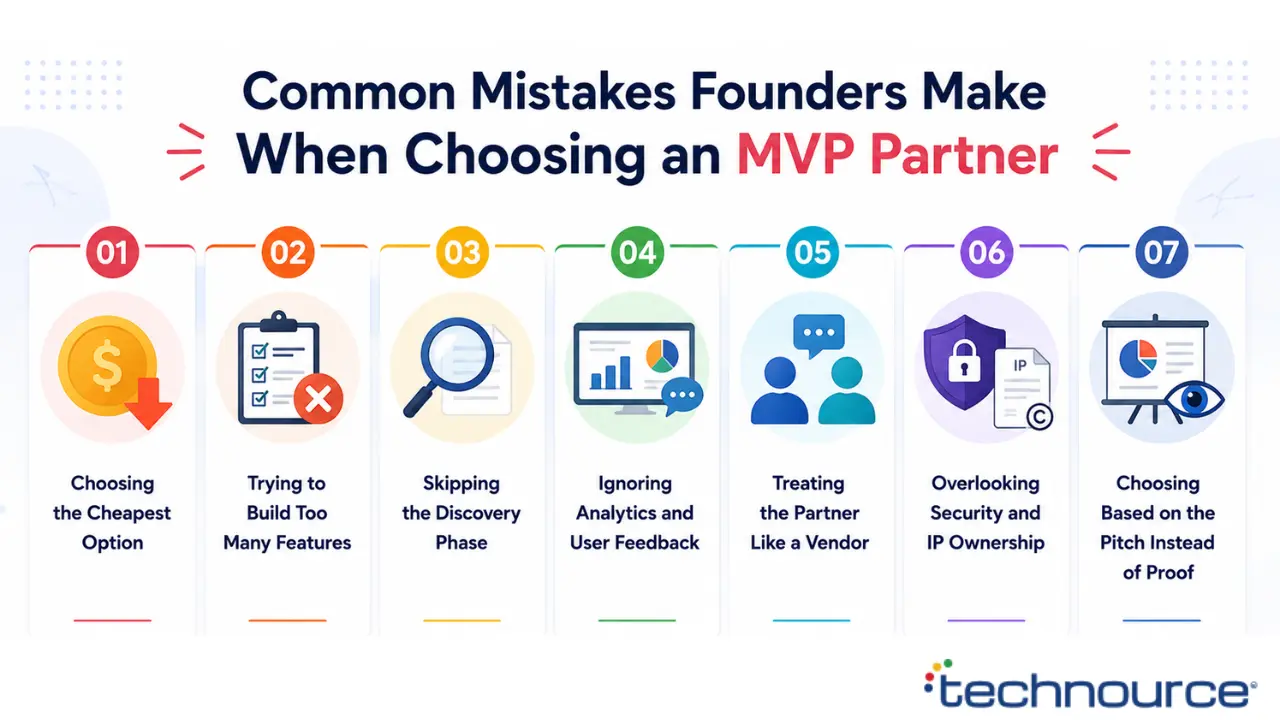
Common Mistakes Founders Make When Choosing an MVP Partner
Here are some common mistakes founders make when choosing an MVP partner, along with the solutions:
Mistake 1. Choosing the Cheapest Option
Many founders assume the lowest quote is the smartest choice. In reality, low-cost providers often cut corners on planning, development, testing, or support. This can lead to delays, poor product quality, and expensive fixes later.
Solution: Look beyond the price tag. Evaluate the partner’s experience, technical expertise, communication process, and past work. Paying a little more for a proven team is often cheaper than rebuilding a failed MVP.
Mistake 2. Trying to Build Too Many Features
A common mistake is treating an MVP like a complete product. Founders often include every feature they envision, which increases development time, costs, and complexity. The result is a slower launch and delayed user feedback.
Solution: Focus on the minimum set of features needed to solve the core problem and validate your idea. Launch quickly, gather feedback from real users, and add new features based on actual demand.
Mistake 3. Skipping the Discovery Phase
In an effort to save time, some founders jump directly into development without fully defining the product requirements. This often leads to confusion, scope changes, and costly rework later in the project.
Solution: Spend time on discovery before writing code. Clearly define your target audience, business goals, user journeys, key features, and success metrics. A strong foundation reduces risk and helps the project stay on track.
Mistake 4. Ignoring Analytics and User Feedback
The purpose of an MVP is to learn what users want. Without analytics and feedback systems, you have no way to measure user behavior or identify areas for improvement.
Solution: Make analytics and feedback collection part of the MVP from day one. Track user actions, monitor key metrics, and collect feedback regularly. These insights will help you make smarter product decisions and avoid guesswork.
Mistake 5. Treating the Partner Like a Vendor
Some founders view their development partner as a team that simply follows instructions. This limits collaboration and prevents them from benefiting from the partner’s technical and product expertise.
Solution: Treat your development partner as an extension of your team. Share your vision, goals, and challenges openly. The more context they have, the better they can contribute ideas, identify risks, and recommend improvements.
Mistake 6. Overlooking Security and IP Ownership
When founders focus only on development, important topics like security, confidentiality, compliance, and intellectual property ownership are often pushed aside until later. This can create legal and operational risks.
Solution: Discuss these topics before development begins. Ensure contracts clearly define code ownership, data protection responsibilities, compliance requirements, and confidentiality terms. Getting these details right early prevents problems in the future.
Mistake 7. Choosing Based on the Pitch Instead of Proof
A polished sales presentation can make any company look impressive. However, great presentations do not always translate into successful project delivery.
Solution: Ask for case studies, client references, and examples of products they have built. Speak with previous clients whenever possible. Real-world results and proven experience are much stronger indicators of success than marketing promises.
Why Technource Is a Reliable Software Development Partner for Your MVP
You are putting real time and money into your MVP, so the partner you choose has to deliver, not just advise.
At Technource, we help founders turn ideas into scalable digital products with AI-powered automation built in. Our approach maps directly to the criteria for selecting a reliable software development partner for an MVP.
13+ years of experience: A long track record of building SaaS platforms, marketplaces, and enterprise systems.
1,000+ projects delivered: Proven execution across industries and product stages.
70+ in-house experts: A full cross-functional team of engineers, designers, and strategists under one roof.
300+ clients served: Founders and enterprises across the US, UK, Canada, and beyond.
Outcome-driven delivery: Measurable results, like our SaaS pharmacy platform that achieved 65% faster approvals and 90% transparent onboarding.
Secure-by-design and scalable: Built to grow with you, with security and compliance from day one.
Conclusion
Choosing the right partner is one of the most important decisions in your product journey. The criteria for selecting a reliable software development partner for an MVP come down to proven experience, scope discipline, clear communication, and post-launch commitment.
Run a structured process, watch for the red flags, ask the hard questions, and score your options against real evidence rather than a polished pitch.
We hope this guide helped you understand the criteria for selecting a reliable software development partner for an MVP before you commit.
Now it is your turn to evaluate your options with confidence and move your idea forward. When you are ready, connect with our experts to turn your MVP into a product built to scale.
FAQs
Start by defining your problem, scope, and budget, then judge each partner against the criteria for selecting a reliable software development partner for an MVP. Shortlist three to five, run working sessions, check references, and score every option before you commit.
Most MVPs take around two to four months, though complex or regulated products can take longer. The timeline depends on feature scope, integrations, and how quickly you make decisions. A tight scope and a focused partner are the fastest way to launch.
A focused MVP often ranges from $15,000 to $50,000, while mid-level and complex builds cost more. The real driver is scope, not any single rate. Clear requirements and ruthless prioritization keep your MVP development cost under control.
Freelancers work for small, well-defined tasks, but an MVP usually needs a full cross-functional team and one accountable owner. An MVP development company gives you design, development, testing, and support under one roof, which reduces risk and keeps delivery on track.
The most common mistake is choosing a price or a polished pitch instead of proof. Cheap quotes often hide weak scope or junior teams. Always prioritize verifiable delivery, real references, and a clear process over the lowest number on the table.
Confirm ownership before development begins. Your contract should clearly state that you own the source code, data, and intellectual property, and every contributor should sign an NDA. Settling this on day one prevents costly disputes later.
A solid contract covers scope, milestones, pricing, timelines, IP ownership, confidentiality, and post-launch support. It should also define how scope changes and costs are handled. Clear terms upfront protect both your budget and your product.
Launch is the beginning, not the end. You collect real user feedback, fix issues, and improve the product based on data. A reliable partner stays involved with support, iteration, and a plan to scale as your user base grows.