

Blog Summary
This guide explains how loan management software development works in 2026 across origination, underwriting, and servicing. It covers the US rules that shape each stage, the integrations and tech stack lenders need, and what an MVP costs and how long it takes. You will also see three Technource case studies from lending and AI projects, each with measured results.
Key Takeaways
- Loan management software development costs $20,000–$30,000 for a mid-complexity MVP, $30,000–$50,000+ for a complex MVP, and $60,000–$100,000 for an enterprise MVP. An AI MVP that adds AI underwriting or collections costs $10,000–$50,000.
- An LMS MVP costs $20,000–$50,000+ and launches in 12–24 weeks. A full platform with multiple loan products and states takes 9–12+ months.
- AI underwriting must give specific reasons for every denial. ECOA and Regulation B adverse action rules still apply after the CFPB’s 2026 Regulation B changes.
- Manual work is expensive: mortgage lenders spent about $11,100 to produce each loan in 2025 (MBA, 2026).
- Technource builds delivered 65% faster loan processing (Cashguru), 60% faster onboarding (IDVerify AI), and a 70% reduction in human-agent dependency (VoiceMate AI).
Most lenders don’t run one loan system. They run an application portal, a spreadsheet for underwriting exceptions, and a servicing tool nobody fully trusts.
Loan management software development fixes that by putting origination, underwriting, and servicing on one loan record. According to Grand View Research, the digital lending platform market was worth about $13.1 billion in 2025 and is projected to grow about 29% a year from 2026 to 2033.
Margins leave little room for manual work. Mortgage lenders spent about $11,100 to produce each loan in 2025 and earned an average profit of $785 per loan (MBA, 2026).
Most lending platforms still fail for the same three reasons: a ledger that can’t reconcile, underwriting that can’t explain its decisions, and compliance added after launch.
What Is Loan Management Software Development?
Loan management software development is the process of designing and building a platform that runs the full loan lifecycle: origination, underwriting, servicing,g and collections. A custom build gives a lender one loan record, its own credit policy logic, and direct integrations with bureaus, banks, and payment rails.
Lending is one of the most rules-heavy areas of fintech software development, because every module touches money, credit data, or a regulated disclosure.
At Technource, we build these platforms with our AI development services and product engineering teams, so decisioning and automation sit in the core instead of being added later.
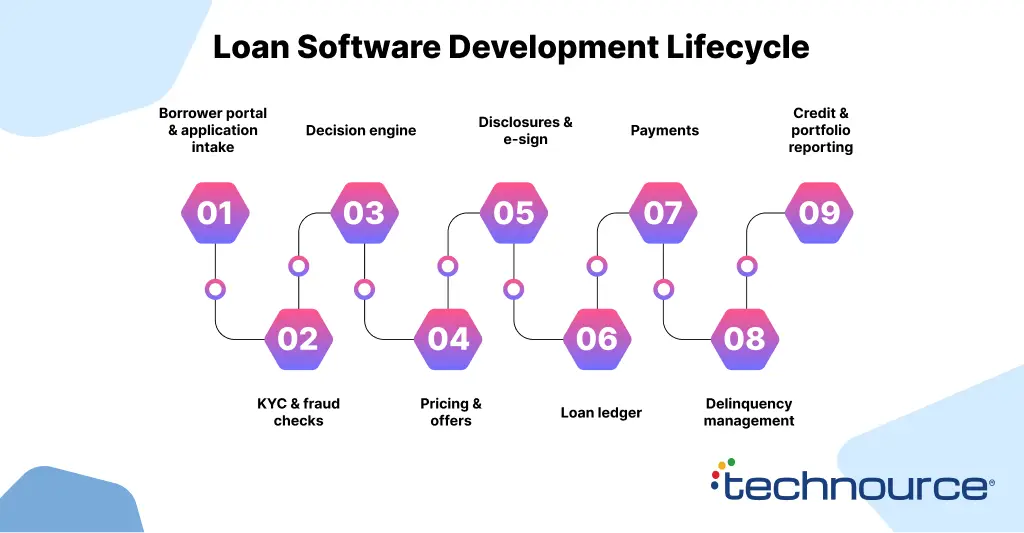
| Stage | Core Module | What It Does |
|---|---|---|
| Origination | Borrower portal and application intake | Captures applications, documents, consent, and identity data |
| Origination | KYC and fraud checks | Verifies identity and screens applicants against sanctions lists |
| Underwriting | Decision engine | Applies credit policy, scores risk, and returns approve, decline, or refer |
| Underwriting | Pricing and offers | Sets rate, term, and fees within policy and state limits |
| Closing | Disclosures and e-sign | Generates required disclosures and the signed loan agreement |
| Servicing | Loan ledger | Tracks principal, interest, fees, and every payment |
| Servicing | Payments | Runs ACH or card collection, autopay and payoff quotes |
| Collections | Delinquency management | Manages reminders, hardship plans and recovery workflows |
| Reporting | Credit and portfolio reporting | Furnishes bureau data and produces portfolio reports |
Why Are Lenders Investing in Custom Loan Management Software?
Lenders invest in custom loan management software to cut cost per loan, decide faster, and launch new loan products without waiting on a vendor’s roadmap. A custom platform also lets a lender own its credit policy logic and borrower data.
| Benefit | What Changes | How It Works |
|---|---|---|
| Faster decisions | Minutes instead of days for standard applications | The decision engine auto-approves or declines files that meet policy |
| Lower cost per loan | Less manual review, data entry, and rework | Automated data pulls, document extraction and straight-through processing |
| Product agility | New loan types launch as configuration | Loan products are defined by rules, not hard-coded |
| Accurate servicing | Fewer payment and interest errors | A double-entry ledger with daily accrual and reconciliation |
| Audit readiness | Every decision has a trail | Versioned policies, decision logs and reason codes |
| Data ownership | The lender controls borrower and performance data | Own database and analytics, with no per-loan license fees |
Adoption is still early, which leaves room to stand out. Only 21% of community banks and credit unions use AI in underwriting or risk review, while 66% rank fraud detection as a top AI priority (MeridianLink, 2026).
Benefits for Lenders and Credit Teams
Credit, operations, and compliance teams gain the most from one loan platform, because most of their manual work comes from switching between systems.
- Fewer manual touches: underwriters review only referred files, not every application.
- One view of risk: origination, payment, and delinquency data sit on the same loan record.
- Faster audits: examiners get decision logs, disclosures, and payment history from one system.
Benefits for Borrowers
Borrowers judge a lender on speed and clarity, and a custom platform improves both from application to payoff.
- Faster answers: most applicants with complete data get a decision in the same session.
- Self-service: borrowers check balances, schedule payments, and download statements without calling.
- Clear reasons: declined applicants receive specific reasons they can act on.
Planning a lending platform but not sure where to start?

LOS vs LMS: What’s the Difference?
A loan origination system (LOS) handles everything before funding: application, verification, underwriting, and closing. A loan management system (LMS) handles everything after funding: the ledger, payments, statements, delinquency, and payoff.
| Criteria | LOS | LMS |
|---|---|---|
| Lifecycle stage | Application to funding | Funding to payoff |
| Core users | Borrowers, loan officers, underwriters | Servicing, collections, and finance teams |
| Key data | Application, credit report, documents | Balances, payments, accruals, delinquency |
| Typical integrations | Credit bureaus, KYC, bank data, e-sign | ACH processors, card gateways, accounting, bureau reporting |
| Main risk | A wrong or unexplained credit decision | A wrong balance, fee, or interest charge |
| Main US rules | TILA/Regulation Z, ECOA/Regulation B, FCRA | FCRA furnishing, Regulation F, SCRA, state servicing rules |
Technource’s Recommendation
Build the LOS and LMS as separate services that share one loan ID and one borrower record. Separate services let you change underwriting policy without touching the ledger, and the shared ID keeps origination data available for servicing, collections, and reporting.
What Are the Main Types of Loan Management Software?
Loan management software comes in seven main types: consumer installment, BNPL, mortgage, commercial and SBA, credit union, marketplace, and microfinance platforms. Each type differs in loan structure, users, and compliance load.
| Type | Typical Lender | Core Need |
|---|---|---|
| Consumer installment | Online lenders, banks | Fast decisions, autopay, adverse action notices |
| Buy now, pay later | Merchants, BNPL providers | Checkout integration, short schedules, merchant settlement |
| Mortgage | Mortgage lenders and servicers | Escrow, investor reporting, long amortization |
| Commercial and SBA | Banks, CDFIs, alternative lenders | Covenant tracking, collateral, cash-flow analysis |
| Credit union | Credit unions | Member data, core banking integration, multiple products |
| Marketplace and P2P | Loan marketplaces | Lender matching, offer comparison, fee splits |
| Microfinance | MFIs, community lenders | Small-ticket loans, group lending, field collections |
How Does Loan Origination Software Work?
Loan origination software takes a borrower from application to a funded loan in five steps: application intake, identity and fraud checks, data collection, underwriting, and closing. A well-built origination flow can complete the first four steps in a single session for a standard consumer application.
| Feature | Who Uses It | Why It Matters |
|---|---|---|
| Pre-qualification with a soft pull | Borrowers | Shows likely offers without affecting credit scores |
| Digital application and e-consent | Borrowers | Captures data and consent once for every downstream step |
| Identity verification and OFAC screening | Compliance team | Stops synthetic and stolen identities before a hard pull |
| Bank data and income verification | Underwriters | Replaces paystub uploads with verified cash-flow data |
| Document upload and extraction | Loan officers | Pulls fields from IDs, statements, and tax forms automatically |
| Loan officer workspace | Loan officers | Shows conditions, notes and next actions in one queue |
| Disclosures and e-sign | Borrowers, compliance | Produces required disclosures and a signed agreement |
Borrower Onboarding, KYC and Identity Checks
Onboarding sets your fraud loss and your conversion rate at the same time. Strong flows verify identity with a document scan, selfie, and liveness check, then screen the applicant against sanctions lists before any hard credit pull.
In the IDVerify AI project, document scanning, OCR, face matching, and liveness detection ran in one pipeline, which made onboarding for new users 60% faster.
Application Intake, Bank Data and Document Collection
Ask only for data you will use. Every extra field lowers completion, and most income and identity data can come from bank connections or bureaus.
Store each borrower’s consent with a timestamp for every data source. Auditors will ask for it, and open banking rules may change how consent must work.
How Does Automated Loan Underwriting Work?
Automated loan underwriting uses a decision engine to apply the lender’s credit policy to application, bureau, and bank data, then returns approve, decline, or refer in seconds. Every decision should be stored with its policy version, input data, and the specific reasons behind it.
| Component | What It Does | Risk |
|---|---|---|
| Knockout rules | Declines files that fail hard policy, such as state or fraud flags | Rules drifting from the written credit policy |
| Credit scoring | Scores risk from bureau and application data | Outdated models that misprice risk |
| Cash-flow analysis | Reads income and spending from bank data | Errors from miscategorized transactions |
| Affordability checks | Calculates debt-to-income and payment capacity | Approving loans borrowers can’t repay |
| Pricing engine | Sets rate, term, and fees by risk tier | Breaching state rate caps |
| Manual review queue | Routes edge cases to underwriters | Backlogs that slow decisions |
| Reason codes | Records specific reasons for each decline | Vague reasons that fail adverse action rules |
Rules-Based vs Machine Learning Underwriting
Rules-based underwriting is transparent and fast to launch, which makes it the right start for a new loan product with little performance data. Machine learning models add predictive power once you have enough repayment history to train and validate them.
Most lenders end up running both: rules for policy and compliance, and ML scores as one input to the decision.
Explainability and Adverse Action Notices
Under ECOA and Regulation B, a lender must give a declined applicant the specific principal reasons for the decision. An ML model that can’t produce those reasons isn’t ready for consumer credit decisions.
Build reason codes into the model from day one, using explainability methods such as SHAP values mapped to plain-language reasons. Test every notice template before launch, not after the first complaint.
What Does Loan Servicing Software Handle?
Loan servicing software manages a loan from funding to payoff: the ledger, payment collection, interest accrual, statements, delinquency, and payoff quotes. Servicing is where most lending platforms break, because one rounding or allocation error repeats across every loan.
| Feature | Who Uses It | Why It Matters |
|---|---|---|
| Loan ledger | Finance, servicing | The single source of truth for every balance |
| Amortization and accrual | System | Calculates daily interest and builds payment schedules |
| Payment processing | Borrowers, servicing | Collects ACH and card payments with autopay and retries |
| Payment allocation | System | Applies payments to fees, interest, and principal in order |
| Borrower portal | Borrowers | Balances, statements, payoff quotes and payment changes |
| Modifications and hardship | Servicing team | Deferrals, re-amortization and payment plans |
| Bureau reporting | Compliance | Furnishes monthly data in Metro 2 format |
Amortization, Interest Accrual and the Payment Waterfall
Design the ledger before any screen. Use double-entry accounting, store amounts as integers in cents, and accrue interest daily with one fixed day-count convention.
The payment waterfall decides whether a payment covers fees, interest, or principal first. Make it configurable per loan product, because state rules and loan agreements differ.
Collections and Delinquency Management
Collections works best when it starts before a payment is missed. Pre-due reminders, flexible payment dates, and self-service hardship plans reduce roll rates at a lower cost than calls after 30 days.
AI voice agents in lending now handle pre-due reminders, payment promises, and balance questions, with handoff to a person for disputes or hardship.
In the VoiceMate AI project, a multilingual voice agent with instant human transfer cut human-agent dependency by 70%.
Which AI Features Are Worth Building Into Loan Management Software?
The AI features worth building first are document extraction, fraud detection, cash-flow underwriting, and collections automation, because each one cuts manual work on every loan. Features that make or explain credit decisions need the strongest governance.
| AI Feature | What It Does | Risk / Impact |
|---|---|---|
| Document extraction | Reads IDs, bank statements, and tax forms | High impact, low risk; keep human review for low-confidence fields |
| Fraud and identity scoring | Flags synthetic IDs, deepfakes, and loan stacking | High impact; tune it to avoid blocking good applicants |
| Cash-flow underwriting | Scores income and spending from bank data | Medium risk; needs explainable reason codes |
| ML credit scoring | Predicts default risk | Highest risk; needs validation, monitoring, and adverse action reasons |
| Collections voice and chat agents | Handle reminders, promises and FAQs | Medium risk; must follow call limits and consent rules |
| Servicing copilot | Summarizes borrower history for agents | Low risk; saves handle time |
| Portfolio early warning | Predicts which loans will roll delinquent | Medium impact; drives earlier outreach |
Collections and servicing are the usual starting point for AI agent development, because results show up within weeks and credit decisions stay with the policy engine.
Plan for governance from the start. In a 2026 AARMR, MBA, and BCG survey of 31 mortgage lenders and servicers, 87% had written AI policies but only 58% monitored their AI systems on an ongoing basis (HousingWire, 2026).
Want AI underwriting that explains every decision?

Which US Regulations Apply to Loan Management Software?
US loan management software must support TILA/Regulation Z disclosures, ECOA/Regulation B fair lending and adverse action rules, FCRA, GLBA privacy and security, and state licensing and rate limits. Servicing and collections add Regulation F, the TCPA, the SCRA, and accurate credit reporting.
This section is general information, not legal or regulatory advice. Confirm your obligations with qualified counsel for each state and loan product.
| Regulation or Standard | Lifecycle Stage | Key Requirement |
|---|---|---|
| TILA / Regulation Z | Origination | Disclose APR, finance charge, and payment schedule before the loan is signed |
| ECOA / Regulation B | Underwriting | No discrimination on prohibited bases; adverse action notice with specific reasons within 30 days of a completed application |
| FCRA | Underwriting, servicing | Permissible purpose for credit pulls, accurate furnishing and notices when a report affects the decision |
| GLBA | All stages | Privacy notices and an information security program for customer data |
| BSA/AML and OFAC | Origination | Identity verification, sanctions screening and suspicious activity monitoring |
| FDCPA / Regulation F | Collections | Call frequency and communication rules, mainly for third-party collectors |
| TCPA | Servicing, collections | Prior consent for autodialed, prerecorded, or AI-voice calls and texts |
| SCRA | Servicing | 6% interest cap and other protections for eligible service members |
| Metro 2 format | Servicing | Industry standard for furnishing loan data to credit bureaus |
| State licensing and rate caps | All stages | Lender licenses, usury limits and fee rules vary by state |
What Changed in 2026
The CFPB amended Regulation B in April 2026 and removed its disparate-impact (“effects test”) language, effective July 21, 2026 (CFPB). The adverse action notice requirement did not change, and state fair lending laws and the Fair Housing Act may still apply disparate-impact standards (Cooley, 2026). Fair lending groups have filed two federal lawsuits challenging the amendments, but the rule remains in effect while the cases proceed (Troutman Pepper Locke, 2026).
Open banking rules are also unsettled. A federal court has blocked CFPB enforcement of the Section 1033 rule while the Bureau reconsiders it (Cozen O’Connor, 2026).
The CFPB sent a revised Section 1033 proposal to the White House regulatory review office in August 2026 (Consumer Finance Monitor, 2026). Build bank-data connections so consent, data scope, and revocation are configurable, whatever the final rule says.
What Integrations Does Loan Management Software Need?
Loan management software needs integrations with credit bureaus, identity verification, bank data, payment rails, e-signature, accounting, and CRM tools. A typical consumer lending MVP connects 6–8 of these services before launch.
| Integration | Standard or Tool | Typical Use |
|---|---|---|
| Credit bureaus | Experian, Equifax and TransUnion APIs | Soft and hard pulls, credit attributes |
| Identity and fraud | KYC/IDV providers, OFAC lists | Document, selfie and sanctions checks |
| Bank data | Open banking aggregators such as Plaid or MX | Account ownership, balances, cash flow |
| Payments | ACH through NACHA-compliant processors, card gateways | Disbursement, autopay, payoff |
| E-signature | DocuSign or similar | Signed loan agreements and disclosures |
| Accounting | QuickBooks, NetSuite | General ledger sync and reconciliation |
| CRM and messaging | Salesforce, HubSpot, Twilio | Leads, SMS and email notices |
| Bureau reporting | Metro 2 files | Monthly furnishing to credit bureaus |
| Core banking | Bank or credit union core APIs | Member data and deposit-linked products |
What Tech Stack Is Best for Loan Management Software?
Most loan management platforms in 2026 use a Node.js, Python, or Go backend, PostgreSQL for the ledger, React or Next.js for web portals, Flutter or React Native for mobile, and AWS, Azure, or Google Cloud for hosting. The ledger and decision engine design matter more than the framework choice.
| Layer | Common Choices | Note |
|---|---|---|
| Backend | Node.js, Python, Go | Python suits ML scoring; Node.js or Go suits high-volume APIs |
| Ledger database | PostgreSQL | ACID transactions and double-entry tables |
| Cache and queues | Redis, Kafka, RabbitMQ | Event-driven payments, notices and retries |
| Decision engine | Rules engine plus Python ML services | Versioned policies and reason codes |
| Web frontend | React, Next.js | Borrower portal and back-office console |
| Mobile | Flutter, React Native | One codebase for iOS and Android |
| Cloud | AWS, Azure, Google Cloud | Managed key management and encryption |
| Security and monitoring | SSO, MFA, audit logging, SIEM | Supports SOC 2 audits and exam requests |
How to Build Loan Management Software: Step-by-Step
Building loan management software takes six steps, and an LMS MVP reaches launch in 12–24 weeks. Steps 1–5 cover the MVP; step 6 continues after launch.
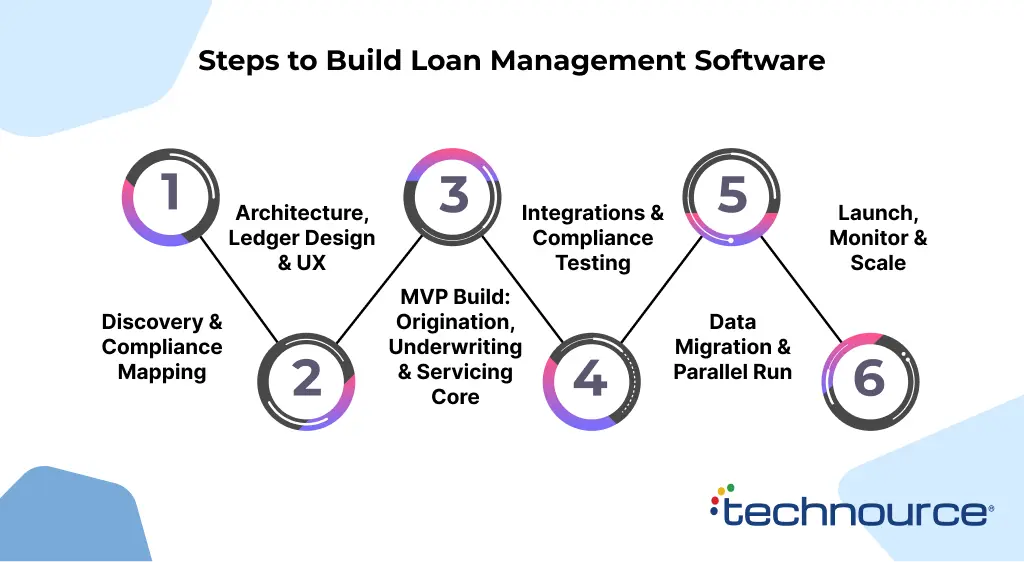
Step 1: Discovery and Compliance Mapping (1–2 Weeks)
Define the first loan product, target states, borrower journey, and credit policy. Map every disclosure, notice, and license the product triggers before design starts.
The output is a product spec, a compliance matrix, and a prioritized feature list.
Step 2: Architecture, Ledger Design and UX (1–2 Weeks)
Design the ledger, loan states, payment waterfall, and data model first. Then design borrower and back-office screens around those states.
Decide build or buy for each integration in this step, not during development.
Step 3: MVP Build: Origination, Underwriting and Servicing Core (8–12 Weeks)
Build the application flow, decision engine, ledger, payments, and borrower portal in two-week sprints. Demo working software at the end of every sprint.
Limit the first release to one loan product and a small group of states. That focus keeps MVP development services for lenders within 8–12 weeks of build time.
Step 4: Integrations and Compliance Testing (1–6 Weeks)
Connect bureaus, KYC, bank data, payments, and e-sign in sandbox, then in production. Test disclosures, adverse action notices, interest calculations, and payment allocation against written test cases.
Run a security test and fix every critical finding before launch.
Step 5: Data Migration and Parallel Run (1–2 Weeks)
Lenders moving from another LMS or spreadsheets migrate active loans and run both systems in parallel until balances match to the cent. Specialist data migration services help when loan history, payments, and documents sit in several systems.
New lenders without an existing book use this step for a pilot with a small group of real borrowers.
Step 6: Launch, Monitor and Scale (Ongoing)
Track KPIs from day one, review decline reasons weekly, and add loan products and states as configuration. A full platform with multiple products and states takes 9–12+ months.
How Much Does Loan Management Software Development Cost?
Loan management software development for a mid-complexity MVP costs $20,000–$30,000, while a complex MVP costs $30,000–$50,000+ and an enterprise MVP $60,000–$100,000. An AI MVP for underwriting or collections costs $10,000–$50,000, and a PoC starts at $3,000.
| Build Type | Typical Scope | Cost (USD) | Timeline |
|---|---|---|---|
| PoC | One decision engine or servicing calculation tested on sample data | $3,000–$8,000 | 1–3 weeks |
| Prototype | Clickable borrower and back-office flows for investor or partner demos | $6,000–$12,000 | 2–4 weeks |
| Mid-complexity MVP | One loan product with application, rules-based underwriting, ledger and ACH payments | $20,000–$30,000 | 12–16 weeks |
| Complex MVP | Several products or states, bureau and bank data, collections workflows | $30,000–$50,000+ | 16–24 weeks |
| AI MVP | AI underwriting, document extraction, or a collections agent added to a loan platform | $10,000–$50,000 | 8–24 weeks |
| Enterprise MVP | Core banking integration, multi-role back office, audit and reporting suite | $60,000–$100,000 | 24–36 weeks |
| Full platform | Multiple loan products, states and channels at scale | From $100,000 | 9–12+ months |
Lending MVPs sit at the upper end of general MVP development cost ranges, because every regulated integration and disclosure adds build and test time.
What Drives Loan Management Software Cost?
Loan management software cost depends mostly on how many loan products, states, and integrations the platform supports. AI underwriting, migration, and security audits add further scope.
| Cost Driver | Why It Adds Cost |
|---|---|
| Number of loan products | Each product adds rules, schedules, and disclosures |
| Number of states | State rate caps, fees and licenses need configuration and testing |
| Integrations | Each bureau, KYC, bank data, or payment API needs build, testing, and monitoring |
| AI underwriting | Model training, validation, and reason codes add data science work |
| Migration | Moving active loans needs mapping, reconciliation, and a parallel run |
| Security and audits | Penetration testing and SOC 2 readiness add scope |
Hidden and Ongoing Costs to Budget
Loan management software keeps costing money after launch, mainly through vendor fees, compliance work, and hosting.
- Per-use data fees: credit pulls, KYC checks, and bank data connections are usually charged per call.
- Payment processing: ACH and card fees scale with loan volume.
- Compliance upkeep: rule changes, state license renewals and annual audits.
- Cloud and monitoring: hosting, logging and backups grow with the portfolio.
- Model monitoring: AI models need drift checks and periodic revalidation.
These costs depend on volume, vendors, and states, so budget them per loan rather than as a fixed annual figure.
Want a cost range for your loan product, integrations, and states?
Build vs Buy: Should You Build Custom Loan Management Software?
Build custom loan management software when lending is your core product, your credit policy is a differentiator, or per-loan license fees will outgrow the cost of running your own platform. Buy an off-the-shelf LMS when you need a standard loan product live within weeks and can accept the vendor’s roadmap.
| Factor | Custom Build | Off-the-Shelf | Hybrid |
|---|---|---|---|
| Time to launch | 12–24 weeks for an MVP | Weeks after configuration | Between the two |
| Upfront cost | MVP tiers in the cost table | Setup fees plus licenses | Lower build cost plus licenses |
| Ongoing cost | Hosting and maintenance | Per-loan or per-account fees | Both |
| Credit policy control | Full | Limited to vendor settings | Full on the decision layer |
| Data ownership | Full | Shared with the vendor | Full on custom parts |
| Product flexibility | Any loan structure | Vendor-supported products only | Custom front end, vendor ledger |
The trade-offs mirror the wider SaaS vs custom software decision, but lending adds per-loan fees that compound as the book grows.
Technource’s Recommendation
Start hybrid if you are testing a new loan product: build your own borrower experience and decision engine, and run a vendor ledger behind them. Move to a custom LMS once per-loan license fees exceed what a custom platform would cost to run each year.
What Are the Biggest Challenges in Loan Management Software Development?
The biggest challenges in loan management software development are ledger accuracy, explainable underwriting, state-by-state compliance, legacy data migration, and fraud. Each one costs less to solve in the architecture than after launch.
| Challenge | Real Consequence | How to Solve It |
|---|---|---|
| Ledger errors | Wrong balances, refunds and exam findings | Double-entry ledger, integer amounts, daily reconciliation |
| Unexplainable decisions | Adverse action notices that fail review | Reason codes and model explainability from day one |
| State variation | Rate cap or fee violations | State rules as configuration, with test cases per state |
| Legacy migration | Balance mismatches after cutover | Field mapping, reconciliation reports and a parallel run |
| Synthetic and deepfake fraud | First-payment defaults and losses | Document, liveness and bank-account ownership checks |
| AI governance gaps | Model drift nobody notices | Ongoing monitoring, named owners and a revalidation schedule |
| Vendor dependency | An outage stops originations | Fallback providers and circuit breakers for critical APIs |
Common Mistakes to Avoid in Loan Management Software Development
Most lending platform failures trace back to seven early decisions. Avoid these mistakes before the first sprint.
- Building screens before the ledger: the data model bends around the UI, and accrual bugs follow.
- Hard-coding loan products: every new product becomes a development project instead of a configuration change.
- Treating compliance as a launch checklist: disclosures and notices belong in the flows, not in the last sprint.
- Using floating-point math for money: small rounding errors repeat across every loan and payment.
- Launching ML underwriting without reason codes: a model that can’t explain a decline can’t support adverse action notices.
- Skipping the parallel run: migration errors surface as borrower complaints instead of test failures.
- Leaving servicing out of the MVP: a loan you can originate but not service correctly is a liability.
Which KPIs Should Lenders Track After Launch?
Lenders should track time to decision, straight-through rate, approval rate, application completion, cost per loan, first-payment default, 30+ days past due, and cure rate after launch. These eight KPIs show speed, efficiency, and credit quality together.
| KPI | What It Shows | How to Measure |
|---|---|---|
| Time to decision | Origination speed | Minutes from submitted application to decision |
| Straight-through rate | Automation level | Share of applications decided with no manual touch |
| Approval rate | Policy fit and demand quality | Approved applications ÷ completed applications |
| Application completion rate | Borrower experience | Completed applications ÷ started applications |
| Cost per loan | Operational efficiency | Total origination cost ÷ funded loans |
| First-payment default | Fraud and underwriting quality | Loans missing the first payment ÷ funded loans |
| 30+ days past due | Portfolio health | Balance 30+ days past due ÷ total balance |
| Cure rate | Collections effectiveness | Delinquent loans returned to current ÷ delinquent loans |
How to Choose a Loan Management Software Development Company
Choose a loan management software development company that has shipped lending or fintech products, can explain how it builds a ledger and adverse action reasons, and hands over code and documentation you own. Ask for case studies with measured results, not feature lists.
| Question to Ask | Good Answer | Red Flag |
|---|---|---|
| How do you design the loan ledger? | Double-entry, integer amounts, daily reconciliation | “The database handles it” |
| How do you produce adverse action reasons? | Reason codes mapped to policy and model outputs | No answer, or “the model decides” |
| Which compliance rules have you built for? | Names specific rules and states | “We follow all regulations” |
| How do you handle state variation? | Rules as configuration, with test cases | Separate code per state |
| Who owns the code and data? | You do, with full documentation | Vendor-locked components |
| What does support look like after launch? | Defined SLAs, monitoring, and a release plan | Ad hoc fixes only |
Technource has 14+ years of product engineering experience and a 4.9/5 rating on Clutch. Clients also rate Technource 4.9/5 on GoodFirms.
What Are the Future Trends in Loan Management Software?
The main trends shaping loan management software through 2027 are AI agents in servicing, cash-flow underwriting, embedded lending, instant disbursement, and stricter AI model governance. Each one changes what a new platform should support from day one.
AI Agents Across Underwriting and Servicing
AI agents are moving from chat widgets to task owners that collect documents, chase conditions, and record payment promises. This is the next phase of AI in fintech, and lenders with clear handoff rules and audit logs will adopt it fastest.
Cash-Flow Underwriting and Open Banking
Bank transaction data lets lenders score thin-file borrowers that bureau scores miss. Data rights rules are still being rewritten, so build consent and data-source logic that can adapt.
Embedded Lending and BNPL
More credit is offered inside checkout flows, SaaS platforms, and marketplaces. An API-first LMS lets partners originate loans without building their own back office.
Instant Disbursement on Real-Time Payment Rails
Real-time payment rails such as FedNow and RTP let lenders fund loans in seconds instead of days. Build disbursement as its own service so new rails can be added without touching the ledger.
Model Governance for AI Credit Decisions
State examiners and loan investors increasingly ask for AI policies, monitoring evidence, and model records. Platforms that log model versions, inputs, and outputs by default pass these reviews with less rework.
How Technource Delivers Measurable Results in Lending Software
Technource has built lending, identity verification, and AI agent products that map directly to the loan lifecycle. These three projects cover origination, onboarding, and servicing.
How Technource Built Cashguru, a Digital Loan Marketplace With 65% Faster Loan Processing
We built Cashguru, a B2C digital loan marketplace in Singapore that connects borrowers with licensed money lenders. The client wanted borrowers to compare offers in one place instead of visiting lenders one by one, while handling sensitive personal data under strict government protocols.
We mapped real lending logic with financial experts into a modular backend and integrated Singapore’s MyInfo service for verified borrower data. The platform includes lender eligibility rules, real-time offer matching, encrypted borrower–lender chat and an admin dashboard, built with Laravel, MySQL, MyInfo and Stripe.
Measurable Result
- 65% faster loan processing.
- 50% increase in borrower–lender match rate.
- 40% reduction in operational overhead.
- 30% higher borrower engagement.
How Technource Built IDVerify AI, an Identity Verification Module That Speeds Onboarding by 60%
We built IDVerify AI, an AI identity verification module, for a client that needed to automate identity checks inside its existing platform. Manual KYC and ID reviews slowed onboarding and left room for forged documents.
The module combines document scanning, forgery detection, OCR text extraction, facial recognition and liveness detection in one plug-and-play pipeline. We built it with Node.js, TypeScript, Next.js, MySQL, Redis and AWS.
Measurable Result
- 60% faster onboarding for new users.
- Manual KYC and ID checks replaced with AI-driven automation.
- Altered or fake documents flagged through optical variance checks.
- One plug-and-play module that adapts to other platforms and workflows.
How Technource Built VoiceMate AI, a Multilingual Voice Agent That Cuts Human Agent Dependency by 70%
We built VoiceMate AI, a multilingual AI voice agent, for an enterprise client in Greece that needed to automate inbound customer calls inside Microsoft Teams without robotic, laggy conversations.
The agent runs on Azure Communication Services with ElevenLabs speech, intent detection, smart routing and instant transfer to a person on request. Call recordings auto-delete after 15 days to support GDPR requirements. For lenders, the same intent detection, human handoff and limited retention can be applied to payment reminder and servicing calls.
Measurable Result
- 70% reduction in human-agent dependency.
- 80% faster response time for customer inquiries.
Technource’s Approach to Loan Management Software
Technource follows five principles on every lending build, and each one prevents a failure covered earlier in this guide.
- Ledger first: we design the loan ledger, loan states and payment waterfall before any screen.
- Every decision explained: each approval or decline is stored with its policy version, inputs and reason codes.
- Compliance as configuration: state rates, fees and disclosures live in rules, so a new state doesn’t need new code.
- One loan ID across the lifecycle: origination, servicing and collections share one borrower and loan record.
- Narrow launch, then expand: one product and a few states first, with more products once KPIs hold.
Conclusion
Three decisions shape loan management software development: whether the LOS and LMS share one loan record, whether every credit decision can be explained, and whether you launch with an MVP or a full platform.
Get those right, and an LMS MVP can go live in 12–24 weeks with costs you can plan.
Technource builds lending platforms as an AI-powered product engineering company, with a fintech software development company team that covers origination, underwriting and servicing.
If you are ready to scope your loan platform, contact us for a short consultation on your compliance path, budget and timeline.
Ready to turn your lending idea into a compliant platform?
Frequently Asked Questions
A mid-complexity MVP of loan management software costs $20,000–$30,000, a complex MVP $30,000–$50,000+ and an enterprise MVP $60,000–$100,000. An AI MVP for underwriting or collections costs $10,000–$50,000. Costs rise with the number of loan products, states and integrations, and per-use fees for credit pulls, KYC checks and payments come on top. An LMS MVP takes 12–24 weeks: 1–2 weeks of discovery, 1–2 weeks of architecture and UX, 8–12 weeks of build, 1–6 weeks of integration and compliance testing, and 1–2 weeks for migration or a pilot. A full platform with multiple loan products and states takes 9–12+ months. A loan origination system (LOS) covers five steps up to funding: intake, identity checks, data collection, underwriting and closing. A loan management system (LMS) covers the ledger, payments, statements, delinquency and payoff after funding. Most lenders need both, and the best setup shares one loan ID so origination data flows into servicing. Yes, if the lender can explain each decision. ECOA and Regulation B require specific principal reasons for every adverse action, and the CFPB’s 2026 Regulation B changes did not remove that rule. Use reason codes, document and monitor the model after launch, and keep a human review queue for edge cases. Most US consumer lending platforms must support TILA/Regulation Z disclosures, ECOA/Regulation B adverse action notices, FCRA, GLBA, BSA/AML and OFAC checks, and state licensing and rate caps. Servicing adds the TCPA, Metro 2 reporting and the SCRA’s 6% interest cap for eligible servicemembers. Confirm exact obligations with counsel for each state. Buy an off-the-shelf LMS if you need a standard loan product live within weeks. Build custom if lending is your core product or your credit policy is a differentiator; a custom MVP takes 12–24 weeks. A hybrid suits new products: your own borrower experience and decision engine on a vendor ledger, until per-loan fees outgrow it. An LMS MVP should include a borrower application, identity and fraud checks, a rules-based decision engine, required disclosures and e-sign, a double-entry loan ledger, ACH payments with autopay, a borrower portal and basic delinquency workflows. A mid-complexity MVP with one loan product costs $20,000–$30,000 and takes 12–16 weeks. Most loan platforms use a Node.js, Python or Go backend, PostgreSQL for the ledger, Redis plus Kafka or RabbitMQ for events, React or Next.js for web portals and Flutter or React Native for mobile, hosted on AWS, Azure or Google Cloud. An LMS MVP on this stack launches in 12–24 weeks. Map every field, migrate active loans with full payment history, and run both systems in parallel until balances match to the cent. The migration and parallel-run step takes 1–2 weeks for an MVP-sized book. Test payoff quotes and interest accruals on sample loans first, and keep the old system read-only for audits. Ongoing costs depend on loan volume, vendors and states rather than a fixed annual fee. Budget for per-use credit pulls and KYC checks, payment processing, cloud hosting, compliance updates, security testing and AI model monitoring. Track cost per loan, one of the eight KPIs worth monitoring after launch, to see whether automation pays off.
Related Insights and Articles