

Blog Summary
This guide explains how to build an AI fraud detection system in 2026, from architecture and model choice to the data you need before training. It covers US compliance rules, a seven-step build plan, and costs from a $3,000 PoC to a $100,000 enterprise MVP. You will also see how Technource built IDVerify AI, an identity verification module that cut manual KYC time by 90%, and Cashguru, a lending marketplace that processes loans 65% faster.
Key Takeaways
- An AI fraud detection system costs $3,000–$8,000 for a PoC, $10,000–$50,000 for an AI MVP, and $60,000–$100,000 for an enterprise MVP.
- A PoC takes 3–4 weeks. An AI MVP takes 16–24 weeks, including 2–4 weeks in shadow mode, and an enterprise MVP takes 24+ weeks.
- Combine rules with machine learning, run every new model in shadow mode before it blocks payments, and log a reason code for every decision.
- Every $1 of fraud now costs US financial services firms $5.47 in total, up from $4.00 in 2021 (LexisNexis Risk Solutions, 2026).
- Technource’s IDVerify AI cut manual KYC verification time by 90%, and its Cashguru lending marketplace processes loans 65% faster.
Fraud teams must approve or block a payment in a fraction of a second, with partial data and no second chance.
An AI fraud detection system makes that call by scoring every event against patterns learned from your own history.
The pressure keeps rising. US consumers reported $15.9 billion in fraud losses in 2025, up from over $12 billion the year before (FTC, 2026).
Budgets are following the losses. According to MarketsandMarkets, the fraud detection and prevention market will grow from about $36 billion in 2026 to about $80 billion by 2031.
Yet many in-house fraud models stall before launch. Teams train on immature labels, block good customers on day one, or ship a model with no review workflow around it.
What Is an AI Fraud Detection System?
An AI fraud detection system is software that scores every transaction, login, or application for fraud risk in real time, usually in under 100 milliseconds, and then approves, challenges, or blocks it. Machine learning models learn fraud patterns from your historical data, while rules handle known threats and regulatory blocks.
Unlike a static rules engine, the system improves as analysts confirm or clear cases. Each confirmed outcome feeds the next model version.
Most companies build one as a custom layer on top of their payment, lending or checkout stack, often with a partner for AI development services.
How the System Decides: Approve, Challenge or Block
Every event passes through the same short path:
- Score: the model returns a risk score between 0 and 1, plus the top reasons behind it.
- Decide: the decision engine compares the score with thresholds and business rules.
- Act: low-risk events pass, medium-risk events get a step-up check such as a one-time code, and high-risk events are blocked or sent to review.
- Learn: analyst outcomes and chargebacks flow back as labels for retraining.
The challenge tier matters most. Step-up checks stop fraud without declining customers who only look unusual.
Why Are FinTech and eCommerce Companies Investing in AI Fraud Detection?
FinTech and eCommerce companies invest in AI fraud detection because rules alone miss new fraud patterns and decline too many good customers. AI scoring cuts fraud losses and false declines at the same time, which protects both revenue and trust.
| Benefit | What Changes | How It Works |
|---|---|---|
| Lower fraud losses | Fraud is stopped before money moves | Real-time scoring inside the payment or transfer flow |
| Fewer false declines | Good customers get approved | Models weigh context instead of single hard limits |
| Smaller review queues | Analysts see only risky cases, ranked | Risk scores plus reason codes for each alert |
| Faster onboarding | Low-risk users pass instantly | AI identity checks with step-up only when needed |
| Faster response to new fraud | New patterns are caught in weeks, not quarters | Retraining on confirmed cases and analyst feedback |
| Audit-ready decisions | Every outcome can be explained | Logged reason codes and model versions |
The cost of fraud goes far beyond the stolen amount. Every $1 of fraud costs US financial services firms $5.47 once fees, recovery work and lost customers are counted (LexisNexis Risk Solutions, 2026).
Retail faces the same multiplier. The total cost of fraud now exceeds $5 for every $1 of direct loss for retail and eCommerce businesses in the US and Canada (LexisNexis, 2026).
Benefits for Fraud and Risk Teams
- Ranked queues: analysts start with the riskiest cases instead of the oldest ones.
- Reason codes: each alert shows why it fired, which shortens investigations.
- One view of risk: payments, logins and onboarding events share the same scoring layer.
- Fewer rule updates: models absorb new patterns that would otherwise need dozens of new rules.
Benefits for Customers and Revenue
- Fewer false declines: genuine buyers and borrowers finish checkout or applications.
- Less friction: extra checks appear only when risk is high.
- Safer accounts: account takeover attempts are flagged before a payout.
For teams that run eCommerce development projects, fewer false declines usually show up directly in checkout conversion.
Planning an AI fraud detection system but not sure where to start?

What Types of Fraud Can AI Detect?
AI can detect card-not-present fraud, account takeover, synthetic identities, loan application fraud, money mule activity, promo abuse and friendly fraud. Each fraud type needs its own signals, labels and model, so most teams start with the type that costs them the most.
| Fraud Type | Where It Hits | Key Signals | Best-Fit Model |
|---|---|---|---|
| Card-not-present fraud | eCommerce, payments | Velocity, billing and shipping mismatch, device, card BIN | Gradient boosting plus rules |
| Account takeover | FinTech apps, online stores | New device, impossible travel, password reset then payout | Sequence models plus behavioral signals |
| Synthetic identity | Lending, account opening | Thin files, shared phone or address across applicants, edited documents | Graph models plus document AI |
| Loan application fraud | Digital lending, BNPL | Income mismatch, forged documents, repeat applications | Gradient boosting plus identity checks |
| Money mules and laundering | Banks, wallets, P2P apps | Fast in-and-out flows, structuring, linked accounts | Graph analytics plus AML rules |
| Promo and refund abuse | eCommerce, marketplaces | Multiple accounts per device, high return rates | Clustering plus link analysis |
| Friendly fraud | eCommerce, subscriptions | Dispute history, delivery proof, usage after purchase | Gradient boosting on dispute data |
Synthetic identity fraud deserves early attention in lending. Checks built on AI document verification stop many fake applicants at sign-up, before any credit is extended.
What Is the Architecture of an AI Fraud Detection System?
An AI fraud detection system has seven layers: event ingestion, stream processing, a feature store, model serving, a decision engine, case management and a feedback loop. Together, the layers score an event in milliseconds and improve the model with every confirmed case.
| Layer | What It Does | Why It Matters |
|---|---|---|
| Event ingestion | Captures payments, logins, sign-ups and device data as they happen | Late data means late decisions |
| Stream processing | Computes live features such as transactions per hour per card | Velocity is one of the strongest fraud signals |
| Feature store | Serves the same features to training and live scoring | Prevents a model that works in testing and fails in production |
| Model serving | Returns a risk score and reason codes through an API | Must meet the latency budget of the payment flow |
| Decision engine | Combines scores, thresholds and rules into approve, challenge or block | Keeps business logic out of the model |
| Case management | Gives analysts queues, evidence and outcome buttons | Turns alerts into decisions and new labels |
| Feedback loop | Sends outcomes and chargebacks back to training | Keeps the model current as fraud changes |
Real-Time vs Batch Scoring: When You Need Each
Use real-time scoring when a decision blocks money or access, such as card payments, logins and instant transfers. Use batch scoring for checks that can wait hours, such as AML pattern reviews, merchant risk and refund abuse.
Most systems run both. Real-time models catch single risky events, while nightly batch jobs find slower patterns across many accounts.
We always keep a rules-only fallback path for the real-time layer. If the model service slows down, payments still get a decision instead of timing out.
What Data Do You Need to Train a Fraud Detection Model?
A fraud detection model needs transaction history, account and device data, and confirmed fraud labels such as chargebacks and analyst decisions. Twelve months of history is a practical minimum, because it covers seasonal spending and holiday fraud spikes.
| Data Source | Example Signals | Why It Matters |
|---|---|---|
| Transactions | Amount, merchant, time, channel, velocity | The core input for almost every fraud model |
| Account and profile | Account age, KYC status, limits, past disputes | Defines what normal looks like per customer |
| Device and network | Device ID, IP reputation, emulator flags | Catches account takeover and bots |
| Behavior | Login timing, typing rhythm, navigation path | Separates real owners from attackers |
| Identity and KYC | Document checks, selfie match, liveness result | Stops synthetic identities at onboarding |
| Fraud labels | Chargebacks, confirmed cases, analyst decisions | Ground truth for supervised training |
| External data | Sanctions lists, email and phone risk, consortium signals | Adds context you cannot see in-house |
Fraud now concentrates in digital channels. Websites and mobile apps account for 69% of fraud losses at North American financial services and lending firms (LexisNexis, 2026).
How Many Labeled Fraud Cases Are Enough?
As a working rule, we look for a few hundred confirmed cases per fraud type before training a supervised model. With fewer labels, a model tends to memorize a handful of fraudsters instead of learning the pattern.
Below that level, start with rules plus anomaly detection. Unsupervised models flag unusual behavior without labels, and the cases analysts confirm become training data for the next model.
Handling Label Delay and Class Imbalance
Fraud labels arrive late. A chargeback can land weeks or months after the purchase, so recent “good” transactions may still turn out to be fraud.
Train only on data old enough for labels to mature, and use analyst decisions as faster interim labels.
Fraud is also rare, usually a tiny share of all transactions. Use class weights or resampling, and judge models on precision and recall instead of accuracy.
A model that labels every transaction as safe can post near-perfect accuracy and still catch nothing.
Which Machine Learning Models Work Best for Fraud Detection?
Gradient-boosted trees such as XGBoost and LightGBM work best for most fraud detection systems because they are accurate on tabular data, fast to serve and easy to explain. Teams then add anomaly detection for new fraud, graph models for fraud rings and sequence models for account takeover.
| Model | Best For | Trade-off |
|---|---|---|
| Gradient-boosted trees (XGBoost, LightGBM) | Labeled payment and application fraud | Needs enough confirmed cases |
| Logistic regression | Simple baselines and heavily regulated decisions | Lower accuracy, easiest to explain |
| Isolation forest and autoencoders | New fraud with few or no labels | More false alarms; needs tuning |
| Graph models and link analysis | Fraud rings, mule accounts, synthetic identities | Needs entity data and heavier infrastructure |
| Sequence models (LSTM, transformers) | Account takeover and session behavior | More data and compute |
| Rules engine | Sanctions hits, hard limits, known patterns | Brittle against new tactics |
Most production systems use an ensemble. Each model scores what it sees best, and the decision engine combines the scores with rules.
Building custom machine learning models for fraud is less about algorithm choice and more about features. Transaction velocity, device history and links between accounts usually matter more than model depth.
Technource’s Recommendation
Start with gradient boosting plus a small set of rules, and get that baseline into shadow mode fast. Add graph models only when you see fraud rings, mule accounts or shared devices across many accounts.
Which AI Features Are Worth Building Into a Fraud Detection System?
The AI features worth building first are reason codes for every score, adaptive thresholds by customer segment, device and behavioral signals, and a generative AI copilot that summarizes cases for analysts. Each feature either cuts false declines or saves analyst time.
| AI Feature | What It Does | Risk / Impact |
|---|---|---|
| Reason codes (SHAP) | Shows the top factors behind each score | Needed for audits and adverse action notices |
| Adaptive thresholds | Sets different cut-offs by segment, channel or amount | Cuts false declines; needs monitoring per segment |
| Device and behavioral intelligence | Spots new devices, bots and unusual navigation | Strong against account takeover; update privacy notices |
| Generative AI case copilot | Summarizes evidence and drafts case notes | Saves analyst time; keep it out of the scoring path |
| AI-powered workflow automation for alerts | Routes, enriches and closes low-risk alerts | Shrinks queues; keep human sign-off on blocks |
| Graph link analysis | Connects accounts, devices and payout destinations | Finds rings; heavier data work |
Keep large language models out of the real-time score. LLMs are slow and hard to explain for a block decision, but they add real value around the decision, in investigation and reporting.
Want AI that stops fraud without blocking good customers?

Rules-Based vs AI Fraud Detection: What’s the Difference?
Rules-based fraud detection blocks events that match fixed conditions, such as a large payment from a new country. AI fraud detection weighs hundreds of signals together and adapts as fraud changes. Most teams get the best results from a hybrid of both.
| Criteria | Rules Engine | AI Model | Hybrid |
|---|---|---|---|
| How it decides | Fixed if-then conditions | Learned patterns across many signals | Rules for known threats, models for the rest |
| New fraud patterns | Missed until someone writes a rule | Often caught as anomalies | Caught by models, then codified as rules |
| False positives | High, because rules are blunt | Lower, because context counts | Lowest when tuned |
| Explainability | Easy | Needs reason codes | Easy for rules, reason codes for models |
| Maintenance | Constant rule updates | Retraining and monitoring | Both, at lower volume |
| Best for | Sanctions and hard limits | High-volume scoring | Most production systems |
Which US Regulations Apply to AI Fraud Detection Systems?
US AI fraud detection systems commonly fall under GLBA and the FTC Safeguards Rule, PCI DSS, BSA/AML and OFAC rules, ECOA and Regulation B, FCRA, and state privacy laws such as the CCPA. Which rules apply depends on whether you handle card data, move money or make credit decisions.
| Regulation | Applies When | Key Requirement |
|---|---|---|
| GLBA and FTC Safeguards Rule | You are a financial institution or non-bank lender holding customer financial data | Written security program, encryption, access controls, and breach notice to the FTC when 500 or more consumers are affected |
| PCI DSS v4.0.1 | You store, process or transmit card data | Protect cardholder data; keep raw card numbers out of model features through tokenization |
| BSA/AML and OFAC | You move money as a bank, money services business or similar | Transaction monitoring, suspicious activity reporting and sanctions screening |
| ECOA and Regulation B | Fraud signals lead to denied credit or changed terms | Specific, accurate reasons for each adverse action |
| FCRA | You use consumer report data in decisions | Permissible purpose and adverse action notices |
| State privacy laws (e.g., CCPA/CPRA) | You process California residents’ personal data | Notice, access and deletion rights, with fraud-prevention exceptions |
| Model risk guidance (SR 11-7) | You are a bank or sell models to banks | Model validation, documentation and ongoing monitoring |
PCI DSS v4.0.1 includes 51 future-dated requirements that became mandatory on March 31, 2025 (PCI SSC).
For credit decisions, the CFPB has made clear that creditors using complex algorithms must still give specific and accurate reasons for adverse actions. Reason codes are therefore a compliance feature, not an extra.
This section is general information, not legal or regulatory advice. Confirm your obligations with qualified counsel.
What Integrations Does a Fraud Detection System Need?
A fraud detection system needs integrations with your payment gateway or core banking platform, identity verification, device intelligence, sanctions and AML data, and a case management tool. Payment and identity integrations come first because they feed the real-time score.
| Integration | Standard or Tool | Typical Use |
|---|---|---|
| Payment gateway | Stripe, Adyen or Braintree APIs and webhooks | Score before authorization; receive chargebacks |
| Core banking or loan origination | REST APIs, ISO 20022 messages | Score transfers and loan applications |
| Identity verification (KYC) | Document, selfie and liveness APIs | Stop synthetic and stolen identities at onboarding |
| Device intelligence | Device fingerprinting SDKs | Flag new devices, emulators and bots |
| Sanctions and AML data | OFAC lists, AML screening providers | Screen names, counterparties and payouts |
| Case management | Custom dashboard or ticketing tools | Analyst review, notes and outcomes |
| Data warehouse | Snowflake, BigQuery, PostgreSQL | Training data and reporting |
Integration work is often the slowest part of fintech software development, because partner sandboxes rarely behave like production.
In the Cashguru project, we connected a Singapore loan marketplace to MyInfo, the government data service, so borrower details arrived verified instead of typed in by hand.
What Tech Stack Is Best for an AI Fraud Detection System?
Most 2026 AI fraud detection systems use Kafka for event streaming, Flink or Spark for stream processing, Python with XGBoost or LightGBM for models, and a Node.js, Python or Go service for low-latency scoring on AWS, Azure or Google Cloud.
| Layer | Common Choices | Note |
|---|---|---|
| Event streaming | Apache Kafka, Amazon Kinesis, Google Pub/Sub | Kafka is the default at high volume |
| Stream processing | Apache Flink, Spark Structured Streaming | Computes velocity features in real time |
| Feature store | Feast with a Redis online store | Same features for training and scoring |
| Models | Python, XGBoost, LightGBM, PyTorch, scikit-learn | Boosted trees for most tabular fraud |
| Graph | Neo4j, PyTorch Geometric | Only when ring fraud justifies the cost |
| Scoring API | Node.js, Python (FastAPI), Go, ONNX Runtime | Target p95 latency under 100 milliseconds |
| MLOps and monitoring | MLflow, Evidently, Prometheus, Grafana | Tracks drift, versions and latency |
| Explainability | SHAP | Reason codes for each score |
| Cloud | AWS, Azure, Google Cloud | Pick the cloud your payment stack already uses |
How to Build an AI Fraud Detection System: Step-by-Step
Building an AI fraud detection system takes seven steps, from defining fraud types to retraining in production. Steps 1–3 form a 3–4 week PoC, and steps 1–6 deliver an AI MVP in 16–24 weeks, including 2–4 weeks in shadow mode.
The first six steps match how we run MVP development: one fraud type, one success metric, and a working system in production before anything else gets built.
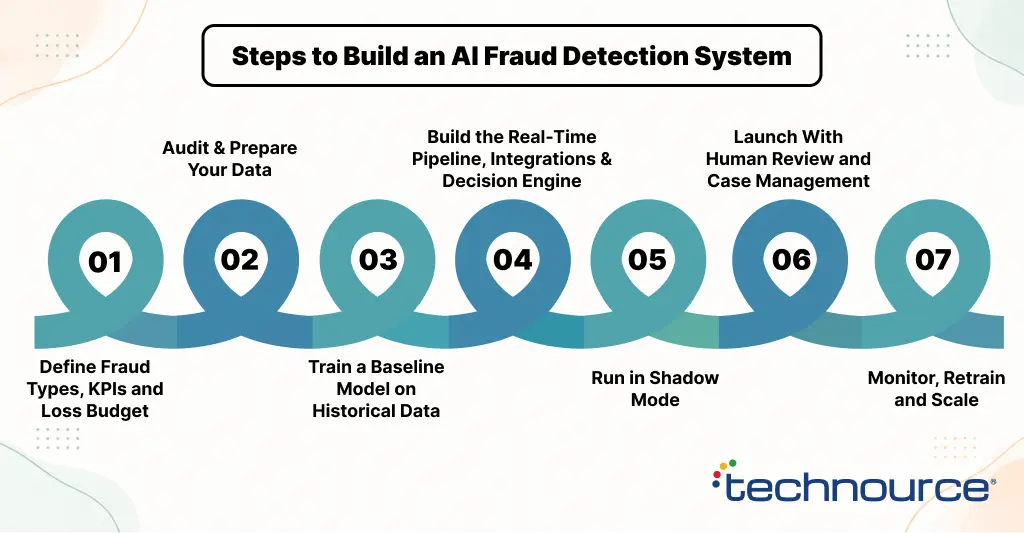
Step 1: Define Fraud Types, KPIs and Loss Budget (1 Week)
Pick the fraud type that costs you the most today. Set target recall, precision, approval rate and decision latency.
Agree on a loss budget, meaning how much fraud you accept to keep approvals high. That number later sets your thresholds.
Step 2: Audit and Prepare Your Data (1–2 Weeks)
- List every data source and join them on customer, device and payment IDs.
- Collect labels from chargebacks, confirmed cases and analyst decisions.
- Drop recent months where labels have not matured yet.
- Tokenize or remove card numbers and other sensitive fields.
Step 3: Train a Baseline Model on Historical Data (1 Week)
Train a gradient-boosted baseline and validate it on a later time window, not a random split. Random splits leak future patterns into training and inflate results.
Compare the model with your current rules at several thresholds. The PoC ends with a go or no-go decision based on catch rate and false positives, not a demo.
Step 4: Build the Real-Time Pipeline, Integrations and Decision Engine (10–14 Weeks)
Set up event streaming, the feature store, the scoring API and the decision engine. Connect the payment, identity and data integrations in the same step, which makes it the longest one. Add the rules-only fallback path and test the full flow against your latency target.
Step 5: Run in Shadow Mode (2–4 Weeks)
In shadow mode, the model scores live traffic but takes no action. Analysts compare its scores with real outcomes and tune thresholds per segment.
Shadow mode is the cheapest insurance in the project. Problems show up as numbers on a dashboard instead of blocked customers.
Step 6: Launch With Human Review and Case Management (1–2 Weeks)
Switch on decisions in stages, starting with step-up challenges before hard blocks. Give analysts a case queue with reason codes and one-click outcomes that become new labels.
Step 7: Monitor, Retrain and Scale (Ongoing)
Track drift, latency and KPIs weekly. Retrain on a fixed schedule, usually monthly, and immediately when drift alerts fire.
From here, teams add channels, fraud types, graph models and AML integrations, which typically takes the system to an enterprise MVP in 24+ weeks.
How Much Does an AI Fraud Detection System Cost?
An AI fraud detection system costs $3,000–$8,000 for a PoC, $10,000–$50,000 for an AI MVP, and $60,000–$100,000 for an enterprise MVP. The final price depends on the number of fraud types, integrations, latency targets and compliance needs.
| Build Type | Scope | Cost (USD) | Timeline |
|---|---|---|---|
| PoC | One fraud type, historical data, baseline model and results report | $3,000–$8,000 | 3–4 weeks |
| AI MVP | One or two fraud types, real-time scoring, decision engine, shadow mode and case review | $10,000–$50,000 | 16–24 weeks |
| Enterprise MVP | Several channels and fraud types, graph models, AML and KYC integrations, audit trails | $60,000–$100,000 | 24+ weeks |
Fraud detection follows the same tier logic as any MVP development cost estimate: scope, integrations and compliance set the price, not the algorithm.
What Drives AI Fraud Detection Cost?
Scope drives cost more than model choice. These factors move a quote the most:
| Cost Driver | Why It Adds Cost |
|---|---|
| Number of fraud types | Each type needs its own features, labels and validation |
| Latency target | Sub-100-millisecond scoring needs streaming, caching and tuned serving |
| Data quality | Messy or siloed data needs cleaning, joining and label backfill |
| Integrations | Every gateway, core banking or KYC vendor adds build and testing time |
| Compliance and explainability | Reason codes, audit logs and model documentation take extra work |
| Case management | Analyst queues, permissions and outcome tracking add front-end scope |
| Transaction volume | Higher volume raises infrastructure and load-testing effort |
Hidden and Ongoing Costs to Budget
Running costs depend on transaction volume and vendors. Budget for these lines from day one:
- Per-check fees from identity, device and AML data vendors.
- Cloud compute for streaming, feature storage and scoring.
- Retraining, drift monitoring and model updates.
- Analyst time for reviews and label quality.
- Model validation and audits in regulated environments.
Ask every vendor for a run-cost estimate alongside the build quote.
NOT SURE WHICH OF THESE NINE REQUIREMENTS YOUR CURRENT PLATFORM IS MISSING?
Build vs Buy: Should You Build a Custom Fraud Detection System?
Build a custom AI fraud detection system if your fraud patterns are specific to your product, you make regulated decisions that need your own explanations, or vendor fees grow faster than your volume. Buy an off-the-shelf tool such as Stripe Radar or Sift if you process standard card payments and need protection within days.
| Factor | Custom Build | Off-the-Shelf | Hybrid |
|---|---|---|---|
| Time to launch | 16–24 weeks for an AI MVP | Days to weeks | Vendor live first, custom models added in 16–24 weeks |
| Upfront cost | $10,000–$50,000 for an AI MVP | Subscription or per-transaction fees | Vendor fees plus a smaller custom build |
| Fit to your fraud | Trained on your own data | Network-wide patterns | Your models on top of vendor signals |
| Explainability | Full control of reason codes | Varies by vendor | Full for your layer |
| Data ownership | Yours | Shared with the vendor | Mixed |
| Best for | Product-specific fraud and regulated decisions | Standard card payments at low volume | Most growing FinTech and eCommerce teams |
Technource’s Recommendation
Start hybrid if you already use a vendor: keep its network signals and add your own model for the fraud it misses. Move fully custom when vendor fees exceed what a custom system would cost to run each year, or when false declines keep rising despite tuning.
What Are the Biggest Challenges in AI Fraud Detection?
The biggest challenges in AI fraud detection are rare and late fraud labels, false positives, model drift, latency limits and explaining decisions to regulators. Each one can quietly erase the value of an accurate model.
| Challenge | Real Consequence | How to Solve It |
|---|---|---|
| Class imbalance | The model learns to call everything safe | Class weights, resampling, precision and recall metrics |
| Label delay | Fraud is trained as “good” behavior | Mature-label windows plus analyst labels |
| False positives | Lost revenue and angry customers | Segment thresholds and step-up checks instead of blocks |
| Model drift | Catch rate drops without anyone noticing | Drift monitoring and scheduled retraining |
| Latency limits | Slow checkouts and payment timeouts | Precomputed features, fast models, rules fallback |
| Explainability | No clear reasons for customers or auditors | SHAP reason codes and logged decisions |
| Adaptive fraudsters | Attackers probe and learn your thresholds | Graph features, varied challenges, frequent updates |
Common Mistakes to Avoid When Building an AI Fraud Detection System
The most common mistakes are blocking on day one, judging models by accuracy, ignoring label delay and shipping a model without a review workflow. Each mistake is cheap to avoid during the build and expensive to fix after launch.
- Blocking on day one: skip shadow mode and you discover false positives through customer complaints.
- Measuring accuracy: fraud is rare, so accuracy hides a model that misses most fraud.
- Ignoring label delay: recent transactions look clean only because their chargebacks have not arrived.
- Starting with deep learning: a complex model without a baseline makes problems hard to diagnose.
- No case management: alerts without a workflow never become decisions or new labels.
- No fallback path: a model outage should never stop payments.
Which KPIs Should You Track After Launch?
Track recall, precision, false positive rate, approval rate, chargeback rate, manual review rate and p95 decision latency. Review the KPIs weekly in the first 90 days, then monthly.
| KPI | What It Shows | How to Measure |
|---|---|---|
| Recall (detection rate) | Share of fraud you catch | Fraud value caught ÷ total fraud value |
| Precision | Share of alerts that are real fraud | Confirmed fraud ÷ flagged events |
| False positive rate | Good customers flagged | Flagged good events ÷ all good events |
| Approval rate | Revenue impact of your thresholds | Approved events ÷ attempted events |
| Chargeback rate | Fraud that reached customers | Chargebacks ÷ total transactions |
| Manual review rate | Analyst workload | Reviewed events ÷ total events |
| p95 decision latency | Customer experience at checkout | 95th percentile scoring time in milliseconds |
| Fraud loss rate | Overall business impact | Fraud losses ÷ processed volume |
How to Choose an AI Fraud Detection Development Company
Choose an AI fraud detection development company that has shipped fraud or identity systems to production, plans for label delay and shadow mode, and gives you full ownership of code, models and data. Ask for live metrics, not demo screenshots.
| Question to Ask | Good Answer | Red Flag |
|---|---|---|
| Which fraud or identity systems have you shipped? | Named projects with measured results | Only demos or proofs of concept |
| How will you handle label delay and imbalance? | Mature-label windows, class weights, precision and recall | Quotes overall accuracy only |
| How do you validate before blocking? | Shadow mode with threshold tuning | Live blocking from day one |
| How are decisions explained? | Reason codes and logged model versions | “The model decides” |
| Who owns the code, models and data? | You do, in full | Licensing or lock-in clauses |
| What happens after launch? | Monitoring, drift alerts and a retraining plan | Handover and goodbye |
Technource has 14+ years of product engineering experience. Clients rate Technource 4.9/5 on Clutch. Reviewers on GoodFirms give the same 4.9/5 rating.
What Are the Future Trends in AI Fraud Detection?
The main trends in AI fraud detection are AI-generated attacks, identity checks moving to the front of every flow, AI agents supporting fraud analysts, shared graph intelligence, and instant payments that shrink the decision window.
AI-Generated Fraud Raises the Bar
Organizations estimate that AI-generated techniques now contribute about one-fifth of fraud losses (LexisNexis Risk Solutions, 2026).
Reported US cybercrime losses reached $20.9 billion in 2025, up 26% from 2024, and AI-related complaints alone accounted for $893 million (FBI IC3, 2026).
Identity Verification Moves to the Front
Nearly two thirds (62%) of North American financial institutions plan to invest in AI-enhanced identity verification (LexisNexis, 2026). Expect deepfake-resistant liveness checks to become a standard onboarding step.
AI Agents Support Fraud Analysts
AI agents can pull device history, linked accounts and past cases into one summary for each alert. The final call on blocks still stays with a human analyst.
Graph and Shared Intelligence Grow
Fraud rings move between platforms, so more teams will share signals through consortiums and privacy-preserving methods such as federated learning.
Instant Payments Shrink the Decision Window
Real-time rails such as FedNow and RTP settle in seconds, with little chance to recall funds. Scoring has to happen before release, not after settlement.
How Technource Delivers Measurable Results in AI Fraud Prevention
Technource builds fraud and identity systems as working products, not models on a slide. The projects below show the identity and lending layers that stop fraud at onboarding, where many fraud losses start.
How Technource Built IDVerify AI, an Identity Verification Module That Cuts Manual KYC Time by 90%
We built IDVerify AI, a plug-and-play AI identity verification module for a client in Austria. The client needed to replace slow, manual KYC and ID checks inside an existing platform without rebuilding it.
We combined document scanning, OCR-based text extraction, forgery detection, face matching and liveness checks in one pipeline. The module runs on Node.js, TypeScript and Next.js, with MySQL, Redis, AWS S3 and AWS EC2.
Measurable Result
- 90% reduction in manual KYC verification time.
- 99% accuracy in face and document matching.
- 60% faster onboarding for new users.
- User consent controls built in to support GDPR obligations.
- Plug-and-play module that works inside the client’s existing platform.
How Technource Built Cashguru, a Digital Loan Marketplace That Processes Loans 65% Faster
We built Cashguru, a digital loan marketplace that connects borrowers with licensed money lenders in Singapore. The client wanted borrowers to compare loan offers in one place, and wanted lenders to receive verified applicants instead of typed-in details.
We integrated MyInfo, Singapore’s government data service, through an encrypted API workflow, so borrower data arrives verified at sign-up. The platform runs on Laravel and MySQL, with Stripe for payments.
Measurable Result
- 65% faster loan processing.
- 50% increase in borrower–lender match rate.
- 40% reduction in operational overhead.
- 30% higher borrower engagement.
Technource’s Approach to AI Fraud Detection
Five principles guide every fraud detection build we deliver:
- Shadow mode first: every model scores live traffic before it blocks anyone.
- One fraud type, one metric: the first release targets the biggest loss and one success number.
- Rules plus models: rules handle hard limits and sanctions, while models handle what keeps changing.
- Explain every decision: each score ships with reason codes and a logged model version.
- Retrain on analyst feedback: confirmed cases flow back into training on a fixed schedule.
Conclusion
An AI fraud detection system succeeds or fails on three decisions: which fraud type you start with, whether your data and labels are ready, and how carefully you move from shadow mode to live blocking.
Get those right, and a PoC can prove value in 3–4 weeks, with an AI MVP in production in 16–24 weeks.
Technource builds these systems as an AI-powered product engineering company and fintech product engineering partner, from the first data audit to retraining in production.
If you are ready to scope your fraud detection system, contact us for a short consultation that maps your data, timeline and budget.
Ready to turn your fraud data into a working detection system?
Frequently Asked Questions
An AI fraud detection system costs $3,000–$8,000 for a PoC, $10,000–$50,000 for an AI MVP, and $60,000–$100,000 for an enterprise MVP. Price depends on the number of fraud types, integrations, latency targets and compliance needs. Ongoing costs such as vendor checks, cloud scoring and retraining depend on transaction volume. A PoC on historical data takes 3–4 weeks. An AI MVP takes 16–24 weeks, including 2–4 weeks in shadow mode, where the model scores live traffic without blocking anyone. An enterprise MVP with more channels, graph models and AML integrations takes 24+ weeks. You need transaction history, account and device data, and confirmed fraud labels such as chargebacks and analyst decisions. Twelve months of history is a practical minimum because it covers seasonal fraud spikes. For supervised training, aim for a few hundred confirmed cases per fraud type, or start with rules and anomaly detection. Gradient-boosted trees such as XGBoost and LightGBM work best for most systems. They are accurate on tabular data, explainable with SHAP reason codes and fast enough to score in under 100 milliseconds. Add isolation forests or autoencoders for new fraud, graph models for fraud rings and sequence models for account takeover. Yes. A well-built AI fraud detection system scores a payment, login or application in under 100 milliseconds, before money moves. Real-time scoring needs event streaming, a feature store with precomputed features and a fast scoring API. Batch scoring still suits slower checks such as AML pattern reviews and refund abuse. Buy an off-the-shelf tool such as Stripe Radar or Sift if you process standard card payments and need protection within days. Build custom, starting with an AI MVP at $10,000–$50,000, when your fraud patterns are product-specific or you need your own explanations. Many teams start hybrid and add custom models later. AI reduces false positives by weighing hundreds of signals together instead of blocking on one rule. Adaptive thresholds by segment, step-up checks instead of hard declines, and analyst feedback all lower false alarms. Tuning thresholds during 2–4 weeks of shadow mode catches most false positives before real customers feel them. Most fraud models should be retrained monthly, and immediately when drift monitoring shows falling recall or rising false positives. Train only on data old enough for chargeback labels to mature. Every new model version should pass through shadow mode before release, so a weaker model never reaches live traffic. Yes, when every score ships with reason codes and a logged model version. According to the CFPB, creditors using complex algorithms must still give specific and accurate reasons for adverse actions under ECOA. SHAP reason codes, decision logs and documented validation give auditors a clear trail. Confirm your exact obligations with qualified counsel. Yes. A startup can begin with a vendor tool plus rules, then run a PoC for $3,000–$8,000 with an outside team once a few hundred confirmed fraud cases exist. The PoC shows expected catch rates and false positives on your own data within 3–4 weeks, before you commit to an AI MVP.
Related Insights and Articles