
Blog Summary
Healthcare MVP development turns one clinical or patient workflow into a secure product that real users can test in 8–16 weeks. You will see which features to build first, when HIPAA and FDA rules apply, how deep to go on EHR integration, and what each build tier costs. Three Technource healthcare case studies show the results.
Key Takeaways
- Healthcare MVP development costs $20,000–$50,000 for a HIPAA-compliant MVP, such as a telehealth, patient portal, or remote monitoring product. A simple MVP with no patient data costs $8,000–$15,000, and an enterprise MVP costs $60,000–$100,000.
- Most HIPAA-compliant MVPs launch in 8–16 weeks. An enterprise MVP with hospital integrations takes 16–24 weeks.
- If the MVP stores or sends protected health information (PHI), HIPAA applies from the first pilot user. Settle the FDA intended-use question in week one, and build MFA and encryption in now, because the HIPAA Security Rule update is still a proposed rule.
- Breaches are the costliest risk: a healthcare breach costs about $7.4 million on average, more than in any other industry (IBM, 2025).
- Three Technource healthcare products show the payoff: 50% faster clinical decision-making (My Vital View), 65% faster e-prescribing approvals (Telepath), and 60% faster doctor recruitment (LocumPRN).
Most healthcare founders start with a clear problem: a clinic workflow, a patient gap, or a care team buried in manual work.
Funding is available for teams that can prove their idea. U.S. digital health startups raised $7.4 billion across 244 deals in the first half of 2026 (Rock Health).
Investors and health system buyers now expect a working product with real users. Healthcare MVP development is how founders get there without spending a full platform budget on an untested idea.
Yet many first builds fail for avoidable reasons. Teams add too many features, defer HIPAA until after launch, or discover an FDA question two weeks before go-live.
What Is Healthcare MVP Development?
Healthcare MVP development is the process of building the smallest secure version of a healthcare product that real patients or clinicians can use to prove one workflow. A HIPAA-compliant MVP typically takes 8–16 weeks and includes the security controls needed to handle patient data from the first user.
A healthcare MVP is not a demo. The MVP runs on production infrastructure, serves real users, and produces evidence you can show investors or hospital buyers.
Most founders use MVP development services that cover scoping, design, build, and launch with one team, so compliance decisions stay consistent from discovery to go-live.
| Stage | What It Proves | Uses Real PHI? | Typical Time |
|---|---|---|---|
| Proof of Concept (PoC) | The core data or technical approach works | No | 2–4 weeks |
| Prototype | Users understand the flow and want it | No, sample data only | 2–4 weeks |
| HIPAA-Compliant MVP | Real users complete the workflow and get value | Yes, with HIPAA-required safeguards | 8–16 weeks |
| Full Product | The model scales across sites, roles, and integrations | Yes | 6–12 months |
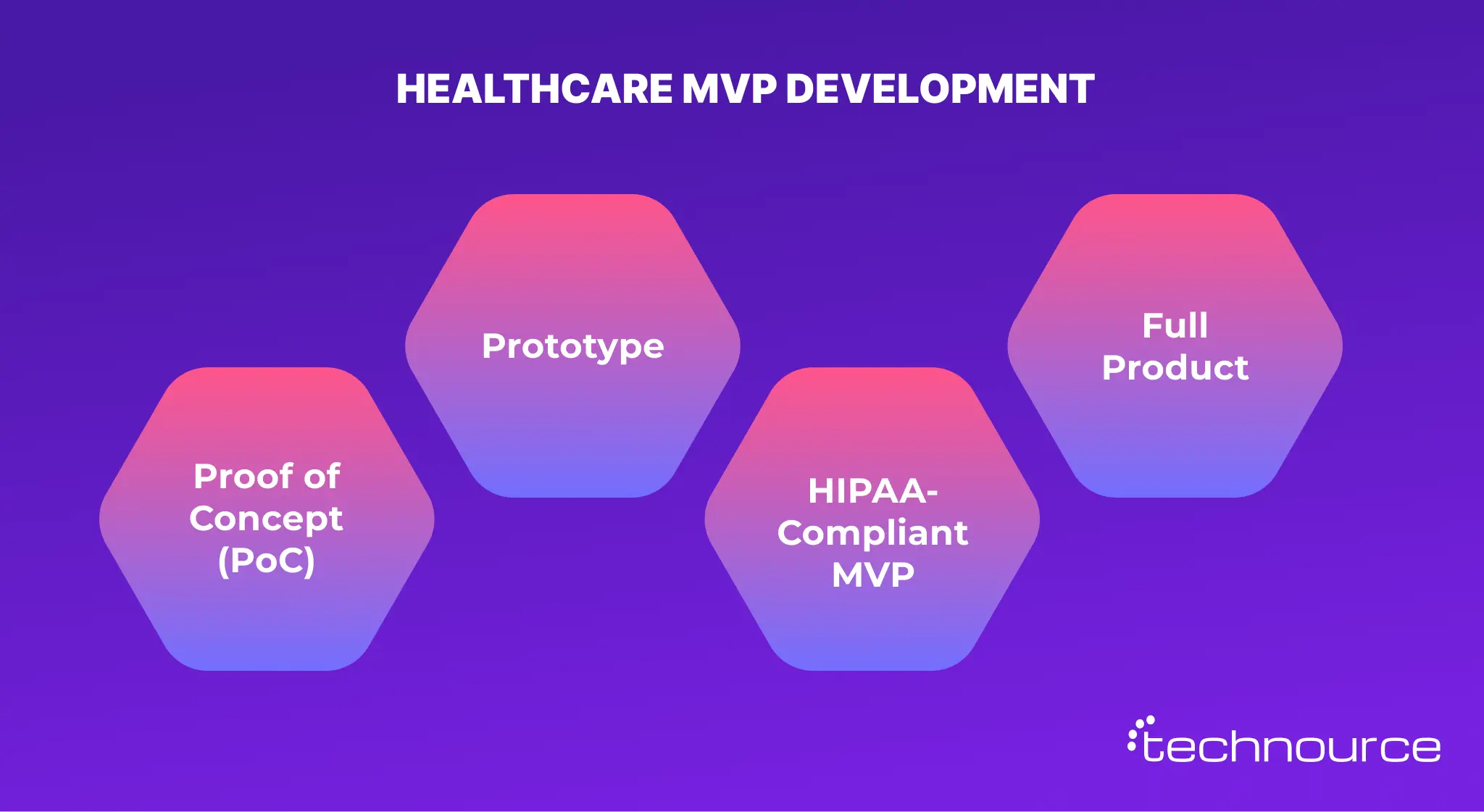
Pick the stage by the question you need answered. A technical risk calls for a PoC, an adoption risk calls for a prototype, and a real-world usage question calls for the MVP.
Why Are Healthcare Startups Building an MVP First?
Healthcare startups build an MVP first because an MVP proves one clinical or operational workflow with real users in 8–16 weeks, before they commit a full platform budget. The pilot also produces the usage data that investors and health system buyers ask for.
| Benefit | What Changes | How It Works |
|---|---|---|
| Lower build risk | Spend validates one workflow, not a full platform | One persona, one workflow, 3–5 features |
| Faster evidence | Real usage data arrives in weeks | Pilot with one clinic or patient group |
| Investor readiness | Traction replaces assumptions in the pitch | Pilot KPIs tied to time saved or adherence |
| Compliance foundation | No rebuild when patient volume grows | HIPAA-required safeguards built into version one |
| Clinician buy-in | Staff shape the tool before rollout | Co-design sessions and a physician champion |
Adoption depends on who invites the user. In 2024, 87% of people encouraged by their provider to use a patient portal logged in at least once, compared with 57% of people who were not encouraged (ASTP/ONC).
For an MVP, that finding means clinicians belong in the launch plan, not just on the user list.
Benefits for Healthtech Founders
Founders get proof before they spend at platform scale. The MVP also sharpens the story they tell investors.
- Capital efficiency: A $20,000–$50,000 MVP tests the riskiest assumption before a six-month platform build.
- Sharper positioning: Pilot data shows which user and which workflow value the product most.
- Fundable traction: Active clinicians and measured time savings carry more weight than a feature list.
Benefits for Providers and Health Systems
Providers get a low-risk way to test new tools inside real operations. One department can pilot the product without disrupting the rest of the organization.
- Contained pilots: One department, one workflow, and a clear success metric.
- Workflow fit before rollout: Staff feedback changes the product while changes are still cheap.
- A stronger procurement case: Results come from the organization’s own staff and patients.
Planning a healthcare MVP but not sure what to build first?

Healthcare MVP vs Generic Software MVP: What’s the Difference?
A healthcare MVP must protect patient data, fit clinical workflows, and pass regulatory checks from the first user, while a generic software MVP mainly tests demand. Healthcare builds therefore add compliance scoping, vendor BAAs, and security testing to every release.
| Criteria | Healthcare MVP | Generic Software MVP |
|---|---|---|
| Data | PHI protected under HIPAA | Customer and business data |
| First-release rule | Safe and compliant before feature-rich | Useful before polished |
| Integrations | EHRs, labs, devices, pharmacies | Payments, CRM, email |
| Vendors | Signed BAA when PHI is involved | Standard terms of service |
| Success metric | Adoption, time saved, adherence | Sign-ups, retention, conversion |
| Cost of a mistake | Patient harm, breach, penalties | Lost users |
In practice, a healthcare MVP carries a compliance floor. Even the smallest feature set needs encryption, access control, and audit logs.
What Are the Main Types of Healthcare MVPs?
The main types of healthcare MVPs are telehealth, patient portal, remote patient monitoring (RPM), e-prescribing and online pharmacy, AI clinical documentation, care coordination, and clinician staffing. Each type proves a different workflow, so each one needs a different first release.
| MVP Type | Workflow to Prove | Build Now | Defer to V2 |
|---|---|---|---|
| Telehealth | Patients complete a virtual visit | Booking, BAA-covered video, visit notes | Group visits, AI transcription |
| Patient portal | Patients self-serve without calling | Secure login, results, messaging, booking | Bill pay, wearable sync |
| Remote patient monitoring | Care teams act on home readings | 1–2 device types, alerts, provider dashboard | Multi-vendor devices, risk scoring |
| E-prescribing / online pharmacy | Prescriptions reach patients faster | Certified e-prescribing network, orders, audit logs | Subscriptions, loyalty offers |
| AI clinical documentation | Notes take less clinician time | One visit type, clinician sign-off on every note | Multi-specialty templates, EHR write-back |
| Care coordination | Care managers close tasks faster | Intake, task queue, secure messaging | Payer data, population reporting |
| Clinician staffing | Open shifts get filled faster | Job posting, matching, credential checks | Payroll, advanced analytics |
In the LocumPRN project, the first priority was one job workflow with clear stages, time stamps, and a required reason for every change. Clinics and doctors trusted the status they saw, so both sides kept using the platform.
Teams planning a multi-clinic telemedicine SaaS platform still start with one visit type in the MVP and add specialties after the pilot.
What Features Should a Healthcare MVP Include?
A healthcare MVP should include 3–5 workflow features plus a fixed compliance layer: secure login with MFA, role-based access, audit logs, and encrypted data storage. Everything else waits until the pilot shows what users need.
| Feature | Who Uses It | Why It Matters |
|---|---|---|
| Secure login with MFA | All users | Protects PHI and user accounts |
| Role-based access | Patients, clinicians, admins | Each role sees only the data it needs |
| Core workflow screens | Primary user | Proves the main value of the product |
| Scheduling and reminders | Patients, front-desk staff | Cuts phone calls and missed visits |
| Secure messaging | Patients, care teams | Replaces phone tag with a tracked thread |
| Admin panel | Operations team | Manages users, roles, and content |
| Audit logs | Compliance team | Records who viewed or changed PHI, and when |
| Consent capture | Patients | Documents agreement before data use |
| Usage analytics without PHI | Product team | Measures pilot KPIs without exposing patient data |
Features to Defer to V2
Defer anything that does not prove the core workflow. These items usually wait for version two:
- EHR write-back: Read-only access or manual import is enough for most pilots.
- Multi-language support: Add languages once a second market is confirmed.
- Advanced reporting: Start with the 3–5 pilot KPIs, not a full analytics suite.
- White-label themes: Build them when a second organization signs.
Give each deferred feature a trigger, such as “add billing once three clinics are live.” A trigger keeps the roadmap tied to evidence instead of opinions.
Which AI Features Are Worth Building Into a Healthcare MVP?
AI features are worth building into a healthcare MVP when they save staff time on admin work and keep a clinician in the loop. Intake summaries, message triage, and no-show prediction fit the AI MVP tier of $10,000–$50,000, while diagnostic AI usually belongs in a later, regulated release.
| AI Feature | What It Does | Risk / Impact |
|---|---|---|
| Intake summarization | Turns intake forms into a short pre-visit summary | Low risk; cuts pre-visit review time |
| Message triage | Routes patient messages to the right team | Low risk; faster replies |
| No-show prediction | Flags appointments likely to be missed | Proves the main value of the product |
| Eligibility pre-checks | Checks insurance details before the visit | Low risk; fewer billing surprises |
| Ambient visit notes | Drafts notes for clinician approval | Medium risk; clinician signs off on every note |
| Clinical decision support | Shows options to clinicians with the reasoning | Medium to high; check FDA CDS criteria first |
| Patient-facing symptom checker | Suggests a level of care to patients | High; needs regulatory review before launch |
Keep PHI away from any AI model or API vendor that will not sign a BAA. Log prompts and outputs for review, but strip identifiers from those logs.
Products that add models to an existing workflow usually need AI integration services that cover vendor review, safe logging, and a human approval step.
Want AI features in your MVP without adding FDA risk?

Does Your Healthcare MVP Need FDA Clearance?
Most healthcare MVPs do not need FDA clearance, because scheduling, messaging, admin, and general wellness functions usually fall outside device rules. An MVP may need FDA review when the software diagnoses, treats, or drives clinical decisions, depending on its intended use.
The FDA updated its clinical decision support (CDS) and general wellness guidance on January 6, 2026 (FDA). The CDS guidance still separates software that supports a clinician’s judgment from software that directs it.
| App Behavior | Likely Classification | What It Means for the MVP |
|---|---|---|
| Tracks steps, sleep, or general wellness | General wellness | Usually no FDA review |
| Books visits, sends reminders, or handles billing | Administrative software | No FDA review; HIPAA may apply |
| Shows clinicians data and options with visible reasoning | Possibly non-device CDS | Document how the four CDS criteria are met |
| Recommends treatment directly to patients | Likely a device (SaMD) | Plan the regulatory pathway before the build |
| Analyzes images or signals to detect a condition | Likely a device (SaMD) | Ship it as a separate, regulated release |
Technource’s Recommendation
Write the intended-use statement before the feature list. If one feature pushes the product into device territory, launch the non-device workflow as the MVP and plan the regulated feature as its own release with counsel involved.
How Do You Make a Healthcare MVP HIPAA-Compliant?
A healthcare MVP meets HIPAA requirements when every vendor that touches PHI signs a business associate agreement (BAA), PHI is encrypted at rest and in transit, access uses MFA and roles, and every access is logged. BAAs, encryption, MFA, and audit logging belong in the first sprint, not after launch.
Any vendor that creates, receives, maintains, or transmits PHI on your behalf is a business associate and needs a BAA (HHS). The BAA requirement covers cloud hosting, video, SMS, email, and AI vendors.
Skipping BAAs, encryption, or MFA is expensive. According to IBM (2025), the average healthcare breach costs about $7.4 million, far more than these controls cost to build.
| Control | What to Implement in the MVP | Common Mistake |
|---|---|---|
| Vendor BAAs | Signed BAAs with cloud, video, SMS, email, and AI vendors | Using a free tier that offers no BAA |
| Encryption | AES-256 at rest and TLS 1.2 or higher in transit | PHI cached on devices or in logs |
| Access control | MFA, role-based permissions, session timeouts | Shared admin accounts |
| Audit logging | Who viewed or changed PHI, and when | Writing PHI into the log text |
| Minimum necessary data | Only the fields the workflow needs | Importing full records “just in case” |
| Analytics and tracking | No PHI sent to analytics tools without a BAA | Tracking pixels on logged-in pages |
| Security testing | Penetration test before the pilot | Testing only after an incident |
| Risk analysis | Written risk analysis before go-live | No record of security decisions |
The HIPAA Security Rule update would make MFA and encryption mandatory, but the update is still a proposed rule. HHS published the proposal on January 6, 2025 (Federal Register), and the 2026 Unified Agenda lists it under long-term actions, with no final rule date set (Reginfo.gov).
Build both controls into the MVP anyway. Adding MFA and encryption after launch means reworking login flows, data stores, and vendor setups that pilot users already depend on.
Map every control to an owner with a HIPAA compliance checklist before the first sprint starts.
Not sure if your MVP handles PHI or needs FDA review?
Should a Healthcare MVP Include EHR Integration?
Most healthcare MVPs should launch with read-only EHR access or no EHR integration, unless the core workflow fails without EHR data. Full read-write integration usually moves a build toward the enterprise MVP range of 16–24 weeks, because EHR vendor approval follows the vendor’s timeline.
| Integration Option | Standard or Tool | When to Include in the MVP |
|---|---|---|
| No integration | CSV import or manual entry | Pilot with one clinic and low volume |
| Read-only EHR access | HL7 FHIR R4, SMART on FHIR | The workflow needs patient context |
| Legacy hospital feeds | HL7 v2 through an integration engine such as Mirth Connect | The pilot site runs older systems |
| Integration platform | Redox or a similar network | Several EHRs are planned within a year |
| Read-write EHR integration | FHIR R4 with EHR vendor approval | Defer to V2 unless the workflow depends on it |
Apply for EHR vendor access in the first two weeks if integration is in scope. Finished code can wait weeks for production approval, so the application should never start after the build.
What Tech Stack Is Best for a Healthcare MVP?
Most healthcare MVPs in 2026 use Flutter or React Native for iOS and Android, React.js for web dashboards, a Node.js or Python backend, and HIPAA-eligible hosting on AWS, Azure, or Google Cloud under a signed BAA. HL7 FHIR R4 joins the stack when EHR data is in scope.
| Layer | Common Choices | Healthcare Note |
|---|---|---|
| Mobile | Flutter, React Native | One codebase for both app stores |
| Web dashboards | React.js, Next.js | Provider and admin portals usually run on the web |
| Backend | Node.js, Python (Django, FastAPI), Laravel | Build audit logging into the API layer |
| Database | PostgreSQL, MongoDB, MySQL | Encrypt PHI fields and restrict access |
| Cloud | AWS, Azure, Google Cloud | Sign the BAA before storing any PHI |
| Video, SMS, and email | BAA-ready communication vendors | Keep PHI out of message bodies and notifications |
| Interoperability | HL7 FHIR R4, SMART on FHIR | Add when EHR data is in the MVP scope |
Native Swift or Kotlin pays off only for camera diagnostics or heavy sensor work, so teams providing healthcare mobile app development services ship one Flutter or React Native codebase.
In My Vital View, React Native ran the patient app while React.js and Node.js powered the provider web platform, so one team covered mobile and web.
How to Build a Healthcare MVP: Step-by-Step
Building a healthcare MVP takes six build steps and a pilot, and the build steps fit inside 8–16 weeks. Architecture work runs alongside design rather than after it.
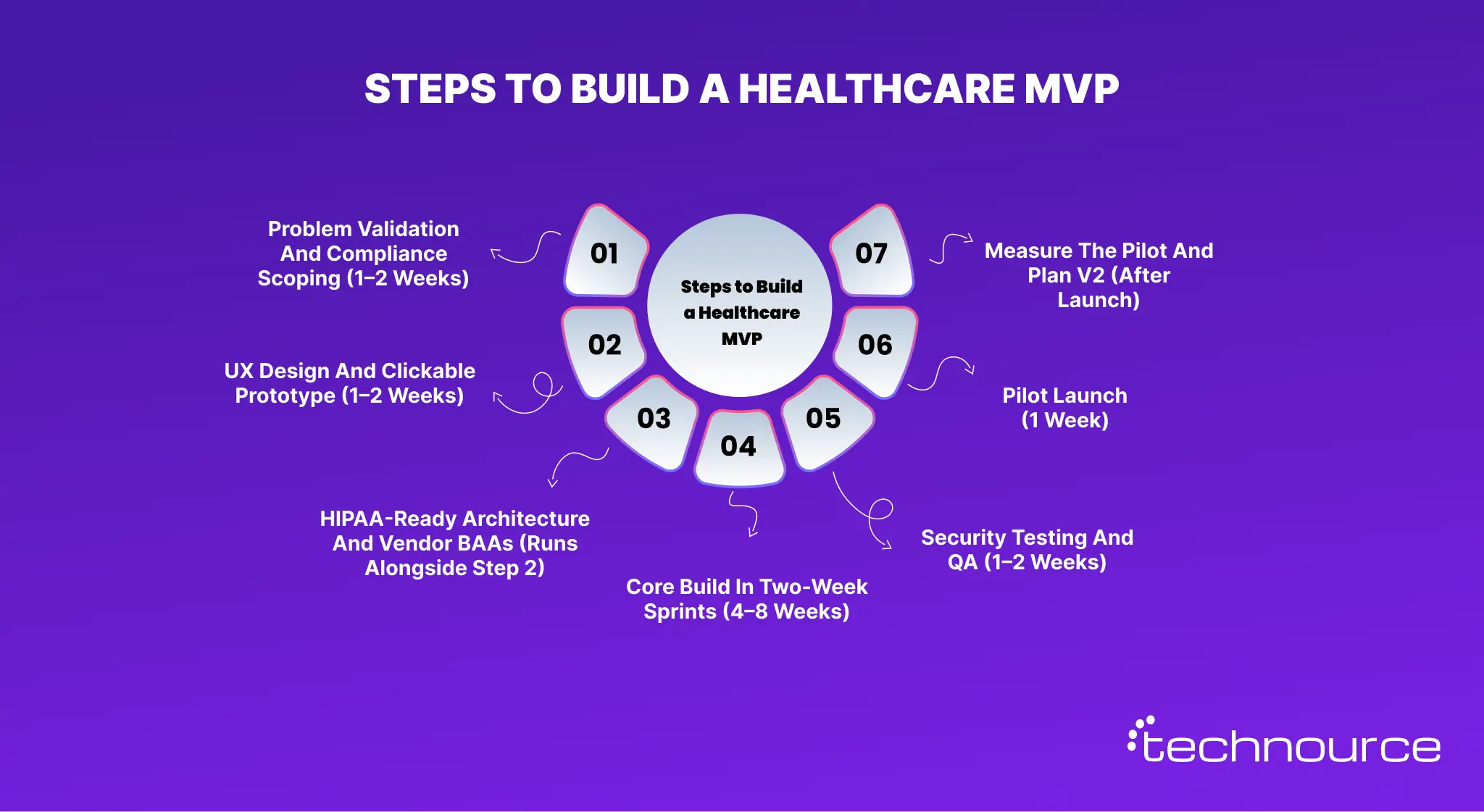
Step 1: Problem Validation and Compliance Scoping (1–2 Weeks)
Interview the people who feel the problem every day: clinicians, front-desk staff, care managers, or patients. Confirm the problem is frequent, costly, and worth changing a habit for.
Write a one-page MVP charter with the problem, primary user, core workflow, success metric, and out-of-scope list. The scoping steps in how to build an MVP apply here, with three compliance answers added in writing: Does the product touch PHI? Could any feature be a medical device? Does the workflow need EHR data?
Step 2: UX Design and Clickable Prototype (1–2 Weeks)
Design for the least confident user, often an older patient on a small screen or a clinician between appointments.
Test a clickable prototype with 3–5 real users before any code is written. Count clicks per task, because every extra click lowers clinician adoption.
Inside an MVP build, the clickable prototype takes 1–2 weeks because it covers only the core workflow. A standalone prototype for adoption testing takes 2–4 weeks.
Step 3: HIPAA-Ready Architecture and Vendor BAAs (Runs Alongside Step 2)
Map every place PHI flows, from the device to the cloud to each third-party API. List every vendor on that map and confirm each one will sign a BAA before you commit to it.
Choose HIPAA-eligible cloud services, plan encryption and key management, and define roles and permissions. Start the EHR vendor application now if integration is in scope.
Step 4: Core Build in Two-Week Sprints (4–8 Weeks)
Build the compliance layer and the core workflow together in two-week sprints. Demo working software at the end of every sprint so clinicians can correct the workflow early.
Protect the scope. New requests go into a V2 list with a trigger, not into the current sprint.
Step 5: Security Testing and QA (1–2 Weeks)
Run functional, usability, and accessibility tests alongside a penetration test. Fix every high-severity finding before real patient data enters the system.
Complete the written risk analysis and store test evidence with the release notes.
Step 6: Pilot Launch (1 Week)
Launch to one clinic, department, or patient group. Train the first users in person or on a call, and give them a direct line for issues.
For mobile apps, prepare health data disclosures for app store review before submission.
Step 7: Measure the Pilot and Plan V2 (After Launch)
Run the pilot for 4–8 weeks and track the KPIs set in the charter. Then decide whether to scale, change direction, or stop.
Feed the results into the V2 list. Features with a met trigger move up, and features nobody asked for move out.
How Much Does Healthcare MVP Development Cost?
Healthcare MVP development costs $20,000–$50,000 for a HIPAA-compliant MVP, $8,000–$15,000 for a simple MVP with no patient data, and $60,000–$100,000 for an enterprise MVP with hospital integrations. Scope, user roles, and integrations decide where a project lands.
| Build Type | Healthcare Scope | Cost (USD) | Timeline |
|---|---|---|---|
| PoC | Tests one technical approach, no PHI | From $3,000 ($3,000–$8,000) | 2–4 weeks |
| Prototype | Clickable flow tested with real users | From $6,000 ($6,000–$12,000) | 2–4 weeks |
| Simple MVP | Wellness or reminder app with no PHI | $8,000–$15,000 | 6–8 weeks |
| Mid-complexity MVP/td> | Telehealth or portal with HIPAA-required safeguards | $20,000–$30,000 | 8–12 weeks |
| Complex MVP | RPM, device data, read-only FHIR, multiple roles | $30,000–$50,000 | 12–16 weeks |
| AI MVP | AI features added to one of the tiers above | $10,000–$50,000 | 6–16 weeks |
| Enterprise MVP | Multi-site, hospital integrations, deep audit needs | $60,000–$100,000 | 16–24 weeks |
The HIPAA-compliant MVP range of $20,000–$50,000 covers the mid-complexity and complex tiers. The AI MVP range overlaps other tiers because AI sits on top of a base build.
A no-code or low-code MVP at $5,000–$7,000 can test demand before any PHI enters the product.
Security testing and the written risk analysis take a larger share of the MVP development cost in healthcare than in a generic build.
What Drives Healthcare MVP Cost?
User roles, integrations, and compliance scope drive most healthcare MVP cost. Each one adds screens, tests, or legal review on top of the core workflow.
| Cost Driver | Why It Adds Cost |
|---|---|
| User roles | Each role needs its own screens, permissions, and tests |
| EHR integration | FHIR mapping, vendor approval, and realistic test data |
| Device integration | Pairing, data validation, and device lifecycle management |
| E-prescribing | Certified network integration and prescriber verification |
| AI features | Evaluation, monitoring, and human review workflows |
| Platforms | iOS, Android, and web each add QA effort |
| Markets | Each region adds legal review and consent flows |
Hidden and Ongoing Costs to Budget
Ongoing costs depend on users, integrations, and markets, so estimate them during scoping rather than after launch.
- HIPAA-eligible hosting: Grows with users, storage, and backups.
- BAA-ready vendor plans: Video, SMS, email, and AI vendors may require paid tiers to sign a BAA.
- Security testing: Plan a penetration test and risk analysis at least once a year.
- EHR and API fees: Some EHR programs and e-prescribing networks charge access or usage fees.
- Maintenance: OS releases, library updates, and rule changes need regular engineering time.
Want a fixed scope and budget for your healthcare MVP?
Build vs Buy: Should You Build a Custom Healthcare MVP?
Build a custom healthcare MVP when your workflow, patient experience, or data model is your competitive advantage. Use a white-label platform when standard telehealth or scheduling is enough and launch speed matters more than control.
| Factor | Custom MVP | White-Label Platform | Hybrid |
|---|---|---|---|
| Time to pilot | 8–16 weeks | Days to weeks | Weeks |
| Workflow fit | Built around your process | You adapt to the tool | Custom module on a vendor core |
| Ownership | You own the code and data model | Vendor owns the platform | Split by contract |
| Cost profile | Upfront build, lower per-user cost at scale | Low upfront, per-user fees grow | Mixed |
| Investor view | Proprietary asset | Harder to defend | Partly defensible |
| Medical Staffing | Clinics, clinicians | Shift posting, matching, payments | Credential checks; generally lower PHI exposure |
| Wellness and Fitness | Consumers | Activity, sleep, nutrition tracking | Often FTC rules rather than HIPAA, depending on the service and data handling |
Technource’s Recommendation
Buy when the workflow is a commodity and build when the workflow is the product. If a white-label tool covers most of the need, launch on it and build only the missing piece as a custom module.
What Are the Biggest Challenges in Healthcare MVP Development?
The biggest challenges in healthcare MVP development are scope creep, late compliance decisions, EHR access delays, low clinician adoption, and alert fatigue. Each one can push an 8–16 week MVP past its launch date.
| Challenge | Real Consequence | How to Solve It |
|---|---|---|
| Scope creep | Budget drifts toward full-platform cost | One persona, one workflow, a signed charter |
| Late compliance decisions | Re-architecture just before launch | BAAs and a PHI data-flow map in week one |
| EHR access delays | Finished code waits for vendor approval | Apply for access in the first two weeks |
| Low clinician adoption | Staff return to phone calls and fax | Co-design with a physician champion |
| Alert fatigue | Real warnings get ignored | Retest logic and per-patient thresholds |
My Vital View reduced unnecessary alerts with retest logic. An extreme reading triggers a second reading, and providers are notified only when the retest confirms it.
Common Mistakes to Avoid in Healthcare MVP Development
The costliest mistakes are building for every user at once, treating HIPAA as a post-launch task, and launching without a success metric. Each one wastes part of a $20,000–$50,000 budget on work the pilot cannot use.
- Building for every persona: Adding patients, clinicians, admins, and payers to version one doubles the scope.
- “We’ll add HIPAA later”: Retrofitting encryption, roles, and logs means rebuilding core flows.
- Free-tier vendors: Many free plans cannot sign a BAA, so PHI cannot pass through them.
- PHI in notifications and logs: Lock screens and log files are common leak points.
- No clinician in the room: A tool that adds clicks to a clinical day will not be used.
- No success metric: Without a target, pilot data cannot support a go or stop decision.
- Treating the MVP as throwaway code: A secure, well-structured MVP becomes the base for version two.
Which KPIs Should a Healthcare MVP Pilot Track?
A healthcare MVP pilot should track task completion, clinician adoption after the second week, time saved per task, patient adherence, and alert response time. Pick 3–5 KPIs before the build starts and measure them for 4–8 weeks.
| KPI | What It Shows | How to Measure |
|---|---|---|
| Task completion rate | Users can finish the core workflow | Completed tasks divided by started tasks |
| Week-two clinician adoption | Use continues after the novelty fades | Active clinicians in weeks 2–8 |
| Time saved per task | The workflow creates real value | Minutes per task before and during the pilot |
| Patient adherence | Patients keep using the product | Share of patients completing tasks on schedule |
| Alert response time | Care teams act on signals | Median minutes from alert to action |
| Support tickets per user | Usability gaps | Weekly tickets divided by active users |
Set a target for each KPI before launch, such as “clinicians save 10 minutes per intake.” A target turns pilot data into a clear decision to scale, adjust, or stop.
How Do You Scale a Healthcare MVP Into a Full Product?
Scale a healthcare MVP in phases once pilot KPIs hit their targets: add EHR integration and patient-facing features first, then multi-site support, automation, and AI. A full product typically takes 6–12 months from the start of the project, including the MVP.
| Phase | What to Add | Trigger to Start |
|---|---|---|
| V1 (MVP) | One workflow plus the compliance layer | Charter signed |
| V2 | EHR read-write, patient app, reporting | Pilot KPIs met at one site |
| V3 | Multi-site setup, automation, AI features | A second customer or site signs |
Multi-tenant design matters if you plan to sell to several clinics. A SaaS application development approach lets each organization run on one codebase with separate data and branding.
How to Choose a Healthcare MVP Development Company
Choose a healthcare MVP development company that can show live healthcare products, explain its BAA and data-flow process, and scope one workflow instead of every feature you mention. Ask for the vendor list it would use before you sign.
| Question to Ask | Good Answer | Red Flag |
|---|---|---|
| Can we use your live healthcare apps? | Store links and case studies with results | Screenshots only |
| How do you handle PHI and BAAs? | Named vendors and a data-flow map | “We are HIPAA certified” |
| How do you scope the MVP? | One workflow, a written charter, pilot KPIs | “We will build everything you listed” |
| What is your EHR experience? | Named EHRs and FHIR resources | “We can integrate anything” |
| Who owns the code? | You do, stated in the contract | Licensed code or unclear IP |
| What happens after launch? | Pilot support and a V2 plan | Support ends at handover |
Check third-party reviews as well. Technource is rated 4.9/5 on Clutch and 4.9/5 on GoodFirms, with 14+ years of product engineering experience.
What Are the Future Trends in Healthcare MVP Development?
The trends shaping healthcare MVPs through 2027 are AI with clinician sign-off, the pending HIPAA Security Rule update, FHIR-first data exchange, and buyers who expect pilot evidence before they sign. Each trend raises the bar for what version one must include.
AI MVPs With Clinician Sign-Off
The updated FDA CDS guidance favors software that supports clinical judgment rather than replacing it. Expect AI MVPs to ship with review screens, override options, and logs that show why the system made each suggestion.
Stricter Security Requirements
MFA, encryption, and documented risk analysis are moving from best practice toward requirement. MVPs that ship with them now avoid a forced rebuild once the final rule lands.
FHIR-First Data Exchange
Impacted payers must offer FHIR-based APIs, generally by January 1, 2027, under CMS-0057-F (CMS). MVPs built on FHIR data models will connect to payers and providers faster.
Pilot Evidence Before Contracts
Capital is concentrating in fewer, larger deals: mega-deals took 45% of U.S. digital health funding in the first half of 2026 (Rock Health). Smaller startups need measured pilot results to stand out.
How Technource Delivers Measurable Results in Healthcare Products
Technource builds healthcare products around one measurable workflow first, then scales what the data supports. These three projects show the pattern.
How Technource Built My Vital View, a Remote Patient Monitoring Platform That Speeds Clinical Decisions by 50%
We built My Vital View, a B2B SaaS remote patient monitoring platform for a U.S. healthcare organization that offers RPM and chronic care management (CCM) services. The client needed one system to connect providers with patients at home, manage medical devices, and automate RPM and CCM workflows.
We built role-based dashboards for patients, providers, staff, clients, and admins, with readings synced from BLE devices and an IMEI-based BodyTrace API. Retest logic confirms extreme readings before providers are alerted, and session tracking automates RPM and CCM billing logs. The stack includes Node.js, React.js, React Native, MongoDB, Twilio, SendGrid, WestFax, and the BodyTrace API.
Measurable Result
- 50% faster clinical decision-making
- 80% increase in clinical staff efficiency
- 70% improvement in documentation accuracy
- Fewer unnecessary provider alerts through automated retest logic
- Automated RPM and CCM session tracking, monthly reports, and billing logs
- Live on web, iOS, and Android with secure video calls and in-app messaging
How Technource Built Telepath, a Branded Online Pharmacy Platform That Speeds E-Prescribing Approvals by 65%
We built Telepath, a SaaS online pharmacy platform for a U.S. client that lets healthcare organizations launch branded pharmacies with e-prescriptions and telehealth. Each organization needed its own portal, secure prescribing, and smooth handoffs to pharmacy and shipping partners.
We built a multi-tenant architecture with subdomain and custom-domain portals, DoseSpot for e-prescribing, Agora for audio and video visits, and Carepoint, TransitionRx, and Easypost for pharmacy coordination and shipment tracking. The stack includes React.js, Node.js, MySQL, AWS S3, and Paytheory.
Measurable Result
- 65% faster e-prescribing approvals
- 55% more patient engagement through chat and video
- 40% higher conversions with automated cart recovery
- Multiple organizations running branded pharmacies from one platform
- Audit logs and pharmacy order tracking for compliance
How Technource Built LocumPRN, an On-Demand Doctor Staffing Platform That Speeds Doctor Recruitment by 60%
We built LocumPRN, an on-demand doctor staffing marketplace for a client in Malaysia that connects clinics posting locum shifts with qualified doctors. The client wanted to replace phone calls, emails, and manual paperwork with one transparent hiring system.
We built stage-based job tracking with time stamps and a required reason for every change, admin-reviewed no-show and discontinuation workflows, document-based credential verification, and in-app chat with reporting. The stack includes Flutter, Laravel, MySQL, Stripe, cloud storage, and Google Maps.
Measurable Result
- 60% faster doctor recruitment
- 45% reduction in no-show cases
- 70% improvement in clinic-doctor communication
- 50% higher job fulfillment rate
Technource’s Approach to Healthcare MVPs
- Intended use before features: PHI scope, intended use, and the FDA question are settled in week one.
- One persona, one workflow: The MVP proves a single job for a single user before anything else is added.
- Safeguards from sprint one: Encryption, roles, audit logs, and BAA-ready vendors ship in the first sprint.
- Proven APIs for regulated rails: E-prescribing, video, and device data run through proven APIs, as in Telepath and My Vital View.
- A decision date for every pilot: Every MVP launches with 3–5 KPIs and a decision date.
Conclusion
Healthcare MVP development comes down to three decisions: the one workflow to prove, the compliance layer to build in from day one, and how deep to go on EHR integration.
With those settled, a HIPAA-compliant MVP can reach real users in 8–16 weeks for $20,000–$50,000.
Technource is an AI-powered product engineering company that delivers healthcare software development services around one measurable workflow, then scales what the pilot proves.
If you are planning a healthcare MVP, contact us for a short scoping call that maps your workflow, compliance path, budget, and timeline.
Ready to turn your healthcare idea into a pilot-ready MVP?
FAQs
A HIPAA-compliant MVP, such as a telehealth, patient portal, or remote monitoring product, costs $20,000–$50,000. A simple MVP with no patient data costs $8,000–$15,000, and an enterprise MVP with hospital integrations costs $60,000–$100,000. User roles, EHR and device integrations, and AI features decide where a project lands within each range. Most HIPAA-compliant MVPs take 8–16 weeks from discovery to pilot launch. A prototype takes 2–4 weeks, a simple MVP with no patient data takes 6–8 weeks, and an enterprise MVP takes 16–24 weeks. Plan another 4–8 weeks of pilot measurement after launch before deciding what goes into version two. Yes, if the MVP creates, stores, or sends protected health information for a healthcare provider, health plan, or their business associates. HIPAA applies from the first pilot user, not from scale. A wellness MVP with no PHI may fall under the FTC Health Breach Notification Rule instead, so confirm the rule during the 1–2 week scoping step. Only if the MVP never touches PHI, for example a wellness tracker or a demo running on synthetic data. A simple MVP with no PHI costs $8,000–$15,000. Once real patient data enters the product, every vendor needs a signed BAA and the build moves into the $20,000–$50,000 HIPAA-compliant MVP range. Usually not. Scheduling, messaging, admin, and general wellness MVPs typically fall outside FDA device rules. Software that diagnoses, treats, or directs clinical decisions may need FDA review, depending on intended use. The FDA’s clinical decision support guidance, updated on January 6, 2026, separates tools that support clinician judgment from tools that direct it. Only when the core workflow fails without EHR data. Most MVPs launch with no integration or read-only HL7 FHIR R4 access, then add read-write integration in version two. Full EHR integration usually pushes a build toward the enterprise MVP range of $60,000–$100,000 and 16–24 weeks, because vendor approval follows the EHR vendor’s timeline. Start with 3–5 features that prove one workflow, such as booking, secure messaging, or a provider dashboard. Add a fixed compliance layer: secure login with MFA, role-based access, audit logs, and encryption. Defer billing, multi-language support, advanced reporting, and white-label themes until pilot data shows real demand for them. Yes, for testing demand without real patient data. A no-code or low-code MVP costs $5,000–$7,000 and works well for waitlists, intake mock-ups, or clinician feedback. Once the product handles PHI, the platform must sign a BAA and support encryption, access controls, and audit logs, and many no-code tools do not. Yes, when AI saves staff time and a clinician reviews the output. Intake summaries, message triage, and no-show prediction fit an AI MVP budget of $10,000–$50,000. Send PHI only to AI vendors that sign a BAA, and keep diagnostic or treatment-recommending AI for a later release with regulatory review. Run a controlled pilot with one clinic, department, or patient group for 4–8 weeks. Complete a penetration test and written risk analysis before real data enters the system, sign BAAs with every vendor, and give clinicians a way to report issues. Track 3–5 KPIs, such as time saved per task and week-two adoption.
Related Insights and Articles