
Short Summary
This guide explains how ecommerce MVP development works in 2026 for both D2C brands and multi-vendor marketplaces. It covers the features each model needs, the US rules that change scope, the right tech stack, and what each build costs and how long it takes. You will also see three Technource ecommerce and marketplace builds, Equipt, Tojarcom and Collegely, and what each one shipped.
Key Takeaways
- Ecommerce MVP development costs $5,000–$7,000 for a Shopify-based D2C store, $8,000–$15,000 for a simple custom store, and $30,000–$50,000 for a multi-vendor marketplace with split payouts.
- A Shopify-based store launches in 2–4 weeks, a simple custom D2C MVP in 8–10 weeks, and a multi-vendor marketplace MVP in 16–24 weeks.
- Choose D2C or marketplace before you scope anything. A marketplace adds seller onboarding, split payouts, disputes, and, in most US states, sales tax collection on behalf of sellers.
- Checkout is the biggest leak in any store: about 70% of online shopping carts are abandoned before purchase (Baymard Institute, 2025).
- Technource’s ecommerce builds include Equipt (70% better order and dispute handling), Tojarcom (60% better customer service efficiency), and Collegely (every business profile verified before it goes live).
Most ecommerce founders don’t run out of ideas. They run out of runway while version one is still in development.
Demand is not the problem. US retail ecommerce sales reached about $340 billion in Q2 2026, about 17% of all retail sales and up 12% year over year (U.S. Census Bureau).
The channel mix is shifting too. Marketplaces generated over 83% of global ecommerce revenue in 2025, up from about 81% in 2023 (ECDB).
Yet ecommerce MVP development goes wrong in predictable ways. Founders build a marketplace when a D2C store would prove demand faster, ignore sales tax until a state sends a notice, or ship a loyalty program before the first repeat customer.
What Is Ecommerce MVP Development?
Ecommerce MVP development is the process of building the smallest live store or marketplace that lets real customers browse, pay, and receive orders, so you can validate demand before funding a full platform. Most ecommerce MVPs ship 6–8 core features and launch in 2–24 weeks, depending on the business model.
An MVP is not the same as a prototype or a proof of concept. Each one answers a different question.
| Build Stage | Question It Answers | Real Customers? | Output |
|---|---|---|---|
| Prototype | Will users understand the flow? | No, clickable screens only | Design feedback |
| Proof of Concept | Can a risky piece of tech work? | No, internal test | Technical go or no-go |
| MVP | Will customers actually buy? | Yes, live orders and payments | Sales and behavior data |
Teams that use our MVP development services usually start with the purchase loop: product page, cart, checkout, payment, and order confirmation. Everything else waits until that loop converts.
Why Are Founders Building an Ecommerce MVP First?
Founders build an ecommerce MVP first because it turns assumptions about price, demand, and repeat purchase into real order data within weeks. A simple MVP at $8,000–$15,000 answers the same demand questions a full platform would, months earlier and at a fraction of the cost.
| Benefit | What Changes | How It Works |
|---|---|---|
| Demand Proof | Real orders replace survey answers | Paid checkout records conversion and repeat orders |
| Lower Risk | Spend is capped at one MVP tier | Budget covers one purchase loop, not a full platform |
| Faster Learning | Launch in weeks, not quarters | GA4 funnels track buyers from day one |
| Investor Signal | Traction you can show in a raise | GMV, AOV, and retention cohorts come from live data |
| Cleaner Roadmap | Features ranked by real usage | Live customer requests set the next sprint |
Testing demand early matters because poor product-market fit was cited by 43% of failed VC-backed startups in an analysis of 431 shutdowns (CB Insights).
Benefits for D2C Brands
A D2C MVP lets a brand own the customer relationship from the first order. You keep the margin a marketplace would take and the email list it would keep.
- Test price points, bundles and subscriptions on real buyers.
- Learn which acquisition channels deliver profitable first orders.
- Collect first-party data that marketplaces rarely share with sellers.
Benefits for Marketplace Founders
A marketplace MVP tests both sides of the business at once. You learn whether sellers will list and whether buyers will pay through your platform
- Validate your take rate before sellers get used to a lower one.
- Find the category where supply and demand meet fastest.
- Prove the trust model: reviews, disputes, and payouts that both sides accept.
Planning an ecommerce MVP but not sure where to start?

D2C vs Marketplace MVP: What’s the Difference?
A D2C MVP sells your own products directly to customers, while a marketplace MVP lets third-party sellers list and sell to buyers, with your platform earning a commission. A simple D2C MVP costs $8,000–$15,000 and takes 8–10 weeks, while a multi-vendor marketplace MVP costs $30,000–$50,000 and takes 16–24 weeks.
| Criteria | D2C MVP | Marketplace MVP |
|---|---|---|
| Who Sells | You | Third-party sellers |
| Revenue Model | Product margin | Commission or listing fees (take rate) |
| Payments | One merchant account | Split payouts to sellers, e.g. Stripe Connect |
| Inventory | You hold stock or dropship | Sellers manage their own listings |
| Admin Load | Orders, returns and content | Seller approval, disputes, payouts and moderation |
| Sales Tax | You collect where you have nexus | The platform often collects for sellers |
| Hardest Problem | Customer acquisition cost | Cold start: supply and demand at once |
| Typical Tier | Simple MVP: $8,000–$15,000 | Complex MVP: $30,000–$50,000 |
| Typical Timeline | 8–10 weeks | 16–24 weeks |
Founders who plan to build an AI-powered marketplace later should still design the catalog and order model for multiple sellers from day one. Retrofitting seller IDs into a single-merchant database is one of the costliest rebuilds in ecommerce.
Technource’s Recommendation
If you are unsure, launch a curated D2C store first, even if a marketplace is the long-term plan. Sell a small range you source yourself, prove buyers convert, then open the platform to outside sellers. You validate demand at simple-MVP cost and reuse the storefront when you add the seller layer.
What Are the Main Types of Ecommerce MVPs?
The five main types of ecommerce MVPs are a Shopify or no-code store, a custom-coded store, a headless storefront, a mobile-first app, and a concierge marketplace run partly by hand. The right type depends on how much of your advantage lives in the software itself.
| Type | Best For | Trade-Off |
|---|---|---|
| Shopify or No-Code Store | D2C brands testing products and pricing | Fast and low-cost, but limited checkout and data control |
| Custom-Coded Store | Unique pricing, bundles, or checkout rules | More build time; you own every line of code |
| Headless Storefront | Custom UX on a proven commerce engine | Two layers to maintain |
| Mobile-First App | Repeat-purchase categories driven by push alerts | App store reviews and heavier QA |
| Concierge Marketplace | Testing a marketplace before automating payouts | Manual work does not scale past early volume |
A concierge marketplace is underrated. Your team handles seller onboarding and payouts by hand for the first few weeks, so you learn what to automate before you pay to build it.
What Features Should an Ecommerce MVP Include?
An ecommerce MVP needs 6–8 features that complete one purchase: product catalog, search, cart, checkout, payments, order emails, and a basic admin panel. A marketplace MVP adds seller onboarding, listing management, split payouts, reviews, and dispute handling.
A simple rule helps you prioritize MVP features: if a feature does not help a customer find, buy, or receive a product, it waits for version two.
Must-Have Features for a D2C MVP
Start with these features to make product discovery, checkout, and order management simple without adding unnecessary complexity.
| Feature | Who Uses It | Why It Matters |
|---|---|---|
| Product Catalog with Variants | Shoppers | Sizes, colors, and stock must be accurate at checkout |
| Search and Filters | Shoppers | Shoppers who can’t find a product leave |
| Cart and Guest Checkout | Shoppers | Forced account creation drives cart abandonment |
| Payments with Wallets | Shoppers | Apple Pay and Google Pay cut form-filling on mobile |
| Order and Shipping Emails | Shoppers | Confirmations and tracking reduce support tickets |
| Admin Panel | Your Team | Manage products, orders, refunds and discounts |
| Analytics | Your Team | Funnel data shows where buyers drop off |
Must-Have Features for a Marketplace MVP
Build these features to support both sides of the marketplace while keeping transactions, seller management, and buyer trust under control.
| Feature | Who Uses It | Why It Matters |
|---|---|---|
| Seller Onboarding and KYC | Sellers, Admin | Payment providers verify identity before payouts |
| Listing Management | Sellers | Category-specific fields keep listings consistent |
| Split Payouts and Commissions | Sellers, Platform | The platform keeps its fee and pays sellers automatically |
| Buyer-Seller Messaging | Buyers, Sellers | Questions get answered before purchase |
| Reviews and Ratings | Buyers | Trust signals stand in for a known brand |
| Disputes and Returns | Buyers, Sellers, Admin | Clear rules protect the platform’s reputation |
| Moderation and Approvals | Admin | Fake or prohibited listings are stopped early |
In the Equipt project, dynamic categories loaded only the fields relevant to each item. A saddle listing and a feed listing captured different details without extra effort from the seller.
Features to Leave Out of Version One
These features are useful later but rarely change whether an MVP proves demand.
- Loyalty points and referral programs, until you have repeat buyers to reward.
- AR try-on and 3D product views, unless returns are the core problem you solve.
- Multi-currency and multi-language storefronts, until you sell outside the US.
- Native iOS and Android apps, until the responsive web store converts.
- Custom recommendation engines, until you have enough order history to train them.
Which AI Features Are Worth Building Into an Ecommerce MVP?
AI search, product recommendations, AI-written listing descriptions and a support chatbot are the four AI features most worth adding to an ecommerce MVP, because each one runs on model APIs and needs no training data of your own. Demand forecasting and dynamic pricing can wait until you have several months of order history.
| AI Feature | What It Does | Risk / Impact |
|---|---|---|
| AI Search | Understands queries like “waterproof boots under $100” | High impact on conversion; low risk with a hosted search API |
| Recommendations | Suggests related or bundled products | Weak without order data; start rules-based |
| Listing Generation | Drafts titles and descriptions from photos and specs | Big time saver for marketplace sellers; needs human review |
| Support Chatbot | Answers order status, shipping, and returns questions | Must hand off to a person; never let it invent policies |
| Fraud Flags | Scores risky orders before fulfillment | Use your payment provider’s built-in tools first |
Most teams add these through AI integration services that connect a model API to the product catalog, instead of training a model. Adding them places the build in the AI MVP development cost tier of $10,000–$50,000, depending on how many AI features ship in version one.
Want AI search or recommendations without inflating your MVP budget?

How Do You Solve the Marketplace Cold-Start Problem?
You solve the marketplace cold-start problem by building supply first: recruit and onboard sellers by hand in one narrow category before you spend on buyer acquisition. Buyers who land on empty categories rarely come back, so the first weeks belong to sellers.
| Tactic | How It Works | When to Use It |
|---|---|---|
| Single-Category Launch | Start with one niche, such as equestrian gear | Almost always; broad catalogs look empty |
| Concierge Listings | Your team creates listings for early sellers | When sellers lack time, photos, or copy |
| Seeded Supply | List your own or sourced stock first | When buyers need choice on day one |
| Waived Fees | No commission for the first sellers | To win sellers from incumbent platforms |
| Strict-Then-Open Approvals | Approve every listing by hand, then automate | When trust and quality matter most |
Collegely used an admin toggle that starts with strict manual approvals and switches to automatic approval as the community grows. Early quality stayed high without slowing the platform later.
Which US Rules Apply to an Ecommerce MVP?
A US ecommerce MVP usually has to address six rule sets before launch: PCI DSS for card data, state sales tax, marketplace facilitator laws, state privacy laws such as the CCPA, ADA web accessibility, and the FTC rule on fake reviews. Most of them can be handled in the MVP through the right vendors and settings rather than custom compliance work.
| Rule | Applies When | What to Do in the MVP |
|---|---|---|
| PCI DSS | You accept card payments | Use a hosted checkout or embedded payment fields so card data never touches your servers (PCI Security Standards Council) |
| Sales Tax Economic Nexus | Sales into a state pass its threshold, often $100,000 a year (the South Dakota level upheld in Wayfair) | Add an automated tax engine such as Stripe Tax or Avalara from day one |
| Marketplace Facilitator Laws | Your marketplace processes payments for sellers | Plan for the platform to collect and remit tax on seller sales |
| CCPA and Other State Privacy Laws | You collect personal data from residents of covered states | Publish a privacy policy, add cookie consent and handle deletion requests (California Attorney General) |
| ADA Web Accessibility | Your store serves the public | Build to WCAG 2.1 AA, the common benchmark: alt text, keyboard navigation and color contrast (U.S. Department of Justice) |
| FTC Consumer Reviews Rule | You show reviews or testimonials | No fake, bought, or undisclosed insider reviews; in force since October 21, 2024 (FTC) |
The 2018 South Dakota v. Wayfair Supreme Court decision allowed states to require sales tax from remote sellers with no physical presence. Every state with a statewide sales tax has since adopted a marketplace facilitator law that moves collection to the platform, though thresholds and rules vary by state (Avalara).
Tax affects conversion as well as compliance. Extra costs such as shipping, taxes, and fees are the top reason US shoppers abandon checkout, cited by about 4 in 10 of those who leave (Baymard Institute, 2025). Showing tax and shipping before the final step protects both your margin and your conversion rate.
This section is general information, not legal or regulatory advice. Confirm your tax obligations with a qualified US tax advisor or attorney.
Which Integrations Does an Ecommerce MVP Need?
An ecommerce MVP needs six integrations at launch: a payment processor, a tax engine, a shipping and label tool, email, analytics, and site search. Marketplaces add a payout layer such as Stripe Connect so the platform can split each order between sellers and itself.
| Integration | Standard or Tool | Typical Use |
|---|---|---|
| Payments | Stripe, PayPal, Shopify Payments | Cards, wallets and refunds |
| Marketplace Payouts | Stripe Connect, Adyen for Platforms | Seller onboarding, KYC and split payouts |
| Sales Tax | Stripe Tax, Avalara, TaxJar | Rates by address and filing support |
| Shipping | ShipStation, EasyPost, Shippo | Rates, labels and tracking |
| Email and SMS | Klaviyo, Postmark, Twilio | Order emails and abandoned-cart flows |
| Analytics | GA4, PostHog | Funnels and cohorts |
| Search | Algolia, Typesense | Fast, typo-tolerant product search |
In the Tojarcom project, the DHL API generated an Air Waybill number for every package. Customers could track cross-border orders without contacting support.
Once orders flow, AI-powered workflow automation can route refunds, flag delayed shipments, and tag support tickets without adding headcount.
What Tech Stack Is Best for Ecommerce MVP Development?
Most 2026 ecommerce MVPs use Shopify for a fast D2C launch, or a Next.js storefront on a headless engine such as Medusa or the Shopify Storefront API for custom builds, with Stripe for payments and a managed PostgreSQL database. Marketplaces typically pair a Node.js or Laravel backend with Stripe Connect.
| Layer | D2C MVP | Marketplace MVP | Note |
|---|---|---|---|
| Storefront | Shopify theme or Next.js | Next.js or React | Server-side rendering helps SEO |
| Mobile | Responsive web first | Flutter or React Native | Add apps after web converts |
| Commerce Engine | Shopify or Medusa | Node.js, Laravel or Medusa | Marketplaces need multi-seller order logic |
| Database | Platform-managed or PostgreSQL | PostgreSQL or MySQL | Relational data suits orders and payouts |
| Payments | Stripe or Shopify Payments | Stripe Connect | Payouts drive the marketplace choice |
| Hosting | Shopify or Vercel | AWS or Google Cloud | Managed services cut DevOps work |
Equipt runs on Laravel, Flutter, and MySQL with Stripe Connect for seller payouts. That pairing is common when a web app and mobile apps share one backend.
How to Build an Ecommerce MVP: Step-by-Step
Building an ecommerce MVP takes seven steps, from discovery to iteration. The steps overlap, so a simple custom D2C MVP launches in 8–10 weeks and a multi-vendor marketplace MVP in 16–24 weeks. On a Shopify-based store, Steps 1–5 overlap inside a 2–4 week window.
The same principles behind how to build an MVP apply here. Ecommerce adds payments, tax, and fulfillment to the plan.
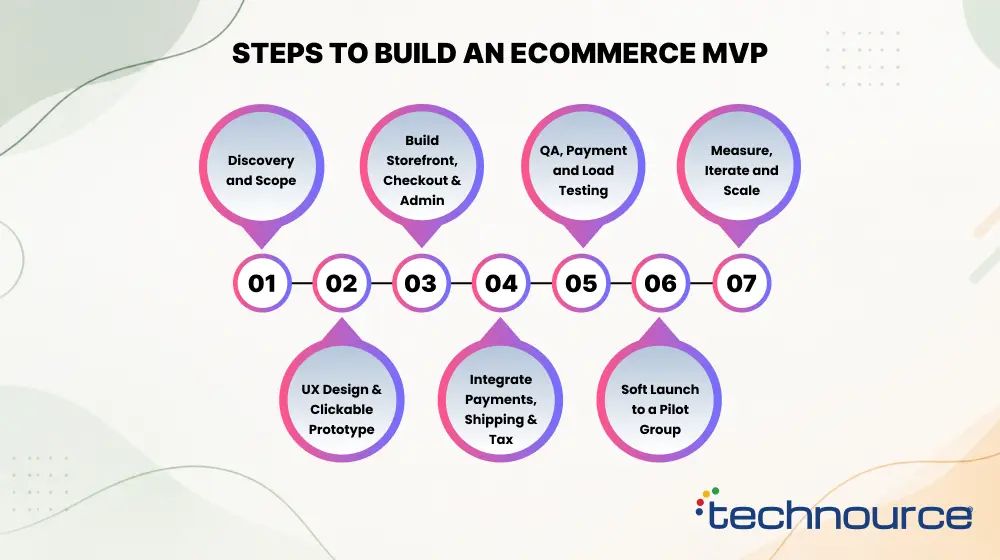
Step 1: Discovery and Scope (1–2 Weeks)
Pick the model first: D2C, marketplace, or a D2C store that opens to sellers later. Then define the one purchase loop version one must complete.
List the US states you will ship to, the payment methods buyers expect, and the three metrics that will decide whether the MVP worked.
Step 2: UX Design and Clickable Prototype (1–3 Weeks)
Design the product page, cart, and checkout for mobile first, then adapt them for desktop. For a marketplace, add the seller listing flow and the payout settings screen.
Test the clickable prototype with five or more target buyers. Fix anything that makes them hesitate at checkout.
Step 3: Build Storefront, Checkout and Admin (2–17 Weeks)
Build time runs 2–3 weeks on Shopify, 5–7 weeks for a simple custom D2C store, 8–9 weeks for a headless store, and 12–17 weeks for a multi-vendor marketplace.
Build in one- or two-week sprints, with a working checkout in the first sprint. Each sprint ends with a demo you can click through.
The admin panel ships alongside the storefront, because your team needs to manage orders and refunds from day one.
Step 4: Integrate Payments, Shipping and Tax (1–2 Weeks, Alongside the Build)
Connect the payment processor, the tax engine, and the shipping tool while the storefront is being built. Marketplaces also set up seller onboarding and split payouts in this step.
Run test orders end to end in sandbox mode before any real card is charged.
Step 5: QA, Payment and Load Testing (1–2 Weeks)
Test every money path: purchase, partial refund, full refund, failed payment, and, for marketplaces, the seller payout. Check tax on addresses in different states.
Test on real phones and browsers, and run a basic accessibility check against WCAG 2.1 AA.
Step 6: Soft Launch to a Pilot Group (2–4 Weeks After Build)
Open the store to an invite list or one paid channel before a public launch. A small, controlled audience exposes checkout and fulfillment issues while they are cheap to fix.
For a marketplace, onboard the first sellers before the buyer invites go out.
Step 7: Measure, Iterate and Scale (Ongoing)
Review the KPIs every week and ship small improvements in short sprints. Add a feature only when the data shows which metric it should move.
How Much Does Ecommerce MVP Development Cost?
Ecommerce MVP development costs $5,000–$7,000 for a Shopify-based D2C store, $8,000–$15,000 for a simple custom store, $20,000-$30,000 for a headless store or single-category marketplace, and $30,000–$50,000 for a multi-vendor marketplace. Enterprise builds with ERP or order-management integrations cost $60,000–$100,000.
| Build Type | Typical Scope | Cost (USD) | Timeline |
|---|---|---|---|
| No-Code / Low-Code MVP | Shopify-based D2C store with theme customization | $5,000–$7,000 | 2–4 weeks |
| Simple MVP | Custom D2C store with one payment gateway | $8,000–$15,000 | 8–10 weeks |
| Mid-Complexity MVP | Headless D2C store or single-category marketplace | $20,000–$30,000 | 12–16 weeks |
| Complex MVP | Multi-vendor marketplace with split payouts | $30,000–$50,000 | 16–24 weeks |
| AI MVP | D2C store or marketplace plus AI search or recommendations | $10,000–$50,000 | Depends on scope |
| Enterprise MVP | ERP or order-management integrations, multi-region | $60,000–$100,000 | Depends on scope |
Native apps, loyalty programs, and advanced personalization push a project past MVP pricing and into full ecommerce app development cost territory.
What Drives Ecommerce MVP Cost?
Six factors move an ecommerce MVP between tiers. The business model has the biggest effect.
| Cost Driver | Why It Adds Cost |
|---|---|
| Business Model | Marketplaces need seller, payout, and dispute logic |
| Platform vs. Custom | Custom checkout and pricing rules take engineering time |
| Integrations | Each ERP, 3PL or POS connection adds build and test work |
| Platforms | Native iOS and Android apps add QA and release cycles |
| AI Features | Model APIs, prompt design and review workflows |
| Compliance Scope | Tax engines, accessibility work and privacy tooling |
Hidden and Ongoing Costs to Budget
The build price is not the full cost of running a store. Budget for these recurring items from the start.
- Platform plan and app subscriptions, if you launch on Shopify or a similar platform.
- Payment processing fees on every transaction, plus payout fees for marketplaces.
- Tax engine, shipping software and email platform subscriptions.
- Hosting, CDN and third-party API usage, including AI model calls.
- Maintenance, security updates and app store fees for native apps.
These costs depend on order volume, traffic, and your stack, so ask for them to be estimated alongside the build quote.
Want a fixed estimate for your D2C store or marketplace MVP?
Shopify vs Custom: Should You Build or Buy Your Ecommerce MVP?
Buy, meaning Shopify or a similar platform, if you sell your own products and your advantage is the brand rather than the software. Build custom or headless if you need marketplace payouts, unusual pricing or checkout rules, or full ownership of the code and data.
| Factor | Shopify | Custom | Headless Hybrid |
|---|---|---|---|
| Launch Speed | 2–4 weeks | 8–24 weeks | 12–16 weeks |
| MVP Cost | $5,000–$7,000 | $8,000–$50,000 | $20,000–$30,000 |
| Marketplace Support | Limited, via third-party apps | Full control of seller logic | Depends on the engine |
| Checkout Control | Platform rules | Fully custom | Custom front end, engine checkout |
| Code Ownership | Platform-owned | 100% yours | Front end yours, engine licensed or open source |
| Ongoing Fees | Plan plus app subscriptions | Hosting and maintenance | Both, with lower app spend |
Technource’s Recommendation
Start on Shopify if you are a D2C brand testing products. Move to headless once app subscriptions and checkout limits start costing you conversions. Build custom from day one only for marketplaces, because split payouts and seller logic are where most platform shortcuts break.
What Are the Biggest Challenges in Ecommerce MVP Development?
The biggest challenges in ecommerce MVP development are scope creep, payout complexity, sales tax, marketplace cold start, legacy integrations, and checkout friction. Each one can add weeks to the timeline if it surfaces after the build starts.
| Challenge | Real Consequence | How to Solve It |
|---|---|---|
| Scope Creep | Launch slips and the budget runs out | Freeze scope to one purchase loop per release |
| Payout Complexity | Sellers paid late or incorrectly | Use Stripe Connect or a similar provider from day one |
| Sales Tax | Back taxes and penalties after crossing nexus | Automate tax collection before launch |
| Cold Start | Buyers arrive to empty categories | Seed supply in one niche first |
| Legacy Integrations | Orders re-entered by hand | Connect one system at a time through APIs |
| Checkout Friction | High cart abandonment | Guest checkout, wallets and upfront costs |
Most of these trace back to the root causes of why most MVPs fail: unclear success metrics and a version one that tries to do too much.
Common Mistakes to Avoid in Ecommerce MVP Development
The most common ecommerce MVP mistakes are choosing the wrong model, overbuilding version one, hiding costs until checkout, skipping analytics, launching native apps too early, and treating payouts as a later feature. Each one wastes the budget the MVP was meant to protect.
- Choosing the wrong model. Building a marketplace to sell products you could source and sell yourself.
- Overbuilding version one. Shipping wishlists, loyalty points, and AR before the first repeat order.
- Hiding costs until checkout. Surprise shipping and tax at the last step drive shoppers away.
- Launching without analytics. Without funnel data, you cannot tell why buyers leave.
- Going native too early. Two app codebases double QA before the web store has proven demand.
- Treating payouts as a later feature. Seller payments touch onboarding, refunds, and tax, so they belong in sprint one.
Which KPIs Should You Track After Launch?
Track conversion rate, average order value, customer acquisition cost, cart abandonment, and repeat purchase rate for a D2C MVP. Marketplaces should also track GMV, take rate, sell-through rate, and seller time to first sale.
| KPI | What It Shows | How to Measure |
|---|---|---|
| Conversion Rate | Whether visitors buy | Orders ÷ sessions in GA4 |
| Average Order Value | Basket size | Revenue ÷ orders |
| Customer Acquisition Cost | Cost to win a buyer | Marketing spend ÷ new customers |
| Cart Abandonment | Checkout friction | Compare against Baymard’s average of about 70% |
| Repeat Purchase Rate | Product-market fit | Returning buyers ÷ total buyers, by cohort |
| GMV and Take Rate | Marketplace scale and revenue | Total order value; platform fees ÷ GMV |
| Sell-Through Rate | Supply quality | Listings sold ÷ listings live |
| Seller Time to First Sale | Supply-Side Activation | Days from seller approval to first order |
How to Choose an Ecommerce MVP Development Company
Choose an ecommerce MVP development company that has shipped live stores or marketplaces with payments in production, gives a fixed scope with a phased budget, and hands over full code ownership. Ask for at least two live products you can buy from today.
| Question to Ask | Good Answer | Red Flag |
|---|---|---|
| Can I Buy from a Store or Marketplace You Built? | Links to live sites and apps | Only mockups or NDAs |
| How Do You Handle Seller Payouts? | Names a provider and the KYC flow | “We’ll build payments ourselves” |
| How Do You Handle US Sales Tax? | A tax engine in the MVP scope | “Add it later” |
| Who Owns the Code? | You do, from day one | Licensing or lock-in clauses |
| What Is in Version One? | A short, ranked feature list | Everything you asked for, unpriced |
| What Happens After Launch? | Iteration sprints and support options | A handover with no plan |
Technource has 14+ years in product engineering and a 4.9/5 rating on Clutch from 25 reviews. GoodFirms also rates Technource 4.9/5, from 12 reviews.
The same criteria for choosing an MVP development partner apply to ecommerce, with payments and tax added to the list.
What Are the Future Trends in Ecommerce MVP Development?
Four trends are shaping ecommerce MVPs in 2026: AI shopping assistants, headless and composable stacks by default, social and creator commerce, and embedded payments such as buy now, pay later. Each one changes what version one should be ready for, even if it does not ship on day one.
AI Shopping Assistants and AI-Platform Referrals
More shoppers start product research in AI assistants instead of search engines. Clean product data, structured markup, and accurate stock levels make your catalog easier for those assistants to recommend.
Headless and Composable by Default
New builds increasingly separate the storefront from the commerce engine. An MVP built this way can swap search, payments, or tax providers without a rebuild.
Social and Creator Commerce
Shoppable videos and creator storefronts send traffic straight to product pages. MVPs need fast mobile product pages and checkout links that work from social apps.
Embedded Payments and BNPL
Buy now, pay later and wallet payments are now standard expectations at checkout. Choose a payment provider that adds them through settings, not custom code.
How Technource Delivers Measurable Results in Ecommerce
Technource has built marketplace and ecommerce platforms for founders in the US, the UK, and the Middle East. The three builds below show how the decisions in this guide play out in production.
How Technource Built Equipt, a UK Equestrian Marketplace That Delivers 70% Better Order and Dispute Handling
We built Equipt, a niche B2C marketplace for the UK equestrian community. The founder needed buyers and sellers in one trusted app, with secure payments, shipping, and dispute handling, but had no logistics system of its own.
We built one app where users switch between buying and selling, with category-specific listing fields, offers, chat, reviews, and disputes. The stack is Laravel, Flutter and MySQL, with Stripe Connect for seller payouts and Royal Mail, Evri and TrackingMore APIs for shipping.
Measurable Result
- 70% better order and dispute handling.
- 65% faster product discovery.
- Seller payouts, refunds and disputes run through Stripe Connect, with real-time earnings tracking for sellers.
- Shipping charges and labels are generated automatically, removing manual label work for sellers.
- Category-specific listing fields keep every listing complete and searchable.
- GDPR-ready data handling: consent at signup, data export and deletion, and encrypted storage.
- Live on the web, iOS, and Android.
How Technource Built Tojarcom, a Cross-Border Shopping Platform That Delivers 60% Better Customer Service Efficiency
We built Tojarcom, a B2C shopping and service platform that lets customers in Jordan, the UAE, and Saudi Arabia buy from US and European stores that don’t ship to them. Hidden customs and shipping charges were the main source of customer frustration.
We integrated Google Programmable Search Engine for cross-store product discovery, the Slice API to pull vendor order data, and the DHL API for tracking. The platform runs on Laravel, Angular, and MySQL, with role-based dashboards for each team.
Measurable Result
- 60% better customer service efficiency.
- 65% faster cross-border shopping.
- A six-part cost breakdown (base price, handling, shipping, international tax, customs, and clearance) is shown before purchase.
- DHL Air Waybill numbers are generated for every package, with real-time tracking.
- Vendor order and shipping data is fetched automatically through the Slice API, removing manual entry.
- A role-based workflow connects customer service, purchasing, warehouse, logistics, delivery, and accounts.
How Technource Built Collegely, a US Community Marketplace That Verifies Every Business Profile Before It Goes Live
We built Collegely, a US-based classified marketplace where students and local users post and find jobs, housing, cars, services, and items. The client wanted a simpler, safer alternative to established classified sites.
Revenue comes from pay-per-add-on ad posting through Stripe. We added business account verification with admin approval, reporting and moderation for listings, and an approval toggle that moves from manual to automatic review as the community grows. The stack includes Stripe, Firebase, and OpenStreetMap-based maps.
Measurable Result
- Business profiles are verified and approved by admins before they go live.
- An admin-controlled approval mode scales from manual review to auto-approval.
- The pay-per-add-on revenue model runs live through Stripe.
- Reported-content moderation keeps listings trustworthy for buyers.
Technource’s Approach to Ecommerce MVPs
Five principles guide every ecommerce MVP we build.
- Model first. Decide D2C or marketplace before the feature list, because it sets payments, tax, and admin scope.
- One purchase loop, one metric. Ship the shortest path from product page to delivered order, and judge it on conversion.
- Money flows are architecture. Payouts, refunds, and tax are designed in sprint one, not bolted on later.
- Buy commodity, build differentiation. Use proven payment, tax, and shipping providers, and write custom code only where it sets you apart.
- Measure, then add. Every new feature needs a KPI it is expected to move.
Conclusion
Three decisions shape every ecommerce MVP: D2C or marketplace, Shopify or custom, and what version one leaves out.
Get those right, and ecommerce MVP development becomes predictable, from $8,000–$15,000 for a simple D2C store to $30,000–$50,000 for a multi-vendor marketplace.
Technource is an AI-powered product engineering company, and our ecommerce development solutions cover D2C stores, marketplaces, and the AI features around them.
If you are ready to scope your store or marketplace, contact us for a short call that maps your model, budget, and launch timeline.
Ready to turn your ecommerce idea into a store that sells?
FAQs
AI in recruitment refers to the use of machine learning, natural language processing, and predictive analytics to automate and improve the hiring process, from sourcing and screening candidates to scheduling interviews and forecasting hiring outcomes. The key benefits include faster time-to-hire, lower cost-per-hire, consistent candidate evaluation at scale, better quality-of-hire through predictive analytics, and improved candidate experience through automated communication. No, AI shifts bias rather than eliminating it. If a model is trained on historically biased hiring data, it can amplify that bias algorithmically. Regular audits, diverse model-building teams, and transparent AI systems are essential to managing this risk. It depends on your scale, technical resources, and specific requirements. SaaS platforms are faster and cheaper to deploy. Custom solutions, built with the help of an AI development company, offer more control, deeper integrations, and long-term flexibility for companies with complex needs. Hilton cut time-to-hire from 6 weeks to 5 days using AI video screening. Unilever saved 50,000 recruiter hours annually through AI resume screening. L’Oréal managed 1.7 million applications using AI chatbots. IBM uses predictive AI to identify flight-risk employees with 95% accuracy.
Related Insights and Articles