Traditional IVR systems were built to route calls efficiently, and for many businesses, they still do that well. AI phone agents, often developed by an AI development company, were built to resolve calls through natural conversation, handling tasks end-to-end without menus or transfers. This guide compares both honestly: what each does well, what each costs, where each fails, and how to decide which belongs in your phone stack in 2026.
IVR vs AI Phone Agent: Quick Answer
IVR systems route calls through fixed menus and remain the most reliable option for high-volume enterprise routing, predictable self-service, and compliance-heavy environments.
AI phone agents resolve calls through natural conversation, completing tasks like booking, order management, and L1 support end-to-end, without routing the caller anywhere.
Traditional IVR costs businesses an estimated $262 per customer annually in churn and missed revenue (Vonage), but only in environments where abandonment is high and call types are varied.
AI phone agents reduce call abandonment by 30–40% on complex, multi-intent call types, but underperform IVR on high-volume routing and deterministic compliance flows.
The right answer for most businesses is not IVR or AI, it is knowing which call types belong on which system, and migrating the high-abandonment flows first.
Your customer calls at 7:43 PM with a billing question. They hit the menu. They press 2. They get transferred. They press 1 again. They wait. Then they hang up and call your competitor.
That scenario is real, but it is not an argument against IVR. It is an argument against using IVR for the wrong type of call. Businesses exploring AI integration solutions are often trying to fix exactly this issue. The Vonage Global Customer Engagement Report found that 51% of consumers have abandoned a business after a frustrating IVR experience.
What that figure does not tell you is that those businesses were routing varied, complex, high-emotion calls through a system designed for single-intent menu navigation.
IVR has powered enterprise telephony for over 50 years. Billions of calls per year still run through IVR infrastructure because, in the right context, it is fast, reliable, auditable, and cost-effective.
The case for AI phone agents is not that IVR is broken; it is that the nature of customer calls has changed, and a growing share of those calls requires resolution, not routing.
This guide gives both technologies a fair hearing.
According to Grand View Research, the global AI in contact center market was valued at $1.95 billion in 2023 and is projected to grow at a CAGR of 21.3% through 2030. That growth is real. But whether it applies to your business depends on what your call data actually shows, not on industry projections.
What Is an IVR System?
An IVR (Interactive Voice Response) system is an automated telephony platform that manages incoming calls through pre-recorded voice menus and caller inputs, either DTMF keypad tones or limited voice commands.
The caller hears a menu, makes a selection, and gets routed to a queue, a sub-menu, a voicemail box, or a live agent based on rules configured in advance.
IVR was engineered in the 1970s to reduce switchboard load in large call centers. The core mechanism has not changed: a fixed decision tree where every possible call type must be anticipated, scripted, and mapped to a menu path before the system goes live.
What has evolved significantly is the sophistication of the voice recognition layer, the depth of backend integrations, and the cloud delivery model that has made IVR accessible to businesses of all sizes.
How Does IVR Work Technically?
A production IVR deployment is more architecturally complex than it appears from the outside. At the front end, the telephony platform, typically from Genesys, Cisco, Avaya, NICE, or cloud providers like Amazon Connect and Twilio, handles call reception, queue management, and PSTN integration. The IVR application server sits above this layer and contains the menu logic, scripts, routing rules, and business conditions.
Modern IVR systems can also use speech recognition and basic NLU to understand common requests and connect with CRM, billing, scheduling, and support systems through backend integrations. This allows callers to check account balances, track orders, confirm appointments, and access information without speaking to a live agent.
One of IVR’s biggest strengths is its predictability. Every menu path, routing decision, and caller action is logged, creating a complete audit trail that helps enterprises maintain compliance, monitor performance, and manage high call volumes consistently.
Where IVR Performs Well and Why Enterprises Still Use It
IVR remains highly effective for high-volume contact centers that need reliable call routing, queue management, and skills-based distribution. Industries such as healthcare, banking, and insurance continue to rely on it because routing accuracy, auditability, and operational consistency matter more than conversational flexibility.
IVR also benefits from decades of operational maturity. Companies have already invested in telephony infrastructure, reporting systems, compliance processes, and workforce management tools built around IVR. For businesses with strong self-service performance and low abandonment rates, replacing a working system often offers limited value compared to optimizing it.
Common reasons businesses continue to use IVR:
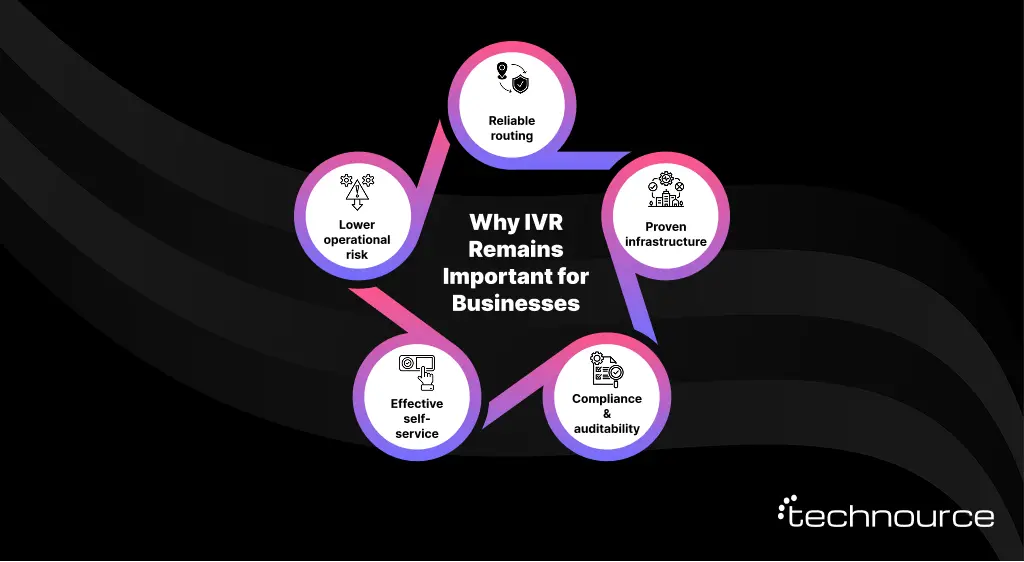
Reliable routing — handles high call volumes across departments, teams, and service levels consistently
Proven infrastructure — existing integrations, reporting systems, and workflows built around IVR
Compliance and auditability — deterministic call paths with complete logging for regulated industries
Effective self-service — account balance checks, order tracking, payment processing, and appointment confirmations
Lower operational risk — established system with predictable behavior in environments where stability matters
Where IVR Consistently Breaks Down
IVR is highly effective for routing and simple self-service tasks, but certain limitations become more noticeable as customer requests grow more complex. This is where companies start considering building AI agents that can handle multi-intent conversations instead of rigid menu flows.
However, these challenges are often the reason businesses explore conversational AI alternatives.
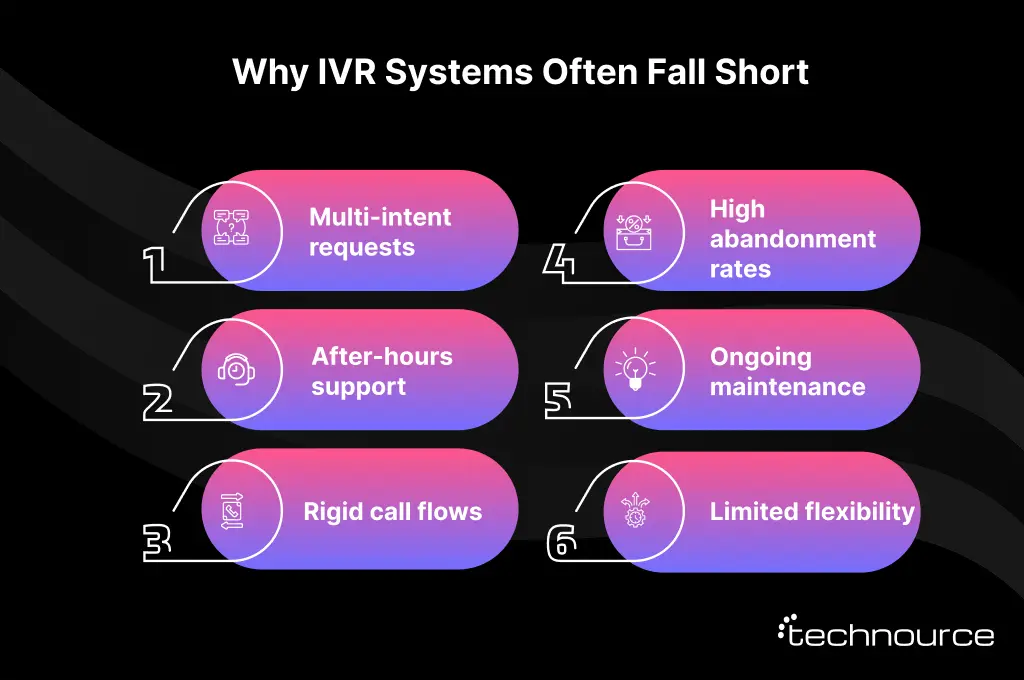
Multi-intent requests: IVR is designed for one request at a time, making it difficult to handle conversations that involve multiple questions or actions.
After-hours support: Most IVR systems route callers to voicemail or callback requests, which can result in missed leads and unresolved customer issues.
Rigid call flows: Callers must follow predefined menu paths, even when their needs do not fit neatly into the available options.
High abandonment rates: Long menus, multiple transfers, and confusing navigation can frustrate callers and increase hang-ups.
Ongoing maintenance: Updating menus, scripts, business hours, promotions, or compliance language often requires manual changes and testing.
Limited flexibility: IVR performs best with predictable requests but struggles when customers phrase requests differently or ask unexpected questions.
What Is an AI Phone Agent?
An AI phone agent is a conversational system that uses technologies such as speech recognition, natural language understanding (NLU), large language models (LLMs), and voice synthesis to understand caller requests and complete tasks during a call. Unlike IVR, these systems are part of a broader shift toward building AI software that can take action, not just route requests.
Instead of routing customers to another queue or agent, it can book appointments, answer questions, update records, and resolve requests in real time.
The key difference between an AI phone agent and an IVR system is the outcome. IVR is designed to route callers to the right destination, while AI phone agents are designed to resolve requests without requiring additional transfers or menu navigation.
The Technology Stack Behind AI Phone Agents
AI phone agents rely on multiple technologies working together to understand requests, take action, and deliver a natural conversational experience. Businesses working with a chatbot development company often extend these capabilities across voice, chat, and omnichannel support systems.
Component
Role
ASR (Automatic Speech Recognition)
Converts spoken language into text so the system can understand what the caller is saying.
NLU (Natural Language Understanding)
Identifies the caller’s intent and extracts important details such as dates, times, names, or account information.
LLM (Large Language Model)
Handles context, multi-turn conversations, and requests that do not fit predefined scripts or intents.
Backend Integrations
Connects the agent to CRM, scheduling, billing, ERP, or order management systems so it can take real actions, not just answer questions.
TTS (Text-to-Speech)
Converts AI-generated responses into natural-sounding speech for the caller.
Escalation Protocol
Transfers calls to human agents when necessary and provides conversation history to ensure a smooth handoff.
AI Phone Agent Capabilities and Limitations
AI phone agents resolve calls through natural conversation.
Their performance, however, depends heavily on execution quality. This is why choosing the best AI development company becomes a critical decision—poor implementation can lead to worse outcomes than IVR.
Where AI Phone Agents Perform Well
AI phone agents are most effective when customers need a resolution rather than routing. They perform well for appointment scheduling, order management, L1 support, after-hours inquiries, and other scenarios where callers expect a conversation and immediate action.
They also excel at handling multi-part requests, maintaining context throughout a call, and providing 24/7 support without relying on menus, transfers, or voicemail.
Where AI Phone Agents Still Face Challenges
AI phone agents are not ideal for every use case. They can struggle when integrations are incomplete, compliance requirements are extremely strict, or call handling requires deterministic behavior with zero tolerance for errors.
Their success also depends heavily on implementation quality. Poor intent design, weak integrations, inadequate testing, or poorly defined escalation rules can reduce accuracy and create a frustrating caller experience.
IVR vs AI Phone Agent: Head-to-Head Comparison
The table below compares both systems across the dimensions that matter most to business decision-makers. Neither column is universally better; the right answer depends on your call type distribution and operational requirements.
Feature
Traditional IVR
AI Phone Agent
Interaction model
Menu-driven, keypad or fixed voice commands
Natural conversation, open-ended speech
Core logic
Deterministic, every path pre-scripted
Probabilistic, LLM reasons about intent
Primary function
Routes calls to the right destination
Resolves calls without routing
Task completion
Routes calls, rarely resolves them end-to-end
Completes tasks end-to-end within the call
Multi-part requests
Fails — one intent per menu selection
Handles complex, multi-topic conversations
After-hours handling
Voicemail or callback request
Full conversation capability 24/7
Personalization
Generic, same menu for every caller
Context-aware, adapts to caller history
Error recovery
Loops or escalates — no recovery logic
Asks clarifying questions, re-routes fluidly
Backend integration
Lookups and routing; limited write capability
Reads and writes CRM, scheduling, and billing
Language support
Pre-recorded, typically 1–2 languages
Multilingual, 20+ languages, real-time
Auditability
Full, deterministic path logging
Full, transcript + structured audit trail
Compliance fit
Strong, deterministic, fully auditable
Improving requires deliberate architecture
Maintenance burden
High, every change requires manual re-scripting
Intent refinement + model updates
Call abandonment
High (30–51%) on complex or varied queries
Significantly lower,2 immediate engagement
Platform cost (SMB)
$0.01–0.06/min + setup; $50–500/mo cloud
$30–200/mo SaaS; $40K–200K+ custom build
Best for
High-volume routing, compliance, and enterprise queuing
Resolution-focused, varied needs, after-hours
The Business Cost of IVR Abandonment
Poor IVR experiences affect more than customer satisfaction. Companies evaluating the cost to develop AI application solutions often realize that the real cost is not development; it’s lost revenue from abandoned calls.
Impact Area
Business Impact
Customer Churn
Research from Vonage found that 51% of consumers have abandoned a business after a frustrating IVR experience.
Lost Revenue
Missed calls, abandoned interactions, and unresolved requests can directly impact sales, bookings, and renewals.
Higher Agent Costs
Calls that fail in IVR often escalate to live agents, increasing support costs and reducing operational efficiency.
Lower Customer Satisfaction
Long menus, multiple transfers, and poor routing can create friction throughout the customer journey.
Brand Perception
Customers associate frustrating phone experiences with the business itself, which can affect loyalty and referrals.
Operational Inefficiency
High abandonment and escalation rates increase call volumes and place additional pressure on support teams.
When to Use IVR vs When to Use an AI Phone Agent
The decision is not binary, and framing it as IVR versus AI misses the most practical answer for most businesses: use IVR for the call types it handles reliably, and deploy an AI phone agent for the flows where IVR consistently fails callers.
Keep IVR When These Conditions Apply
IVR remains the better choice in several scenarios, particularly when routing efficiency, compliance, and operational stability are more important than conversational flexibility.
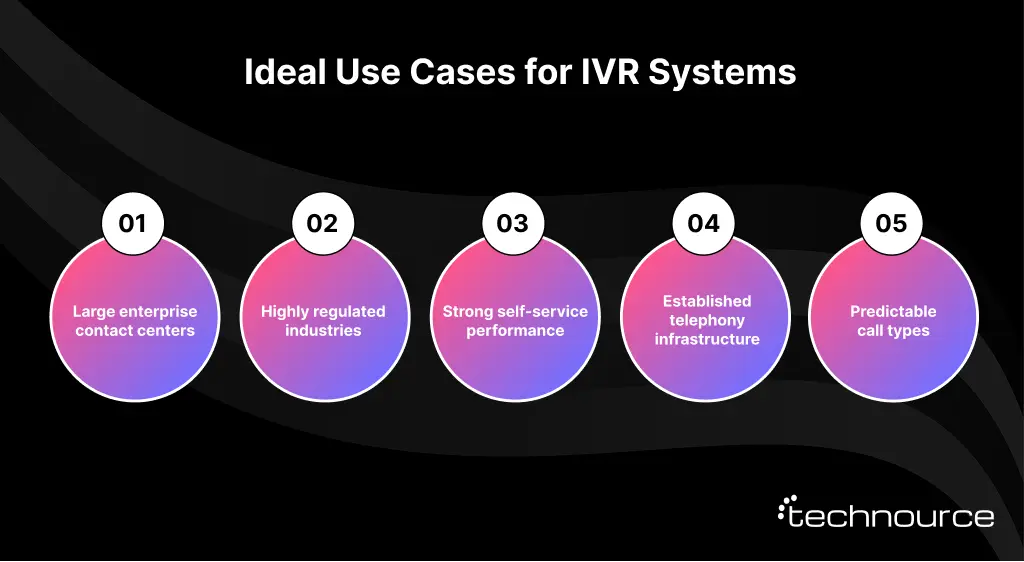
Large enterprise contact centers: IVR excels at skills-based routing, priority queuing, callback management, and SLA enforcement across large agent teams.
Highly regulated industries: Banking, insurance, and healthcare organizations often require deterministic, fully auditable call paths for compliance purposes.
Strong self-service performance: If callers are successfully resolving requests through IVR and abandonment rates are low, replacing the system may provide limited ROI.
Established telephony infrastructure: Businesses with significant investments in IVR workflows, reporting systems, and operational processes may benefit more from optimization than replacement.
Predictable call types: Simple requests such as account inquiries, payment confirmations, and order status checks are often handled efficiently through IVR.
Switch to AI Phone Agents When These Conditions Apply
AI phone agents are most valuable when customers need a resolution rather than routing. If callers frequently abandon IVR menus, require after-hours support, or contact agents for repetitive requests, AI can often deliver a better experience and lower operational costs.
Industry / Context
Problem IVR Creates
What AI Phone Agent Delivers
Healthcare & Clinics
30%+ abandonment on appointment booking; after-hours requests lost to voicemail
24/7 booking, rescheduling, insurance pre-check; zero abandoned booking windows
SaaS & Tech Support
Complex support queries cannot be mapped to a menu; agents handle avoidable L1 volume
AI resolves L1 end-to-end; escalates L2+ with full context and ticket already created
Financial Services / Fintech
Compliance scripts go stale; IVR updates are slow and require specialist time
Dynamic compliance language, auto-updated; full transcript audit trail per call
E-commerce & Retail
Order status, returns, and delivery queries overwhelm agents; IVR cannot query OMS in real time
OMS/WMS API integration enables real-time order resolution without a human agent
Home Services & Field Ops
After-hours calls produce lost leads; callers do not leave voicemails
AI captures request, assesses urgency, queues dispatch — converting missed calls to booked jobs
Enterprise HR / IT Helpdesk
Password resets, access requests, and onboarding queries repeat at volume
AI resolves L1 IT tickets autonomously with ITSM integration (ServiceNow, Jira)
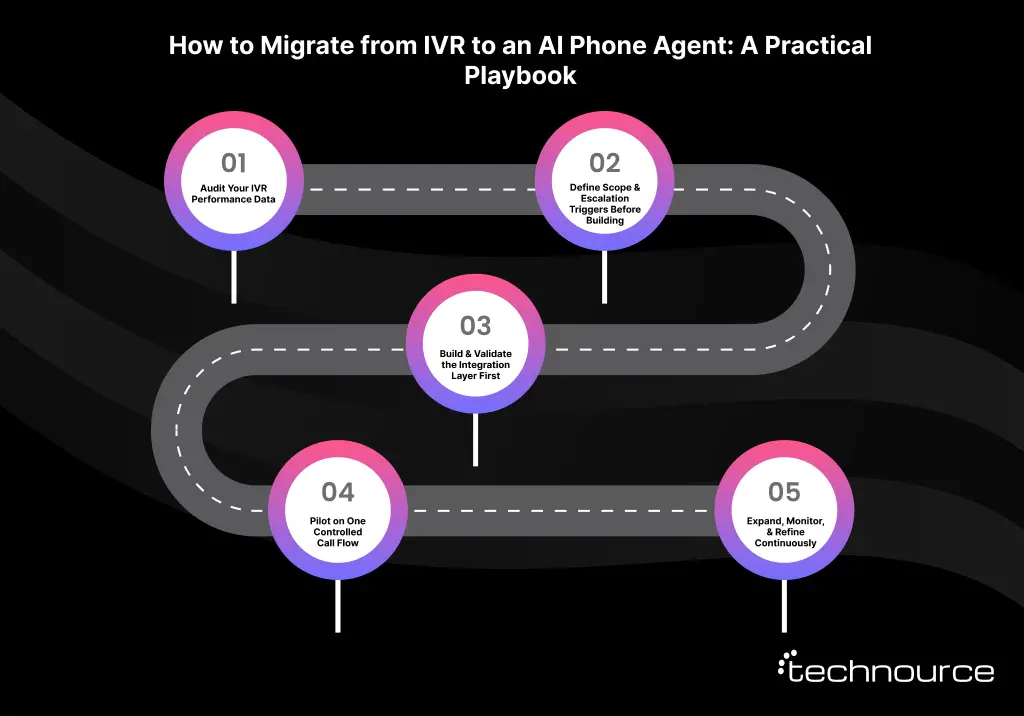
How to Migrate from IVR to an AI Phone Agent: A Practical Playbook
A successful migration does not start with a full IVR replacement. It starts with identifying the highest-value failure in your current IVR and solving that problem first. The goal of the first phase is not to eliminate IVR; it is to stop losing customers on the specific call types where IVR is failing them most visibly.
Step 1: Audit Your IVR Performance Data
Review the last 60–90 days of call data.
Identify menu paths with the highest abandonment rates.
Find call types that generate the most agent escalations.
Analyze after-hours call volume and missed opportunities.
Determine which IVR flows are performing well and should remain unchanged.
Step 2: Define Scope and Escalation Triggers Before Building
Start with 2–3 high-volume or high-abandonment use cases.
Define what constitutes a successfully resolved call.
Establish clear escalation rules for human handoffs.
Set confidence thresholds for AI decision-making.
Document compliance, safety, and exception scenarios.
Step 3: Build and Validate the Integration Layer First
Connect the AI agent to CRM, scheduling, billing, and support systems.
Map required actions to specific API endpoints.
Test authentication and data access workflows.
Validate error handling and fallback mechanisms.
Confirm all integrations work before AI deployment begins.
Step 4: Pilot on One Controlled Call Flow
Launch the AI agent on a single call type.
Run the pilot for a defined testing period.
Measure resolution, abandonment, and escalation rates.
Compare results against the existing IVR baseline.
Fix issues before expanding to additional use cases.
Step 5: Expand, Monitor, and Refine Continuously
Gradually introduce new call types and workflows.
Review escalated and abandoned calls regularly.
Refine intents, knowledge bases, and responses.
Adjust escalation rules based on performance data.
Treat the AI phone agent as an evolving product, not a one-time deployment.
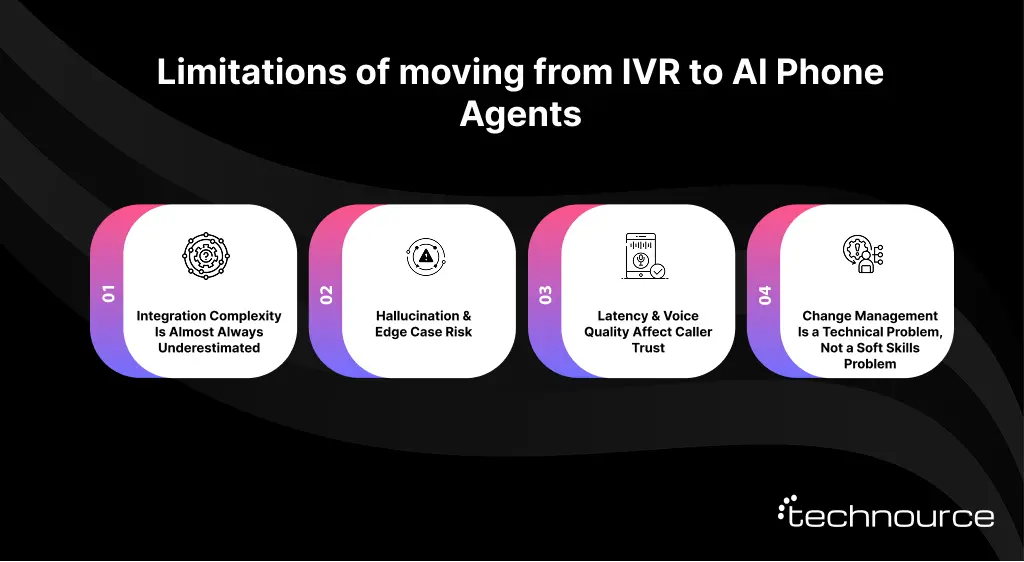
Real Challenges When Moving from IVR to AI Phone Agents
The biggest challenge is rarely the AI; it is the integration. As part of broader emerging technologies, AI voice agents require deep system connectivity, not just surface-level automation.
Every vendor selling AI phone agents will show you a 40% resolution rate and a 30% abandonment reduction. What they show less often is what goes wrong in production, and what goes wrong determines whether a deployment succeeds or becomes an expensive mistake.
1. Integration Complexity Is Almost Always Underestimated :
The biggest challenge in AI phone agent deployments is rarely the AI; it is the integration. CRM limitations, legacy systems with undocumented APIs, authentication complexity, and rate-limiting issues routinely turn planned 6-week projects into multi-month implementations.
The AI component of a modern phone agent is increasingly commoditized. The integration layer, connecting the agent to your specific systems in your specific data environment, is where the hard engineering lives.
2. Hallucination and Edge Case Risk :
AI phone agents occasionally generate inaccurate responses. On a scheduling agent, this might mean confirming an appointment slot that the calendar cannot actually support. For a financial services agent, it could mean providing incorrect account information.
Guardrails, grounding responses in verified data sources, restricting generation to defined topics, and building confidence thresholds that trigger human escalation, are core architecture requirements for production deployments, not optional enhancements.
3. Latency and Voice Quality Affect Caller Trust :
Response delays above 1.5–2 seconds and synthetic-sounding voices both reduce caller trust and increase abandonment, the same metrics IVR is criticized for, applied to AI phone agents when they are built without latency optimization.
In Technource’s deployment experience, optimizing the full ASR → LLM → TTS pipeline for latency is as important as optimizing it for accuracy. Callers do not diagnose what is causing a delay; they interpret it as the system not understanding them.
4. Change Management Is a Technical Problem, Not a Soft Skills Problem :
Moving from IVR to AI phone agents requires operational changes alongside technical ones. Agent teams need new escalation protocols. Supervisors need new monitoring dashboards. QA teams need new call review frameworks.
Organizations that hand a deployed AI phone agent to the contact center team on launch day without preparation, treating it as a completed IT project rather than an operational change, experience higher escalation rates, weaker feedback loops, and slower performance improvement than organizations that invest in change management upfront.
IVR vs AI Phone Agent: Full Cost Comparison
A complete cost comparison requires looking beyond platform fees to include implementation, maintenance, integration, and the revenue impact of call handling performance. The table below covers the full picture.
Predictable routing, compliance, and enterprise scale
SMB, standard use cases, fast deployment
Enterprise, complex workflows, proprietary systems
Build vs. Buy for AI Phone Agents
Once you’ve decided to deploy an AI phone agent, the next step is choosing between a SaaS platform and a custom-built solution.
Factor
Buy (SaaS Platform)
Build (Custom Solution)
Deployment Time
2–6 weeks
3–6+ months
Upfront Cost
Lower
Higher
Integration Flexibility
Limited to available connectors
Can integrate with any system
Customization
Standard features and workflows
Built around specific business requirements
Compliance Control
Depends on the vendor
Full control over security and compliance
Best For
SMBs and straightforward use cases
Enterprises with complex workflows or proprietary systems
Why Technource for AI Phone Agent Development
Building an AI phone agent requires more than conversational AI. Success depends on reliable integrations, accurate intent recognition, compliance readiness, and ongoing optimization.
What sets Technource apart:
Product engineering expertise across AI, SaaS, and enterprise applications.
Custom integrations with CRM, scheduling, billing, ERP, and legacy systems.
Industry experience in healthcare, fintech, eCommerce, and customer support automation.
Compliance-focused development with support for HIPAA, GDPR, and industry-specific requirements.
Phased deployment approach that reduces risk through testing, pilot launches, and continuous optimization.
Technource helps businesses move beyond basic call automation by building AI phone agents that work reliably in real-world production environments.
Conclusion
IVR and AI phone agents solve different problems. IVR is best for high-volume routing, predictable self-service workflows, and compliance-driven environments, while AI phone agents excel at handling complex conversations, resolving requests, and providing 24/7 support.
The right choice depends on your call patterns, customer expectations, and operational goals. Many businesses achieve the best results with a phased approach, keeping IVR where it works and introducing AI phone agents for high-abandonment, high-volume, or after-hours use cases.
If you want an honest assessment of whether AI phone agents make sense for your specific call volume and business context, not a vendor pitch, the Technource team will walk through your IVR data with you and tell you what the numbers actually show.
Frequently Asked Questions
IVR routes callers through predefined menus using keypad inputs or limited voice commands. An AI phone agent understands natural language, holds conversations, and can complete tasks such as appointment booking, order tracking, and billing inquiries without transfers or menu navigation.
For many small and mid-sized businesses, yes. AI phone agents can handle routing, customer interactions, and task completion in a single conversation. However, organizations with complex queue management, skills-based routing, or large contact center operations may benefit from a hybrid approach.
A SaaS AI phone agent costs $30–$200 per month, while a custom build ranges from $40,000 to $200,000+. Traditional IVR has lower upfront costs but higher long-term costs from abandoned calls and agent escalations. The most important comparison is cost-per-resolved-call, not platform cost alone.
SaaS AI phone agent deployments typically take 2–6 weeks. Custom builds take 3–6 months, depending on integration complexity.
Many businesses start with a single high-volume call flow before expanding further.
AI phone agents designed for regulated industries include compliance as an architectural requirement with encrypted transcript storage, full audit trails, and support for HIPAA, GDPR, TCPA, and FDCPA.
This allows organizations to automate customer interactions while maintaining regulatory requirements.
A properly designed AI phone agent escalates the call to a human representative when confidence is low, the caller requests a human, or the request falls outside the agent’s scope. The transfer includes conversation history and context so customers do not have to repeat information.
Consider an AI phone agent if your IVR abandonment rate exceeds 15%, you have high after-hours call volume going to voicemail, or agents are frequently handling routine requests that could be automated.
Any of these signals may indicate opportunities to improve customer experience and operational efficiency.
Technource develops AI phone agents through a phased delivery process that includes system architecture review, backend integration design, intent model development, pilot deployment, and continuous optimization. This approach helps ensure the solution performs reliably in production environments, not just in controlled demos.