
Blog Summary
This guide explains how AI medical scribe development works in 2026, from audio capture to a signed note in the EHR. The guide covers HIPAA safeguards, recording consent, FDA scope, AI MVP and enterprise MVP costs, and an 8-step build process. You will also see when to build or buy, and three Technource case studies with measured results.
Key Takeaways
- AI medical scribe development costs $10,000–$50,000 for an AI MVP covering one specialty and one EHR, and $60,000–$100,000 for an enterprise MVP with several specialties and EHRs.
- An AI MVP reaches real clinicians in 12–16 weeks. An enterprise MVP takes 16–24 weeks because EHR write-back and the pilot take longer.
- HIPAA safeguards and clinician sign-off are architecture decisions. Every vendor that touches audio or transcripts needs a Business Associate Agreement (BAA), and no draft note enters the chart unsigned.
- Ambient scribes reduce burnout. After 30 days of use, the share of clinicians reporting burnout fell from 51.9% to 38.8% (JAMA Network Open, 2025).
- Technource healthcare and voice AI builds delivered 50% faster clinical decision-making (My Vital View), 65% faster e-prescribing approvals (Telepath), and a 70% reduction in human agent dependency (VoiceMate).
Clinicians still finish too many notes after the last patient leaves, and AI medical scribe development is how health systems and healthtech startups are taking that work back.
According to the American Medical Association, 81% of physicians used AI professionally in 2026, more than double the share in 2023.
The market is following. According to The Business Research Company, AI medical scribe software will grow from about $1.9 billion in 2026 to more than $5 billion by 2030.
Yet many scribe projects stall between demo and daily use. A demo transcribes a clean recording; a production scribe must separate speakers in a noisy exam room, avoid invented details, and write a signed note back into the EHR.
What Is AI Medical Scribe Development?
AI medical scribe development is the process of building software that records a clinician-patient conversation, converts it to text, and drafts a structured clinical note for the clinician to review, sign, and send to the EHR. A production scribe chains six components, and each one needs its own accuracy and safety checks.
The industry also calls this ambient clinical documentation, because the scribe listens in the background instead of waiting for dictation.
| Stage | What It Does | Typical Tools |
|---|---|---|
| Audio capture | Records the visit on a phone, tablet, or telehealth call | Mobile app, browser, telehealth SDK |
| Speech-to-text (ASR) | Converts speech to text, including drug names and doses | Whisper, Deepgram, AssemblyAI, AWS HealthScribe |
| Speaker diarization | Labels who said what: clinician, patient, or caregiver | Built into most medical ASR APIs |
| Note generation | Turns the transcript into a SOAP note or specialty template | HIPAA-eligible LLM endpoint and prompts |
| Clinician review | Shows the draft for edits and sign-off | Web or mobile review screen |
| EHR write-back | Files the signed note in the right chart | HL7 FHIR, SMART on FHIR, vendor APIs |
Each stage can fail on its own, which is why the work sits closer to full AI development services than to a single API call.
Why Are Healthcare Organizations Investing in Ambient Clinical Documentation?
Healthcare organizations invest in AI medical scribes to cut documentation time, reduce burnout, and give clinicians more face time with patients. Peer-reviewed studies published in 2025 show burnout dropping within 30 to 84 days of rollout.
| Benefit | What Changes | How It Works |
|---|---|---|
| Less after-hours charting | Most of the note is done when the visit ends | The scribe drafts during or right after the visit |
| Lower burnout | Notes take less mental effort | Reviewing a draft replaces writing from memory |
| More patient attention | Eye contact replaces typing | The device listens while the clinician talks to the patient |
| More consistent notes | Every note follows the same structure | Templates enforce sections and required fields |
| Less after-hours charting | Most of the note is done when the visit ends | The scribe drafts during or right after the visit |
| Better coding support | Fewer missed diagnoses in the record | Drafts can suggest ICD-10 codes for review |
| Faster note turnaround | Referrals and orders leave sooner | Signed notes write back to the EHR at once |
The clearest evidence comes from a study across six US health systems. After 30 days with an ambient scribe, clinicians reporting burnout fell from 51.9% to 38.8% (JAMA Network Open, 2025).
A second study found a 21.2% absolute drop in burnout at Mass General Brigham after 84 days, and a 30.7% absolute rise in documentation-related well-being at Emory Healthcare after 60 days (JAMA Network Open, 2025).
Benefits for Clinicians
- Less charting at home: Most of the note exists before the clinician leaves the exam room.
- Lower cognitive load: Editing a draft takes less effort than recalling a 20-minute visit hours later.
- Better patient conversations: Clinicians look at the patient, not the keyboard.
- Notes that sound familiar: Specialty templates and personal preferences keep each note in the clinician’s own style.
Benefits for Healthcare Organizations and HealthTech Companies
- Retention: Lower burnout supports clinician retention, and replacing a physician is slow and expensive.
- Capacity: Time saved on notes can go to extra visits or shorter wait lists.
- Documentation quality: Complete, structured notes support coding accuracy and audits.
- Product differentiation: For healthtech companies, a built-in scribe can become a core feature of a telehealth, EHR, or specialty platform.
Planning an AI medical scribe but not sure where to start?

AI Scribe vs Human Scribe vs Dictation: What’s the Difference?
An AI scribe drafts the full note from the natural conversation, a human scribe writes it in person or remotely, and dictation software only transcribes what the clinician says aloud. AI scribes scale at software cost, while human scribes scale with headcount.
| Criteria | AI Scribe | Human Scribe | Dictation Software |
|---|---|---|---|
| Input | Natural visit conversation | Live or remote observation | Clinician speaks after the visit |
| Output | Structured draft note | Finished note | Raw or lightly formatted text |
| Clinician effort | Review and sign | Review and sign | Dictate, then edit |
| Scaling | Software and usage costs | Hiring and turnover | Per-user license |
| Availability | Every visit, every shift | Shift-based | Whenever the clinician dictates |
| Main risk | Invented or missed details | Turnover and training gaps | Clinician time stays high |
Many teams keep a hybrid during rollout. The AI drafts every note, and human reviewers check a sample until edit rates stabilize.
What Are the Main Types of AI Medical Scribes?
AI medical scribes come in five main types: real-time ambient, post-visit ambient, dictation-based, telehealth-embedded, and hybrid scribes with human quality review. The right type depends on visit setting, specialty, and how fast notes must reach the EHR.
| Type | How It Works | Best For | Integration Effort |
|---|---|---|---|
| Real-time ambient | Listens during the visit and drafts as it goes | Primary care, high-volume clinics | High |
| Post-visit ambient | Processes the recording after the visit ends | Specialty clinics, longer visits | Medium |
| Dictation-based | Clinician dictates a summary; AI structures it | Surgery, radiology, procedures | Low to medium |
| Telehealth-embedded | Captures audio from the video call | Virtual care platforms | Medium |
| Hybrid with human QA | AI drafts; a trained reviewer checks before the clinician signs | High-risk specialties, early pilots | Medium |
Telehealth scribes fit naturally inside a telemedicine SaaS platform, because the audio already passes through your own servers.
Ambient documentation also shares its speech stack with other voice AI use cases in healthcare, such as intake calls and refill requests.
What Features Should an AI Medical Scribe Include?
An AI medical scribe needs consent capture, medical-grade transcription, speaker labels, specialty note templates, a clinician review screen, EHR write-back, and audit logs. Ship the five features your first specialty needs, then add the rest after the pilot.
| Feature | Who Uses It | Why It Matters |
|---|---|---|
| Consent capture | Clinician, front desk | Records patient permission before audio starts |
| One-tap recording | Clinician | Starts and stops capture without breaking eye contact |
| Medical transcription | System | Gets drug names, doses, and anatomy right |
| Speaker labels | System, clinician | Keeps patient statements apart from clinician findings |
| Specialty templates | Clinician, admin | Matches SOAP, H&P, or specialty note formats |
| Review and sign screen | Clinician | Lets the clinician edit, accept, or reject each section |
| Source highlighting | Clinician | Links each note line to the transcript moment behind it |
| EHR write-back | System | Files the signed note in the correct encounter |
| Audit logs | Compliance team | Shows who viewed, edited, and signed each note |
| Admin dashboard | Practice manager | Tracks usage, edit rates, and time saved per clinician |
Source highlighting is one of the fastest ways to earn clinician trust. When every sentence links back to the transcript, reviewers check facts in seconds instead of replaying audio.
Which Regulations Apply to AI Medical Scribes?
HIPAA applies to every US AI medical scribe because audio, transcripts, and notes are protected health information (PHI). State recording-consent laws, FDA rules for any diagnostic features, and GDPR or PIPEDA for non-US patients may also apply.
This section is general information, not legal or regulatory advice. Confirm your obligations with qualified healthcare counsel.
| Regulation | Applies When | Key Requirement |
|---|---|---|
| HIPAA Privacy Rule | Any US use with patient data | Use and disclose PHI only as permitted |
| HIPAA Security Rule | Storing or sending audio, text, or notes | Administrative, physical, and technical safeguards |
| Business Associate Agreements | Any vendor that touches PHI | Signed BAA before PHI reaches the vendor |
| State recording laws | Recording any conversation | Some states require consent from everyone recorded |
| FDA device rules | Features that diagnose or recommend treatment | Intended use decides whether device oversight applies |
| GDPR / PIPEDA | EU or Canadian patients | Lawful basis, data residency, and patient rights |
Does an AI Medical Scribe Need FDA Clearance?
An AI medical scribe that only transcribes and summarizes a visit is generally treated as administrative software, not a medical device. Features that suggest diagnoses or treatments can change that, depending on intended use and the FDA’s clinical decision support criteria.
Marketing claims count too. A feature described as “detects early sepsis” signals a different intended use than one that “summarizes the visit.”
Technource’s Recommendation
Keep version one documentation-only. Treat any diagnosis, treatment, or risk-score feature as a separate product decision with its own regulatory review, so your first launch stays out of device territory while you prove adoption.
How Do You Build HIPAA-Required Safeguards Into an AI Scribe?
You build HIPAA-required safeguards into an AI scribe by signing BAAs with every vendor that touches audio, encrypting data in transit and at rest, limiting audio retention, keeping PHI out of logs, and recording every access in audit trails. HIPAA safeguards belong in the architecture from week one.
Healthcare data breaches cost about $6.6 million on average, the highest of any industry (IBM, 2026).
| Control | What to Implement | Common Mistake |
|---|---|---|
| BAAs | Signed BAAs with ASR, LLM, cloud, and EHR vendors | Using a consumer AI API with no BAA |
| Zero data retention | Vendor settings that delete inputs after processing | Leaving default retention or model training on |
| Audio retention | Delete raw audio after sign-off, per written policy | Keeping recordings forever “just in case” |
| Encryption | TLS in transit, AES-256 at rest, managed keys | Storing transcripts in plain text |
| PHI-free logs | Redact PHI before it reaches logs and monitoring | Debug logs full of transcripts |
| Access control | Role-based access and SSO with MFA | Shared admin accounts |
| Audit trails | Log every view, edit, signature, and export | Logging only sign-off events |
| Consent records (state law) | Store consent with each encounter | Verbal consent with no record |
In the VoiceMate project, call recordings sat in encrypted temporary storage with a 15-day auto-deletion policy. A scribe should set its own retention window the same way, based on your legal and clinical policy.
Before any code is written, run the design against a HIPAA compliance checklist and record who owns each control.
Not sure your scribe design meets HIPAA and consent rules?

How Do AI Medical Scribes Integrate With EHR Systems?
AI medical scribes integrate with EHR systems through HL7 FHIR APIs, SMART on FHIR app launches, vendor-specific note APIs, or HL7 v2 interfaces. FHIR-based write-back is the standard path for new builds in 2026, but each EHR supports different note types and write permissions.
| Integration | Standard or Tool | Typical Use |
|---|---|---|
| Patient and encounter context | FHIR R4 Patient and Encounter resources | Pull the right patient before the visit starts |
| Pre-visit chart summary | FHIR Condition, MedicationRequest, AllergyIntolerance | Give the scribe medical history context |
| Launch inside the EHR | SMART on FHIR | Open the scribe from the clinician’s EHR screen |
| Note write-back | FHIR DocumentReference or vendor note API | File the signed note in the chart |
| Legacy systems | HL7 v2 interfaces | Send notes to older EHRs and data warehouses |
| Scheduling | EHR or practice management API | Match recordings to booked appointments |
| Telehealth | Video platform SDK | Capture audio from virtual visits |
The write-back path usually sets the timeline, and your HL7 and FHIR integration architecture decides how much custom interface work you need.
Check each EHR vendor’s app marketplace rules early. Some vendors review your app before it can write notes in production.
Which AI Features Are Worth Building Into an AI Medical Scribe?
The AI features worth building first are transcript-grounded hallucination checks, pre-visit chart summaries, specialty note styles, and patient-friendly visit summaries. Coding suggestions and order drafts add value later, but they carry more compliance and payer risk.
| AI Feature | What It Does | Risk / Impact |
|---|---|---|
| Hallucination check | Flags note lines with no support in the transcript | Low risk; builds clinician trust |
| Pre-visit summary | Summarizes history from EHR data before the visit | Low risk; saves prep time |
| Specialty note styles | Writes in the format each specialty expects | Low risk; raises adoption |
| Patient visit summary | Turns the note into plain-language instructions | Medium risk; clinician must approve |
| ICD-10 and CPT suggestions | Proposes codes based on the note | Medium risk; payers watch coding levels |
| Order and referral drafts | Prepares orders mentioned in the visit | Higher risk; needs clinician confirmation |
| Multilingual visits | Transcribes and summarizes non-English visits | Medium risk; test each language separately |
Most of these features run on the same LLM development layer that drafts the note, so they add prompts and checks rather than new models.
In the VoiceMate project, a caller phrase such as “I want to talk to a person” connected the caller to a live agent, and the AI session ended, and recording stopped upon transfer. Scribes need the same hard stops, such as pausing capture the moment a patient asks.
Want AI features clinicians trust enough to sign?
What Tech Stack Is Best for AI Medical Scribe Software Development?
Most 2026 AI medical scribes use a medical speech-to-text API, a HIPAA-eligible large language model, a Node.js, Python, or Go backend, a React or React Native front end, and HIPAA-eligible cloud hosting. FHIR APIs handle the EHR connection.
| Layer | Common Choices | Note |
|---|---|---|
| Audio capture | React Native, Flutter, web audio APIs | Handle noise, interruptions, and offline buffering |
| Speech-to-text | Whisper, Deepgram, AssemblyAI, AWS HealthScribe, Azure AI Speech | Test medical vocabulary per specialty |
| Language model | HIPAA-eligible LLM endpoints on Azure, AWS, or Google Cloud | Confirm BAA coverage and zero retention |
| Backend | Node.js, Python, Go | Python suits AI pipelines; Node.js suits real-time APIs |
| Front end | React, React Native | One review screen for web and mobile |
| Data | PostgreSQL, Redis, encrypted object storage | Keep PHI apart from analytics data |
| Integration | FHIR APIs, SMART on FHIR, HL7 v2 interfaces | Plan per EHR vendor |
| Infrastructure | HIPAA-eligible AWS, Azure, or Google Cloud services | Use only services covered by the BAA |
Keep the speech and language models behind one internal interface. Models improve every few months, and swapping a provider should not mean rebuilding the product.
How to Build an AI Medical Scribe: Step-by-Step
Building an AI medical scribe takes eight steps, from discovery to post-launch monitoring. An AI MVP takes 12–16 weeks because Steps 3–6 run as one 6–8 week build block, and an enterprise MVP takes 16–24 weeks.
Most scope the first release as focused MVP development services with one specialty, one EHR, and one measurable goal.
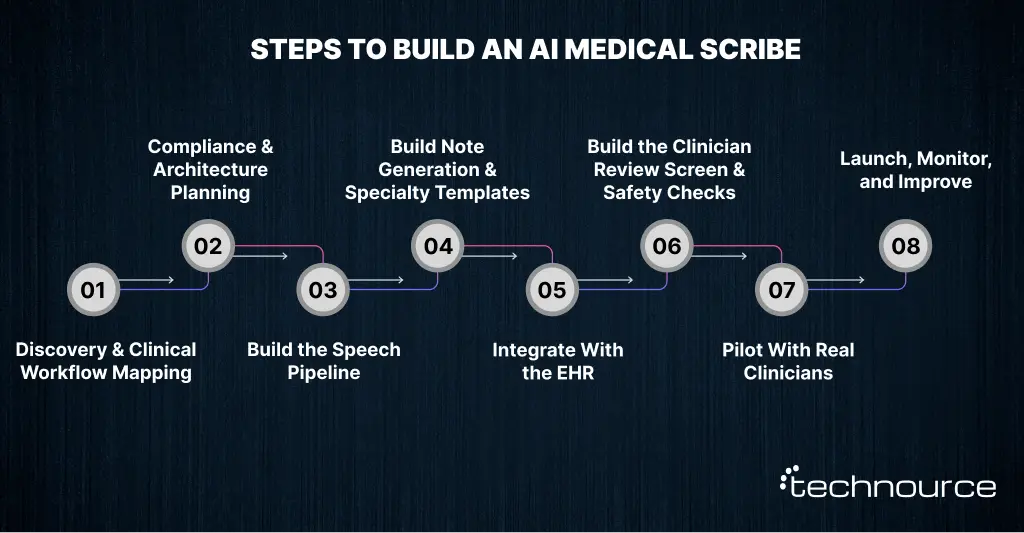
Step 1: Discovery and Clinical Workflow Mapping (2–3 Weeks)
Shadow clinicians in the target specialty. Map where notes start, who edits them, and where they land in the EHR.
Pick one success metric, such as documentation minutes per visit, and record a baseline before development starts.
Step 2: Compliance and Architecture Planning (1–2 Weeks)
Choose vendors that sign BAAs, set the audio retention policy, and design consent capture.
Decide where each piece of PHI lives and who can see it. Changing these choices later costs far more than getting them right now.
Step 3: Build the Speech Pipeline (2–3 Weeks)
Set up capture, transcription, and speaker labels. Test with real clinic audio: accents, masks, background noise, and three-way conversations with caregivers.
Measure word error rate on medical terms, not only on everyday speech.
Step 4: Build Note Generation and Specialty Templates (3–4 Weeks)
Write prompts and templates for the first specialty with clinicians in the room. Add the hallucination check that compares every note line against the transcript.
Note generation starts as soon as the first transcripts are ready, so it overlaps Step 3.
Step 5: Integrate With the EHR (2–4 Weeks)
Connect patient context and note write-back for one EHR. Start the vendor’s app review early, since approval can take longer than the code.
Integration overlaps Step 4. Enterprise builds that connect several EHRs need more time here.
Step 6: Build the Clinician Review Screen and Safety Checks (2–3 Weeks)
Build the screen clinicians use to review, edit, and sign. Show the transcript source for every line and make rejecting a section one tap.
The review screen is built alongside Step 5.
Step 7: Pilot With Real Clinicians (2–3 Weeks)
Launch with five to ten clinicians who want the tool. Track edit rate, time per note, and every reported error.
Score drafts against a fixed test set, the same way you would test AI models for any regulated workflow.
Step 8: Launch, Monitor, and Improve (Ongoing)
Roll out in waves by clinic or specialty. Review edit rates weekly, refine prompts, and re-test after every model upgrade.
How Much Does AI Medical Scribe Development Cost?
AI medical scribe development costs $10,000–$50,000 for an AI MVP covering one specialty and one EHR, and $60,000–$100,000 for an enterprise MVP. A PoC costs $3,000–$8,000 and takes 2–4 weeks.
| Build Type | Scope | Cost (USD) | Timeline |
|---|---|---|---|
| PoC | Sample recordings to draft notes, no EHR connection | $3,000–$8,000 | 2–4 weeks |
| Prototype | Clickable review flow with live transcription | $6,000–$12,000 | 3–5 weeks |
| AI MVP | One specialty, one EHR, HIPAA safeguards, pilot | $10,000–$50,000 | 12–16 weeks |
| Enterprise MVP | Several specialties and EHRs, SSO, admin, audit | $60,000–$100,000 | 16–24 weeks |
The AI MVP range is wide for the same reasons that shape other AI MVP development costs: specialty count, EHR depth, and how much safety tooling the pilot needs.
What Drives AI Medical Scribe Development Cost?
Specialty count, EHR integrations, real-time processing, safety tooling, and the deployment model move the price most.
| Cost Driver | Why It Adds Cost |
|---|---|
| Number of specialties | Each one needs templates, prompts, and clinician testing |
| EHR integrations | Each EHR has its own APIs, note types, and app review |
| Real-time drafting | Streaming audio needs lower latency and more infrastructure |
| Hallucination and source checks | Extra model calls and a richer review screen |
| Multilingual support | Separate testing for each language |
| Deployment model | Private cloud or on-premise hosting adds DevOps work |
| Pilot depth | More clinicians and sites mean more support and analysis |
Hidden and Ongoing Costs to Budget
Ongoing costs depend on visit volume and vendor choices, so budget them per visit rather than as one fixed number.
- Speech-to-text usage: Most medical ASR APIs bill per audio minute.
- LLM usage: Each note uses tokens for drafting, checking, and summaries.
- HIPAA-eligible hosting: Covered cloud services, backups, and logging.
- EHR fees: Some vendors charge for app review, API access, or marketplace listing.
- Model monitoring: Re-testing after every model or prompt change.
- Clinical support: Template updates as specialties and guidelines change.
Build vs Buy: Should You Build a Custom AI Medical Scribe?
Build a custom AI medical scribe if the scribe is part of your product, you need specialty depth a vendor lacks, or you must control where data lives. Buy a vendor scribe if you are a single practice on a widely supported EHR and need notes this quarter.
| Factor | Custom Build | Vendor Scribe | Hybrid |
|---|---|---|---|
| Time to first use | 12–16 weeks for an AI MVP | Days to weeks | Shorter than a full build |
| Upfront cost | $10,000–$50,000 for an AI MVP | Low setup, per-clinician license | Lower than a full build |
| Specialty fit | Built for your workflows | General templates | Your note layer on vendor speech |
| Data control | Full control of storage and retention | Vendor’s terms | Shared |
| Ownership | You own the code and prompts | You license the tool | You own the note layer |
| Best for | Healthtech products, specialty groups | Single practices, common specialties | Teams still testing demand |
Technource’s Recommendation
Start hybrid if you are still testing demand: use a vendor speech API and build your own note layer and review screen. Move to a full custom build once the scribe is core to your product or per-clinician license fees exceed what your own scribe would cost to run.
What Are the Biggest Challenges in AI Medical Scribe Development?
The biggest challenges in AI medical scribe development are invented details in notes, poor transcription in noisy rooms, specialty vocabulary, EHR write-back limits, and clinician adoption. Adoption is the challenge teams often plan for too late.
Results vary even among large health systems. In a survey of 43 US health systems, all reported ambient-note activity, but only 53% reported a high degree of success with AI for clinical documentation (JAMIA, 2025).
| Challenge | Real Consequence | How to Solve It |
|---|---|---|
| Hallucinated details | Wrong facts enter the legal record | Transcript-grounded checks and mandatory sign-off |
| Noisy rooms and accents | Missed or wrong words | Test with real clinic audio; choose ASR per specialty |
| Speaker confusion | Patient statements read as exam findings | Diarization tests with caregivers and interpreters |
| Specialty vocabulary | Drug and procedure errors | Custom vocabulary lists and specialty prompts |
| EHR write-back limits | Notes stuck outside the chart | Confirm write permissions during discovery |
| Low adoption | Paid seats go unused | Clinician champions and one-tap workflows |
| Coding scrutiny | Payer audits of higher coding levels | Keep code suggestions reviewable and documented |
Common Mistakes to Avoid in AI Medical Scribe Development
The most common mistakes are building for every specialty at once, prototyping with real patient audio before BAAs are signed, trusting demo audio, and launching without a review screen that shows sources.
- Starting with every specialty: One specialty with strong templates beats five with weak ones.
- Prototyping with real PHI and no BAA: Even a test on real visits needs covered vendors.
- Testing on clean audio: Real exam rooms have noise, masks, and interruptions.
- Hiding the transcript: Clinicians stop trusting notes they cannot verify quickly.
- No baseline metric: Without a pre-launch number, you cannot prove time saved.
- Ignoring EHR app review: Vendor approval can delay launch more than development.
- Letting coding drive the design: A scribe sold mainly on billing uplift invites audit risk.
Which KPIs Should You Track After Launch?
Track documentation time per visit, after-hours EHR time, note edit rate, transcription accuracy, adoption rate, and clinician burnout scores. Edit rate is the earliest warning sign of quality problems.
| KPI | What It Shows | How to Measure |
|---|---|---|
| Documentation time per visit | Time saved per encounter | EHR audit logs before and after launch |
| After-hours EHR time | Charting pushed outside clinic hours | EHR activity logs by time of day |
| Note edit rate | Draft quality | Share of text changed before signing |
| Transcription accuracy | Speech layer quality | Word error rate on a fixed test set |
| Adoption rate | Real usage | Share of eligible visits recorded |
| Clinician burnout score | Well-being impact | Validated survey before and after rollout |
| Patient experience | Visit quality | Post-visit survey questions on attention |
How to Choose an AI Medical Scribe Development Company
Choose an AI medical scribe development company that has shipped healthcare software handling PHI, signs a BAA, can show EHR integration work, and has a plan for hallucination checks and post-launch monitoring.
| Question to Ask | Good Answer | Red Flag |
|---|---|---|
| Will you sign a BAA? | Yes, plus BAAs with every sub-vendor | “Our cloud is HIPAA-certified” |
| How do you prevent invented details? | Transcript-grounded checks and sign-off | “The model is very accurate” |
| Which EHRs have you integrated? | Named EHRs with write-back examples | Only read-only demos |
| How will you test accuracy? | A fixed test set per specialty and edit-rate tracking | Demo recordings only |
| Who owns the code and prompts? | You do | A licensed, locked platform |
| What happens after launch? | Monitoring and re-testing after model updates | Support ends at handover |
Technource has 14+ years in software product engineering and holds 4.9/5 ratings on Clutch and GoodFirms.
What Are the Future Trends in AI Medical Scribes?
AI medical scribes are moving from notes into orders and coding, EHR vendors are adding their own ambient features, and buyers want real-time documentation help, multilingual support, and clear audit trails.
Adoption keeps climbing. Physician use of ambient documentation tools rose from 20% to 29% between early 2025 and early 2026 (Doximity, 2026).
From Notes to Orders and Coding
Scribes are starting to draft orders, referrals, and code suggestions from the same conversation. Each of those steps still needs clinician confirmation.
Native EHR Scribes Raise the Bar
As EHR vendors add their own ambient features, custom scribes must win on specialty depth, workflow fit, or tight product integration.
Real-Time Documentation Support
Scribes can prompt clinicians during the visit about missing details, such as a dose that was never stated.
Multilingual Visits
Better speech models make non-English and mixed-language visits practical. Each language still needs its own test set.
Payer Scrutiny of AI-Driven Coding
Payers are watching coding levels at practices that adopt scribes. Clear audit trails for every suggested code will matter more each year.
How Technource Delivers Measurable Results in Healthcare AI
Technource builds healthcare and voice AI products that clinicians and staff use every day. My Vital View, Telepath, and VoiceMate show the speech, workflow, and compliance skills an AI medical scribe needs.
How Technource Built My Vital View, a Remote Patient Monitoring Platform That Speeds Clinical Decisions by 50%
We built My Vital View, a B2B SaaS remote patient monitoring platform for a US healthcare organization. The client needed to monitor patients at home, automate RPM and CCM processes, and cut the time providers spent on routine readings.
The platform connects patient devices to care teams on web, iOS, and Android. Extreme readings first trigger a patient retest, and providers are alerted only if the second reading is also extreme. The stack includes Node.js, React.js, React Native, MongoDB, Twilio, SendGrid, WestFax, and the BodyTrace API.
Measurable Result
- 50% faster clinical decision-making
- 70% improvement in documentation accuracy
- 100% remote access for patients and care teams
- Fewer unnecessary provider alerts through retest logic
- Automated RPM/CCM tracking and billing logs
- Live on web, iOS, and Android
How Technource Built Telepath, an Online Pharmacy Platform That Delivers 65% Faster E-Prescribing Approvals
We built Telepath, a multi-tenant SaaS platform that lets US healthcare organizations launch branded online pharmacies. The client needed secure e-prescribing, telehealth visits, and pharmacy coordination in one place.
Telepath handles e-prescriptions through DoseSpot, video and audio consultations through Agora, and pharmacy and shipping workflows through Carepoint, TransitionRx, and EasyPost. The stack uses React.js, Node.js, MySQL, and AWS S3.
Measurable Result
- 65% faster e-prescribing approvals
- Multiple organizations running branded pharmacies on one platform
- Connected pharmacy and shipping workflows
- Audit logs and order tracking for compliance
- Abandoned cart recovery that lifts conversions
How Technource Built VoiceMate, an AI Call Agent That Cut Human Agent Dependency by 70%
We built VoiceMate AI, an AI call representative for a client in Greece that answers customer calls inside Microsoft Teams and Azure Communication Services. The client needed natural, low-latency voice conversations that could take orders, classify inquiries, and hand callers to people.
VoiceMate uses ElevenLabs for speech recognition and voice synthesis, Azure Cognitive Services, Azure Key Vault, and a Python backend. The agent detects caller intent in real time and routes each call to an order flow, the right Teams queue, or a live agent.
Measurable Result
- 70% reduction in human agent dependency
- 80% faster response time for customer inquiries
- 60% cost optimization through AI automation
- 100% integration with the Microsoft 365 ecosystem
Technource’s Approach to AI Medical Scribe Development
- Documentation-only first: Launch without diagnostic features, then add them as separate, reviewed decisions.
- One specialty, one metric: Prove time saved in one specialty before expanding.
- HIPAA in the architecture: BAAs, retention, and audit trails are designed before the first recording.
- The clinician signs every note: No draft reaches the chart without review.
- Measure edit rate after launch: Falling edit rates show the scribe is learning the specialty; rising rates trigger a review.
Conclusion
Three decisions shape every AI medical scribe: which specialty to start with, whether to build or buy, and how HIPAA safeguards fit the architecture.
Get those right, and AI medical scribe development becomes a predictable 12–16 week AI MVP instead of an open-ended experiment.
Technource brings product engineering, AI-powered workflow automation, and hands-on healthcare software development to every build.
If you are ready to scope your scribe, contact us for a short consultation that maps your specialty, EHR, budget, and timeline.
Ready to turn your AI scribe idea into a clinic-ready product?
Frequently Asked Questions
An AI MVP costs $10,000–$50,000 and covers one specialty, one EHR, and HIPAA safeguards. An enterprise MVP with several specialties and EHRs costs $60,000–$100,000. A PoC that turns sample recordings into draft notes costs $3,000–$8,000. Ongoing speech, model, and hosting costs depend on visit volume. An AI MVP takes 12–16 weeks from discovery to a live pilot with real clinicians. An enterprise MVP takes 16–24 weeks because EHR write-back and multi-site pilots take longer. A PoC takes 2–4 weeks, which makes it a quick way to test transcription quality on your own audio. An AI medical scribe can meet HIPAA requirements when every vendor touching audio, transcripts, or notes signs a BAA and the system uses encryption, access controls, audit trails, and limited audio retention. No software is HIPAA-certified by itself. The safeguards matter: healthcare breaches cost about $6.6 million on average (IBM, 2026). Usually not. A scribe that only transcribes and summarizes visits is generally treated as administrative software. Features that suggest diagnoses, treatments, or risk scores may fall under FDA device oversight, depending on intended use. Keeping version one documentation-only, which an AI MVP can deliver in 12–16 weeks, keeps that question out of your first launch. Ambient clinical documentation accuracy depends on audio quality, specialty vocabulary, and the safety checks around the model. Results vary by organization: only 53% of 43 surveyed US health systems reported a high degree of success with AI for clinical documentation (JAMIA, 2025). Track note edit rates and word error rate on a fixed test set to measure your own accuracy. Buy a vendor scribe if you are a single practice on a widely supported EHR. Build a custom scribe if the scribe is part of your product, you need specialty depth, or you must control your data. A custom AI MVP costs $10,000–$50,000, and a hybrid with vendor speech and your own note layer costs less than a full build. An AI medical scribe can integrate with most major EHRs, including Epic, Oracle Health, and athenahealth, through HL7 FHIR APIs, SMART on FHIR launches, or vendor note APIs. Older systems may need HL7 v2 interfaces. EHR integration typically takes 2–4 weeks for one EHR in an AI MVP, plus time for the vendor’s app review. Yes, get consent. Some US states, including California, require consent from everyone in a recorded conversation, and most health systems ask every patient regardless of state law. Store the consent with each encounter. Build consent capture during the 1–2 week compliance and architecture planning step, so it is in place before the first recording starts. Yes. Language models can add details that no one said, such as a medication or an exam finding. Prevent it with transcript-grounded checks that flag unsupported lines, source highlighting on the review screen, and mandatory clinician sign-off. A pilot with five to ten clinicians catches most of these issues before full rollout. Most AI medical scribes span eight layers: audio capture, a medical speech-to-text API such as Deepgram or AWS HealthScribe, a HIPAA-eligible LLM, a Node.js, Python, or Go backend, a React or React Native front end, PostgreSQL storage, FHIR APIs for EHR write-back, and HIPAA-eligible cloud hosting. Every vendor in the stack needs a BAA.
Related Insights and Articles