Blockchain Application Development Guide: Steps, Costs & Best Practices
Dhrumil Mistry
Published: Dec 12, 2025|Updated: Mar 16, 2026
Quick Summary: Blockchain has matured, and enterprises across finance, supply chain, healthcare, and the public sector are now building production-grade dApps instead of pilot projects. This Blockchain App Development guide walks product leaders, CTOs, and engineering managers through the situations where blockchain makes sense, how to select a platform and architecture, realistic budgets and timelines, and best practices for security and audits. By the end, you’ll have a concrete framework for enterprise-grade blockchain delivery.
Over the past several years, working directly with enterprises exploring blockchain application development, I have seen the technology move far beyond early experimentation. Organizations in finance, supply chain, healthcare and government are no longer asking whether blockchain is relevant they are asking how to design secure, scalable and production-ready systems.
From running architecture reviews to guiding multi-stakeholder pilots, I have witnessed firsthand how blockchain is reshaping data integrity, automation and cross-organization collaboration.
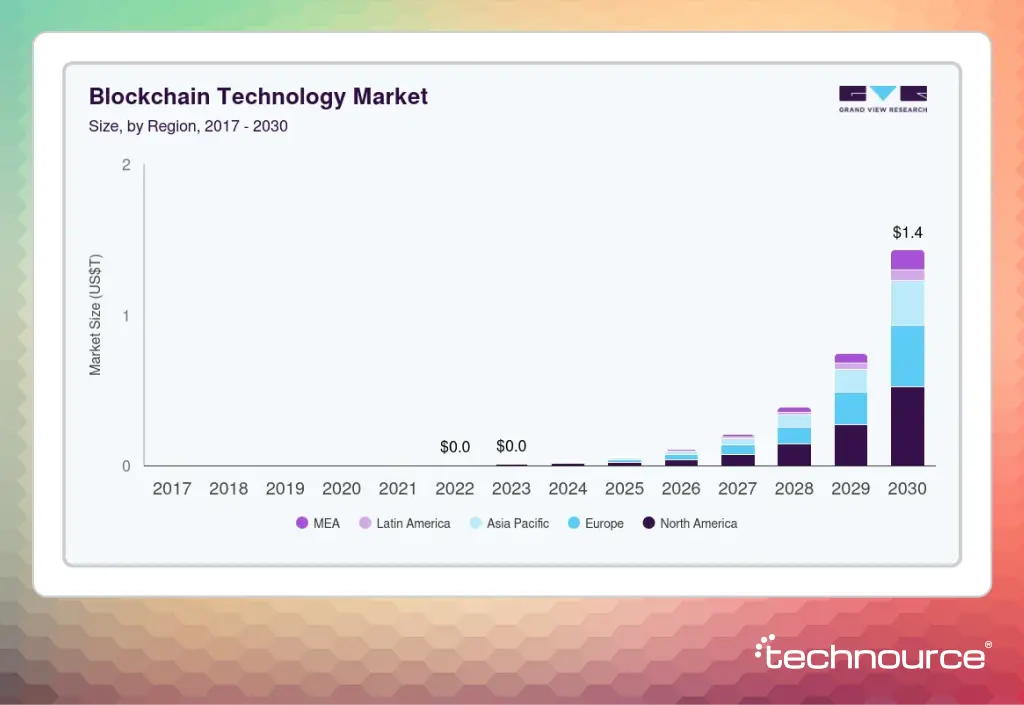
This shift is backed by strong market growth.
According to Grand View Research, the global blockchain technology market reached USD 31.28 billion in 2024 and is expected to surpass USD 1.4 trillion by 2030. A separate forecast from Markets and Markets projectsthat blockchain will grow from USD 32.99 billion in 2025 to USD 393.45 billion by 2030, driven by rising enterprise demand for transparency and secure data sharing.
Despite this momentum, many leaders still struggle with practical questions: When do you truly need blockchain? Which platform fits best for enterprise use? How do you design a scalable hybrid architecture? And what does an audit-ready, secure deployment look like in production?
This guide brings together the insights gained from my experience supporting enterprise blockchain initiatives alongside the proven frameworks we use at Technource. It provides a clear, practical, and engineering-driven roadmap to help you validate use cases, design reliable architectures, accurately estimate costs, and build blockchain applications that can operate confidently at scale.
What Is a Blockchain App
Blockchain applications (dApps) are software solutions built on distributed ledger technology (DLT), enabling tamper-proof data storage, automated execution via smart contracts, and shared trust across participants.
Here, we break down the core functionalities, value propositions, and what differentiates a blockchain-powered app from a standard one.
Core Value Propositions
Immutable, tamper-resistant records
Shared truth across participants
Trustless automation through smart contracts
Transparent audit trails and cryptographic security
Why Blockchain Matters for Enterprises Today
The ecosystem has matured enough for enterprises to adopt blockchain confidently, without the risks associated with early-stage technologies. Market demand, regulatory clarity, and cloud-native infrastructure now support enterprise-grade blockchain deployments at scale.
According to Grand View Research, enterprise investment posted a compound annual growth rate (CAGR) exceeding 60% between 2024 and 2029, indicating that adoption is rapidly accelerating across regulated sectors such as finance, healthcare, and supply chain.
Organizations spanning finance, logistics, healthcare, real estate, and the public sector are now considering blockchain not just for pilots but for production workloads, making 2026 a pivotal year to move from experimentation to implementation.
High-ROI Blockchain App Development Use Cases
At Technource, we have seen through hands-on experience that blockchain creates the most value in environments where multiple participants depend on shared trust, verifiable records and automated execution. Across the enterprise projects we support, these use cases consistently deliver measurable outcomes such as higher efficiency, improved transparency and reduced operational risk. Below are the blockchain applications that most often translate into strong business returns.
Cross-Border Payments and Settlements
Real-time settlement with lower reconciliation effort and automated compliance checks. In many engagements, we have seen payment workflows become significantly faster and more accurate after blockchain adoption.
Supply Chain Provenance
Complete traceability from origin to destination, counterfeit prevention and automated recall triggers. Our team has helped organizations remove visibility gaps and strengthen trust across supplier networks.
Decentralized Identity and Credentials
Faster onboarding, secure verification for KYC and AML and user-controlled identity credentials. These systems have allowed clients to reduce onboarding time while improving compliance reliability.
Asset Tokenization
Token-based models for real estate, commodities and digital assets that enable fractional ownership and improved liquidity. Technource has supported tokenization frameworks that have made traditionally illiquid assets more accessible and trade-ready.
Document Notarization and Audit Trail
Immutable notarization and simplified regulatory audits with verifiable digital records. These implementations consistently reduce audit time and strengthen non-repudiation.
Across all of these enterprise scenarios, we focus on KPIs such as reduced reconciliation time, fewer disputes, faster settlements, lower fraud incidents, and higher asset liquidity. Based on our project experience, these indicators remain the most compelling evidence that blockchain delivers meaningful enterprise value.
Step-by-Step Blockchain App Development Process
Blockchain application development requires a disciplined, phased approach; skipping steps or rushing can lead to failed deployments. This workflow ensures clarity, control, and predictability.
Step 1: Business Fit & Use Case Validation
Clarify the real business problem. If a database suffices, avoid unnecessary blockchain overhead. Define stakeholders, shared trust needs, and measurable KPIs. Build a minimal viable pilot (MVP) to validate assumptions.
Step 2: Platform & Permission Model Selection
Decide between public blockchains (Ethereum, Polygon, Solana), better for open ecosystems, marketplaces, or tokenization, and permissioned blockchains (Hyperledger, Corda, Quorum) for regulated industries requiring privacy and controlled participation. Consider Layer 2 solutions when throughput and cost are the primary factors.
Step 3: Architecture Design & Data Patterns
Define what goes on-chain (Hashes, proofs, state updates, critical checkpoints) and what stays off-chain (PII, large files, heavy business logic, compliance data). This hybrid model balances performance, cost, and compliance.
Step 4: Smart Contract Development
Design modular, upgradeable contracts. Optimize for gas (on EVM chains), implement role-based access controls, include event logging, and maintain clear documentation.
Step 5: Security Testing & Third-Party Audits
Perform static analysis (e.g., Slither, Mythril), fuzz testing or formal verification (e.g., Echidna, Certora), unit and integration tests, and engage independent audit firms for external review re-audit after remediation.
Step 6: Deployment & Operations
Choose deployment model (managed nodes, cloud, hybrid). Set up monitoring (node health, chain metrics, gas spikes), incident response processes, backup and disaster recovery, versioning, and rollback plans.
Step 7: Governance & Compliance
Define on-chain upgrade governance, access control procedures, participant onboarding flows, data retention, privacy compliance, and regulatory guardrails.
Architecture & Tech Stack
Selecting the right stack is crucial for long-term maintainability, performance, and compliance. Below is a recommended stack commonly used in enterprise blockchain projects:
Smart Contracts: Solidity (EVM chains), Rust (Solana/NEAR), Go (Hyperledger)
Storage: IPFS, Arweave, S3, Azure Blob
Infrastructure: Docker, Kubernetes, managed blockchain nodes or Blockchain-as-a-Service
This configuration supports modularity, scalability, and integration with existing enterprise systems.
Security & Audit Checklist
Security is the most critical part of enterprise blockchain projects. A robust security program should include:
Threat modeling and risk assessment
Secure key management (HSM or MPC)
Multi-signature admin controls
Static and dynamic code analysis
CI/CD security gates
Third-party penetration testing & audits
Real-time monitoring and alerts
Node health monitoring
Incident response & recovery plan
These controls are necessary to prevent catastrophic failures and ensure audit readiness.
Blockchain Development Cost Estimates and Budget Planning
We help enterprises plan blockchain budgets with clarity because we have seen how easily costs can grow without proper architecture and audit planning. Accurate budgeting requires understanding development, security audits, infrastructure and long-term maintenance. Below are realistic cost expectations for 2026 based on our project experience and industry benchmarks. These ranges make it easier for decision makers to allocate resources confidently and avoid unexpected expenses.
Estimated Budget Ranges
Small prototype or proof of concept: Around 25000 USD
Suitable for validating a use case with limited smart contract complexity.
Mid-level production dApp: Between 40000 and 150000 USD
Covers smart contracts, backend integration, workflows, and limited security testing.
Enterprise-grade blockchain solution: 120000 USD and above
Covers business analysis, technical design and platform evaluation.
Innovative Contract Development: 20-30%
Includes contract logic, documentation, optimization and internal testing.
Backend and Integrations: 25-30%
Covers APIs, middleware, system integrations and off-chain data workflows.
Security and Audits: 10-20
Includes static analysis, formal verification, third-party audits and remediation.
Infrastructure and Node Costs: Ongoing
Covers nodes, storage, monitoring and cloud resources.
Maintenance and Monitoring: Ongoing
Includes updates, performance tuning, governance support and incident readiness.
These Blockchain app development cost structures reflect what we regularly see in enterprise engagements at Technource. They help stakeholders plan realistically, prioritize features, and ensure the blockchain solution remains secure, scalable, and production-ready over time.
At Technource, we use a delivery framework shaped by years of hands-on work with enterprise blockchain solutions. This approach has been refined across complex industry projects and is designed to deliver predictable outcomes, reduced technical risk, and a significantly faster path to production. Each pillar represents a critical stage we follow to ensure every blockchain application we build is secure, scalable, and aligned with real business goals.
Business Clarity and KPI Driven Pilot Scoping
We begin by validating the business need and defining measurable KPIs. This step ensures that blockchain is the right choice and that every development decision supports a clear set of performance goals.
Platform and Architecture Recommendations Based on Economics and Compliance
Our team evaluates factors such as throughput, privacy requirements, governance, cost, and long-term scalability to recommend the most suitable blockchain platform and architecture for your use case.
Hybrid Architecture Blueprinting
We design a detailed architecture that defines what should remain on-chain and what should operate off-chain. This helps control cost, improve performance, and maintain compliance while ensuring the system remains future-ready.
Risk First Security and Audit Program
Security governs every stage of our process. We include smart contract reviews, automated scanning, formal verification tools, internal testing, and coordination with independent auditors to ensure production-grade security.
Operations, Monitoring and SLA Driven Maintenance
Once deployed, we establish continuous monitoring, node health checks, incident response planning, and service-level commitments to keep your blockchain application reliable and operational at all times.
This five-pillar approach reflects Technource’s commitment to delivering every blockchain project with engineering discipline, business alignment, and long-term stability.
How AI Enhances Blockchain Application Development
AI is quickly becoming a core enabler in modern blockchain application development, helping teams build smarter, more secure, and more adaptive dApps. While blockchain ensures decentralized trust, transparency, and immutable records, AI adds intelligence, automation, and predictive capabilities. Together, they enable enterprise systems that can learn, respond, and operate at scale.
As Satya Nadella, CEO of Microsoft, puts it:
“AI creates intelligence. Blockchain creates trust. Together, they will shape the next generation of distributed systems.”
This combination is exactly what many enterprises are now pursuing—intelligent systems built on trusted infrastructure.
At Technource, we apply this synergy directly in our development processes and client solutions. Our engineering teams leverage AI-driven tools, predictive models, and intelligent monitoring techniques, an approach strengthened by our in-house AI development services to accelerate delivery, reduce vulnerabilities, and enhance the reliability of blockchain apps from design to deployment.
1. AI-Assisted Smart Contract Development & Review
AI-powered analysis and linting tools help detect vulnerabilities, gas inefficiencies, and logic flaws early in the development cycle. This complements our internal review processes, reducing audit cycles and improving smart contract safety before external audits.
2. Predictive Analytics for dApp Optimization
AI models analyze transaction behavior, network load, and user interaction patterns. These insights allow us to refine transaction flows, optimize on-chain/off-chain data distribution, and proactively design for scale—especially in enterprise deployments. To process and interpret such high-volume datasets efficiently, organizations often rely on a robust big data analytics development solution that helps extract meaningful insights and improve overall system performance.
AI drives dynamic decision-making in workflows such as:
Real-time fraud scoring in financial dApps
Predictive maintenance triggers in supply chain apps
Automated KYC/AML risk assessments for identity solutions
This creates dApps that adapt intelligently rather than relying solely on static contract rules.
4. AI-Powered Security & Network Monitoring
AI helps detect anomalies that traditional monitoring often misses:
Irregular transaction spikes
Potential exploitation attempts
Governance or role misuse
Node health deviations
These automated insights strengthen the operational reliability of production-ready blockchain systems.
5. Smarter Testing & Simulation Through AI
AI-driven testing tools simulate thousands of edge cases, load conditions, and attack patterns. This accelerates QA cycles and significantly improves system resilience before deployment.
Why AI + Blockchain Matters for Enterprise dApps
For enterprises, this integration results in:
Faster development cycles
Higher security and fewer vulnerabilities
Smarter workflows with automated decision-making
Better performance under scale
Lower operational and maintenance risks
By embedding AI into every phase of blockchain development—from architecture to smart contract testing and post-deployment monitoring—Technource helps organizations build intelligent, secure, and future-ready blockchain applications.
Real Case Highlights
Case 1 – Supply Chain Provenance
A global logistics client used a permissioned blockchain network to improve traceability. The solution reduced reconciliation time by 78% and disputes by 45%, delivering ROI in under 6 months.
Case 2 – Digital Identity & Credentialing
A fintech client implemented a self-sovereign identity solution, reducing KYC onboarding from 48 hours to 12 minutes and improving fraud detection accuracy by 34%.
Common Misconceptions in Blockchain Development
Many enterprises still hold outdated myths about blockchain. Common misconceptions include:
“Blockchain is only for crypto” — in reality, governments, supply chain, and healthcare sectors use it heavily.
“Blockchain cannot scale” — with Layer 2, sharding, and hybrid models, it now supports high transaction volumes.
“Smart contracts are secure by default” — security comes only through rigorous audits, testing, and safe key management.
Final Thoughts on Building Enterprise Blockchain Applications
Blockchain has reached a point where it can genuinely support enterprise-scale systems when applied to the correct problems. As you have seen throughout this guide, successful blockchain development is not about choosing a trending technology. It is about identifying use cases where shared trust, transparent data flows and automated execution create meaningful business value.
A secure, production-ready blockchain solution requires deliberate planning across platform selection, hybrid architecture, smart contract design, security reviews, audits, and long-term governance. Each of these elements determines how resilient, scalable and maintainable your application will be once deployed.
Drawing from years of practical experience, Technource continues to help organizations approach blockchain with clarity and discipline. Our DevOps consulting services help enterprises establish reliable CI/CD pipelines, monitoring systems, and operational maturity for long-term system stability. Whether you are validating your first use case or preparing to scale an existing solution, applying the principles in this guide will help you make informed decisions and build blockchain applications that deliver measurable, lasting impact.
FAQs
POC: ~3 months. Enterprise: 9–12 months, depending on integrations and audit scope.
It depends on privacy requirements, governance, throughput needs, and cost constraints (public vs permissioned vs Layer 2).
Yes. Most enterprise designs use modular plug-ins, APIs, and off-chain data stores to integrate with ERPs, CRMs, or legacy systems.
Yes — permissioned chains, hybrid architecture, and robust governance make blockchain a viable option for finance, healthcare, supply chain and public sector sectors.
Dhrumil Mistry is a tech expert and full-stack developer at Technource, skilled in PHP, Laravel, MySQL, and modern backend development. He contributes to building scalable, secure, and performance-focused digital solutions. Along with his backend expertise, he is proficient in frontend technologies such as React, Vue, and Next.js, enabling him to build seamless, responsive, and dynamic user interfaces. His interest in emerging technologies drives his work across AI/ML, data engineering, SaaS, blockchain, and IoT solutions, helping deliver innovative products for businesses.
Request Free Consultation
Amplify your business and take advantage of our expertise & experience to shape the future of your business.