In Python programming, the ‘if not’ statement is a powerful tool for handling conditions. Understanding its usage can simplify your code and make it more readable. In this blog, we will talk about the ‘if not’ statement, its importance, syntax, and practical applications.
Whether you are a beginner, an experienced developer, or just want to improve your Python knowledge mastering this conditional statement will enhance your Python programming skills. Additionally, you should know the basics of Python programming language to select the rightPython development companyfor your project.
Why Do We Use the If Not Python Statement?
The ‘if not’ statement in Python checks if a condition is not true. It helps you make decisions and execute specific code when a condition is false. In a nutshell, you want to take action only when something doesn’t happen, like checking if a list is empty or a value is not present.
It simplifies code and makes it easier to understand and control program flow. ‘Not’ is a negation operator. Conditional statements are used in other programming languages as well. Many developersCompare Go and Pythonfor web development.
Imagine checking your phone for missed calls. You might want to relax or continue with your work if there are no missed calls (Condition: no missed calls).
if not missed_calls:
print(“No missed calls. Relax!”)
Importance of Conditional Statements in Programming
Conditional statements in programming allow you to create dynamic and decision-making code. They help programs respond differently to various situations. For example, you can use them to execute specific actions when a condition is met.
Utilizing conditional statements can make software creation a straightforward process. For example, in an online store, if a total purchase is above a certain threshold; a discount is applied; otherwise the regular price is charged.
Let’s understand the importance of conditional statements with one more example. Weather apps use conditionals to provide different information based on current weather conditions. For instance, if it is raining, the app will recommend carrying an umbrella, if it is sunny, it will suggest using Sunscreen.
Syntax of the “If Not” Statement
Here is the syntax of the Python IF statement with the NOT logical operator. It is a crucial statement used in thePython app developmentprocess.
If not value:
Statement (s)
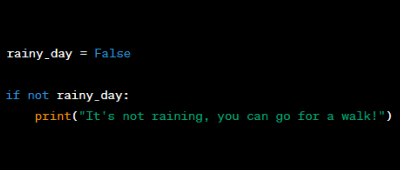
Real-world example:
Difference Between “If” and “If Not” Statement?
“If” Statement: It checks if a condition is true. The code block under if executes when the condition is true.
For example: If temperature>30. Check if the temperature is greater than 30 degrees Celsius.
“If not” Statement: It checks if the condition is Not True (For example, false or not met). The code block under “if not” executes, when the condition is not true.
For example: if not is_raining: Check if it’s not raining.
Use Cases of “if not” in Python
Here is how you can use the “if not” statement for various use cases in Python.
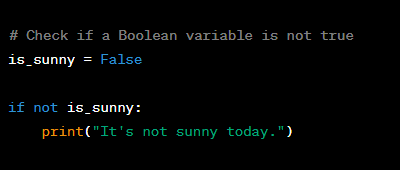
“If Not” with Boolean
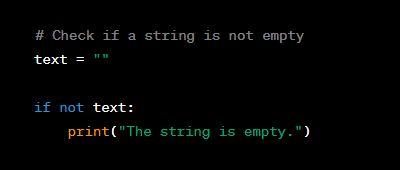
“If Not” with String
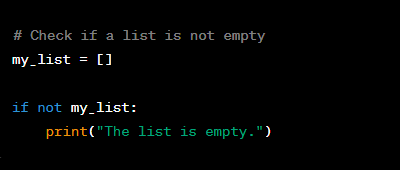
“If Not” with List
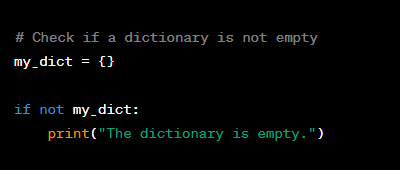
“If Not” with Dictionary
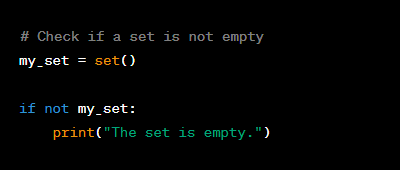
“If Not” with Set
If Not” with Tuple
In each case, the “if not” statement checks whether the given variable or data structure is not true and executes code blocks accordingly.
Best Practices to Use “If Not”
Clarity and Readability in Code: Make sure that your code remains easy to understand. Write clear variable names and use commands.
Avoiding Double Negatives: Double negatives in code can lead to confusion. For example, instead of writing, if not is_not_ready: it is clearer to write if is_ready:
When to use “if” vs. “if not”: Choosing between if and if not depends on the condition you want to check. Use “if” when the condition is true. Use “if not” when the condition is false.
Pitfalls to Avoid While Using “if not”
When using Python if not statement, there are some common pitfalls you need to avoid.
Avoid using double negatives, making your code confusing and difficult to understand.
Be cautious when dealing with complex conditions. Consider breaking complex conditions.
Avoid overusing “if not”. Try to make your code more intuitive.
When using “if not” it is helpful to add comments explaining the intent of the condition.
Python if not statement is used where developers need to apply conditions. It has various benefits, making the code easy, short, and understandable. Analyze the examples of “if not” statements used with the different use cases in this blog. Our developers have written them in the easiest way for you.
Mr. Sanjay Singh Rajpurohit is the Founder and CEO of Technource, a visionary leader with deep expertise in AI, web, mobile, and custom software development. With a strong foundation in education and over a decade of entrepreneurial experience, he guides his team in delivering scalable, innovative digital solutions across industries. He focuses on building future-ready products by integrating cutting-edge technologies and fostering a culture of continuous improvement. In June 2024, he was honored with the “Mister Ahmedabad Personality” title, recognizing his impactful presence beyond the tech world.
Request Free Consultation
Amplify your business and take advantage of our expertise & experience to shape the future of your business.