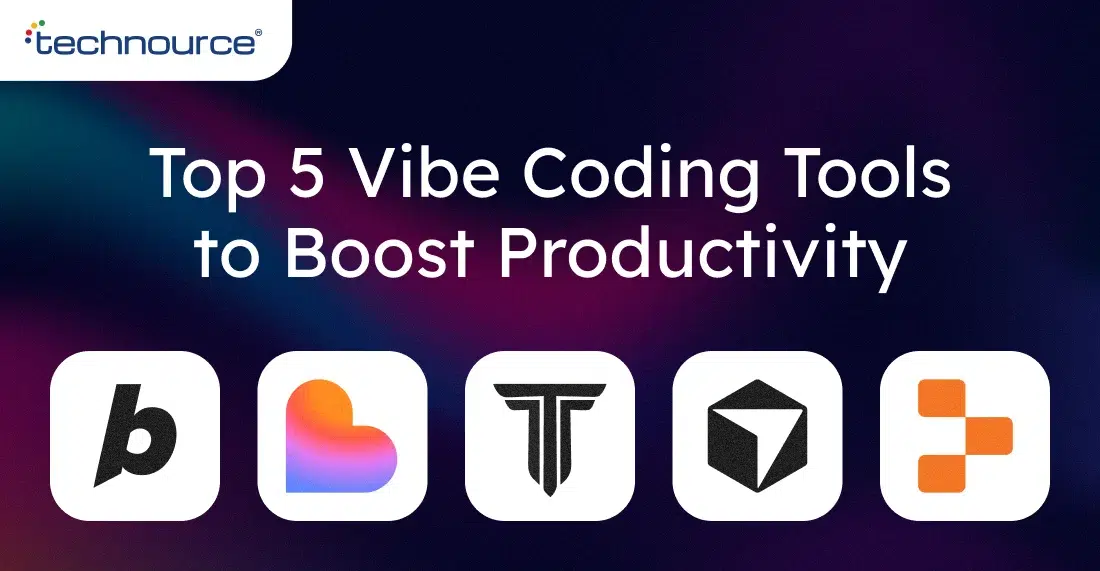
What Is Vibe Coding and How It’s Transforming Software Development in 2026
Sanjay Singh Rajpurohit
Published: Feb 03, 2026|Updated: Mar 16, 2026
TL; DR
Vibe coding is changing software development rapidly with its smart, innovative AI-enabled output generation
Tech behemoths like Google & Microsoft are also utilizing vibe coding.
Vibe coding tools like Replit and Loveable are useful for writing prompts.
Vibe coding is easily accessible for non-technical persons.
Last year, one of our clients, Sam, visited our office, got to know our vibrant work culture, and had several meaningful discussions over a few cups of hot, creamy cappuccino!
Despite the delightful ambiance, Sam seems to be worried. When I asked him whether everything is on track, he replied, “Yeah, everything is fine! But I’m a bit concerned about my startup and its software product because it may take longer to develop, test, and launch. Do you have any idea how to shorten the time frame, as it may help me out to save my hard-earned resources?”
Sam and his brand have been working with our team for an extended period. This time, he looked overwhelmed with his present situation. Considering the same, I replied, “We can make it with vibe coding. It will transform your ideas from ‘let’s do it’ to ‘action’, without making a hole in your pocket!
Sam got convinced, and he’s ready to go with vibe coding.
Sam is not alone! Many startup owners are still under pressure to develop, test, and launch business software.
If you’re one of them, vibe coding is the answer to reshaping your software development without beating around the bush! Vibe coding is also emerging as one of the most impactful software development trends, helping startups and enterprises accelerate product delivery with AI-assisted coding.
According to Grand View Research, the global gen AI-powered coding market may reach $106.3 million by 2030, growing at a 25.2% CAGR.
Sounds interesting?
Yes, it is!
In this blog, we’re going to show you how vibe coding in software development is reshaping the global business landscape. We will also explore the benefits, how it works, case studies, and limitations. Before we unpack the main topic, let’s provide a brief introduction to vibe coding.
What is Vibe Coding?
According to Google Cloud, vibe coding is an approach in which a developer/founder describes the functionality, outcome, or application vibe through prompts. An AI-enabled tool interprets these prompts and generates code. Instead of writing line-by-line code, AI acts as the intelligent co-pilot.
The term “vibe coding” was coined in early 2025 by OpenAI Co-Founder Andrej Karpathy to enable coders to build applications with minimal code. Google CEO is enabling anyone to become a next-gen tech professional.
Imagine you’re providing a detailed recipe breakdown to a chef rather than just describing the type of dish you want. First, you’re describing the steps step by step, but for the latter one, you’re only sharing your expectations.
Can you spot the differences?
The same applies to the difference between traditional and vibe coding. Here, the vibe coding is at a high level, with AI handling the granular implementation.
Here are a few key technologies that are playing a pivotal role in vibe coding-
LLMs – Claude, OpenAI’s GPT series, Gemini, etc. powers the code generation.
NLP – Multiple AI coding assistant tools depend on advanced NLP models to understand human-generated prompts with context, something an experienced NLP development company typically focuses on while building and refining such intelligent systems.
Autonomous AI Agents – It manages complex projects and switch roles to develop an entire application with less human intervention. These systems are often supported by advanced AI agent development solutions, which enable businesses to build intelligent agents capable of automating workflows, coordinating tasks, and accelerating application development with minimal human involvement.
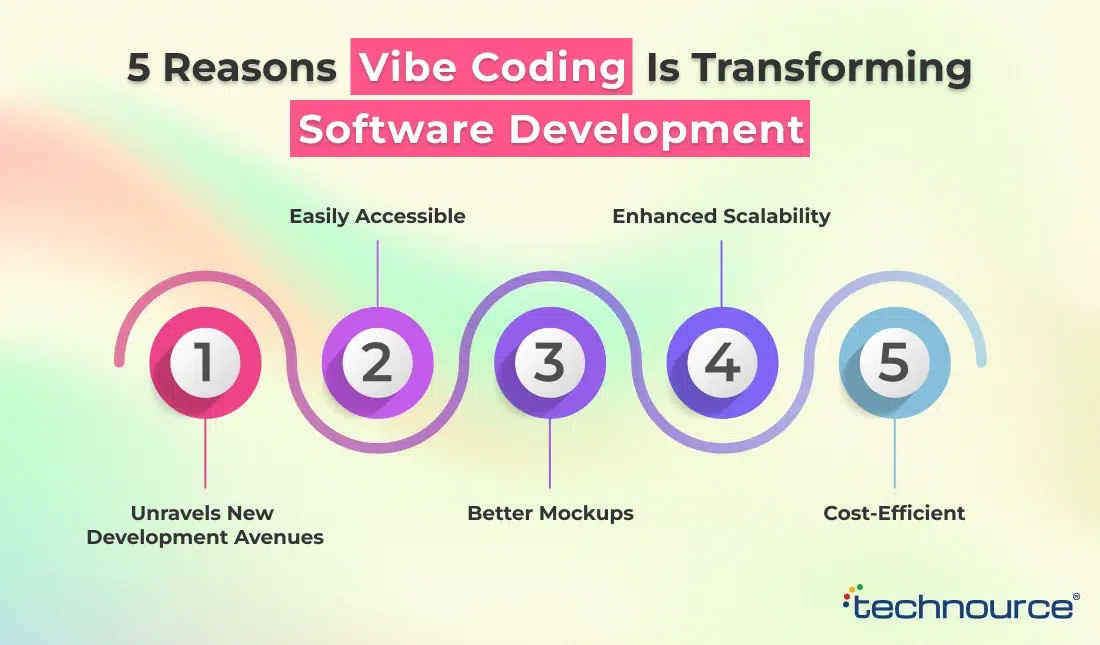
5 Reasons Why Vibe Coding Is Gaining Popularity in 2026
In Alphabet’s Q1 2025 earnings call, Sundar Pichai, Google’s CEO, said that more than 25% of Google’s code is generated by AI. Microsoft CEO Satya Nadella also affirms that 30% of the company’s code is written by AI. “Maybe 20-30% of code is within our repos, and some of the projects are all written by software,” Nadella said the same during a live conversation with Meta CEO Mark Zuckerberg.
And, this isn’t magic! The convergence of technological advancements and modern infrastructure is rapidly transforming the software industry. Here is why-
Unravels New Development Avenues
The evolution of LLM models like Claude-3, ChatGPT, Perplexity, and Gemini is taking the software development industry to new heights, as they can understand complex coding requests. Based on that, it can generate professional code that is functional enough for faster task management.
Easily Accessible
The concept of vibe coding enables non-tech users to develop web applications without prior knowledge. The concept of simple prompt writing and going is helping entrepreneurs cut through the noise.
Better Mockups
Project managers and product engineers often struggle with mockup translation, which is critical for conveying key information to the technical team. They can utilize vibe coding to illustrate their ideas better. This improves the collaboration with software developers.
Enhanced Scalability
Organizations can develop applications more quickly without hiring more resources. For instance, a team developing business software that wants to scale can use Vibe Coding. This will enable the existing developers to work efficiently with prompt engineering. On the other hand, the organization doesn’t need to hire more talent.
Cost-Efficient
Hiring a dedicated development team can be costly for a startup. However, vibe coding for startups offers an efficient way to develop initial product versions. This preserves resources for startups, allowing them to focus on other tasks such as sales and marketing.
That’s only the tip of the iceberg. Vibe coding offers multiple benefits for startups, which we will discuss in the following paragraphs.
How Vibe Coding is Reshaping Startups?
Not only are tech behemoths leveraging the benefits of vibe coding, but startups are, too. Recent statistics from Y Combinator indicate that their latest batch of codebases contains 95% AI-generated code.
Quick MVP & Prototyping Development
With vibe coding for MVP development, startups can build functional prototypes and MVPs within set timelines. The team members can develop a working application at record speed. Also, iterations can be made based on user feedback.
If you’re also running a startup and want to launch a basic MVP, Vibe Coding is the most effective approach. The agile approach reduces the risk of developing something that the target audience doesn’t need.
Non-Technical User Feasibility
Vibe coding in SaaS development reduces costs for startups. You can develop the first version of your product by yourself. We won’t need to hire more resources until the startup concept is validated. In a nutshell, MVP development can reduce development costs by 50-70%.
Remember Sam? He is now leveraging vibe coding for his startup and reducing costs by 60-70%, despite being non-technical. You can too!
More Scope of Experimentation
With vibe coding, you can expect more fuel for experimentation. This enables teams to test multiple ideas, move fast, and dig deeper into different product directions. You can commit to the shortest time-to-market while also driving innovation.
Now, can you make these things possible with traditional coding? What would be your answer? Think once before you jump to the next paragraph.
Traditional Coding Vs Vibe Coding Development: A Detailed Approach
Imagine you’re running a startup with a limited budget. However, you need to develop software to increase internal team efficiency. You had a conversation with the internal team members, and they suggested vibe coding, which will help to build software using natural language.
On the other hand, traditional coding allows you to make changes based on your requirements, which is not possible with vibe coding.
A billion-dollar question arises here- which one to choose?
I’ve spent the last few months back-to-back learning the difference between these two. Here is what I understand-
Aspect
Traditional Coding Development
Vibe Coding Development
Project Complexity
Handles large-scale, complex, regulated applications and software
Perfect for simple, next-gen features, prototypes, MVP development, and internet tools.
Key Value Proposition
Zero platform limits, maximum flexibility, and no compromise on output.
Lower cost, quick pivots, and less risk.
Development Speed
Slower and highly organized in different phases.
Quicker development and iteration.
Control & Flexibility
Full control of SDLC.
Limited control with AI capabilities.
Accessibility
Trained and skilled developers can easily manage a traditional coding platform.
Best for non-technical persons.
Testing & Debugging
Developers are aware of the code and understand it; they will fix the issues.
AI-provided suggestions can fix testing errors, but with less clarity.
Focus
Code structure, project details, and syntax.
Development clarity and ideas.
Limitations
No limitations exist as the developer’s expertise and skills are enough.
AI tools can accelerate repetitive tasks without replacing business logic.
Cost
Development cost is lower than vibe coding.
Cost is higher due to the incorporation of the latest technologies.
Interactions
Code is written manually in a selected programming language.
The code is written using NLP to enable faster iteration.
How Vibe Coding is Reshaping Software Development?
As of now, you might have the idea of how vibe coding is redefining the market. Yes, the process of writing code for startups and some enterprises has changed. This not only helps complete projects ahead of schedule, but also enables a company to grow at a rapid pace.
Sebastian Siemiatkowski, Klarna’s CEO, said he has been vibe-coding for a long time, but the pace of work has now shifted. “Instead of disrupting what good ideas are and what is bad, I test it myself,” Siemiatkowski said on a podcast.
Developer Role Transformation
A vibe coder once told me, “Imagine how a well-engineered prompt can develop software before the expected time frame, augmenting the workflow. This will help your client to get software at a lower price with fewer customizable options!
Over the next couple of days, my team conducted extensive research. We found that vibe coders are not only helping tech behemoths and startups. Instead, developing smart prompts enables a developer to deliver software quickly. This is how the developer role has been transformed, and it is bringing value.
Reduced Team Sizes Yet Maximized Results
Your team doesn’t need to write line-by-line code. With vibe coding, the team can manage it easily with AI-based outcomes on innovation and user experience. Rest assured, the output is sophisticated without compromising quality.
Non-Tech Person Access
Vibe coding doesn’t require full-stack developers; it needs highly skilled professionals in the latest technologies. Non-technical users can also use vibe coding to develop new software. This is shifting toward next-generation software development.
Redundant Task Automation
Vibe coding increases software development speed by automating repetitive tasks. Your team can perform quick prototyping, efficient code generation, and debugging. Ultimately, this will increase development productivity.
Top 5 Best Vibe Coding Tools in 2026 for Maximized Productivity
Decades ago, boilerplate code and lint were only reserved for tech enthusiasts. However, no code opened the gate first for the non-tech persons, and vibe coding is like the real dream-catcher. This begs the next question: which tool to use for vibe coding with zero knowledge?
I took the plunge and put in extra effort to answer the question. Based on our testing, here are the best coding tools for 2026 to simplify your tasks!
Replit
This tool has an online development environment that enables instant collaboration and deployment. The in-built AI assistant will explain existing software or generate new code. Additionally, it supports APIs, making it a strong option for projects.
Pros
Great for new developers and students.
Can debug and fix errors within a short time.
Cost-effective.
Cons
Good for small projects only.
Struggles with complex tasks.
Cursor
An integrated development environment that integrates with other LLMs. This enables a developer to interact with the codebase. Cursor is also known as “code editor”. However, you can use the same for code generation purposes.
Pros
You can write and edit existing code using NLP.
Runs on the combination of frontier models.
Privacy mode ensures that your code is not stored without your consent.
Cons
Cursor may sometimes develop circular dependency.
Bolt
If you’re not a developer but still want to think outside of the box, Bolt is a great choice. This tool installs dependencies and provides you with the breakdown of multiple files. It also detects and resolves errors.
Pros
It has a terminal to run commands.
Can be integrated with Figma and Stripe.
Cons
May run into trouble during the development process.
Lovable
This is another smart, convenient vibe-coding tool. The initial design is smooth and functions well. Once you send the first prompt, the AI engine fetches what to implement before writing the code. Moving forward, it provides you with the option to implement changes, giving you greater flexibility.
Pros
Generates great designs.
Great option if you’re performing vibe coding for the first time.
Cons
May cause high credit burn.
Tempo Labs
This tool focuses more on the product. Once you start with prompt zero, Tempo Labs displays arrows across the screen. This is useful because an application needs to solve a pain point easily.
Pros
Can be integrated with Figma, Supabase, and VS Code.
Generates a system design.
Cons
Works only with limited technologies.
Tool Name
How Does it Help?
Replit
This web-based coding platform supports 50 programming languages. Replit provides AI suggestions for writing, debugging, and code cleaning.
Cursor
Built on VS Code and an embedded AI pair, it enables you to code smarter and faster.
Bolt
Helps in developing quick app prototypes. Also, Bolt provides front-end, backend, and deployment setup.
Lovable
This is a popular no-code/low-code tool for developing applications.
Tempo Labs
A user-experience-focused coding tool that fixes errors at no extra cost.
Vibe Coding Best Practices for Controlled AI-Powered Software Development
Vibe coding is not about “half-baked cookies” that might help you skip due diligence. Instead, it’s shifting traditional coding practices with AI. So, if you’re thinking about how to vibe code well, here are a few best practices to help you stay tall with a clean and controlled environment.
Write Product Requirements Document
Before you provide any prompts to the system, jot down a PRD. This must include what your application would do, edge cases, data models, and APIs. Subtle PRDs lead to efficient AI-assisted coding best practices.
Divide Big Tasks
If you write the prompt, “Develop me a full edtech web application.” The results will be messy, fragile, and incomplete. Instead, divide it into smaller pieces like- “Develop me a full edtech web application, starting from the dashboard. Then, build the product catalog. Once done, develop a cart logic….” This ensures the system better understands your input.
Write Smart Prompt
An out-of-the-box prompt contains three primary things-
Research Analysis: By using NLP prompts, scientists test ideas to generate data-analysis functions.
Prototypes: Healthcare professionals move from one concept to another as a part of A/B testing.
How to Vibe Code a Website: Step-by-Step Guide
As of now, you already learnt that developing a quick website is easy with vibe-coding. What if I say you can make it happen once you follow the steps? Here you go-
Step 1- Determine the Website Intent
First, decide what you want to develop. Ask yourself-
Do I want a quick, portfolio-type website to showcase to my clients?
Or, a corporate-level website?
Based on your goal, determine the website’s appearance. Ensure it’s with your business objective.
Step 2: Pick a Vibe-Code Website Tool
Choose a vibe-coding tool to build your website based on your goals. You can either choose to interpret basic inputs or pick the one that can take the heavy load, such as debugging, QA, etc.
Step 3- Write Your Prompt
Now, start writing your prompt. Always be specific about the functionality you want for your website. Once you write the prompt, AI will analyze your request and generate the necessary components, flows, and pages. Within seconds, you will see your desired website in action.
Step 4- Start Iteration
The first prompt may not yield the desired value. You need to refine it through iteration with prompts to get the final result.
Step 5- Launch and Host Your Website
Once you check that the website matches your vision, it’s time to go live. Rest assured, it’s all automated. Most Vibe coding tools include built-in hosting, so your website can go live whenever you want.
What are the Limitations of Vibe Coding?
Needless to say, that vibe coding is showcasing its potential. However, as with any tool, you must know its limitations as well as its strengths. Once you have identified the pitfalls, incorporating the right tool will be easier! Here you go-
Security Issues
This is one of the most common issues while using the Vibe coding platform. I recall an incident in which a hotel owner told me he used a vibe coding tool for restaurant reservation app development, but encountered a security issue. AI models understand that from historical repositories of public code. This increases the risk of phishing, as most repos are public and accessible to hackers.
Lack of Scalability
The AI-generated code may pass initial tests but fail in later stages. Non-technical people working with vibe-coding may receive minimal feedback, inconsistent structure, and missing opportunities to improve logic.
Therefore, vibe coding tools may not be a great option for scalable apps. Handling more users or adding more features may be difficult as the underlying system may not support them.
Debugging Difficulties
Debugging a vibe-coded application is challenging, especially when you generate code. The approach may work for simple syntax errors, but it fails with complex bugs.
Custom Logic Limitation
Vibe coding platforms may not be effective when you need integrations or custom logic. When tackling multiple concurrency issues, undocumented libraries may yield poor results. You might need to make extensive prompt refinements, which can consume your precious time and money.
The Future of Vibe Coding
According to C. Dunlap, the industry will see a surge in vibe coding to meet growing business needs. She also added that the vibe coding will enable users to access timely, specific applications. However, tools are still far from generating perfect results. Initial limitations may prevent faster adoption once visibility exceeds a certain threshold.
Now, if you come and ask, “Will vibe coding stay here?’ The answer will be yes. It is constantly evolving and enables future non-coders to develop robust software solutions.
However, if you need more customized software to ensure optimal functionality, we recommend hiring an AI development company to help you achieve the desired results within the stipulated timeframe. Remember- the key is to maintain the balance and leverage AI power while ensuring compliance.
Yes. Non-developers can use Vibe coding tools to build apps. However, customization options may not meet expectations due to limited availability.
Vibe coding uses multiple AI agents to generate, refine, iterate on, and debug code from natural language prompts.
Vibe coding has the risks of insecure authentication, SQL injection, and flawed examples.
Mr. Sanjay Singh Rajpurohit is the Founder and CEO of Technource, a visionary leader with deep expertise in AI, web, mobile, and custom software development. With a strong foundation in education and over a decade of entrepreneurial experience, he guides his team in delivering scalable, innovative digital solutions across industries. He focuses on building future-ready products by integrating cutting-edge technologies and fostering a culture of continuous improvement. In June 2024, he was honored with the “Mister Ahmedabad Personality” title, recognizing his impactful presence beyond the tech world.
Request Free Consultation
Amplify your business and take advantage of our expertise & experience to shape the future of your business.