Choosing the Right Tech Stack in 2026 for Modern App Development
Shailesh Gujjar
Published: Feb 20, 2026
TL; DR
A tech stack is the set of modern technologies stacked together to develop a modern web/mobile application
The front-end, also called the user side, enables users to interact with an app’s functionality in a web/mobile app.
The back end is the powerhouse of any application, as it ensures all the functionalities are running properly.
MEAN, MERN, LAMP, and Ruby on Rails are among the popular tech stacks in 2026, enabling applications to run seamlessly.
7 out of 10 businesses prefer MEAN and MERN stack for web/mobile app development
“I want my business application to be secure, scalable, and high-performing!”
That’s what Diana told me at the very first message, during our recent conversation.
Diana is one of our old clients, running multiple businesses in the US. This time, she needs a robust web application, enabling her to run the e-commerce business seamlessly.
“Diana, I understand your query, and you need to choose programming languages to develop an application, databases, frameworks, and various tools to develop multiple parts of the application”. – I replied to her about choosing the right tech stack.
But why right technology stack matter for a seamless app journey? Using the best tech stacks for projects can easily bring value by meeting all the customer needs. Instead of following a run-of-the-mill approach, choosing the right tech stack can make a lot of difference!
However, selecting the right software stack in 2026 is complex as companies balance frontend and backend frameworks with evolving technology requirements.
According to a McKinsey survey, 65% of respondents use AI regularly in their companies. A meteoric rise, right? But this creates the issue of developing apps without proper infrastructure, leading to model drift, failed deployments, and wasted resources.
Choosing the ideal tech stacks in 2026 is the answer. Let my team and I walk you through the tech stack guide for 2026. Before peeling the onion, let’s have a brief introduction to the tech stack.
What Is a Tech Stack?
A technological stack is a set of modern technologies stacked together to develop a specific application. These technical stacks determine the application type you can develop, the level of customization you can achieve, and the other resources you need to develop your application.
Most tech stacks combine back-end and front-end technologies such as Python, JavaScript, Apache, and MongoDB. One popular tech stack is the MEAN stack. This stands for MongoDB-Express-Angular-NodeJS. Also, you can replace Angular with React as MERN stack, as React is one of the most popular programming languages for single-page web applications.
What is the Structure of a Tech Stack?
Let’s check the categories of a technology stack employed in software development. The structure of a tech stack mis ainly server-side and client-side, also known as front-end and back-end.
The Frontend Tech Stack
This is commonly referred to as the user’s side, enabling the user to interact with the program. The purpose of the front end is to provide ultimate user convenience, access provision, and events. For web/mobile frontend development, multiple tech stacks can be employed, including HTML, CSS, and JavaScript. Let’s take a look at both-
For Mobile
This can be categorized as hybrid and native. Hybrid development uses cross-platform technologies such as CSS, HTML, and JavaScript. On the other hand, native development on cross-platform languages. Kotlin and Java suit best for Android, and Objective-C and Swift are good for iOS. Additionally, Flutter and Xamarin can be used to deliver to both iOS and Android.
For Web
Content is objectified and represented using CSS. It involves the applications of colors, fonts, background contents, layout characteristics, etc. On the other hand, HTML is used to develop and display content. JavaScript also plays a key role, enabling interactivity across multiple web pages. You can access multiple JavaScript libraries, such as Bootstrap, jQuery, and Slick, within frameworks like Vue.js, Angular, and React to add robust functionality to the user interface.
The Backend Tech Stack
You can consider this as the “Mitochondrion” of any application, as it propels the same with power. This ensures that all features are properly functioning, responding to, and executing CRUD (create, read, update, and delete) operations.
Backend tech stacks include programming languages, server-side frameworks, databases, OSs, and related technologies. In the current backend development, these elements are supported by hosting, business logic, deployments, and cloud infrastructure.
Explained: Technology Stack Components
Let’s take a closer look at the main components of a tech stack-
Programming Languages
This handles the essential business logic your applications may need. These top programming languages include TypeScript, JavaScript, Ruby, Python, PHP, Scala, etc.
User Interface
Based on the project’s styling needs, you can handle the business logic your applications may need. CSS stylesheets, HTML as markup, or frameworks like Tailwind or Bootstrap can be used.
Servers
The web servers receive client requests and forward them to the database. Nginx and Apache HTTP are the most commonly used web servers.
Frameworks
This provides a structure and common utilities so you don’t need to write logic from scratch. Some renowned frameworks are Spring, Express, Laravel, Django, .NET and Ruby on Rails.
Databases
This is an integral part of the tech stack. Databases enable teams to store all current information, regardless of workflow complexity. Modern database platforms like MySQL and MongoDB enhance functionality by providing smart query optimization, aggregation, and other features.
Frontend vs Backend Tech Stack: How Each Impacts Overall Output
Now that you’ve already had the idea of what front-end and back-end tech stacks are, let’s see how they differ.
Aspect
Front End Tech Stack
Back End Tech Stack
Focus
Used to develop what users can experience and interact with, such as button menus.
Used to handle data management and processing to ensure everything works fine.
Technologies
CSS, HTML, JavaScript
Node.js, Ruby, Python, etc.
Tools and Libraries
A framework like Angular or React
Frameworks like Express.js or Django.
Cost
Depends on the tech stack you’re choosing.
Depends on the project’s complexity.
Importance
Improves user experience
Ensures an application is working smoothly and securely.
How to Choose the Best Technology Stack for Your Business Growth?
Remember Diana?
Of course, you do!
During one of our important chatting sessions regarding her new business website development, she asked me, “Embarking on a new journey is always thrilling to me. However, I’m a bit concerned about selecting the right tech stacks for my website. Could you please help me out?”
I replied, “Don’t worry! I do understand that choosing the ideal development stack is like selecting the right ingredient for a perfect Chinese platter. You want it to be scalable, efficient, and reliable for the road ahead! Before moving forward, you should consider few factors.”
Diana agreed to the same, and her website is now running seamlessly. Thanks to our robust development team.
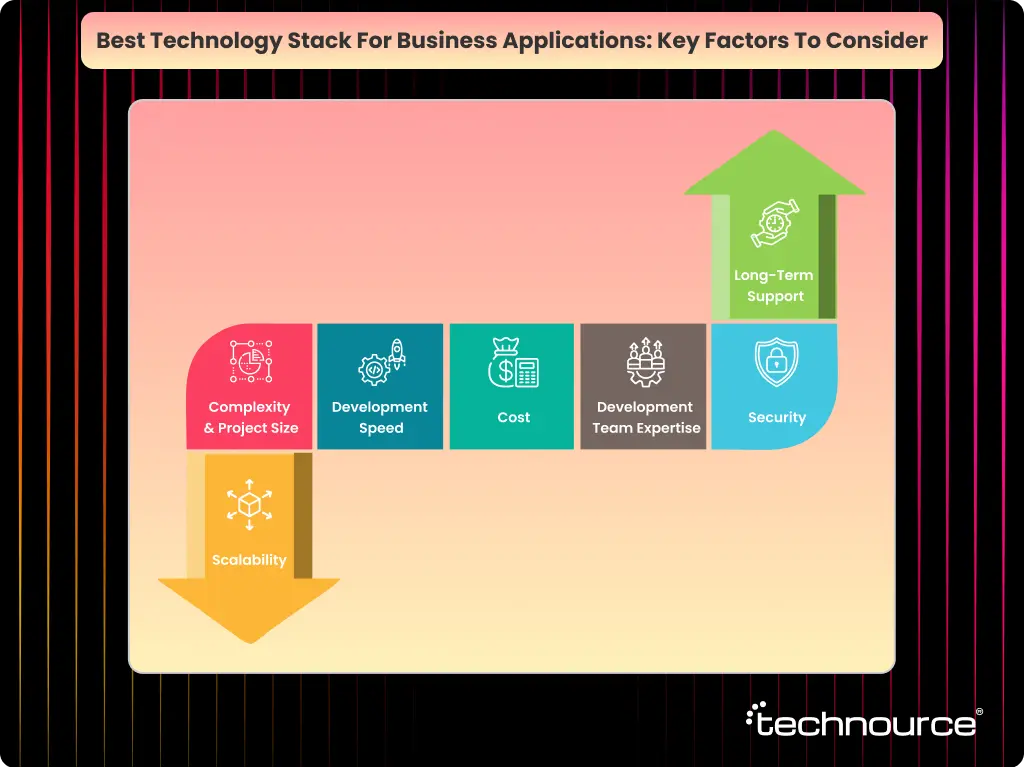
Here are the factors that you must consider too, while choosing the best tech stack for mobile & web-
1. Scalability
This means handling multiple activities done by a large number of visitors regularly. Here, the web and mobile applications should be able to handle both horizontal and vertical growth. On the other hand, the developers must choose the stack that will support the web application’s growth.
We recommend that you choose a custom web development company as they can choose the latest technology for your project. In a nutshell, the approximate visitor numbers will be accounted for during the development of a scalable web application.
2. Complexity & Project Size
An all-encompassing e-commerce platform and a single-page e-commerce website require different sets of technologies. This is how you should differentiate between selecting the tech stacks. One of the most essential factors in choosing the right tech stack is understanding your business needs. In other words, the project size and the requirements play a key role here.
For instance, you can choose Python or NodeJS for smaller projects. On the other hand, choose a tech stack accordingly if the project is comparatively larger. Remember, it’s necessary to assess every aspect for a larger project. Accordingly, deploy the ideal technology.
When developing a new website with next-gen tech stacks, our CEO, Sanjay Singh Rajpurohit, always recommends the Everything Scalable approach. “The right tech stacks for your website development enable you to implement any idea within a stipulated time, using the libraries of databases and servers”, he added.
3. Development Speed
If you want to launch your application as early as possible, consider development speed. To meet tight deadlines, you should choose an ideal front-end and back-end tech stack that enables your team to develop quickly.
For example, you can choose Ruby on Rails or Laravel, as both programming languages have built-in features that reduce development time. The minimal development time enables the development team to release the product early in the market.
4. Cost
Some technologies are free and open, while others may be costly. The ideal technology stack should not drain the company’s resources and, in the long run, deliver 3X value to deliver a high-quality product.
Our Laravel development team lead has given brilliant advice while choosing the best tech stack for web and mobile: “I believe that while developing a new website, you shouldn’t blindly follow the latest technologies, but take one step at a time by asking the following things to yourself:
What are the objectives that the web/mobile application covers?
Do you need to utilize the latest trending technologies?
Do they fit into your business model?
5. Development Team Expertise
The competency of your development team plays a crucial role in the success of your product. Even if you choose smart, innovative technology, if the developer isn’t capable enough, your product is more likely to fail!
It’s better to choose programming languages like JavaScript or Python, as they are the most commonly used today. However, ensure that your selected development team has the required skill set to develop the web/mobile application for your brand.
6. Security
I still remember a scenario when one of our UK-based clients faced a serious issue while developing a mobile app. He has written to our team. We checked and fixed the same. During our initial assessment, we found the issue of choosing the ideal technology stack for his business mobile application.
Luckily, he surpassed the critical issue, and you can too!
Choosing secure frameworks with a proven track record will help you mitigate common risks, such as sensitive information loss and phishing attacks. For example, Django provides multiple safety features, enabling developers to build a robust, scalable application.
7. Long-Term Support
All tech stacks require maintenance and updates. Consider how easily features can be added to the MVP, how the apps can be altered, and what bugs can be removed. Additionally, choose only tech stacks with strong community support. This ensures that you will get help if you’re stuck on something.
Top Technology Stacks for Web and Mobile App Development in 2026
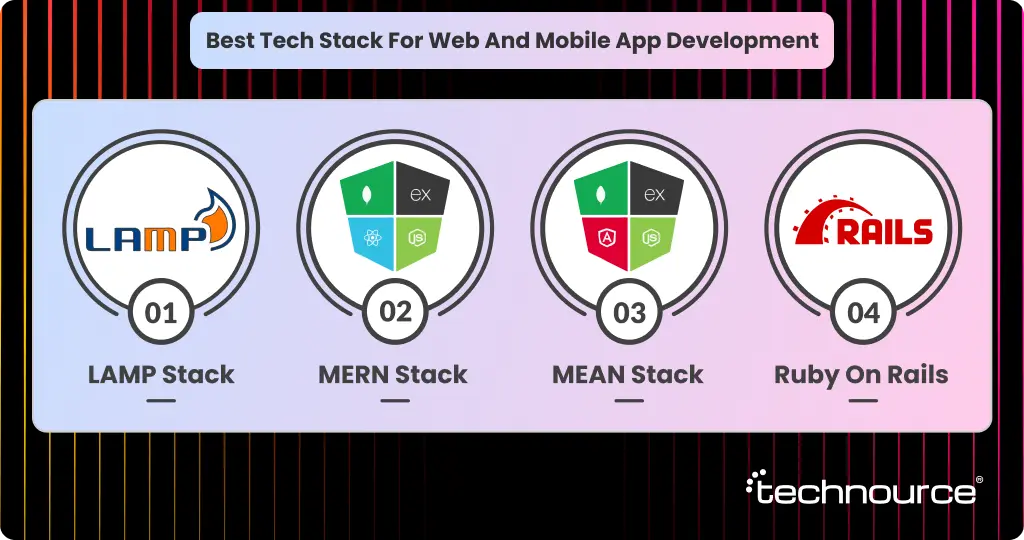
Ready to develop web/mobile applications for your business? But one question remains- which are the best tech stacks for web and mobile in 2026? Here you go:
1. LAMP Stack for Existing Systems
This is one of the most widely used and reliable tech stacks. With this tech stack, e-commerce platforms, content management systems, and other web apps are easier to develop. As this application may have complex data, managing it requires a robust tech stack.
Linux – Consistent and safe operating system
Apache – Configurable web server
MySQL – Database for data management
PHP – Most used server-side scripting language
Advantages
Open Source – This is an open-source tech stack, reducing overall costs.
Stability – Offers a consistent and mature environment
Flexibility – PHP works fine with Apache, offering smart functionalities.
Disadvantages
Scalability – You may need additional configurations for efficient scaling.
A Bit Outdated – LAMP stack lacks modern tools compared to newer ones.
Use Cases
Stores contact form data in MySQL databases
Hosts eCommerce platforms
Runs WordPress Websites
Hosts CRM or internal tools developed in PHP
Alternatives
LEMP stack is one of the primary alternatives, including Linux, NGINX, MySQL, and PHP. This provides the best static delivery with NGINX rather than Apache.
2. MERN Stack for Web Apps
This stack is ideal for building dynamic websites or web applications. Here, JavaScript simplifies development and makes code sharing across layers easier.
MongoDB – This brings scalability and flexibility to a web application as it stores information in JSON-like format.
Express.js – It fosters quicker API development and simplifies server-side coding.
React – This is a front-end library saving time while developing responsive UI components, making React development solutions a preferred choice for building modern, scalable interfaces.
Node.js – It enables you to use the same language on the server and client sides, making it ideal for web applications with live, real-time chat support when you hire an expert Node.js developer for your project.
Many businesses prefer working with a MERN development company to implement this stack efficiently and avoid common architectural pitfalls.
Advantages
Quicker Development Cycle – As Node.js runs on the backend and React on the front, MERN helps in rapid application development.
Flexibility – Irrespective of the project size, the MERN stack offers the flexibility to scale as required.
SPA Development – Developing a single-page application is easy with the MERN stack due to its features like dynamic content rendering and seamless navigation.
Disadvantages
Scalability – Achieving high scalability with this stack requires planning and implementation.
Security – The MERN stack has vulnerabilities like SQL injection, cross-site scripting, and authentication vulnerabilities.
Use Cases
Develops social media applications and event management websites
Builds content management systems
Developes real time collaboration tools like document editors, project management software.
Alternatives
MERN stack is considered an alternative of MERN stack. Here, React.js is replaced with Vue.js, a popular choice for its simplicity and adaptability.
3. MEAN Stack for Enterprise Web Apps
This is an easy solution for developing robust, maintainable, and scalable full-stack apps using JavaScript, and many businesses prefer partnering with a MEAN development company for end-to-end implementation and long-term scalability.
MongoDB – NoSQL database layer
Express.js – Backend framework
Angular – Frontend development framework
Node.js – Server-side runtime environment
Advantages
Faster Development – Developing, testing, and scaling features with modular architecture is now easier.
High Performance – Handling multiple concurrent connections is known to be easy with Node.js and the non-blocking I/O model.
Disadvantages
Learning Angular may be complex for beginners due to its learning curve.
Use Cases
Develops single-page applications where content consistently gets uploaded.
Creates scalable ecommerce platforms
Develops and scales SaaS applications
4. Ruby on Rails for Rapid Web Application Development
Large Community – Extensive community for support.
Disadvantages
Lack of Flexibility – Rails has tight coupling, which makes it challenging to incorporate unique features.
Boot Speed – Due to numerous files and dependencies, the Rails application may be time-consuming.
Use Cases
Rails provides all the necessary components to develop SaaS platforms.
Supports REST APIs.
How Popular Tech Stacks are Helping Small Businesses, SMBs, and Enterprises?
Popular Tech Stack Name
How it’s helping the Enterprises
How It’s Helping the SMBs
How it’s helping the Small Businesses
MEAN Stack
Supports data volume through flexible app structure and modular design.
Provides a high-performance, cost-effective, and rapid development framework for building modern web applications.
Provides a rapid, cost-effective, and scalable solution for developing full-stack web applications.
MERN Stack
Helps to develop scalable, high-performing web applications that enable enterprises to scale efficiently.
Speeds up development cycle, optimizes budget, and streamlines communication.
Small businesses don’t need to hire multiple teams, as the MERN stack provides single-language proficiency. Also, all the MERN stack components are open-source. This eliminates the hefty licensing fees.
LAMP Stack
Provides a highly scalable, secure, and cost-effective open-source framework for developing high-performance applications.
As all the components are open source, this provides a reliable, cost-effective foundation.
Provides a free, open source, and reliable foundation for developing e-commerce stores and dynamic websites.
Ruby On Rails Stack
Provides a robust, cost-effective framework for high productivity, strong security, and smooth scalability.
Fosters overall development speed and cost efficiency.
Prioritizes efficiency, speed, and cost-effectiveness to develop high-quality, functional, and scalable web apps.
5 Common Mistakes in Choosing Tech Stack for Web/Mobile App Development
Most businesses face software stack issues during the SDLC, resulting in wasted resources. This directly affects the security, efficiency, and growth.
1. No Proper Plan
6 out of 10 businesses make the mistake of adopting the wrong technology tool without an orchestrated strategy. This leads to wasted resources, which may limit the growth.
2. Not Suiting Project Requirement
If you’re choosing a tech stack that’s not aligned with your project requirements, it may lead to development delays. Moving forward, this can result in increased development cost, missed deadline and longer time-to-market.
3. Choosing Incompatible Technology
Opting for the right development stack that doesn’t meet your requirements will compromise performance. This will lead to poor performance, subpar user experience and limited device support.
4. Limited Device Functionality
Certain tech stacks may hinder device-specific features, limiting your application’s functionality. Choosing the proper technology architecture is important because it provides the tools to leverage the full potential of device features.
5. Security Issues
Choosing a tech stack with security vulnerabilities will put the user data at risk. Most businesses don’t put much effort into this, and as a result, this causes consequences.
How Globally Renowned Brands are Leveraging Smart Tech Stacks?
Netflix : Being a top video streaming platform, Netflix leverages multiple programming languages like Node.js, Java, Python, Swift, and Kotlin to ensure compatibility across its platform.
Pandora : As one of the oldest streaming platforms, Pandora uses data technologies like HTML5, jQuery, Python, Java, Swift, and DevOps technologies like Bitbucket and Jenkins.
Uber : This transportation giant chooses the hybrid cloud model, which relies on a mainstream monolithic structure, including tools, service providers, backup servers, etc.
Canva : This renowned drag-and-drop website and graphics builder uses tech stacks like JS, React, TypeScript, Amazon CloudFront, Jetty, etc.
Airbnb : With more than 150 million users, Airbnb uses tech stacks like React, JS, NGINX, MySQL, Hadoop, etc.
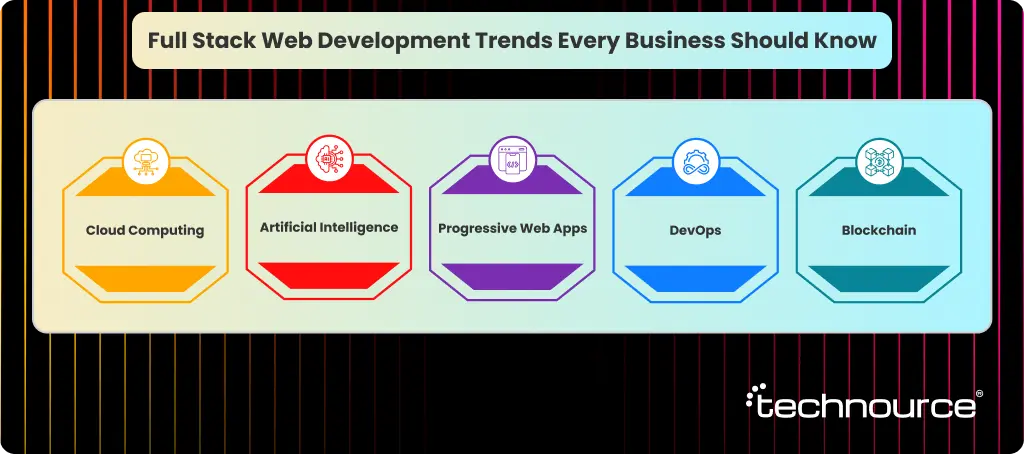
Progressive Full Stack Development Trends to Watch in 2026
The revolutionary, sophisticated, and user-friendly technology is consistently growing into full-fledged applications. This is reshaping how teams collaborate, enhance performance, and deliver next-level experiences. Here are the top trends to watch:
1. Cloud Computing
One of the smart, automated technologies that enables processing power, data storage, and other resources on the internet is cloud computing solutions. Cloud computing supports the full-stack development team by offering easy scaling, flexibility, and a pay-as-you-go model.
2. Artificial Intelligence
This is reshaping full-stack development trends by solving complex issues faster and enabling systems to work efficiently with less human intervention, making AI development solutions a key driver of improved performance and enhanced user experience.
3. Progressive Web Apps
PWA web applications offer modern app-like performance using browser features. They operate without an internet connection, load instantly, send push notifications, and can be installed on multiple devices without consuming much storage.
4. DevOps
This is the practice that combines operations and development to enhance how software is developed, tested, and finally deployed on desired platforms, a core focus of DevOps development services that enable teams to work cohesively.
5. Blockchain
This is a secure technology that stores data across multiple systems. As part of full-stack development, blockchain enables developers to build reliable applications. Hiring blockchain developers enables a brand to develop smart, augmented, and immersive web/mobile apps.
Don’t Let Your Business Application Hold You Back!
“I am done as I have already decided on the trending frameworks- the rest my team will take care of!”
But, wait! That’s only half the battle!
Choosing the development stack is not about choosing trendy frameworks. Instead, it’s more about meeting your business objective, budget, and long-term vision. At Technource, we work for you by following an agile software development methodology. From modern tech stack selection to implementation, our comprehensive web/mobile app development services will turn your business into a success story!
FAQs
Modern web development stacks include MERN, MEAN, Ruby on Rails, React+ Django, etc. Choose the one that matches your business goal.
Smart tech stacks like MEAN and MERN are ideal for startups, as they offer rapid development, scalability, and cost-effectiveness.
Before finalizing the tech stack of your project, consider the team’s expertise, security options, scalability, and project duration.
Knowledgeable developer communities provide helpful resources, libraries, and troubleshooting to make the development process efficient and reliable.
Shailesh Gujjar is a Team Leader at Technource with over 10 years of experience as a web and mobile development expert. He specializes in JavaScript technologies like Node.js, React, and Angular, as well as mobile platforms including native Android, Flutter, and React Native. Shailesh leads end-to-end development projects, ensuring secure, high-performance solutions through strong technical and leadership capabilities.
Request Free Consultation
Amplify your business and take advantage of our expertise & experience to shape the future of your business.