



This guide walks you through how to develop an iOS app in 2026, from choosing a build approach to shipping on the App Store. You will learn the four ways to build, the modern tech stack, a realistic cost and timeline breakdown, and the mistakes that sink most first apps.
- There are four ways to build an iOS app, native (Swift/SwiftUI), cross-platform, hybrid, and no-code. Your choice sets your cost, speed, and performance ceiling.
- A production iOS app in 2026 typically costs $25,000 for a simple MVP and $120,000–$400,000+ for a complex, regulated app, depending on scope and where your team is based.
- iOS is the smaller platform by device count but earns the majority of global app revenue, which is why most serious products still launch on iOS first.
- The modern stack is Swift 6, SwiftUI, and Xcode, targeting iOS 26 and its new Liquid Glass design language.
- Most first apps fail on avoidable issues, unclear scope, App Store rejections, and no post-launch plan, not on code.
Building an iOS app is no longer just an engineering decision. It is a business decision about cost, speed, and where your customers spend money.
And on iOS, they spend a lot. Even though iPhones make up a minority of the world’s phones, the App Store keeps generating the larger share of app revenue.
- Apple’s App Store drove roughly $117.6 billion in consumer spending in 2025, compared with about $49.2 billion on Google Play, despite iOS being the smaller platform. (Business of Apps, 2026)
- Global consumer app spending reached about $167 billion in 2025, up roughly 10.6% year over year. Companies History, 2026
- iOS accounts for only about 28% of global app downloads but roughly 70% of global consumer spending, the monetization gap that keeps iOS first on most launch plans.
The problem is that most guides on this topic are either outdated coding tutorials or vague overviews. This one is built for someone deciding how to actually get an app built in 2026, the options, the stack, the money, and the launch.
Why Build an iOS App in 2026?
You build an iOS app because iOS users spend more per head than any other mobile audience, and the App Store remains the highest-revenue distribution channel in mobile, ideal for premium, subscription, and fintech-style products.
The device base is large enough to matter and wealthy enough to convert.
- Apple reported more than 2.5 billion active devices at the start of 2026. (Apple, 2026)
- iOS holds around 61% of mobile OS usage in the United States, one of the world’s largest app markets. (StatCounter, 2026)
- Revenue per install is far higher on iOS, roughly $2.28 versus about $0.89 on Android by industry estimates. (Axis Intelligence, 2026)
- The App Store held about 2.06 million apps as of December 2025, so standing out requires quality, not just presence. (Adapty, 2026)
If your product depends on paid subscriptions, in-app purchases, or a premium brand experience, iOS is usually where the return on effort is strongest.
What Does It Take to Develop an iOS App?
To develop an iOS app, you need a defined idea and scope, a Mac with Xcode, an Apple Developer account, a build approach (native or cross-platform), a designer and developer, and a plan for testing and App Store submission.
In practice, it breaks into three questions: what are you building, how will you build it, and who will build it.
The rest of this guide answers all three, starting with the build approach, because that single decision shapes your budget and timeline more than anything else.
4 Ways to Develop an iOS App
The four ways to develop an iOS app are native (Swift/SwiftUI), cross-platform (Flutter or React Native), hybrid (web wrapped in a native shell), and no-code/low-code. Native gives the best performance; cross-platform saves cost when you also want Android.
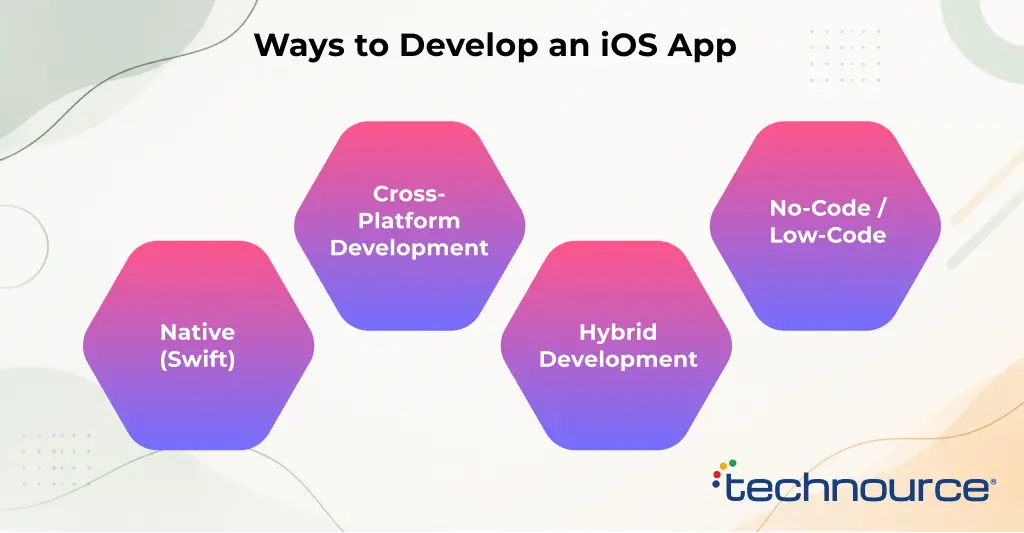
1. Native iOS Development
Native means building directly for Apple with Swift and SwiftUI. It delivers the best performance, the smoothest UI, and full access to Apple features like Face ID, ARKit, HealthKit, and Apple Pay.
The trade-off is cost. A native iOS build does not reuse code on Android, so you pay for one platform at a time.
2. Cross-Platform Development
Cross-platform tools like Flutter or React Native let you write one codebase for iOS and Android. This is the most cost-effective route when you need both platforms at launch.
You give up a little performance and some access to the newest native features, but for most business apps the gap is small.
3. Hybrid Development
Hybrid apps wrap a web app inside a native container. They are cheap and fast to ship, and fine for simple content-driven apps.
They struggle with heavy animation, offline use, and anything that needs deep device integration, so they rarely suit a flagship product.
4. No-Code / Low-Code
No-code platforms let non-developers assemble simple apps visually. They are useful for validating an idea or building an internal tool quickly.
They hit a ceiling fast on custom logic, scale, and App Store approval, so treat them as a test, not a foundation.
| Approach | Best for | Cost impact | Time to launch | Performance |
|---|---|---|---|---|
| Native (Swift) | Flagship, high-performance, premium apps | Highest | 3–8 months | Excellent |
| Cross-platform | iOS + Android on one budget | Medium | 3–6 months | Very good |
| Hybrid | Simple, content-driven apps | Low | 1–3 months | Fair |
| No-code | Validation, internal tools | Lowest | Days–weeks | Limited |

The iOS App Development Process: Step by Step
A well-run iOS project moves through seven stages. Skipping the early ones is the most common cause of blown budgets.
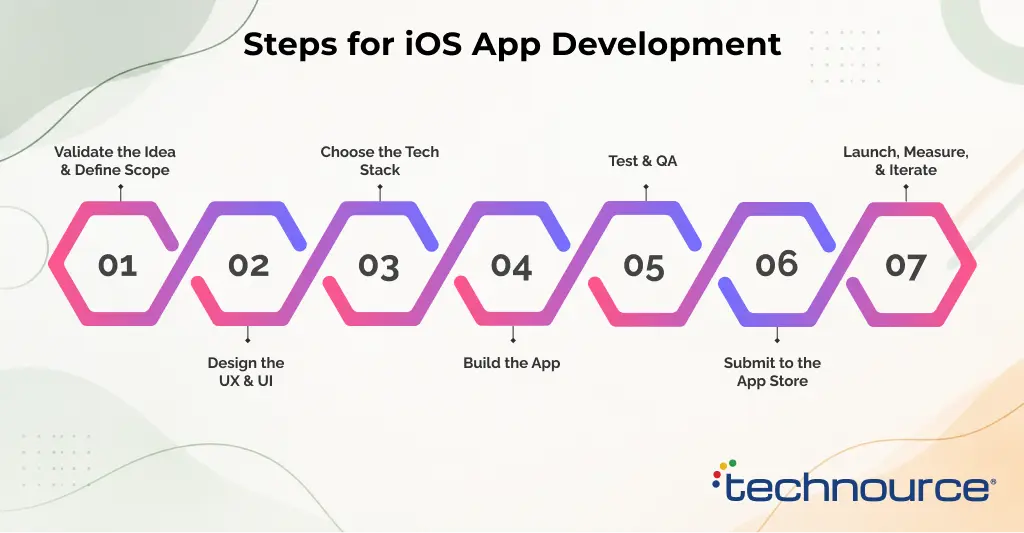
Step 1: Validate the Idea and Define Scope
Write down the one problem your app solves and the single core journey a user takes. Cut every feature that is not essential to that journey.
Tight scope is the cheapest thing you will ever do for your budget. Vague scope is the most expensive.
If you are testing a new idea, an MVP development approach lets you launch the core version first and expand only what users actually use.
Step 2: Design the UX and UI
Design the flows first, then the screens. Follow Apple’s Human Interface Guidelines so the app feels native and passes review more easily.
In 2026, that also means designing for Liquid Glass, the translucent, layered look introduced with iOS 26.
Step 3: Choose the Tech Stack
Lock your language, UI framework, and backend before development starts. For most new apps, that means Swift 6 and SwiftUI on the front end, with a cloud backend and clear APIs. Choosing the right tech stack also depends on your app’s requirements, scalability needs, and development constraints.
Step 4: Build the App
Development runs in parallel across the front end, the backend, and integrations. Work in short cycles so you can see a working build early and often.
Set up automated builds through Xcode Cloud or a CI/CD pipeline from day one; retrofitting it later is costly.
Step 5: Test and QA
Test on real devices, not just the simulator. Use TestFlight to put beta builds in front of real users before launch.
iOS testing generally requires a smaller device and OS matrix than Android because Apple’s hardware and software ecosystem is more controlled.
- Two iOS versions cover roughly 93% of all active iPhones, helping keep the OS-version component of QA relatively focused. (Quashbugs, 2026)
Step 6: Submit to the App Store
Prepare your App Store Connect listing, privacy details, and screenshots, then submit for review. Most apps clear review within a day or two if the guidelines are followed.
Rejections usually come from bugs, broken links, missing privacy disclosures, or thin content — all avoidable.
Step 7: Launch, Measure, and Iterate
Launch is the start, not the finish. Track crashes, retention, and conversion, then ship focused updates.
Budget for maintenance every year, especially around each major iOS release.
What Tech Stack Do You Need to Build an iOS App?
To build a native iOS app in 2026, you need Swift 6 as the language, SwiftUI for the interface, Xcode as the development environment, and a cloud backend with APIs for data. You also need an Apple Developer account and TestFlight for beta testing.
SwiftUI is now the default choice for new apps. It is faster to build with and easier to maintain than the older UIKit. Our guide to the best iOS development tools covers the tools worth considering at each stage.
- SwiftUI produces roughly 30–50% fewer lines of code than equivalent UIKit implementations, cutting both build time and long-term maintenance. (TechAhead, 2026)
| Layer | Recommended in 2026 | Purpose |
|---|---|---|
| Language | Swift 6 | Native, safe, high-performance code |
| UI framework | SwiftUI (UIKit for edge cases) | Screens, layout, Liquid Glass design |
| IDE | Xcode + Xcode Cloud | Building, testing, CI/CD |
| Backend | Cloud (AWS, Firebase, custom) | Data, auth, business logic |
| On-device AI | Core ML / Apple Intelligence | Smart features without server round-trips |
| Testing | TestFlight + XCTest | Beta distribution and automated tests |
| Distribution | App Store Connect | Submission, releases, analytics |
If you do not have an in-house iOS team, you can hire iOS developers who already work in this exact stack rather than training a team from scratch. Before hiring, review these tips to hire iOS developers to evaluate technical skills, experience, and project fit.
Do You Need a Mac to Develop an iOS App?
Yes, you need a Mac to build and submit an iOS app, because Xcode only runs on macOS. You can develop on Windows using a cloud-based Mac, virtualization, or cross-platform tools, but you still need macOS to compile and publish.
The common workarounds are renting a Mac in the cloud, running macOS in a virtual machine, or using Flutter and React Native for most of the work.
Each adds friction. For a serious product, a Mac (or a team that already has one) is the practical answer.
What’s New for iOS Developers in 2026?
The biggest change in 2026 is iOS 26 and its Liquid Glass design system — a translucent, layered interface that apps must adapt to. On-device AI through Core ML and Apple Intelligence is now a standard expectation, not a novelty.
- iOS 26 launched in September 2025 with Apple’s new Liquid Glass design language, introducing updated controls, navigation, and visual elements across iOS and third-party apps. (Apple, 2025)
Privacy rules also keep tightening. Every third-party SDK now needs an accurate Privacy Manifest, and a mismatch can trigger an App Store rejection.
The takeaway: an app built to a 2022 playbook will look and feel dated. Build to the current design and privacy standards from the start.
Key Features to Include in Your iOS App
Every successful iOS app needs a core set of features regardless of category: fast onboarding, secure sign-in, reliable offline handling, push notifications, and privacy-first data handling. Beyond these, your feature list should map directly to your one core user journey.
Adding features that do not serve that journey is how budgets and timelines quietly balloon.
- Frictionless onboarding: get users to value in the first session. This single factor drives early retention more than any other.
- Secure authentication: Face ID, Touch ID, or Sign in with Apple to make login both safe and effortless.
- Offline and low-network handling: cache smartly so the app stays usable on a weak connection.
- Push notifications: used well, they re-engage users; overused, they trigger uninstalls. Design them deliberately.
- Payments and subscriptions: if you monetize, plan for In-App Purchase, Apple Pay, and the App Store commission from the start.
- Privacy-first data handling: accurate Privacy Manifests and clear data disclosures are now a requirement, not a nicety.
- Accessibility: support Dynamic Type, VoiceOver, and contrast. It widens your audience and improves review outcomes.
- Analytics and crash reporting: you cannot improve what you do not measure. Instrument the core journey before launch.
How Much Does It Cost to Develop an iOS App in 2026?
An iOS app in 2026 typically costs $25,000–$50,000 for a simple app, $50,000–$120,000 for a medium app, and $120,000–$400,000+ for a complex or regulated app. Your team’s location can change the total by three to five times.
The two biggest cost levers are feature complexity and who builds it.
| App type | What it includes | Cost range | Timeline |
|---|---|---|---|
| Simple / MVP | One core journey, basic backend, standard UI | $25K–$50K | 2–4 months |
| Medium | Login, payments, chat, admin panel, APIs | $50K–$120K | 3–6 months |
| Complex | Custom logic, AI features, heavy integrations | $120K–$250K | 6–10 months |
| Enterprise / regulated | Compliance, security, scale, multiple roles | $250K–$400K+ | 9–15 months |
- Hourly rates range from about $22–$46 in offshore hubs to $150–$250 in the United States, so location alone can shift total cost by 3–5x. (Saigon Technology, 2026)
- Cross-platform development can reduce costs by roughly 30–40% when launching on both iOS and Android, largely because a shared codebase can serve both platforms. (Saigon Technology, 2026)
- AI features such as Core ML or LLM integration add roughly $8,000–$80,000 per feature, and regulated apps carry a 15–30% compliance premium. (Saigon Technology, 2026)
Hidden Costs to Budget For
The build price is not the whole bill. These recurring items catch teams by surprise.
| Cost item | Typical amount |
|---|---|
| Apple Developer Program | $99 / year |
| App Store commission | Up to 30% of revenue |
| CI/CD pipeline setup | $7,000–$15,000 one-time |
| Annual maintenance per major iOS release | $12,000–$20,000 (complex apps) |
| Backend, hosting, and third-party APIs | Ongoing, scope-dependent |

How Long Does It Take to Develop an iOS App?
A simple iOS app takes about 2–4 months, a medium app 3–6 months, and a complex or enterprise app 6–15 months. Clear scope and an experienced team are the fastest way to compress that timeline.
| Phase | Typical duration |
|---|---|
| Discovery and scope | 1–3 weeks |
| UX / UI design | Up to 30% of revenue |
| Development | 6–20+ weeks |
| Testing and QA | 2–4 weeks (overlaps build) |
| App Store submission and review | 1–7 days |
Native vs Cross-Platform iOS Development: Which Should You Choose?
Choose native (Swift/SwiftUI) when performance, animation, and deep Apple integration matter, or when iOS is your only or primary platform. Choose cross-platform when you need iOS and Android on one budget and timeline.
| Factor | Native (Swift) | Cross-platform |
|---|---|---|
| Performance | Best possible | Very good, minor gaps |
| Cost | Higher (one platform) | Lower for iOS + Android |
| Access to new iOS features | Immediate, full | Sometimes delayed |
| Both platforms | Separate builds needed | Single codebase |
| Best for | Flagship, premium, complex apps | Broad reach on a budget |
There is no universally right answer. If you’re still weighing Android vs iOS, match the choice to your product goals, not to a trend.
Common Reasons iOS Apps Fail (and How to Avoid Them)
Most iOS apps fail on avoidable issues, not code: unclear scope, App Store rejections, poor onboarding, and no post-launch plan. Fixing these before you build saves the most time and money.
- Scope creep: adding features mid-build inflates cost and delays launch. Lock scope, then iterate after release.
- App Store rejection: bugs, broken links, missing privacy disclosures, and thin content are the usual causes. Follow Apple’s guidelines and privacy rules from the start.
- Weak onboarding: most users decide in the first session. A confusing first screen kills retention faster than any bug.
- No post-launch plan:an app that never updates falls behind each iOS release. Budget for maintenance from day one.
- Wrong build approach: choosing hybrid or no-code for a product that needs native performance leads to a costly rebuild later.

iOS App Development Trends to Watch in 2026
The defining iOS trends in 2026 are on-device AI, the Liquid Glass design language, stricter privacy requirements, and cross-device experiences spanning iPhone, iPad, Watch, and Vision Pro.
On-Device AI Becomes Standard
Users now expect smart features, summaries, suggestions, and search that run privately on the device. Core ML and Apple Intelligence make this practical without sending data to a server.
Design Refreshes Around Liquid Glass
iOS 26’s translucent, layered look is reshaping app interfaces. Apps that ignore it start to look legacy quickly.
Privacy as a Build Requirement
Accurate Privacy Manifests are no longer optional. Privacy is now something you engineer, not something you bolt on at the end.
Cross-Device and Spatial Experiences
SwiftUI makes it easier to reuse code across iPhone, iPad, Apple Watch, and Vision Pro. Products that plan for multiple devices reach more users from the same codebase.
How to Choose an iOS App Development Company
Choose an iOS app development company on proven, live App Store apps, not case-study PDFs. Confirm their stack, their IP ownership terms, and their post-launch support model in writing before you sign anything.
Most evaluations go wrong by weighing the wrong signals: logo lists, years in business, and slick sales decks. These predict very little about whether your app ships and performs.
- Ask for live apps: request App Store links to apps they have shipped and still maintain, then actually open them.
- Confirm the stack: make sure they build with Swift and SwiftUI and target the current iOS, not a legacy approach.
- Clarify IP ownership: get written confirmation that the code, design, and App Store listing are entirely yours.
- Check post-launch support: ask what happens after launch and how updates for each iOS release are handled.
- Look for domain experience: in regulated fields like fintech or healthcare, experience with compliance is not optional.
- Compare total cost, not day rate: a cheaper hourly rate that needs more hours, or a rebuild, is not cheaper.
Why Choose Technource for iOS App Development
Technource is an AI-powered product engineering company. We do not just write code; we design, build, ship, and support iOS products end to end.
End-to-End Delivery
Our mobile app development services cover the full journey: product design, native iOS engineering, backend, testing, App Store submission, and post-launch support.
Modern, Current Stack
We build with Swift 6 and SwiftUI, target the latest iOS, and design for Liquid Glass, so your app looks and performs like a 2026 product, not a dated one.
Industry Experience Where It Counts
We have delivered apps in fintech, healthcare, and SaaS, domains where security, compliance, and reliability are non-negotiable.
You Own What We Build
The code, the design assets, and the App Store listing are yours. No lock-in, no proprietary tooling you cannot maintain.
Conclusion
Developing an iOS app in 2026 comes down to a few clear decisions: what you are building, which approach fits, what it will realistically cost, and who will build it with the right custom iOS app development company.
Get the scope and the build approach right, use the current Swift and SwiftUI stack, budget for maintenance, and plan your launch around Apple’s guidelines.
Do that, and you avoid the traps that stall most first apps. Rush it, and the App Store will remind you why the early decisions matter most.

FAQs
A simple iOS app costs roughly $25,000–$50,000, a medium app $50,000–$120,000, and a complex or regulated app $120,000–$400,000+. The final figure depends on features, integrations, and where your development team is based. A simple app takes about 2–4 months, a medium app 3–6 months, and a complex app 6–15 months. Clear scope and an experienced team are the fastest way to shorten that timeline. Swift is the primary language for native iOS development, paired with SwiftUI for the interface. Older apps may still use Objective-C and UIKit, but new projects should start on Swift 6 and SwiftUI. You can do most development on Windows using a cloud-based Mac, virtualization, or cross-platform tools like Flutter and React Native. However, you still need macOS with Xcode to compile, test, and publish the app to the App Store. Yes. Xcode, Apple’s development environment, runs only on macOS, and it is required to build and submit iOS apps. Workarounds exist, but they all rely on macOS somewhere in the process. Native is better when you need top performance, rich animation, or the newest Apple features, or when iOS is your main platform. Cross-platform is better when you want iOS and Android on a single budget and timeline You submit your app through App Store Connect with its listing, screenshots, and privacy details, then Apple reviews it against its guidelines. Most apps are reviewed within a day or two; rejections usually stem from bugs, broken links, or missing privacy disclosures. For a new idea, yes. Building an MVP lets you launch the core journey, test it with real users, and invest further only in what proves valuable — which protects your budget and reduces risk. Yes, for products where performance, animation, and deep Apple integration matter. Native Swift and SwiftUI give the best experience and immediate access to new iOS features; cross-platform is the better call only when you also need Android on the same budget. At minimum: fast onboarding, secure sign-in such as Face ID or Sign in with Apple, reliable offline handling, well-designed push notifications, privacy-first data handling, and analytics. Everything else should map directly to your app’s core purpose.


