



When you think of making a web app, choosing the right language is the major issue. If you are confused between Node.js and Golang, this blog can help you. You need to know about Node.js vs Golang because comparison can help you choose the right language for your dream project.
Our Node.js development company makes you aware of some crucial points about Node.js and Go so that you can easily choose the right language for your web or app. Let’s begging the journey by knowing about Node.js and Go below.
Node.js vs Golang: Quick Comparison
Pick Node.js when your app is I/O-heavy, such as REST APIs, real-time chat, dashboards, or a quick MVP, and your team already writes JavaScript or TypeScript. Pick Golang when you need steady performance under heavy CPU load, high concurrency, or low memory use, as in microservices, network tools, and cloud infrastructure. Many teams use both: Node.js for the user-facing API layer and Go for performance-critical internal services.
Neither option is faster in every case. Node.js handles thousands of waiting connections well because of its event loop, but long calculations block that loop. Go compiles to machine code and spreads work across all CPU cores using goroutines, so it holds up better when each request needs real processing. The table below compares both on the factors that usually decide the choice.
| Factor | Node.js | Golang | Better for |
|---|---|---|---|
| CPU-bound performance | Slower; heavy computation blocks the single event loop | Faster; compiled code runs across all CPU cores | Go for image processing, encryption, and data crunching |
| I/O-bound performance | Strong; non-blocking I/O handles many waiting requests | Strong; goroutines handle I/O with similar efficiency | Either for APIs; Node.js is often quicker to build |
| Concurrency model | Single-threaded event loop with async/await and worker threads | Goroutines and channels, uses multiple cores by default | Go for streaming, messaging, and high-concurrency systems |
| Scalability | Scales horizontally through clustering and more instances | Scales well on multi-core machines with fewer servers | Go for large microservice setups with heavy traffic |
| Learning curve | Easy for developers who already know JavaScript | Small syntax, but pointers and interfaces take practice | Node.js for JavaScript and full-stack teams |
| Ecosystem | npm offers ready-made packages for almost every need | Smaller library pool, but a strong standard library | Node.js for fast prototyping with existing packages |
| Error handling | try/catch and promise rejections; unhandled errors can slip through | Errors returned as values; verbose but explicit | Go for systems where every failure must be handled |
| Hiring | Large talent pool; quicker to hire and onboard | Smaller pool; experienced Go developers cost more | Node.js for startups that need to hire fast |
| Memory use | Higher; the V8 runtime adds overhead per process | Lower; small binaries and lightweight goroutines | Go for cost-sensitive cloud and container deployments |
| Best-fit use cases | Real-time chat, REST APIs, SPA backends, MVPs | Microservices, CLI tools, cloud infrastructure, network servers | Node.js for product teams; Go for platform teams |
What Is Node.js?
Node.js is an open-source, cross-platform JavaScript runtime that lets you run JavaScript on the server. It powers popular backend frameworks such as Express, NestJS, and Fastify. It runs code on a single main thread using an event loop, and supports worker threads and the cluster module for parallel work. You can build fast and scalable server-side applications using it. There are many apps built in Node.js. You can know why does Netflix uses Node.js if you are planning for a similar app. Moreover, Amazon, Netflix, eBay, Reddit, LinkedIn, Tumblr, and PayPal all use Node.js.
Features of Node.js
- Asynchronous & Event-Driven
- No Buffering
- Single-Threaded Event Loop
- Cross-platform compatibility
- Fast Data Streaming
- Uses JavaScript
Also Read: AngularJS vs React.JS vs VueJS vs Node.JS: A Detailed Comparison
What Is Golang?
It is a statically typed, compiled programming language designed at Google. Work on it began in 2007, and it was released publicly in 2009. Many people call it Go also. The team that developed Go studied the C programming language thoroughly. They wanted to keep the features in the new language as well. Moreover, you build highly modular applications with the help of Golang. But many people have a question, is Go a back-end or front-end language? It’s a full-stack language but is mostly used for back-end development. Google, Uber, Twitch, Daily Motion, Send grid, SoundCloud, Dropbox, and many apps use Go.
Features of Golang
- Open-source
- Concurrency Support
- Static Typing
- Testing Capabilities
- Garbage Collection
- Standard Library
Also Read: The positive and negative aspects of Node.js web app development

The Comparison Between Node.js and Golang
Both languages have their pros and cons which is why choosing one for your project makes you confused. However, selecting one is not that difficult, if you know Golang vs Node.js or the difference between both the technologies.
We will use some key areas to compare Node.js and Golang. It will make understanding the differences easy and you can choose the right language for your website or app.
- Learning Curve
- Scalability
- Error Handling
- Performance
- Developers’ Salary
- Availability of Developers
- Level of Maturity
- The Concurrency
- Front-end & Back-end
- Blockchain Implementation
These are the 10 key areas. Read about all of them in the space below comprehensively.
1. Learning Curve
According to the report by Stack Overflow Developer Survey 2021 9.55% of all developers and 10.51% of professional developers use Go. Whereas, 6.3 million websites use Node.js. However, learning Node.js can be easy because many tutorials are available for the same and if you know JavaScript, learning Node.js is a cakewalk for you.
On the other hand, you have to learn the basics of a new language to become a Go developer.
Moreover, you have to learn its specific possesses, concepts, rules, interfaces, database connections, pointers, and more. So, Node.js has a simple learning process.
2. Scalability
Golang is a better choice if you want scalability. But, why is Golang scalable? Simplicity, tools, and compilation are the reasons for its scalability. Moreover, Go supports concurrency better. However, Node.js also has scalability but it’s not as good as Golang.
Node.js can still power large projects, and companies like Netflix and PayPal run it at scale. Its limit is CPU-heavy work, which blocks the event loop. Developers handle this with worker threads, the cluster module, or by moving heavy tasks to separate services. Go avoids this problem because goroutines run across all CPU cores by default.
3. Error Handling
Node.js allows the use of a Catch mechanism that makes detecting the errors easy for the developers. Since it’s a common and conventional method to find errors, developers can easily use it. Whereas Golang uses an explicit error handling method, therefore troubleshooting becomes a difficult task in it.
However, you can still choose it because it offers clean applications due to persistent behavior. But, needs more time to fix errors in the applications.
4. Performance
Golang offers better performance than Node.js. It is because Node.js is a JavaScript run-time environment thus it is slow compared to Golang. It can offer optimum services as a CPU-bound memory, but Nodejs can’t due to JavaScript.
5. Developers’ Salary
Around $119,448 per year is the salary of a Node.js developer in the USA while a Golang developer makes a 135,000 salary per year in the USA. Why is the difference? Because Golang is an entire programming language whereas, Node.js is a run-time environment of JavaScript.
Moreover, JavaScript is a widely known language and there are many developers of Node.js. On the other hand, Golang is an un-explored language.
6. Availability of Developers
It’s crucial to know about the availability of developers because you can know better about Node.js vs Golang. It is not used by many developers whereas, Node.js is a popular language among several developers. Therefore, you will not have to struggle to find Node.js developers, but have to research to find the best Golang developers.
7. Level of Maturity
Which is more mature between Node.js and Golang? Go has a greater degree of maturity because it undergoes enhancements and development. But, in the case of Node.js, you see APIs undergo many changes. It leads to the lack of maturity in Node.js.
8. The Concurrency
It is where Golang is a clear winner. Go uses goroutines, which are lightweight functions that run concurrently. The Go runtime schedules them across multiple OS threads, so a single program can run thousands of goroutines using all CPU cores. Goroutines communicate through channels, which pass data safely between them without complex locking code.
9. Front-end & Back-end
Developers use JavaScript for client-side development. In other words, they give priority to JavaScript for front-end development. Go code can also run in browsers by compiling it with GopherJS or to WebAssembly. But, developers choose it for back-end development because it’s the best option to create concurrent applications.
Moreover, you will not face issues while switching to client-side development using Node.js.
10. Blockchain Implementation
Blockchain implementation is becoming crucial in today’s time. So, you must think about this technology as well while choosing between Node.js and Golang. It seems easier to implement blockchain in applications using Node.js. It is easy in apps because it entails the application of an array and maps it in a way that it holds the ordered hashes. And the map holds the un-ordered hashes.
So, these are the key areas through which you can understand the Node.js vs Golang.
We will look at some of the important frameworks that make the work of developers convenient and fast. Node.js and Golang both have good frameworks. Let’s know about them in the space below.

Node.js vs Golang Cost: Infrastructure and Team
The cost of a backend is more than the developer’s hourly rate. You also pay for servers, hiring time, onboarding, and years of maintenance. Node.js and Golang shift these costs in different directions, so the cheaper option depends on your app’s size and workload.
Infrastructure Costs
Go usually needs less hardware for the same workload. It compiles to machine code, uses less memory per process, and spreads work across all CPU cores without extra setup. For CPU-heavy or high-traffic services, this often means fewer or smaller cloud instances.
Node.js runs on the V8 engine, which adds memory overhead to each process. Since one Node.js process uses one main thread, you scale it by running more processes or containers. For I/O-heavy apps such as APIs and chat, this difference stays small. For apps with heavy computation, the server bill grows faster.
Deployment size also differs. A Go service builds into a single binary, so container images stay small and start quickly. Node.js images carry the runtime and the node_modules folder, which makes them larger and slower to pull and start.
Team Costs
Node.js is usually cheaper on the team side. JavaScript has one of the largest developer pools, so it is easier to hire Node.js developers quickly. Your frontend developers can also work on the backend, which lets a small team cover the full stack without extra hires.
Go developers are fewer, and experienced ones tend to ask for higher salaries. A JavaScript team switching to Go also needs time to learn its concurrency model, pointers, and error handling style. This learning period slows down early delivery.
Maintenance Costs
Node.js projects often depend on hundreds of npm packages. Each one needs updates and security patches, and breaking changes in a package can take developer hours to fix. Go relies more on its standard library and keeps backward compatibility across Go 1 versions, so older code tends to keep working with fewer upgrades.
| Cost Factor | Node.js | Golang |
|---|---|---|
| Server and memory | Higher for CPU-heavy work; fine for I/O-heavy apps | Lower; fewer instances needed under heavy load |
| Deployment | Larger container images with runtime and dependencies | Single small binary; fast container startup |
| Hiring | Faster and cheaper due to a large talent pool | Slower; experienced developers cost more |
| Team size | Smaller; frontend developers can handle the backend | Often needs separate backend specialists |
| Maintenance | Frequent package updates and security patches | Fewer dependencies; stable language versions |
Which One Costs Less?
For MVPs, startups, and small to mid-size apps, Node.js usually costs less overall because team savings outweigh server savings. For large systems with heavy traffic or CPU-heavy work, Go often costs less over time, as lower cloud bills and lighter maintenance can offset higher salaries. If you are unsure, start with Node.js and move only the performance-critical services to Go when your traffic justifies it.
Node.js vs Golang for AI Applications and Agent Backends
Most AI apps today do not train models on their own servers. They call LLM APIs, stream responses to users, query vector databases, and run tools for AI agents. This work is mostly waiting on network calls, so both Node.js and Golang handle it well. The difference lies in ecosystem and scale.
Where Node.js Fits
Node.js has the larger AI tooling ecosystem among the two. Major LLM providers offer official TypeScript SDKs, and libraries such as LangChain.js and the Vercel AI SDK make it quick to build chatbots, RAG apps, and agents. Its event loop also suits streaming tokens to the browser in real time. If you plan to use AI integration services to add AI features to an existing web product, Node.js is usually the faster route.
Where Golang Fits
Go suits the infrastructure behind AI apps. It works well for AI gateways that route thousands of requests across model providers, agent runtimes that execute many tools in parallel, and services that handle rate limits and retries under heavy load. Popular AI infrastructure tools, including Ollama and the Weaviate vector database, are written in Go. Official Go SDKs from major LLM providers are also available, though the library choice is smaller than in Node.js.
Quick Recommendation
Use Node.js to build AI-powered products and agent prototypes quickly. Use Node.js to build AI-powered products and agent prototypes quickly. If you are working with an AI agent development company, ask which language suits your workload before the build starts. Use Go for high-volume AI gateways, tool execution layers, and internal AI infrastructure. For model training and data science work, Python remains the standard, with Node.js or Go serving the results.
What Are the Top Golang Frameworks?
Go is widely used by developers for web apps. They use various Go frameworks for web application development but there are no frontend frameworks for Go. 17% of developers used Go in 2020 as per the reports by JetBrains Developer Ecosystem Survey. Let’s have a look at these famous frameworks of Golang, presented by Javascript development company Technource.
1. Gin
Developers can manage errors conveniently using Gin. It documents the errors as they occur and the developers can handle them on time. Moreover creating middleware is also easy for them. It uses references while running that cover small memory.
2. Iris
Iris is fully accordant and flexible with external libraries. The developers can choose what they want to make with the libraries. It is simple to use and developers can generate impressive solutions using it.
3. Beego
It is used for the rapid development of REST APIs, web applications, and back-end services. So, if you want to know is Golang frontend or backend, you can understand it is for full-stack developers.
4. Echo
Echo has a highly optimized HTTP router with zero dynamic memory allocation. It helps to prioritize routes. You can build robust and scalable REST APIs and organize them into groups with ease. It is an extensible and minimalist web framework in Golang.
5. Fiber
Fiber helps to reduce traffic to a specific endpoint. The server handles its files, style sheets, scripts, images, and makes them cache without difficulties. Moreover, the developers don’t have to worry about the content because it remains static.
Also Read: 7 best backend frameworks
What Are the Top Node.js Frameworks?
Node.js offers various development frameworks that support specific tasks in the development lifecycle. Many websites use Node.js and developers take the help of its frameworks for fast and quality solutions.
1. Hapi.js
It is a powerful and robust open-source Node.js framework. The developers can build JSON APIs with the help of it. You can build websites, HTTP proxy applications, and an Application Programming Interface (API) with Hapi.js.
2. Koa.js
It was developed and maintained by a community of a Node.js framework. It is a cross-platform, server-side runtime environment. The developers can build fast and effective network applications with the help of Koa.js.
3. Meteor.js
Developers can build applications using Node.js on the Meteor.js platform. Moreover, they can use other frameworks like Angular and React. Meteor.js comes with real-time features that make it fast. Impressively integrated front-end with back-end.
4. Derby.js
You can develop modern web applications with the help of Derby.js. It is an open-source, full-stack framework for developing real-time and impressive applications. Moreover, it allows server rendering, components and data-binding, and real-time collaboration.
5. Total.js
Total.js supports MVC architecture, and developers can use it with other frameworks like Angular js, Polymer, Backbone.js, and Bootstrap. It is because of the easy compatibility of Total.js with these frameworks.
People also like to know: Node.js VS PHP? Which is Better for Your Next Web App Development Project?
Using Node.js and Golang Together
Node.js and Golang are not mutually exclusive. Many production systems run both, with each language handling the part of the workload it suits best. This hybrid setup lets you keep the development speed of Node.js while using Go where performance and resource use matter most.
Common Hybrid Patterns
- Node.js API layer, Go backend services: Node.js handles user-facing APIs, authentication, and real-time features, while Go runs services that do heavy processing.
- Node.js app, Go background workers: The main app pushes jobs such as report generation, media conversion, or data imports to a queue, and Go workers process them.
- Go for infrastructure, Node.js for product: Platform teams build internal tools, proxies, and monitoring in Go, while product teams ship features in Node.js.
How the Services Communicate
Services written in different languages talk to each other through shared protocols, not shared code. REST over HTTP is the simplest option and works well for most requests. gRPC is faster and enforces strict contracts between services, which helps when Node.js and Go teams work separately. For background work, message queues such as RabbitMQ, Kafka, or NATS let one service send a job without waiting for the other to finish.
How to Migrate from Node.js to Golang Step by Step
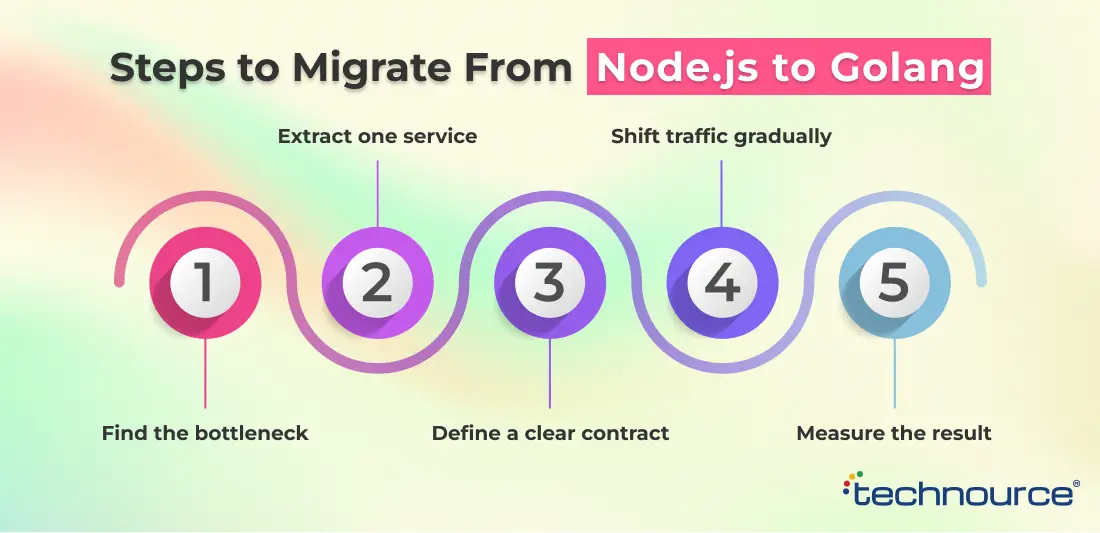
Most teams do not rewrite a full Node.js app in Go. A gradual migration is safer and cheaper.
- Find the bottleneck: Use profiling and monitoring data to identify which endpoints or jobs consume the most CPU, memory, or response time.
- Extract one service: Move only that piece to Go and keep the rest of the app in Node.js.
- Define a clear contract: Keep the same API or message format so other services do not need changes.
- Shift traffic gradually: Send a small share of requests to the Go service first, compare results, then increase traffic step by step.
- Measure the result: Compare latency, server cost, and error rates before deciding whether to move another service.
Points to Consider Before Going Hybrid
Running two languages adds operational work. Your team needs two build pipelines, two sets of dependencies, and developers who can debug across both. CI/CD services can automate testing and deployment for both stacks, but the setup still takes extra effort. For small teams or apps with modest traffic, this overhead often costs more than it saves. A hybrid setup makes sense once a clear performance or cost problem appears that Node.js cannot solve with reasonable effort.
Not sure which fits your project? Let’s choose the right stack for your workload and budget.

Node.js vs Golang: Which Should You Choose?
There is no single winner between Node.js and Golang. The right choice depends on what your app does, how much traffic it handles, and who is on your team. Use the matrix below to match your project with the better fit.
| Use Case | Choose | Why |
|---|---|---|
| MVP or early-stage startup | Node.js | Faster development, npm packages, and easier hiring |
| Real-time chat or collaboration apps | Node.js | Event loop and WebSocket libraries suit many open connections |
| REST or GraphQL APIs for web and mobile apps | Node.js | Shares JavaScript or TypeScript with the frontend team |
| Server-side rendered websites | Node.js | Frameworks like Next.js and Nuxt run on Node.js |
| High-traffic microservices | Golang | Low memory use and multi-core concurrency under heavy load |
| CPU-heavy processing | Golang | Compiled code handles image, video, and encryption work faster |
| Cloud, DevOps, and CLI tools | Golang | Single binary runs anywhere without installing a runtime |
| Payment and fintech transaction systems | Golang | Explicit error handling and steady performance under load |
| IoT backends and network servers | Golang | Goroutines handle thousands of device connections efficiently |
| Large platform with mixed workloads | Both | Node.js for user-facing APIs, Go for heavy internal services |
Choose Node.js If
- Your team already works with JavaScript or TypeScript.
- You need to launch an MVP quickly and test the market.
- Your app mostly reads and writes data, calls APIs, or serves real-time updates.
- You want one language across the frontend and backend.
- You need to hire developers quickly or on a tight budget.
Choose Golang If
- Your app performs heavy calculations or processes large amounts of data.
- You expect high traffic and want to keep server costs low.
- You are building microservices, cloud tools, or network infrastructure.
- You need predictable performance and strict control over errors.
- Your team has the time and budget to work with Go specialists.
Wrapping Up
Node.js and Golang are both proven backend choices, but they solve different problems. Node.js offers faster development, a large package ecosystem, and one language across your stack, which makes it a strong fit for MVPs, real-time apps, APIs, and AI-powered products. Golang offers better CPU performance, lower memory use, and built-in concurrency, which makes it the better choice for high-traffic microservices, cloud tools, and AI infrastructure.
Base your decision on your workload, your team’s skills, and your budget rather than benchmarks alone. As your app grows, you can add Go services alongside an existing Node.js app without a full rewrite.
If you need help choosing the right stack for your project, explore our custom software development services or talk to our team. Technource has 13+ years of experience in web and app development.

FAQs
Nodejs and Golang both have pros and cons. You can use Golang for large projects and Node js for quick development of small projects. Nodejs is the best choice to build front-end code bundles. Moreover, you can select Golang for high performance. But learning Nodejs is easier than Golang. So, there are many things you have to focus on to find which is better.
You can choose Nodejs for faster development, battle-tested old hand, MVP development, and community support. Moreover, it’s easy to learn so there are several Nodejs developers.
Its an open-source programming language and makes the work of developers easy with many frameworks and tools. It is a full-stack programming language, so you don’t have to look for front-end and back-end developers separately. Moreover, Go offers high scalability.
The answer to this question completely depends on the type of your project. Data-rich applications also affect speed. Many say that Nodejs applications are faster than Go, but you must know both pros and cons.
It is preferred for back-end development. But, you can use Go for front-end development as well.


